
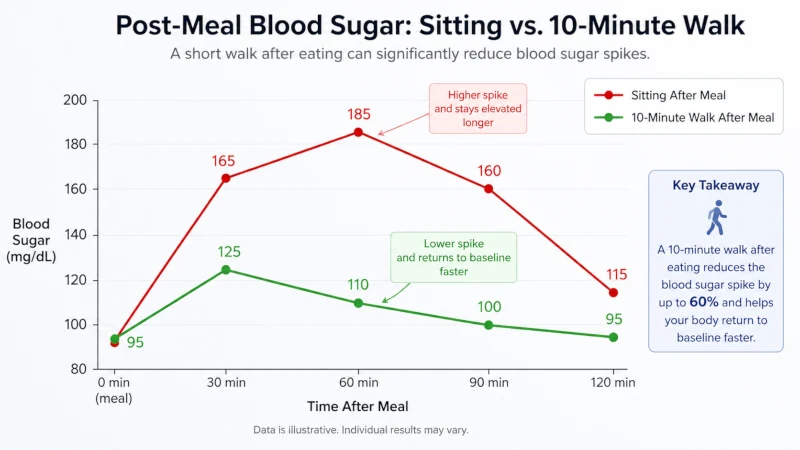
You just finished dinner, and the easiest thing in the world is to sit down. But if you lace up and walk for ten minutes instead, something useful happens right away: your leg muscles start pulling sugar out of your bloodstream, so the after-dinner rise in blood sugar is smaller and gentler.

That’s the honest headline for walking after meals for blood pressure. Its most reliable payoff is steadier blood sugar — not an instant drop in your blood pressure. One stroll won’t move your blood pressure numbers much. What it does is add to the weekly activity that lowers resting blood pressure over weeks and months, and it’s one of the easiest ways to bank that activity, because it attaches a short walk to something you already do a few times a day.
So how long? About ten minutes at an easy pace, ideally after your largest meal, on most days. Below is why that works, how to build it into a habit, and who should be careful.
What a post-meal walk actually does
Two things, mostly.
It blunts the post-meal blood sugar spike. When you sit after eating, glucose from the meal lingers in your blood. When you walk, contracting muscles take up that glucose with very little insulin, so the peak is lower. A systematic review of “activity break” studies found that light walking to interrupt sitting significantly reduced post-meal glucose and insulin compared with staying seated — and did so better than simply standing up [Buffey et al. review in Sports Medicine, 2022].
In adults with type 2 diabetes, a crossover trial found that walking about 10 minutes after each main meal lowered post-meal glucose more than a single 30-minute walk taken at any time of day, with the biggest effect after the evening meal [Reynolds et al. in Diabetologia, 2016].
It adds to your weekly activity total. Guidelines recommend at least 150 minutes a week of moderate activity such as brisk walking [American Heart Association, 2024; Physical Activity Guidelines for Americans, 2018]. Regular aerobic activity is what lowers resting blood pressure over time — a meta-analysis of exercise trials found endurance training reduced resting blood pressure, with the largest reductions (roughly 8/5 mmHg) in people who started with hypertension and much smaller changes in those whose pressure was already normal [Cornelissen & Smart meta-analysis, 2013].
Three ten-minute post-meal walks a day comes to 210 minutes a week — past the target, without a trip to the gym. If you want the full menu of movement that lowers blood pressure, see the guide on exercise for blood pressure.
Notice what isn’t on that list: a big, immediate blood-pressure drop. In the short-term studies, light walking reliably lowered post-meal glucose but did not significantly change systolic blood pressure in the hours after eating [Buffey et al., 2022]. That’s why the blood-pressure benefit here is a slow build, not a stopwatch event.
What most people get wrong
Expecting your blood pressure to drop after one walk. It usually won’t, and that’s normal. Treat each walk as a small deposit; the blood-pressure return shows up over weeks as the deposits accumulate [Cornelissen & Smart, 2013].
Walking too hard, too soon. This is meant to be easy — a conversational pace where you can talk in full sentences. Turning it into a hill climb 15 minutes after a big meal invites reflux, nausea, or lightheadedness, and it earns you nothing extra. The walking studied in the research was gentle by design [Buffey et al., 2022].
Skipping it because you already exercised. A morning workout and an after-dinner walk do different jobs. The workout builds fitness; the walk blunts the evening glucose spike and breaks up a long sedentary stretch. Sitting less matters even for people who exercise [American Heart Association, 2024].
Treating every meal the same. Dinner is usually the largest meal and is often followed by the most sitting, so a walk after dinner tends to do the most work — especially after a carb-heavy meal [Reynolds et al., 2016]. A walk after a light breakfast matters less.
How to do it, step by step
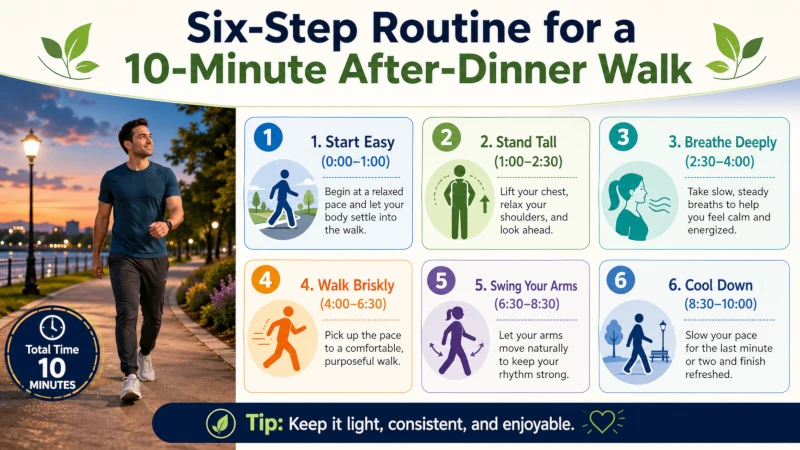
- Start with dinner. It’s usually your biggest meal, you’re likely home, and the walk doubles as a wind-down.
- Walk 5–10 minutes. Set a timer. Aim for a pace where talking stays easy. If you’re winded, slow down.
- Time it within about 15–30 minutes of finishing. Earlier is marginally better for blood sugar, but the difference is small. If you feel too full, wait a little.
- Build to 15–20 minutes over a few weeks. Add five minutes once the current length feels easy. There’s no rush.
- Keep a simple log. Date and minutes, in your phone or a notebook. You’re tracking a habit, not chasing a single number.
- Adjust to real life. Late dinner? Ten minutes is plenty. Raining? Walk indoors, take the stairs, or use a treadmill. Tired? Go slow. Moving beats sitting.
Post-meal walk options
| Option | Duration | Intensity | Best for |
| Starter | 5–10 min | Very easy (you could sing) | Complete beginners, joint pain, or anyone just building the habit |
| Standard | 10–15 min | Easy (talk in full sentences) | Most people; sustainable 5–7 nights a week |
| Builder | 15–20 min | Easy to moderate (can talk, prefer not to) | Active people topping up toward 150+ weekly minutes |
A realistic timeline
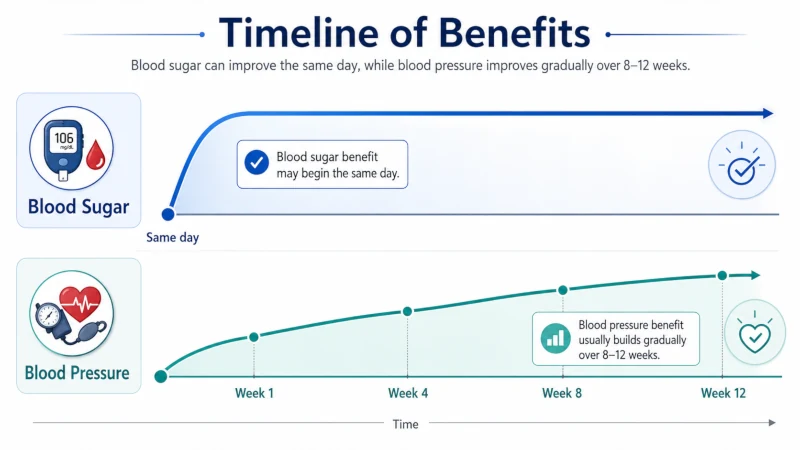
Here’s what’s fair to expect. Blood-sugar benefits can appear immediately — the very first post-meal walk can lower that meal’s glucose peak [Reynolds et al., 2016]. Blood-pressure changes are slower and smaller, and they come from consistency: most exercise studies measure resting blood-pressure changes over roughly 8–12 weeks, and the people who see the most are those who started with higher pressure [Cornelissen & Smart, 2013].
If your pressure is already in the normal range, don’t be surprised if the number barely budges — the metabolic benefit is still real. Walking after meals works best as one piece of a larger picture that includes diet, sleep, stress, and, when prescribed, medication. To watch your own trend the right way, track weekly averages using home blood pressure monitoring rather than judging single readings.
Who should take extra care
For most people, an easy walk after eating is safe. A few situations call for more caution.
If you take blood pressure medication. Keep taking it as prescribed — this is an add-on, not a replacement. Some people, especially older adults and those with existing hypertension, experience a drop in blood pressure after eating (postprandial hypotension) that can cause dizziness or lightheadedness [Cleveland Clinic, 2026]. If you feel woozy on post-meal walks, check your pressure before and after, keep the pace gentle, and ask your prescriber about meal and medication timing. Never change your dose on your own.
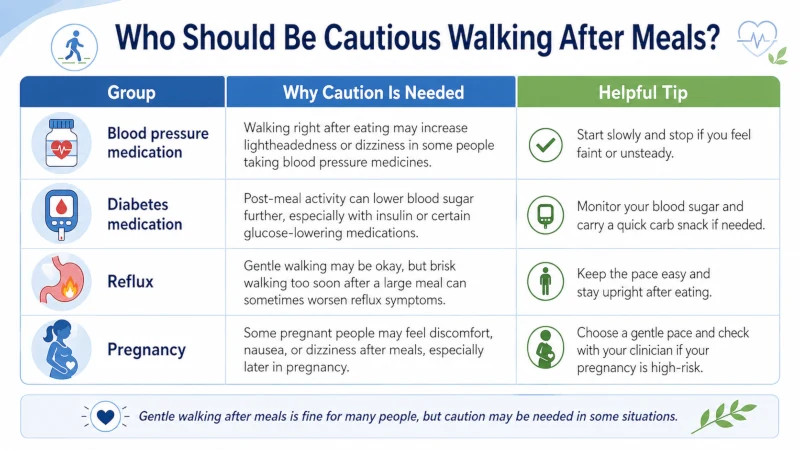
If you have diabetes and take insulin or a sulfonylurea. Activity lowers blood sugar, which is usually the goal — but with these medicines it can occasionally drop too far. Learn your own pattern and talk with your clinician about monitoring.
If you have acid reflux or GERD. Gentle walking is generally fine and may even help, but a brisk pace right after a large meal can worsen symptoms. Waiting 30–45 minutes and keeping the effort easy usually helps.
If you’re pregnant, or have heart or kidney disease. Light walking is often encouraged, but confirm your plan with your clinician before starting a new routine.
Stop and seek urgent care if a walk brings on chest pain, pressure, or tightness; severe or sudden shortness of breath; palpitations that feel new; fainting or near-fainting; or sudden, severe dizziness. A reading of 180/120 mmHg or higher with symptoms such as severe headache, chest pain, vision changes, or trouble speaking is a medical emergency [American Heart Association, 2024].
Talk to a professional — rather than relying on walking alone — if your home readings stay elevated across several days, jump suddenly, or if your pressure is very high or you have an existing heart, kidney, or metabolic condition before you begin.
| Health disclaimer This article about walking after meals for blood pressure is for education only and is not medical advice. If you have high blood pressure, heart disease, kidney disease, diabetes, are pregnant or breastfeeding, or take prescription medication, talk with a qualified clinician before changing your diet, exercise, or treatment. Do not stop or adjust blood pressure or diabetes medication without your prescriber. If you have symptoms like chest pain, fainting, or a reading of 180/120 mmHg or higher with symptoms, seek urgent care. |
Quick checklist
Before you walk: you ate 15–45 minutes ago · comfortable shoes on · not dizzy, no chest discomfort, no severe reflux · timer or route set.
After you walk: you felt comfortable, not breathless or nauseous · logged the date and minutes · planned tomorrow’s walk.
Frequently Asked Questions
How long should I walk after a meal?
About 10 minutes at an easy pace is a solid minimum; build toward 15–20 as it gets comfortable. If you only do it after one meal, make it your largest — usually dinner.
How soon will I notice a difference?
Blood-sugar benefits can start with the first walk. Blood-pressure changes take longer — think weeks to a few months — and are largest in people who started with higher pressure [Cornelissen & Smart, 2013]. Track weekly averages, not single readings.
Do I have to walk after every meal?
No. Dinner gives the biggest return because evening meals tend to be larger and are followed by more sitting [Reynolds et al., 2016]. Walks after other meals still count toward your weekly total.
Does walking speed matter?
Not much. Being upright and moving is what helps your muscles soak up glucose. An easy stroll you can repeat every day beats an occasional fast walk you dread.
What if I take blood pressure medication?
Keep taking it and add the walk on top. Watch for dizziness after eating (postprandial hypotension), which is more common in older adults and people with hypertension [Cleveland Clinic, 2026]. Discuss timing with your prescriber; never self-adjust.
What if I have knee pain or I’m exhausted after dinner?
Shorten it to 5 minutes on flat ground, or walk indoors. A slow, short walk still beats three hours on the couch. If you’re wiped out every evening, it’s worth looking at your sleep, stress, and meal timing.
References
- Buffey AJ, Herring MP, Langley CK, Donnelly AE, Carson BP. The Acute Effects of Interrupting Prolonged Sitting Time in Adults with Standing and Light-Intensity Walking on Biomarkers of Cardiometabolic Health in Adults: A Systematic Review and Meta-analysis. Sports Medicine. 2022;52(8):1765–1787. View source
- Reynolds AN, Mann JI, Williams S, Venn BJ. Advice to walk after meals is more effective for lowering postprandial glycaemia in type 2 diabetes mellitus than advice that does not specify timing. Diabetologia. 2016;59(12):2572–2578. View source
- Cornelissen VA, Smart NA. Exercise Training for Blood Pressure: A Systematic Review and Meta-analysis. J Am Heart Assoc. 2013;2(1):e004473. View source
- Piercy KL, Troiano RP, Ballard RM, et al. The Physical Activity Guidelines for Americans. JAMA. 2018;320(19):2020–2028. View source
- American Heart Association. Recommendations for Physical Activity in Adults and Kids. View source
- Cleveland Clinic. Postprandial Hypotension: Blood Pressure Drops After Eating. View source
