

The European centaury plant (Centaurium erythraea, also called lesser or common centaury) is one of the classic European “bitters” — a small pink-flowered herb whose intensely bitter taste has been used for centuries to wake up a sluggish appetite and settle mild indigestion.
That single use is also the honest headline: European centaury is recognized in the EU as a traditional herbal remedy for mild digestive complaints and poor appetite, and its standing rests on long, safe use rather than on modern clinical trials [EMA, 2015]. The bolder claims you’ll see attached to it — that it treats diabetes, repairs the liver, or heals wounds — come almost entirely from animal and test-tube studies, not from people. Here’s what centaury can reasonably do, how to take it, and the safety points that actually matter.
What the European centaury plant is

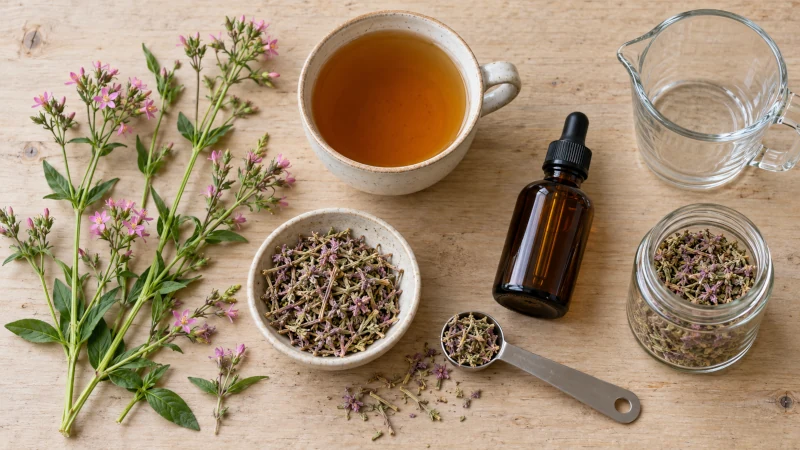
Centaury is a modest herb in the gentian family (Gentianaceae), usually a hand’s-span to knee-high, with a rosette of leaves at the base and small pink flowers at the top. The flowering aerial parts are the part used, dried and brewed as a tea or made into a tincture or extract [EMA, 2015]. Its name traces to Greek myth and the centaur Chiron, the legendary healer.
Lesser centaury vs. the greater centaury mix-up
One point of confusion worth clearing up: “lesser centaury” (Centaurium erythraea) is the medicinal plant discussed here. It is not the same as “greater centaury” (Centaurea scabiosa) or the knapweeds, which belong to a different plant family and aren’t the herb behind the traditional bitter preparations. If you’re reading a label or a supplement, the species name Centaurium erythraea (older synonyms include Erythraea centaurium and Centaurium umbellatum) is what to look for [Drugs.com, 2025].

The bitter chemistry that does the work
Centaury’s character comes from a group of bitter compounds called secoiridoid glycosides — mainly swertiamarin, with smaller amounts of gentiopicroside and sweroside, plus very bitter esters like centapicrin [EMA, 2015]. It also contains xanthones, phenolic acids, and flavonoids. These bitters are the plausible mechanism behind its traditional use: the taste of bitterness on the tongue is thought to reflexively nudge the stomach to release more gastric juice and bile, which in turn can support appetite and digestion. The mechanism is still described as “unclear” in the regulatory literature — reasonable and plausible, not fully proven [EMA, 2015].
What European centaury is actually used for
Appetite and mild indigestion — the one evidence-backed use

This is where centaury has real standing. The European Medicines Agency’s herbal committee reviewed it and classified centaury as a traditional herbal medicinal product for the relief of mild digestive complaints (the vague fullness, bloating, and discomfort of dyspepsia) and temporary loss of appetite [EMA, 2015]. In Germany, the Commission E has long recommended it for poor appetite and indigestion [PeaceHealth]. Like other bitters, it works best taken shortly before a meal, so the bitterness can do its job [PeaceHealth].
Two honest caveats sit alongside that. First, “traditional use” is a specific, modest category: it means the remedy has been used safely and consistently for well over 30 years, which makes its use plausible — not that controlled trials have proven it works [EMA, 2015]. Second, when the EMA searched for actual clinical studies in people, it found none [EMA, 2015]. The professional monograph at Drugs.com puts it just as bluntly: there are no clinical data to support centaury for any indication [Drugs.com, 2025]. So the fair way to think about centaury for digestion is: a low-risk traditional bitter with centuries behind it and a believable mechanism, not a tested treatment.
The bigger claims: liver, diabetes, wounds, fever

Here’s where a lot of centaury content overreaches, so it’s worth being specific about what the evidence is and isn’t.
Diabetes and blood sugar. You will see centaury described as an aid for type 2 diabetes, sometimes with the striking claim that it lets people cut their insulin. That claim is not supported by human evidence and shouldn’t guide anyone’s treatment. What exists are animal and laboratory studies: extracts of centaury have lowered blood glucose in diabetic rats and mice and inhibited digestive enzymes in the test tube [Drugs.com, 2025]. Those are early, preclinical signals — a reason for researchers to keep looking, not a reason to lean on a tea for blood-sugar control. If you have diabetes, centaury is not a substitute for prescribed medication, and no herb should prompt you to change an insulin dose on your own.
Liver. Traditional texts describe centaury as a “liver tonic,” and a methanol extract showed a protective effect against chemically induced liver injury in rats [EMA, 2015]. That’s animal data. It doesn’t establish that centaury treats or reverses any human liver disease. If liver health is your goal, everyday diet has far better-studied leverage — our guide to the best foods for the liver covers what actually has evidence behind it.
Wounds, skin, and fever. Centaury has folk uses for wounds, eczema, and fever, and there are animal studies suggesting anti-inflammatory and wound-related activity [Berkan, 1991]; [El Menyiy, 2021]. But the EMA specifically concluded that topical (skin) use doesn’t meet the evidence bar to be recognized even as a traditional medicine, and that centaury’s use as a fever-reducer “cannot be recommended” because the supporting data are too thin [EMA, 2015]. Treat the skin and fever claims as tradition, not established benefit.
The broader pattern, if you read the scientific reviews, is a long list of “activities” — antioxidant, antimicrobial, gastroprotective, antidiabetic, hepatoprotective — almost all demonstrated in cells or animals [Drugs.com, 2025]; [El Menyiy, 2021]. It’s genuinely interesting biology. It is not the same as proof that drinking centaury tea does those things in a person.
How to use European centaury
For the traditional digestive use, centaury is taken by mouth, usually as a tea before meals. The EMA’s documented preparations and doses for adults are a useful, evidence-grounded reference point [EMA, 2015]:
| Preparation | Typical amount | How often |
| Herbal tea (dried herb) | 1–4 g in ~200 ml boiling water | Up to 4 times daily |
| Powdered herb | 0.25–2 g per dose | Up to 3 times daily |
| Liquid extract (1:1, 25% ethanol) | 2–4 ml per dose | Up to 3 times daily |
| Tincture (1:5, 70% ethanol) | 1.5–5 g per dose | Up to 3 times daily |
A practical note: because the point of a bitter is the taste, centaury is traditionally taken unsweetened and shortly before eating [PeaceHealth]. It is genuinely bitter — that’s the feature, not a flaw. If you’re comparing it with other options for the same job, our overview of herbs for stomach issues sorts the better-evidenced digestive remedies from the merely traditional ones.
Side effects, interactions, and who should avoid it
For a herb, centaury has a reassuring safety record at traditional doses — decades of widespread use in Europe without serious problems reported, and toxicity studies in animals showing a wide margin of safety by mouth [EMA, 2015]. That said, “well tolerated” is not “risk-free,” and a few points matter.
- Realistic expectations. At most, centaury may make meals more comfortable and appetite a little keener. It won’t cure a digestive disease or fix the cause of ongoing symptoms.
- Side effects. None are well documented at normal doses. Taking too much can cause stomach upset and nausea [EMA, 2015].
- Interactions. No drug interactions are well documented [Drugs.com, 2025]. The sensible rule still applies: if you take prescription medicine, check with a pharmacist or doctor before adding any herbal product.
- A liver-safety footnote. There is a single case report of liver injury (cytolytic hepatitis) in a person taking a combination product that contained centaury alongside another herb. Because it was a multi-herb product, no conclusion can be drawn about centaury itself — but it’s an honest reason not to assume “herbal” means “impossible to cause harm” [EMA, 2015]; [Drugs.com, 2025].
Who should not use it
| Anyone with an active peptic (stomach) ulcer. Because centaury reflexively stimulates gastric acid, EU guidance says it must not be used in active peptic ulcer disease [EMA, 2015].During pregnancy or breastfeeding. There’s no safety data for these situations, so the recommendation is to avoid centaury [EMA, 2015]; [Drugs.com, 2025].Children and teens under 18. Not recommended, again due to lack of data [EMA, 2015].Anyone allergic to plants in the gentian family should steer clear [EMA, 2015]. |
A note on “rough centaury” and blood sugar
Older herbal writing claimed that a related plant, “rough centaury” (Centaurea aspera), has strong blood-sugar-lowering effects and can let people on diabetes medication reduce their insulin. We’ve removed that claim. It isn’t supported by reliable human evidence, and advising anyone to adjust insulin based on a herb is unsafe. If you live with diabetes, your medication plan belongs with your healthcare team, not a plant.
When to see a healthcare professional
Centaury is for mild, passing digestive niggles. Some symptoms are signals to stop self-treating and get medical care. See a doctor promptly, or seek urgent care, if you have:
- Difficulty or pain when swallowing
- Vomiting that is persistent, or vomit that is bloody or looks like coffee grounds
- Black, tarry, or bloody stools
- Severe or constant abdominal pain
- Unexplained weight loss or a lasting loss of appetite
- Yellowing of the skin or eyes (jaundice)
- Chest pain, or pain spreading to the jaw, neck, or arm, especially with shortness of breath or sweating — call emergency services, as this can be a heart problem rather than indigestion
Even without these alarm features, indigestion or poor appetite that lasts more than a week or two, keeps returning, or starts after a new medication deserves a proper look — the cause (an H. pylori infection, an ulcer, a medication effect) is something no bitter tea can fix. If digestion is a recurring theme for you, our gastritis food guide and the wider digestive health section are good next reads.
| Health disclaimer: This article is for general education and information only. It is not medical advice and is not a substitute for diagnosis or treatment from a qualified healthcare professional. Herbs can have side effects and can interact with medicines and health conditions. Do not use European centaury if you have an active stomach ulcer, and do not use it during pregnancy or breastfeeding or in anyone under 18. If you take prescription medication — especially for diabetes — talk to your doctor or pharmacist before using centaury, and never change a prescribed dose (including insulin) on your own. If you have severe or lasting abdominal pain, are vomiting blood, notice black or bloody stools, or have chest pain or trouble breathing, seek medical care or call emergency services right away. |
Frequently Asked Questions
Is the European centaury plant good for digestion?
It’s a traditional digestive bitter. In the EU it’s recognized for relieving mild indigestion and poor appetite, taken before meals — but that recognition is based on long-standing safe use rather than clinical trials, and no human studies have proven it works [EMA, 2015]; [Drugs.com, 2025].
Does centaury lower blood sugar or help diabetes?
Only in animals and lab studies so far. Extracts have lowered glucose in diabetic rats and mice, but there’s no human evidence, and centaury is not a treatment for diabetes. Don’t use it to manage blood sugar or adjust diabetes medication [Drugs.com, 2025].
How do you take centaury?
Most often as an unsweetened tea before meals — roughly 1–4 g of the dried herb in a cup of boiling water, up to a few times a day, per EU-documented traditional dosing. Tinctures and liquid extracts are also used [EMA, 2015]; [PeaceHealth].
Are there side effects?
At normal doses, none are well documented; too much can cause stomach upset and nausea. It shouldn’t be used with an active stomach ulcer, and no significant drug interactions are well established [EMA, 2015]; [Drugs.com, 2025].
Can I take centaury while pregnant or breastfeeding?
No. There’s no safety data for pregnancy or breastfeeding, so the guidance is to avoid it. It’s also not recommended for anyone under 18 [EMA, 2015].
References
- European Medicines Agency, Committee on Herbal Medicinal Products. Assessment report on Centaurium erythraea Rafn. s.l., herba (EMA/HMPC/277491/2015), 2015. View source
- Drugs.com. Centaury — Uses, Benefits & Dosage (Natural Products, professional; medically reviewed, updated Oct 22, 2025). View source
- PeaceHealth. Centaury (Health Information Library). View source
- El Menyiy N, Guaouguaou F-E, El Baaboua A, et al. Phytochemical properties, biological activities and medicinal use of Centaurium erythraea Rafn. J Ethnopharmacol. 2021;276:114171. PMID 33940085; doi:10.1016/j.jep.2021.114171. View source
- Berkan T, Üstüneş L, Lermioğlu F, Özer A. Antiinflammatory, analgesic, and antipyretic effects of an aqueous extract of Erythraea centaurium. Planta Med. 1991;57(1):34–37. PMID 2062955. View source
- Guedes L, Reis PBPS, Machuqueiro M, et al. Bioactivities of Centaurium erythraea (Gentianaceae) decoctions: antioxidant activity, enzyme inhibition and docking studies. Molecules. 2019;24(20):3795. doi:10.3390/molecules24203795; PMID 31652501. View source


