
The wormseed plant is one of those herbs that lives a double life. In a Mexican kitchen, a sprig of it in a pot of black beans is unremarkable — a bit of pungent green tossed in near the end of cooking. In an old herbal, the same plant is described as a fearsome dewormer, its concentrated oil dropped onto lump sugar to expel roundworms from children. Both are real. Only one is safe.
If you’ve come across the wormseed plant — the herb Mexican and Central American cooks know as epazote (Dysphania ambrosioides, formerly Chenopodium ambrosioides) — here’s the honest version. As a culinary herb in small amounts, it’s fine and traditional. As a home remedy for intestinal parasites, it belongs to a chapter of medical history that closed for a reason. This guide covers what the plant is, what the evidence actually supports, the safety issues that matter, and what to do if you think you or a family member has worms.
What the wormseed plant is
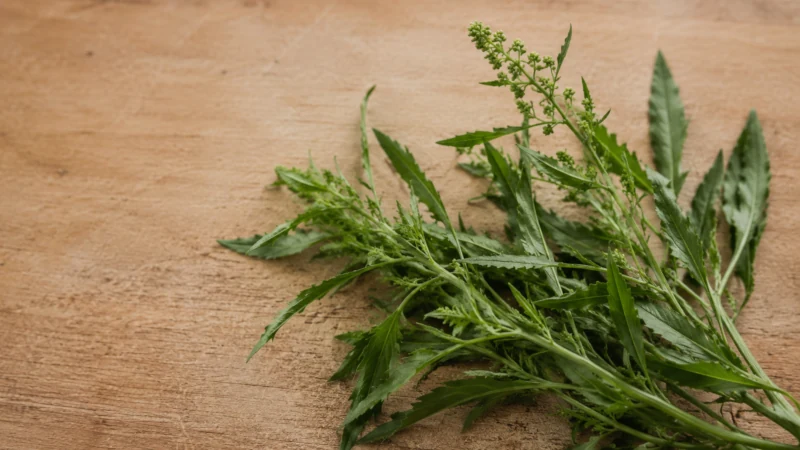
Wormseed is an annual or short-lived perennial herb native to Central America, South America, and southern Mexico. It typically grows one to four feet tall, with lance-shaped, slightly toothed leaves and small greenish flowers in branching clusters at the top of the stem. Crush a leaf and you get the plant’s signature scent — sharp, resinous, sometimes compared to oregano, turpentine, and citrus at the same time. That scent is the point: it comes from a volatile essential oil rich in the monoterpene ascaridole, along with p-cymene, α-terpinene, and limonene [Wikipedia — Dysphania ambrosioides, 2024]. Ascaridole is what gives the plant both its traditional anthelmintic reputation and its toxicity.
Botanists reclassified the plant a while ago. Older literature calls it Chenopodium ambrosioides and places it in the goosefoot family (Chenopodiaceae). Today it’s Dysphania ambrosioides, sitting inside the amaranth family (Amaranthaceae) [NC State Extension Gardener Plant Toolbox — Dysphania ambrosioides]. The Latin names on package labels vary; the plant is the same.
Names you’ll see
- English: wormseed, Mexican tea, Jesuit’s tea, American wormseed, goosefoot
- Spanish: epazote, paico, pazote
- Portuguese: mastruz, erva-de-Santa-Maria
- Nahuatl origin: epazōtl, roughly “skunk sweat” — a fair description of the aroma [Wikipedia — Dysphania ambrosioides, 2024]
The traditional use for intestinal worms — and why modern medicine moved on
For centuries in the Americas, decoctions and infusions of wormseed leaves, roots, and flowering tops were used to expel roundworms and hookworms. In the 19th and early 20th centuries, this folk use crossed into mainstream Western medicine as oil of chenopodium — a steam-distilled essential oil, standardized for its ascaridole content, and given as an anthelmintic in mass-treatment campaigns and clinics. Baltimore was, at one point, a major production hub [ScienceDirect / Meyler’s Side Effects — Chenopodium ambrosioides].
Why it fell out of use
Two things happened. The first is that ascaridole turned out to be genuinely dangerous at doses close to the therapeutic ones. Case reports include severe gastroenteritis, dizziness, temporary deafness, kidney and liver damage, convulsions, and — in overdose — coma and death, with children especially vulnerable [Wikipedia — Dysphania ambrosioides, 2024]. The second is that safer, more effective synthetic drugs arrived. By the 1940s, chenopodium had been “superseded” in medical practice by newer anthelmintics [Meyler’s — Chenopodium ambrosioides].
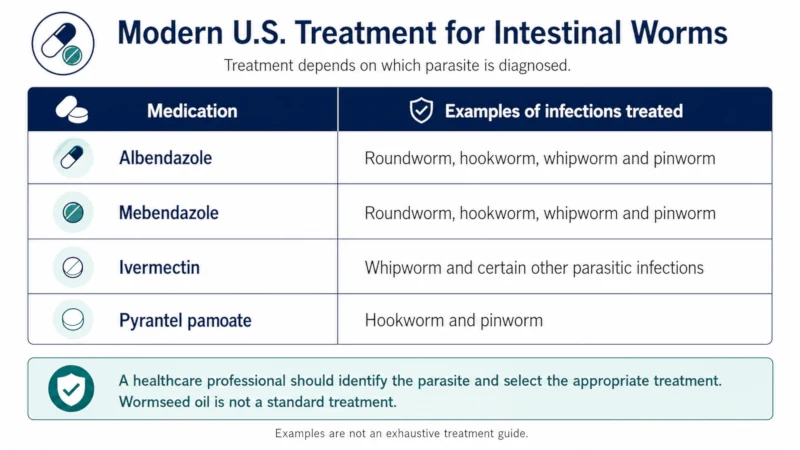
Modern US care confirms this. When intestinal roundworms, hookworms, or whipworms are diagnosed, standard treatment is a short course — usually one to three days — of oral albendazole, mebendazole, ivermectin, or pyrantel pamoate. Cure rates are high and dosing is straightforward, with the same doses for children and adults for most indications [CDC guidance on soil-transmitted helminths, 2024]. Herbal preparations of wormseed do not appear in these guidelines.
That doesn’t erase the plant’s history — it just changes what the plant is for.
What the evidence actually shows
The research picture on wormseed is uneven, which is worth knowing before you read a website that flattens it into a single confident claim.
Anthelmintic activity: strong lab signal, mixed clinical picture
In cell and animal studies, ascaridole-rich extracts consistently kill or paralyze parasites, including Ascaris, Schistosoma, and Entamoeba histolytica [Dagni et al., PMC review on Dysphania ambrosioides essential oils, 2024 — UNVERIFIED; see note]; [PubMed 28504841, 2017]. That’s a real biological effect and it fits the traditional reputation.
Human trials are where things get complicated. The most careful field study — a set of ethnopharmacological trials among Mayan farmers in Chiapas, Mexico — found that traditional dry-plant preparations at doses up to 6,000 mg/kg of body weight had “no significant anthelmintic effect” on adult Necator, Trichuris, or Ascaris [Kliks, J Ethnopharmacol, 1985]. In other words, the whole-plant preparation people actually used at home in the region where the plant is native didn’t perform in a controlled setting. The concentrated oil clearly kills worms — but the oil is exactly the preparation that has caused fatalities.
That gap between “kills worms in a dish” and “safely cures worms in a person” is the reason wormseed no longer sits in the treatment toolkit.
Digestion, gas, and the bean connection
The other traditional claim — that wormseed helps with gas, bloating, and indigestion — has a friendlier evidence base, mostly because the doses involved are much smaller. As a culinary herb, epazote is a well-established carminative, meaning it’s used to reduce the gas associated with foods like beans [The Kitchn, 2022]. Cooks across Mexico, Guatemala, and El Salvador add a sprig or two of epazote to simmering black or pinto beans specifically for this reason. The gas-relief effect isn’t clinically proven the way a pharmaceutical is, but the practice has held up across generations and is consistent with the plant’s antispasmodic essential-oil chemistry.
If your interest is digestive comfort rather than parasites, this is the meaningful use — and it’s the one with the best safety margin.
Other early-stage findings
Research groups have looked at ascaridole and epazote extracts for antimicrobial, antifungal, antioxidant, anti-inflammatory, and even sleep-promoting effects. Most of this work is in test tubes or in mice. One animal study, for example, found that inhaled essential oil of D. ambrosioides reduced locomotor activity in caffeine-agitated mice, suggesting a sedative effect [Monzote et al., J Nat Prod, 2021]. That’s an interesting mechanism, not a reason for a human to breathe wormseed oil. Treat early-stage findings for what they are: signals worth studying, not directions for use.
Using epazote in the kitchen (this is the safe part)
If you want to try wormseed at home, cooking is where the plant earns its place. The typical culinary dose is small — a sprig of fresh leaves, or roughly a teaspoon of dried, per pot of beans — added toward the end of cooking so the flavor doesn’t turn bitter. Ascaridole content is lower in Mexican epazote than in plants grown in Europe or Asia, and it’s also lower in fresh leaves used as a seasoning than in the concentrated distilled oil [Wikipedia — Dysphania ambrosioides, 2024].
The flavor is polarizing. Some people love it; others read it as medicinal or petroleum-like on the first taste. Start with less than you think you need. It also pairs traditionally with quesadillas, tamales with cheese, chilaquiles, mole de olla, and green salsas — not just beans [Wikipedia — Dysphania ambrosioides, 2024].
Safety, side effects, and who should avoid it
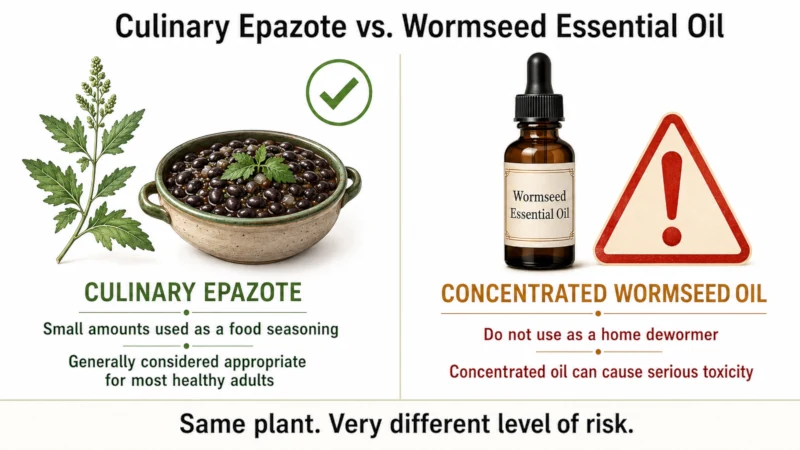
The distinction that matters is plant vs. oil, and small culinary amount vs. medicinal dose. Culinary use of the fresh or dried leaves in moderate amounts is broadly considered safe for healthy adults. Medicinal doses — especially of wormseed essential oil, sometimes sold as “chenopodium oil” — are a different category and carry serious risk.
The ascaridole problem
Ascaridole can irritate the digestive tract lining and, at higher exposures, damage the kidneys and liver, disturb the nervous system, and depress breathing. Documented adverse effects with medicinal use or overdose include nausea, vomiting, diarrhea, headache, dizziness, temporary hearing loss, seizures, and fatalities [WebMD/RxList — Chenopodium Oil]. Chenopodium oil is classified as unsafe for self-use by major consumer drug references [WebMD/RxList — Chenopodium Oil].
Because of that, we can’t in good conscience print a “how to dose it for worms” recipe. If you have or suspect a parasitic infection, see the section below.
Pregnancy and breastfeeding
Wormseed should not be used medicinally during pregnancy. It has been used historically as an abortifacient and to bring on menstruation, and its ascaridole content raises real toxicity concerns for both parent and fetus [Meyler’s — Chenopodium ambrosioides]; [WebMD/RxList — Chenopodium Oil]. Guidance on culinary amounts during pregnancy is not settled, and many clinicians advise erring on the side of caution and simply avoiding it while pregnant. If you’re breastfeeding, the same caution applies — the safety data isn’t there.
Children, liver disease, and drug interactions
Children are more susceptible to ascaridole toxicity, and historic pediatric fatalities from wormseed oil are part of why it left standard medicine [WebMD/RxList — Chenopodium Oil]. People with liver or kidney disease should avoid medicinal preparations entirely. And because the plant’s essential-oil compounds affect drug-metabolizing liver enzymes, anyone on prescription medication — especially medications with a narrow therapeutic window — should talk to a pharmacist or physician before using wormseed as a supplement.
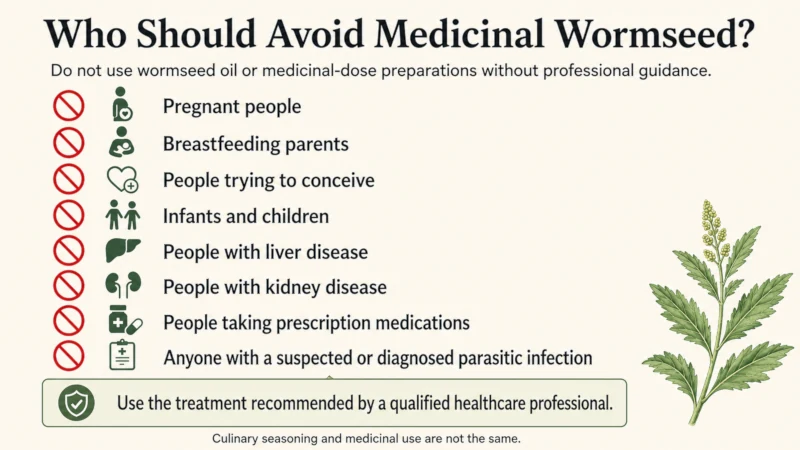
Skip wormseed as a home remedy if you are:
- Pregnant or breastfeeding
- Trying to conceive
- Giving anything to a child
- Managing liver or kidney disease
- Taking prescription medications that are metabolized by the liver
- Working with a clinician for a diagnosed parasitic infection (use the prescribed drug)
When to see a doctor about intestinal worms
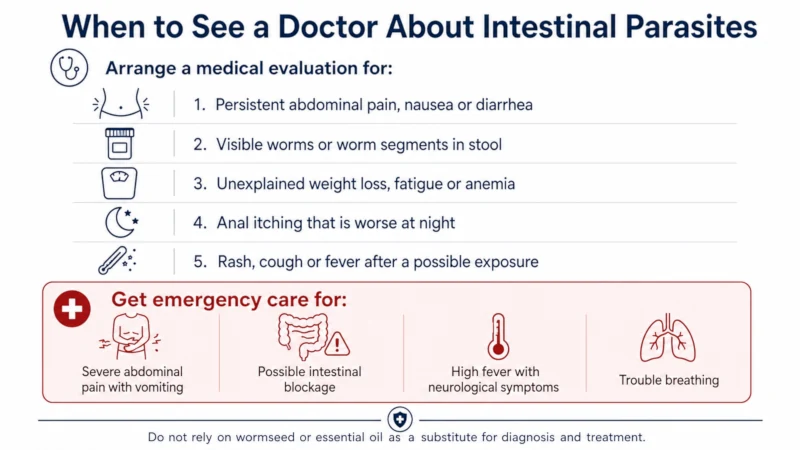
Intestinal parasitic infections are much less common in the US than they used to be, but they still occur — through international travel, contaminated food or water, pets, and (rarely) local exposure. Signs that warrant a medical evaluation rather than a home remedy include:
- Persistent, unexplained abdominal pain, nausea, or diarrhea
- Visible worms or worm segments in stool
- Unexplained weight loss, fatigue, or anemia
- Itching around the anus, especially at night (a classic sign of pinworms)
- Rash, cough, or fever after known exposure to contaminated soil or undercooked meat
A stool test is inexpensive, quick, and pinpoints the parasite so the right medication can be prescribed. Treatment is usually a one- to three-day course of oral medication with cure rates well above 90 percent [CDC guidance on soil-transmitted helminths, 2024]. In the US, start with your primary care provider or an urgent care clinic; travel-medicine or infectious-disease specialists get involved for complicated cases. For a plainer walk-through of parasites you can get from food, see our companion piece on pork parasites and how to prevent them.
Call 911 or go to the ER for severe abdominal pain with vomiting, signs of intestinal obstruction, high fever with neurological symptoms, or trouble breathing during an illness that started after eating raw or undercooked meat.
| HEALTH DISCLAIMER: This article is educational and doesn’t replace medical advice, diagnosis, or treatment from a qualified professional. Wormseed (Dysphania ambrosioides) essential oil is potentially toxic, and no home preparation of the plant is a proven substitute for prescription antiparasitic medication. If you’re pregnant, breastfeeding, giving anything to a child, taking prescription medications, or think you may have an intestinal parasite, talk to a healthcare provider before using wormseed. In an emergency, call 911 or go to the nearest emergency room. |
Frequently Asked Questions
Is wormseed the same as epazote?
Yes. Dysphania ambrosioides is called both. “Wormseed” refers most often to the historical use of the plant (and its seed-derived essential oil) as a dewormer; “epazote” refers to the same plant used as a culinary herb. Older sources may call it Chenopodium ambrosioides — that’s the previous scientific name.
Does wormseed actually kill parasites?
Its main compound, ascaridole, kills worms in laboratory studies and did work in older clinical use as a distilled oil. But whole-plant home preparations performed poorly in a careful field trial in Chiapas, Mexico [Kliks, J Ethnopharmacol, 1985], and the concentrated oil that does work is toxic enough that safer prescription drugs replaced it decades ago. If you have an intestinal parasite, the treatment your provider will prescribe (albendazole, mebendazole, ivermectin, or pyrantel pamoate) is far more reliable and safer [CDC guidance on soil-transmitted helminths, 2024].
Is it safe to cook with epazote?
For most healthy adults, culinary amounts of fresh or dried epazote — a sprig or a teaspoon per pot — are considered safe and are a traditional ingredient in Mexican and Central American cuisine [The Kitchn, 2022]. Skip it during pregnancy, in breastfeeding, and for young children.
Can wormseed help with gas and bloating?
Traditionally, yes — added to beans, epazote has a long, well-established reputation as a carminative that reduces bean-associated gas. It’s not been proven in randomized trials the way a pharmaceutical would be, but the culinary use for digestive comfort has held up across generations and cultures.
Where can I read more about herbs for digestion?
Our overview of plants and herbs for stomach issues covers dozens of carminative and antispasmodic herbs with a similar careful lens on evidence and safety.
References
- Wikipedia contributors. “Dysphania ambrosioides.” Wikipedia, The Free Encyclopedia, 2024. View source
- North Carolina Extension Gardener Plant Toolbox. “Dysphania ambrosioides.” NC State University. View source
- WebMD/RxList. “Chenopodium Oil: Health Benefits, Side Effects, Uses, Dose & Precautions.” View source
- Aronson JK, ed. “Chenopodium ambrosioides.” In: Meyler’s Side Effects of Drugs (via ScienceDirect Topics). View source
- Kliks MM. “Studies on the traditional herbal anthelmintic Chenopodium ambrosioides L.: ethnopharmacological evaluation and clinical field trials.” Journal of Ethnopharmacology, 1985. PMID: 3906906. View source
- Centers for Disease Control and Prevention. “Clinical Care of Soil-transmitted Helminths.” Reviewed 2024. View source
- The Kitchn. “What Is Epazote & How Do You Use It?” 2022. View source
- de Freitas MB et al. “Chemical Composition, Antibacterial, Schistosomicidal, and Cytotoxic Activities of the Essential Oil of Dysphania ambrosioides.” PubMed, 2017. PMID: 28504841. View source
- Fujiwara Y et al. “Role of Ascaridole and p-Cymene in the Sleep-Promoting Effects of Dysphania ambrosioides Essential Oil via the GABAergic System in a ddY Mouse Inhalation Model.” J Nat Prod, 2021. PMID: 33325703. View source
- Dagni A et al. “Essential Oils and Extracts from Epazote (Dysphania ambrosioides): A Phytochemical Treasure with Multiple Applications.” PMC12251798, 2024/2025. View source
