
Condurango is a bitter bark with one well-documented job, and it’s a modest one: nudging a flagging appetite and easing mild indigestion. The condurango plant, a climbing vine from the Andes of Ecuador and Peru, holds a positive German Commission E monograph for loss of appetite [Altmeyer & Bacharach-Buhles, 2025]. No modern clinical trials confirm that it works, though, and the Natural Medicines database rates the evidence as insufficient for every use it has looked at [RxList].
The bark’s more famous claim, that it treats stomach cancer, has a colorful history and no human evidence behind it. And because overdoses can be toxic and the bark can trigger severe reactions in people allergic to latex, how much you take and who takes it matter more here than with most kitchen herbs.
What the condurango plant is
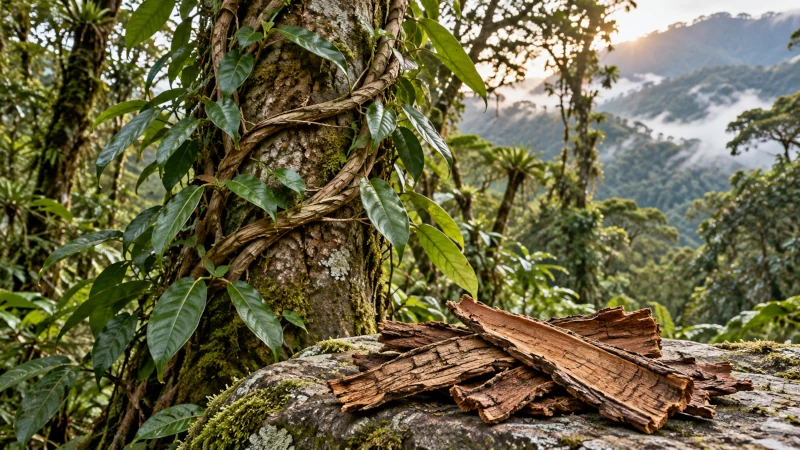
Condurango (Marsdenia cundurango, also written Marsdenia condurango or Gonolobus condurango) is a woody climbing vine that grows in Ecuador and Peru and is commonly called condor vine [Bishayee et al., 2015]. Botanical databases now file the name as a synonym of Ruehssia cundurango [POWO, 2026], so you may see either on labels and in research. Older texts place it in the milkweed family, Asclepiadaceae [Sikdar et al., 2015].
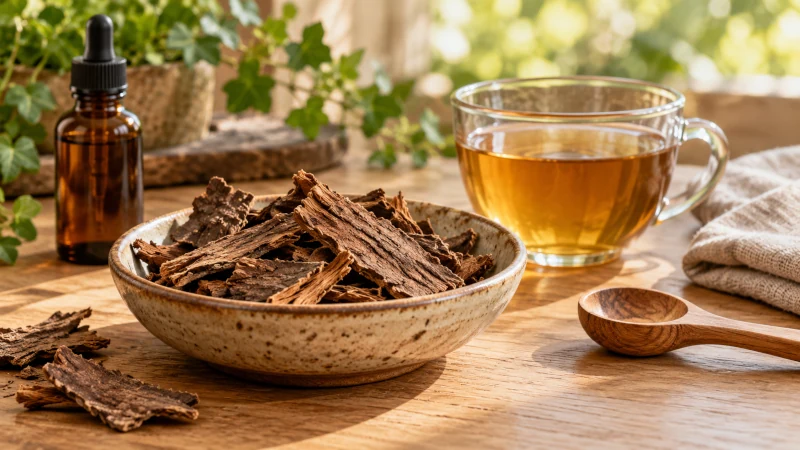
The medicine comes from the dried bark of the twigs and younger stems [Altmeyer & Bacharach-Buhles, 2025]. Its signature ingredient is condurangin, a mixture of bitter glycosides that makes up about 1 to 3% of the bark. Flavonoids, caffeic and chlorogenic acids, coumarin derivatives and a little volatile oil come along with it [EMEA, 2000]. Herbalists group condurango with other traditional herbs for the digestive system that work through bitterness.
The name invites a good story, and popular herbals often say Andean condors ate the leaves to heal snakebites. We couldn’t trace that legend to a reliable source. German phytotherapy references do record snakebite as one of the bark’s first folk uses, before it became known as a stomach remedy [Altmeyer & Bacharach-Buhles, 2025].
The 1871 cancer cure that wasn’t

Condurango reached the United States and Europe in 1871 with a heavy promise attached. Ecuador’s government sponsored it as a new botanical cure for cancer, newspapers fanned public interest, and the episode turned into a fight over quackery and medical authority [Sevilla & Sevilla, 2020].
The promise didn’t hold. By 1922 a standard American materia medica called the bark’s reputation against stomach cancer and syphilis unsustained, and judged it most likely a mild pain reliever and tonic for a weak stomach [Felter, 1922]. A century later, the evidence sits in much the same place.
Condurango plant benefits: what the evidence supports
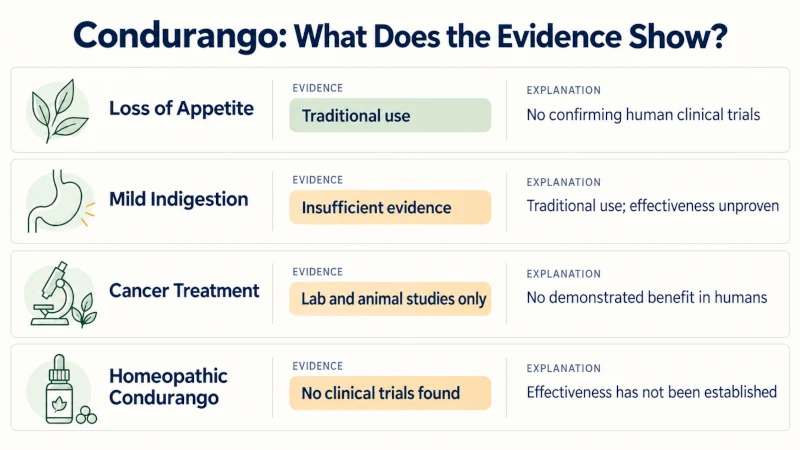
| Claimed use | Strength of evidence | What it means for you |
| Loss of appetite | Traditional use; positive Commission E monograph [Altmeyer & Bacharach-Buhles, 2025]; no clinical trials found | Reasonable to try short term at documented doses |
| Mild indigestion, fullness | Traditional use; rated insufficient evidence [RxList] | Same; see a doctor if it persists |
| Stomach or other cancers | Cell and rat studies from one lab; no human data [Bishayee et al., 2015;Sikdar et al., 2014] | Do not use as a cancer treatment |
| Snakebite | Historical folk use only [Altmeyer & Bacharach-Buhles, 2025] | Never a substitute for emergency care |
| Homeopathic “Condurango Q” and dilutions | No clinical trials found | Not a substitute for diagnosis or treatment |
Appetite and mild indigestion
This is condurango’s legitimate use. Germany’s Commission E, the expert panel that reviewed herbal medicines for German regulators, gave condurango bark a positive monograph for loss of appetite [Altmeyer & Bacharach-Buhles, 2025]. The proposed mechanism is the bitterness itself. The taste stimulates saliva and gastric juice, which is thought to prime the appetite [EMEA, 2000].
Two caveats keep that in proportion. We found no controlled clinical trials of condurango for appetite or indigestion, and neither the EU’s herbal medicines committee (HMPC) nor the European phytotherapy society (ESCOP) has assessed it [Altmeyer & Bacharach-Buhles, 2025]. The Natural Medicines database, published through RxList, rates the evidence for indigestion and appetite as insufficient [RxList].
The fair way to think about condurango, then, is as a traditional bitter with a believable mechanism and very little testing. If a bitter is what you’re after, our guides to gentian root and European centaury cover two that have fuller European regulatory documentation.
Cancer: lab and animal studies only
Most modern condurango research is about cancer, and it’s easy to misread. Extracts and isolated glycosides killed cervical and lung cancer cells in laboratory dishes [Bishayee et al., 2015; Sikdar et al., 2015], and an ethanol extract was reported to improve chemically induced lung tumors in rats [Sikdar et al., 2014].
Three facts should cool any excitement. None of the work involves people. Nearly all of it comes from one university laboratory in India, and the papers state the research was funded at least in part by Boiron, a homeopathic manufacturer that also supplied the extract [Bishayee et al., 2015; Sikdar et al., 2014]. And the rat study’s published abstract contains methods text describing an unrelated bee-venom experiment, a reporting error that makes the paper harder to trust [Sikdar et al., 2014]. The researchers themselves say more animal work is needed before any human use [Sikdar et al., 2015].
If you or someone you love has cancer, condurango is not a treatment. Before adding any herbal product, tell your oncology team, who can check it against your treatment plan.
Homeopathic condurango
Condurango is also sold as a homeopathic remedy, often labeled “Condurango Q” (the mother tincture) or in diluted “C” potencies. We found no clinical trials showing that homeopathic condurango, at any potency, treats digestive problems or cancer. Treat it the same way as the bark: never in place of a diagnosis.
How to take condurango bark
Condurango is taken by mouth as a tea, tincture or liquid extract, or as one ingredient in bitter tonics. German references list these usual daily amounts for adults [Altmeyer & Bacharach-Buhles, 2025]:
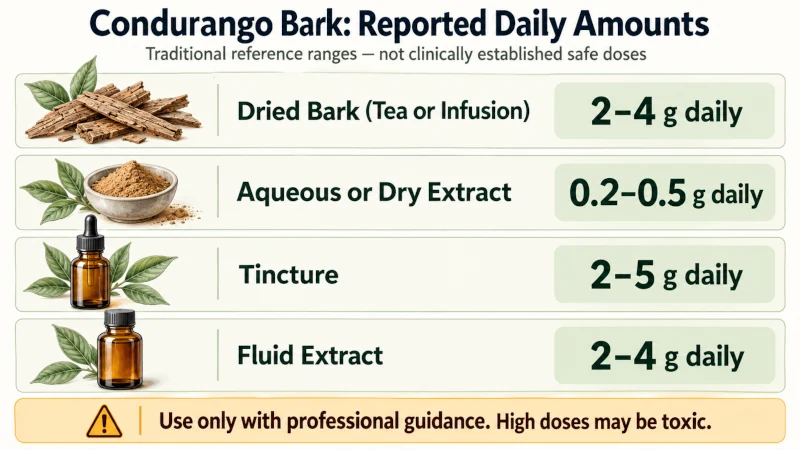
| Form | Usual daily amount |
| Dried, crushed bark (infusion or tea) | 2–4 g |
| Aqueous or dry extract | 0.2–0.5 g |
| Tincture | 2–5 g |
| Fluid extract | 2–4 g |
An EU regulatory report quoted the same 2 to 4 g average daily dose for human use [EMEA, 2000]. Bitters are usually taken shortly before a meal; our gentian guide explains the reasoning.
Be wary of home recipes that call for much more. Some herbal books suggest decoctions made with 30 to 40 g of bark in half a liter of water, taken by the spoonful before meals. Depending on how much you drink, that can deliver several times the documented daily amount. With a plant whose overdoses cause convulsions, stay in the lower, documented range.
A few habits keep things sensible:
- Choose a product that names the species and gives a clear dose, and follow its label.
- Don’t stack condurango with other bitter tonics or multi-herb “stomach bitters.”
- Tinctures are alcohol-based; research extracts have contained about 65% alcohol [Sikdar et al., 2015]. Pick a tea or alcohol-free product if you avoid alcohol for any reason.
- Keep it short-term. If your appetite or digestion hasn’t improved, stop and see a doctor rather than taking more [NIDDK, 2025].
For options with stronger human evidence, such as peppermint oil for IBS or ginger for nausea, see our guide to herbs for stomach issues.
Side effects, interactions, and who should avoid condurango
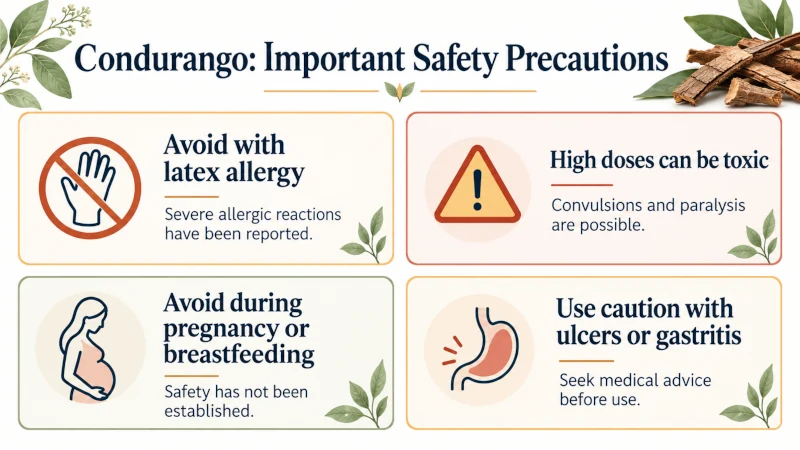
At normal doses, serious problems appear to be uncommon. An EU regulatory review found no reports of adverse effects from condurango in human medicine, and RxList describes it as seemingly safe for most people when used appropriately [EMEA, 2000; RxList]. That reassurance rests on thin documentation, not on safety trials.
Overdose
Too much is genuinely dangerous. Overdoses may cause convulsions ending in paralysis, along with dizziness and disturbed vision [EMEA, 2000]. Older pharmacology texts describe condurangin acting on the nervous system in animals, causing vomiting, drooling, muscle weakness, convulsions and paralysis [Felter, 1922].
If someone feels unwell after taking condurango, get help from Poison Control online or call 1-800-222-1222 (US). Call 911 if they have a seizure, collapse, have trouble breathing or can’t be woken [Poison Control].
Latex allergy
People allergic to natural rubber latex can also react to condurango, and the reaction can be severe. German allergists reported anaphylaxis triggered by condurango bark in a latex-allergic patient [Pfützner et al., 1998], and RxList advises anyone with a latex allergy to avoid it [RxList].
Medication interactions and stomach conditions
We found no documented drug interactions in the sources we reviewed. That probably reflects how little condurango has been studied rather than proof that it’s inert, so ask a pharmacist before combining it with prescription medicine.
Because condurango stimulates stomach secretions [EMEA, 2000], be cautious with an active stomach ulcer or gastritis. EU guidance rules out a similar bitter, European centaury, in active peptic ulcer disease (details in our centaury guide). If your stomach lining is already inflamed, our page on gastritis foods to avoid is a better starting point than any bitter.
Who should not use it
- Pregnant or breastfeeding people. Not enough is known about safety, so avoid it [RxList].
- Anyone with a latex allergy, because of the risk of anaphylaxis [Pfützner et al., 1998; RxList].
- Children and teenagers. We found no safety data for anyone under 18.
- People with an active ulcer or gastritis, for the reasons above.
- Anyone tempted to use it instead of cancer treatment. The evidence doesn’t support it.
When to see a doctor
Poor appetite and indigestion are symptoms, not diagnoses. See a doctor if your indigestion doesn’t get better, and get medical care right away if it comes with any of these [NIDDK, 2025]:
- Pain in your chest, jaw, neck, or arm
- Difficulty swallowing or painful swallowing
- Frequent vomiting, or bloody vomit
- Severe, constant pain in your abdomen
- Long-lasting bloating or swelling in your abdomen
- Shortness of breath
- Weight loss without trying, or loss of appetite
- Yellowing of your eyes or skin
- Black, tarlike stools
Notice that unexplained appetite loss is itself on that list. If a poor appetite is the reason you’re looking at condurango, get it checked first. Our digestive health section covers common causes and next steps.
| HEALTH DISCLAIMER: This article is for general information and education only. It is not medical advice and is not a substitute for diagnosis or treatment from a qualified healthcare professional. Condurango is a traditional herbal remedy whose benefits have not been confirmed in clinical trials, and high doses can be toxic. Talk to your doctor or pharmacist before using it, especially if you are pregnant or breastfeeding, have a latex allergy, have a stomach ulcer or other digestive condition, take prescription medicine, or are considering it for someone under 18. Never use condurango in place of treatment for cancer or any diagnosed illness. If you have severe abdominal pain, vomit blood, pass black stools, or have chest pain or trouble breathing, seek emergency care or call 911. |
Frequently Asked Questions
What is condurango used for?
Mainly as a bitter for loss of appetite and mild indigestion. Germany’s Commission E recognized it for loss of appetite [Altmeyer & Bacharach-Buhles, 2025], but that rests on traditional use; the evidence for any use is rated insufficient [RxList].
Does condurango cure stomach cancer?
No. It was promoted as a cancer cure in 1871 and the claim didn’t hold up [Sevilla & Sevilla, 2020; Felter, 1922]. Modern anticancer findings come from cell and rat studies, mostly from one manufacturer-funded lab, with no human trials [Bishayee et al., 2015; Sikdar et al., 2014].
How much condurango is safe to take?
German references list 2 to 4 g of dried bark a day, or 2 to 5 g of tincture [Altmeyer & Bacharach-Buhles, 2025]. Follow the product label, keep use short, and avoid home recipes that call for much larger amounts, since overdoses can cause convulsions [EMEA, 2000].
Can I take condurango if I’m allergic to latex?
No. Condurango has caused anaphylaxis in a person with latex allergy, and people with latex allergy are advised to avoid it [Pfützner et al., 1998; RxList].
What is “Condurango Q”?
It’s the homeopathic name for condurango mother tincture. We found no clinical trials showing that it, or diluted homeopathic potencies, treats digestive problems or cancer.
Is condurango safe during pregnancy or breastfeeding?
Its safety hasn’t been established, so the standard advice is to avoid it [RxList].
References
- Altmeyer P, Bacharach-Buhles M. Condurango cortex. Altmeyers Encyclopedia — Phytotherapy. View source
- European Agency for the Evaluation of Medicinal Products (EMEA), Committee for Veterinary Medicinal Products. View source
- RxList (Natural Medicines Comprehensive Database content). Condurango: health benefits, side effects, uses, dose & precautions. View source
- Pfützner W, Thomas P, Rueff F, Przybilla B. Anaphylactic reaction elicited by condurango bark in a patient allergic to natural rubber latex. View source
- Bishayee K, Mondal J, Sikdar S, Khuda-Bukhsh AR. Condurango (Gonolobus condurango) extract activates Fas receptor and depolarizes mitochondrial membrane potential to induce ROS-dependent apoptosis in cancer cells in vitro. View source
- Sikdar S, Mukherjee A, Khuda-Bukhsh AR. Anti-lung cancer potential of pure esteric-glycoside condurangogenin A against nonsmall-cell lung cancer cells in vitro via p21/p53 mediated cell cycle modulation and DNA damage-induced apoptosis. View source
- Sikdar S, Mukherjee A, Khuda-Bukhsh AR. Ethanolic extract of Marsdenia condurango ameliorates benzo[a]pyrene-induced lung cancer of rats. J Pharmacopuncture. View source
- Sevilla E, Sevilla A. The “Controversial Cundurango Cure”: Medical professionalization and the global circulation of drugs. View source
- Felter HW. Condurango. In: The Eclectic Materia Medica, Pharmacology and Therapeutics. View source
- Plants of the World Online (Royal Botanic Gardens, Kew). Marsdenia cundurango Rchb.f. View source
- National Institute of Diabetes and Digestive and Kidney Diseases (NIDDK). Symptoms & causes of indigestion. View source
- Poison Control, National Capital Poison Center. poison.org. View source


