
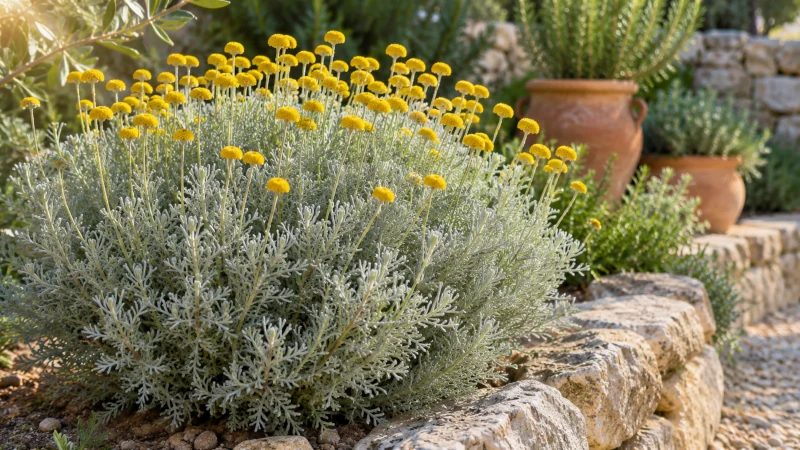
Lavender cotton is a silver-leaved Mediterranean shrub with button-yellow flowers and a smell sharp enough to earn it a place in linen drawers. Despite the name, it isn’t lavender. For generations, folk healers used lavender cotton (Santolina chamaecyparissus) as a stomach tea, a worm remedy, and a way to bring on a late period.
Here’s the short answer before you brew anything: those uses are traditional, the research behind them comes almost entirely from lab dishes and rodents, and no human trial tells us what a safe or effective dose would be. Lavender cotton earns its keep in the garden and the closet far more easily than in the medicine cabinet.
What lavender cotton is — and what it isn’t
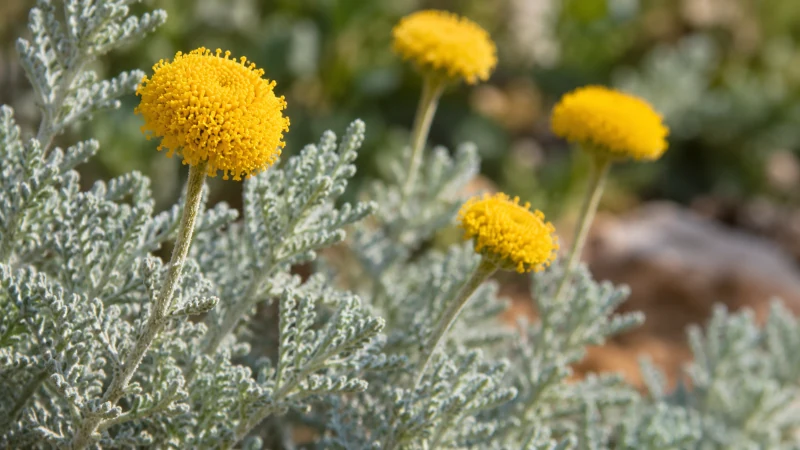
Santolina chamaecyparissus belongs to the daisy family, Asteraceae (once called Compositae). It grows as a low, mounding evergreen subshrub with dense, woolly gray foliage and finely segmented leaves. In summer it carries round golden flower heads made entirely of tiny tube-shaped florets, with none of the petal-like rays you’d see on a daisy [Osmanlıoğlu Dağ et al., 2026]. It’s native to the Mediterranean region [Azevedo et al., 2023] and is widely planted as a clipped edging in herb gardens.
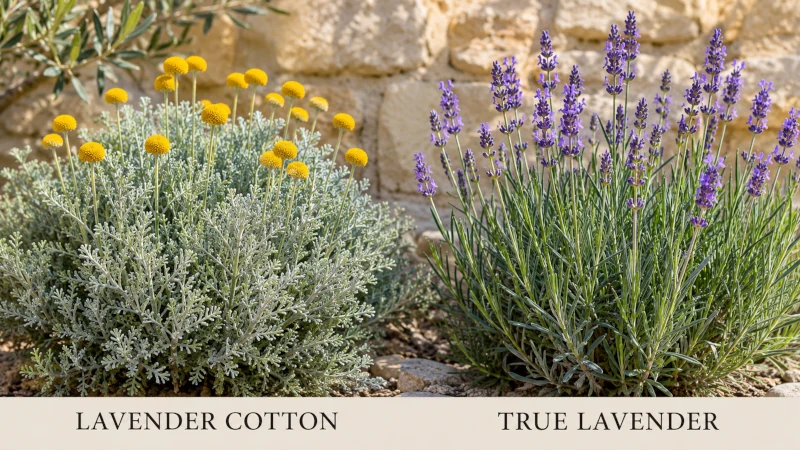
The name causes real confusion. True lavender (Lavandula) comes from a different plant family with different chemistry and a different, better-studied evidence base—see our guide to lavender benefits if that’s the plant you meant. Don’t swap one for the other in a recipe or remedy.
| Quick facts | |
| Botanical name | Santolina chamaecyparissus L. |
| Family | Asteraceae (daisy family) |
| Other names | Cotton lavender, gray santolina, ground-cypress; santoline (French); abrótano hembra (Spanish) |
| Parts used traditionally | Flower heads (inflorescences); some herbals also mention the seeds |
| Common forms | Dried flower heads, infusions, essential oil |
| Human clinical trials | None found |
What’s inside the plant, and why it varies so much
Lavender cotton’s scent comes from a volatile essential oil. Researchers have also identified sesquiterpenes, flavonoids, and coumarins across the genus [Tundis & Loizzo, 2018]. The catch is that the oil’s makeup changes dramatically depending on where the plant grew.
Flower-head oil from wild Tunisian plants was led by 1,8-cineole and β-eudesmol [Salah-Fatnassi et al., 2017]. A 2026 Turkish sample was more than half artemisia ketone, with camphor making up about 21% [Osmanlıoğlu Dağ et al., 2026]. Plants grown in Poland for insect research were also artemisia ketone–rich [Czerniewicz & Chrzanowski, 2021].
Why should you care? Because camphor is a compound that can cause seizures when swallowed [Royal Children’s Hospital Melbourne, 2020], and a bottle labeled “santolina oil” won’t tell you how much of it is inside.
Traditional uses of lavender cotton
Across the Mediterranean, the yellow flower heads have been used as an antispasmodic, digestive, pain reliever, anti-inflammatory, and antiseptic, and to treat dermatitis. In India, the plant has a place in Ayurvedic practice for liver complaints [Tundis & Loizzo, 2018]. In Spain, one subspecies goes by local names built on manzanilla—the Spanish word for chamomile—and was taken for belly pain and stomach problems [Tundis & Loizzo, 2018].
In Tunisia, lavender cotton is used as a vermifuge (to expel intestinal worms) and an emmenagogue (to bring on menstruation) [Salah-Fatnassi et al., 2017]. Reviewers also describe folk use for premenstrual complaints, infections, and digestive disorders [Azevedo et al., 2023].
Then there’s the household use the plant may be best known for: bundles tucked into wardrobes to keep moths off wool. That’s tradition too, though it has some scientific plausibility. In lab tests, santolina oil was the more toxic of two daisy-family oils tested against aphids and cut their reproduction even at sublethal doses [Czerniewicz & Chrzanowski, 2021]. We found no study testing dried sprigs against clothes moths.
What the research actually shows
Look closely at the studies on lavender cotton and one thing is missing: people. Here’s what the lab and animal work does say.
Digestion and cramping
In isolated strips of rat and guinea-pig intestine, santolina extracts reduced muscle contractions triggered by acetylcholine, histamine, and other chemical messengers. Several extracts also protected rats from stress-induced stomach ulcers [Azevedo et al., 2023]. That lines up with the plant’s “settles the stomach” reputation.
But a gut muscle in a lab bath isn’t a person with indigestion, and no human trial has tested lavender cotton tea for any digestive complaint. If you want an herb with genuine human evidence, peppermint oil for IBS and ginger for nausea are better-supported choices—our guide to herbs for stomach issues walks through them.
Inflammation
In mice, a methanol extract reduced paw swelling caused by an inflammatory enzyme, phospholipase A2, and blocked that enzyme in a test tube. Researchers then isolated a flavone called nepetin and four sesquiterpenes from the active fraction [Sala et al., 2000]. Other rodent studies found reduced paw and ear swelling with various extracts [Azevedo et al., 2023]. Interesting chemistry; no clinical data.
Bacteria and fungi
Santolina oil controlled Candida in lab cultures and in animal models of vaginal and systemic candidiasis, and the authors called for further studies, including clinical ones [Suresh et al., 1997]. Tunisian flower-head oil inhibited bacteria such as Pseudomonas aeruginosa and Enterococcus faecalis in the lab [Salah-Fatnassi et al., 2017].
A 2026 screen of a methanol extract was less impressive. It showed modest activity, mainly against Staphylococcus aureus, and weak or baseline effects against most other microbes; the authors noted their method can’t establish potency [Osmanlıoğlu Dağ et al., 2026]. None of this tells you a tea or bath would treat an infection, and a real infection isn’t something to test at home.
Worms
This is the use the plant is most famous for, and the one with the least behind it. In the research reviewed for this article, we found no human or animal study testing lavender cotton against pinworms or roundworms. “Used as a vermifuge” describes a tradition, not a demonstrated effect.
Everything else is lab-only
Reviews also describe extracts killing cancer cells in culture and protecting rat livers from chemical damage [Azevedo et al., 2023]. These are early-stage signals. They say nothing about using lavender cotton for cancer or liver disease.
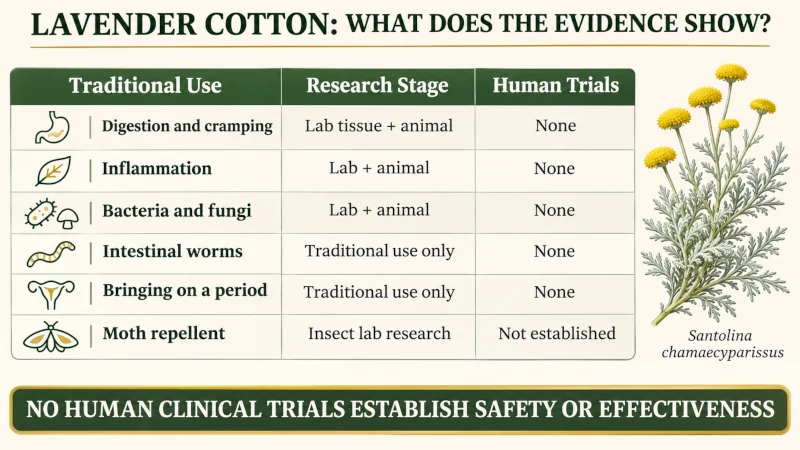
| Use | Strongest evidence so far | Human trials? | What it means for you |
| Digestion, cramping | Isolated animal gut tissue; rat ulcer model | None | Plausible, unproven. Choose better-studied herbs. |
| Inflammation | Mouse paw/ear swelling; test-tube enzyme work | None | Early chemistry only. |
| Fungal and bacterial infections | Lab cultures; animal candidiasis models | None | Don’t self-treat infections with it. |
| Intestinal worms | Traditional use only | None | No evidence it works. Use proven medication. |
| Bringing on a period | Traditional use only | None | A reason to avoid it in pregnancy, not to use it. |
| Repelling moths | Oil is toxic to aphids in the lab | n/a | Reasonable to try in a closet sachet. |
Why lavender cotton isn’t a good worm remedy for children
Some herbal sources still recommend lavender cotton seed powder or seed tea to clear worms from children. That advice has two problems.
First, nothing shows it works. Second, the treatments that do work are simple and inexpensive. Pinworm is treated with mebendazole, albendazole, or pyrantel pamoate—pyrantel is sold without a prescription—usually as two doses given two weeks apart, plus careful hand hygiene for everyone in the household [CDC, 2024].
Children are also the group most vulnerable to camphor. Serious toxicity has been reported in children who swallowed more than 30 mg per kilogram of body weight, and seizures can start within 90 minutes [Royal Children’s Hospital Melbourne, 2020]. Some santolina oils are about one-fifth camphor [Osmanlıoğlu Dağ et al., 2026], and no one has measured how much ends up in a cup of tea. You can’t dose what you can’t measure.
If you’re weighing natural options anyway, our guide to herbs marketed for intestinal parasites sorts the few with evidence from the ones that can do harm.
Side effects, safety, and who should avoid lavender cotton
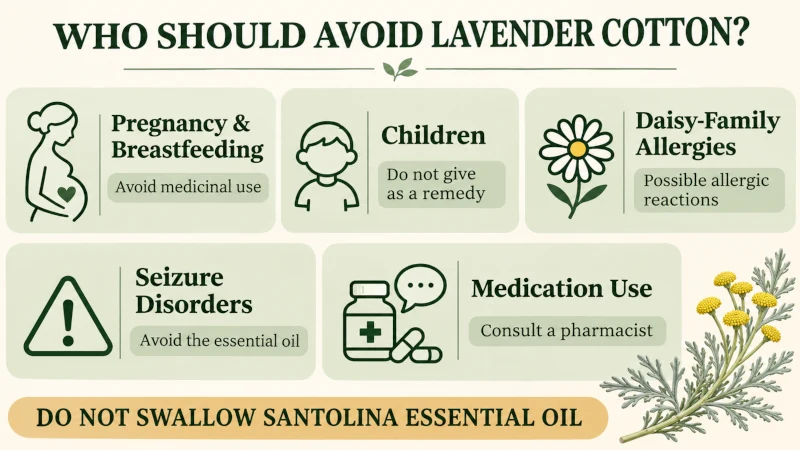
There are no human safety studies on lavender cotton and no established safe dose. The cautions below come from its chemistry, its plant family, and the very uses it’s known for.
Allergic and skin reactions
Plants in the daisy family carry sesquiterpene lactones, the main culprits behind compositae allergy. This shows up as contact dermatitis on skin exposed to the plant or its pollen. Once someone is sensitized to one daisy-family plant, reactions to others are common. Drinking a plant as a tea can trigger a widespread rash (systemic contact dermatitis), and chewing the leaves can inflame the mouth [DermNet, 2024].
Lavender cotton isn’t singled out in that literature, so the risk is a family-level one rather than a documented santolina problem. Still, if ragweed, chamomile, chrysanthemums, marigolds, feverfew, or arnica bother you, give it a pass. Gardeners with sensitive skin should wear gloves when cutting it back.
The essential oil
Some herbal sources recommend taking a few drops of santolina oil by mouth several times a day. Don’t. Poison Control warns that even a small amount of swallowed camphor is dangerous and that seizures can begin within minutes [Poison Control, n.d.]. Children have been seriously poisoned this way [Royal Children’s Hospital Melbourne, 2020].
On skin, undiluted essential oils commonly cause rashes, and they shouldn’t go on damaged skin [Poison Control, n.d.]. Store any bottle locked away from children and pets. Anyone with a seizure disorder should avoid the oil entirely.
Pregnancy, breastfeeding, and periods
Lavender cotton’s traditional job as an emmenagogue [Salah-Fatnassi et al., 2017] is reason enough to avoid it if you’re pregnant or trying to conceive. In the lab, its extracts also acted on rat uterine muscle [Azevedo et al., 2023]. There’s no safety information for breastfeeding, so skip it then too. The same caution applies to other daisy-family “period herbs” such as mugwort tea.
Never use an herb to try to bring on a late period. Take a pregnancy test and talk to a clinician.
Medications
No drug interactions have been documented in people, mostly because no one has looked. In mice, injected extracts reduced spontaneous activity, a sedative-like effect [Azevedo et al., 2023]. That raises a theoretical concern about stacking it with sedatives, sleep aids, or anti-anxiety medication. If you take prescription medicine, check with a pharmacist first.
Who should avoid it
- Anyone pregnant, trying to conceive, or breastfeeding
- Children—especially anything containing the essential oil
- People allergic to ragweed or other daisy-family plants
- Anyone with a seizure disorder (avoid the oil)
- People taking sedatives or several prescription medicines, unless a pharmacist or doctor has cleared it
Lower-risk ways to use lavender cotton
If you like the plant, the safest place for it is outside your body.
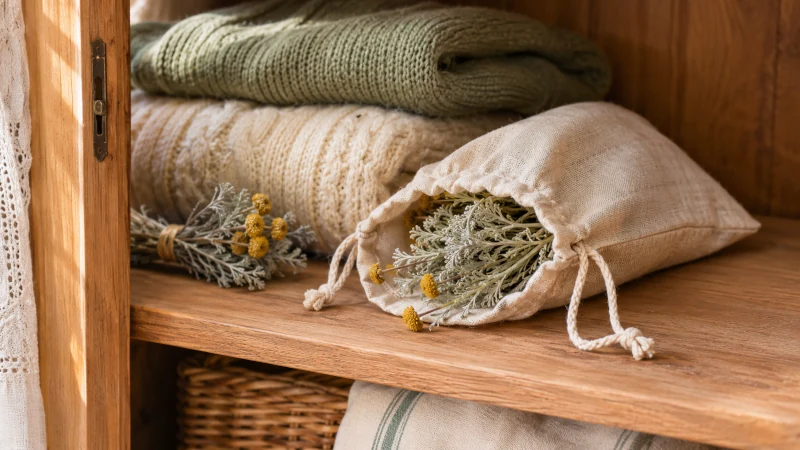
- In the closet: dried sprigs in a breathable cloth sachet. Refresh them when the scent fades, and keep them where small children and pets can’t chew them.
- In the garden: it’s drought-tolerant and takes clipping well. Wear gloves if your skin reacts to daisy-family plants.
- As a tea or bath: there’s no tested dose. If you’re a healthy, non-pregnant adult and still want to try it, ask a pharmacist first, keep it occasional and weak, and stop at the first sign of a rash, mouth irritation, or stomach upset. Not for children.
- As an essential oil: don’t swallow it. Skip it on skin unless it’s well diluted and patch-tested.
For everyday gut comfort, our digestive health guides cover options with better evidence.
When to see a doctor instead
Signs of worms. Night-time anal itching, tiny white threads near the bottom, or worm segments in the stool deserve a proper diagnosis. The usual pinworm test is a simple “tape test,” and treatment is quick [CDC, 2024].
Indigestion with red flags. See a doctor right away if stomach upset comes with pain in your chest, jaw, neck, or arm; trouble or pain swallowing; frequent or bloody vomiting; severe, constant belly pain; long-lasting bloating; shortness of breath; weight loss without trying; yellowing of the eyes or skin; or black, tarry stools. See a doctor, too, if indigestion simply doesn’t get better [NIDDK, 2025]. For chest pain or trouble breathing, call 911.
Someone swallowed the oil. Call Poison Control at 1-800-222-1222 or use the webPOISONCONTROL online tool [Poison Control, n.d.]. If the person has a seizure, is very drowsy, or is struggling to breathe, call 911.
An allergic reaction. A spreading rash is a reason to stop and call your doctor. Swelling of the lips, tongue, or throat, or any difficulty breathing, is an emergency.
| HEALTH DISCLAIMER: This article is for general education and is not medical advice, diagnosis, or treatment. Lavender cotton has not been tested in human clinical trials, and no safe dose has been established. Its essential oil can contain camphor, which is poisonous if swallowed. Do not give lavender cotton to children, and do not use it if you are pregnant, trying to conceive, or breastfeeding. Talk with a doctor or pharmacist before using any herb if you take prescription medication or have a seizure disorder, allergies to daisy-family plants, or another health condition. Suspected worm infections should be diagnosed and treated by a healthcare professional. If someone swallows an essential oil, call Poison Control at 1-800-222-1222; for seizures, severe allergic reactions, or trouble breathing, call 911. |
Frequently Asked Questions
Is lavender cotton the same as lavender?
No. Lavender cotton (Santolina chamaecyparissus) is a daisy-family shrub. True lavender (Lavandula) belongs to a different plant family, has different chemistry, and has its own, stronger evidence base. The shared name comes from the gray, woolly look of santolina’s foliage and its strong scent.
Can lavender cotton get rid of worms?
There’s no evidence it does. Its reputation as a vermifuge is traditional [Salah-Fatnassi et al., 2017], and we found no human or animal study testing it against pinworms or roundworms. Pinworm is reliably treated with mebendazole, albendazole, or over-the-counter pyrantel pamoate in two doses two weeks apart [CDC, 2024].
Is lavender cotton tea safe to drink?
No one knows, because it hasn’t been studied in people. Daisy-family teas can cause allergic rashes in sensitive people [DermNet, 2024], and the plant’s oil can contain camphor [Osmanlıoğlu Dağ et al., 2026]. Avoid it in pregnancy, while breastfeeding, and for children; other adults should check with a pharmacist first.
Does lavender cotton really repel moths?
It’s a long-standing household use, and its essential oil is toxic to some insects in lab tests [Czerniewicz & Chrzanowski, 2021]. Nobody has tested dried sprigs against clothes moths, so think of it as a pleasant-smelling, low-cost thing to try rather than a guaranteed fix.
Is lavender cotton poisonous to touch?
Handling it is usually harmless, but daisy-family plants can cause contact dermatitis in sensitized people, sometimes with blistering [DermNet, 2024]. Wear gloves when pruning if your skin reacts, and wash your hands before touching your face.
References
- Tundis R, Loizzo MR. A review of the traditional uses, phytochemistry and biological activities of the genus Santolina. Planta Medica. View source
- Azevedo T, Faustino-Rocha AI, Barros L, Finimundy TC, Matos M, Oliveira PA. Santolina chamaecyparissus L.: a brief overview of its medicinal properties. Medical Sciences Forum. View source
- Bel Hadj Salah-Fatnassi K, Hassayoun F, Cheraif I, et al. Chemical composition, antibacterial and antifungal activities of flowerhead and root essential oils of Santolina chamaecyparissus L., growing wild in Tunisia. Saudi Journal of Biological Sciences. View source
- Osmanlıoğlu Dağ ŞR, Daher A, Sağlam H, Arabacı T. Integrated botanical and phytochemical characterization of Santolina chamaecyparissus L. and evaluation of its antimicrobial activity. Turkish Journal of Pharmaceutical Sciences. View source
- Sala A, Recio MC, Giner RM, Máñez S, Ríos JL. Anti-phospholipase A2 and anti-inflammatory activity of Santolina chamaecyparissus. Life Sciences. View source
- Suresh B, Sriram S, Dhanaraj SA, Elango K, Chinnaswamy K. Anticandidal activity of Santolina chamaecyparissus volatile oil. View source
- Czerniewicz P, Chrzanowski G. The effect of Santolina chamaecyparissus and Tagetes patula essential oils on biochemical markers of oxidative stress in aphids. Insects. View source
- Oakley A. Compositae allergy. DermNet (New Zealand). View source
- The Royal Children’s Hospital Melbourne. Clinical Practice Guidelines: Camphor poisoning. View source
- Poison Control (National Capital Poison Center). Essential oils: Poisonous when misused. View source
- Centers for Disease Control and Prevention. Clinical overview of pinworm infection. View source
- National Institute of Diabetes and Digestive and Kidney Diseases. Symptoms & causes of indigestion. View source


