
If you’re hunting for herbs that kill parasites, here’s the honest version before you spend money or time: a few plants have real research behind them, most are folk remedies with little human evidence, and several popular “parasite cleanse” herbs are toxic enough to have sent people to the hospital — or worse. Intestinal worms are a genuine problem, especially for children. They’re also one of the easiest infections a doctor can confirm and clear, often with a single inexpensive tablet. So the most useful way to think about herbs that kill parasites is as a careful complement to proper diagnosis and treatment, not a replacement for it.
This guide separates what works from what doesn’t — and flags what can hurt you.
First, make sure you’re actually dealing with worms
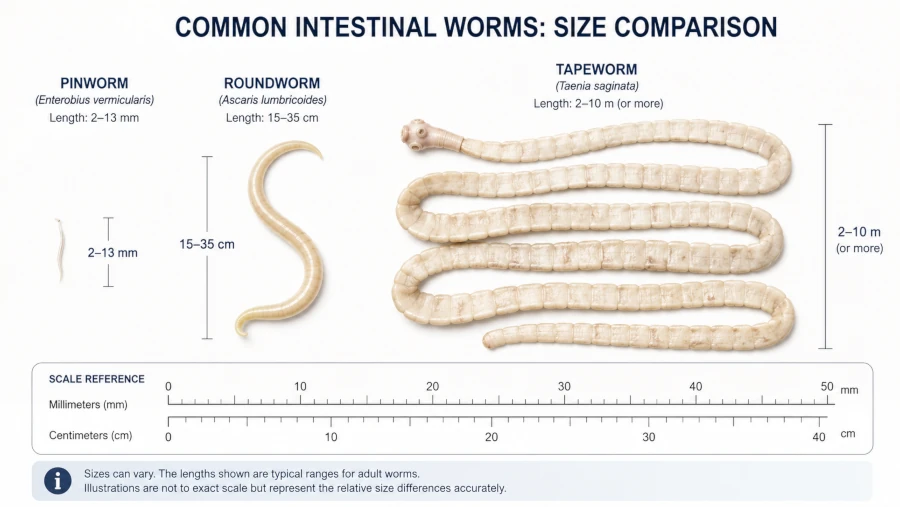
The worms people most often pick up are pinworms (Enterobius vermicularis), large roundworms (Ascaris), tapeworms (Taenia), and hookworms. Pinworm is by far the most common in the United States; the CDC estimates that up to half of children get it at some point (CDC, 2024). The classic signs are itching around the anus, especially at night, restless sleep, and sometimes thin white threads near the bottom or in the stool. Roundworm and hookworm can cause belly pain, nausea, poor appetite, or fatigue. A tapeworm sometimes announces itself when flat, ribbon-like segments turn up in the toilet.
Here’s why guessing matters. Most “I think I have parasites” worry turns out to be something else, and the few real infections are easy to pin down with a simple test. For pinworm that’s the “tape test” — pressing clear tape to the skin around the anus first thing in the morning so a lab can check for eggs (Mayo Clinic, 2024). Other worms show up on a stool ova-and-parasite exam. A confirmed diagnosis tells you which worm you have, and that matters: no single herb — and no single drug — works on all of them.
The proven baseline: what clears worms reliably
It’s worth knowing what you’re comparing herbs against, because the bar is high. The standard treatments — albendazole, mebendazole, and pyrantel pamoate — are cheap, usually taken as a single dose (repeated two weeks later to catch newly hatched worms), and highly effective (CDC, 2024; Mayo Clinic, 2024). Albendazole is the drug of choice for hookworm, Ascaris, and pinworm (Hong & Lee, 2018). Pyrantel pamoate is sold over the counter in the US. Side effects are usually mild and short-lived.
That track record is why most clinicians treat confirmed worms with medication first. It’s also the fair yardstick for any antiparasitic herb: not “does it do something?” but “does it clear the infection as safely and reliably as a tablet that costs a few dollars?”
Herbs and foods with genuine evidence
A few plants have earned a real place in this conversation. None is a proven cure on the level of prescription medication, but the evidence here is more than folklore.
Pumpkin seeds
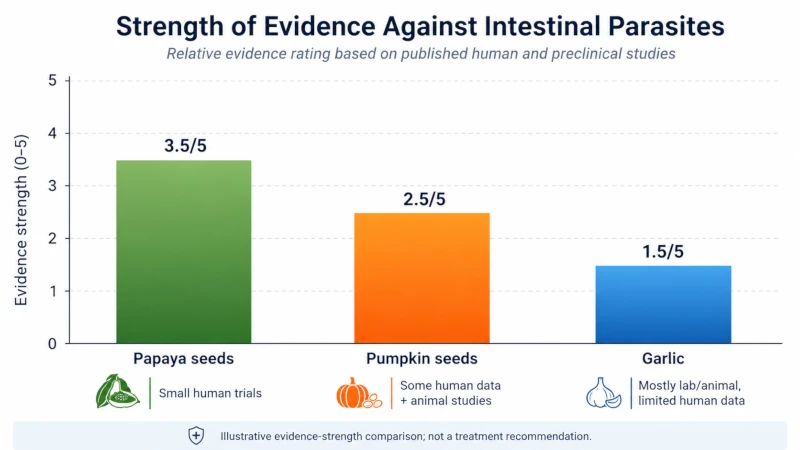
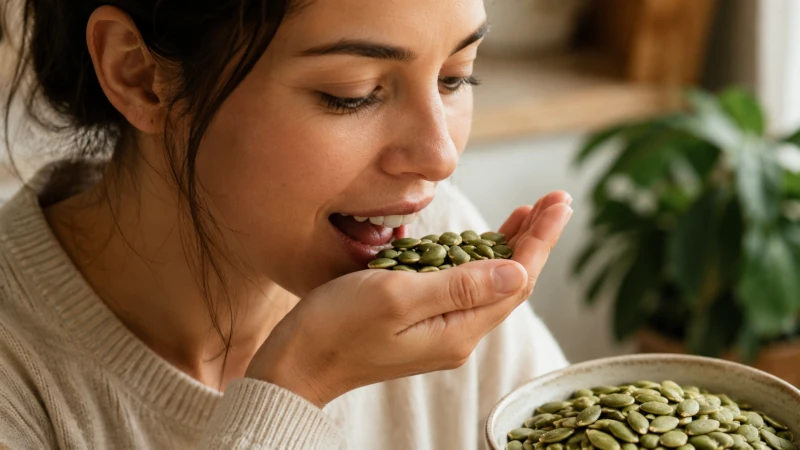
Pumpkin (Cucurbita) seeds are the strongest entry on this list. They contain cucurbitin, a compound that appears to paralyze worms so they lose their grip on the intestinal wall and pass out of the body — most relevant for tapeworm. In a community study in Sichuan, China, people with confirmed tapeworm who took pumpkin seeds passed whole worms in roughly three-quarters of cases, rising to about 89% when the seeds were combined with areca-nut extract (Li et al., 2012). Most of the rest of the evidence is from animal studies, so the picture for roundworms is promising but unsettled.
The practical version: the raw, unprocessed seeds (the thin green coating holds most of the cucurbitin) are the form that was studied — not the salted, roasted snack. Pumpkin seeds are nutritious and low-risk to try, but for a confirmed tapeworm they belong alongside medical care, not instead of it.
Papaya seeds
Dried papaya (Carica papaya) seeds have a small but real human signal. In a pilot study of 60 Nigerian children with intestinal parasites, about 77% of those given a dose of dried papaya seeds in honey cleared their stool of parasites within a week, versus 17% on honey alone (Okeniyi et al., 2007). The seeds contain benzyl isothiocyanate and the enzyme papain, both of which show anti-worm activity in the lab. It’s a promising, low-cost idea — but it’s one small pilot, and as Cleveland Clinic specialists note, results like these shouldn’t be stretched into general at-home treatment without larger trials (Cleveland Clinic, 2021).
Garlic and other kitchen plants
Garlic (Allium sativum) reliably kills a range of parasites in test tubes and animals, largely thanks to allicin (garlic antiparasitic review, 2018). Human evidence is thin, and there’s a real catch: allicin breaks down quickly and is poorly absorbed, so the concentrations that work in a lab dish may never reach the worms in your gut. Eaten as food, garlic is safe for most people and worth including, but treat strong antiparasitic claims with skepticism. (If you take blood thinners, large amounts of garlic can add to their effect.) Onion, from the same family, and pomegranate rind carry similar traditional reputations and similarly limited human data.
Evidence at a glance:
| Herb / food | Strength of evidence | Mainly studied against | What to realistically expect |
| Pumpkin seeds | One human study + animal data | Tapeworm (some roundworm) | Best-supported option; pairs with medical care, not a standalone cure |
| Papaya seeds | One small pilot in children | Roundworm (Ascaris, Strongyloides) | Promising but preliminary; needs larger trials |
| Garlic | Lab + animal; limited human | Protozoa and some worms | Safe as food; antiparasitic claims overstated |
| Onion, pomegranate | Traditional; little human data | Various | Low-risk as food; don’t rely on them |
| Thyme, tamarind, quassia, bilberry | Traditional; no solid human trials | Various | Generally mild; not a treatment for real infection |
Traditional remedies that lack good human evidence
Plenty of plants appear on every “herbs that kill parasites” list because they’ve been used for centuries, not because they’ve been tested in people: thyme, tarragon, tamarind leaf, quassia, carline thistle, and bilberry among them. Some show anti-worm activity in the lab; none has solid human-trial evidence for clearing an intestinal infection. As foods or mild teas they’re generally low-risk, but leaning on them to treat a real infection — especially in a child — lets a treatable problem drag on. One specific caution: skip the old “three days of nothing but milk and bilberries” cure for children. A restrictive mono-diet isn’t a safe way to treat a sick child, and nothing solid backs it.
The herbs to avoid — some of these can seriously hurt you
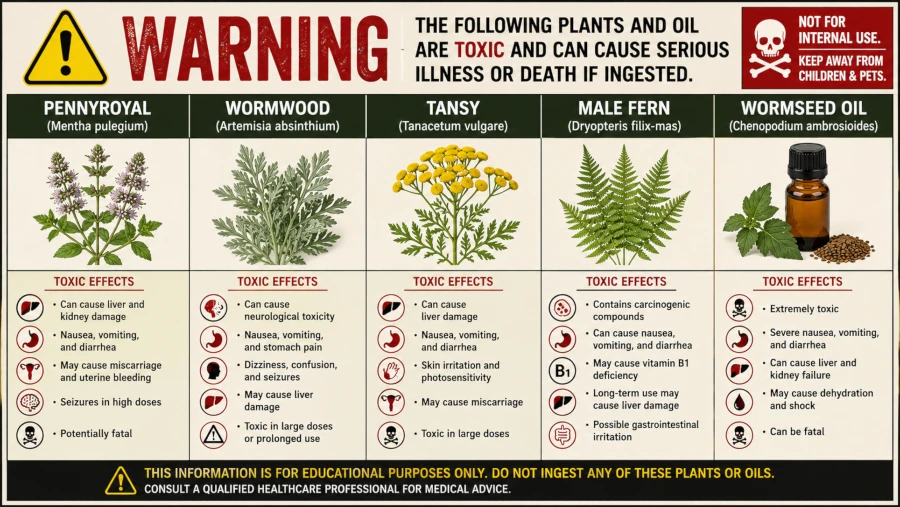
This is the part most “natural parasite cleanse” articles skip, and it’s the most important. Several traditional vermifuges are toxic, and people have died using them. “Natural” does not mean safe — some of the most dangerous poisons known are plant compounds.
Pennyroyal. Pennyroyal, and especially its oil, is genuinely dangerous. Its main compound, pulegone, is converted in the body into a toxin that destroys liver tissue much the way an acetaminophen overdose does. Documented cases include liver and kidney failure, seizures, and death, and infants given pennyroyal tea have died of multi-organ failure (LiverTox, 2020; Poison Control; MSKCC). There is no safe self-treatment dose. Never give it to a child, and never use it in pregnancy.
Wormwood and tansy. Both are high in thujone, a neurotoxin and convulsant; fatal poisonings from oil of tansy are on record (ScienceDirect: Artemisia / thujone).
Male fern. The rhizome was a historical tapeworm remedy, but older pharmacology texts call it a “violent poison” for good reason: absorbed in any quantity it can damage the optic nerve and cause permanent blindness, along with seizures and, rarely, death. Its absorption jumps when it’s taken with oils or fats — exactly the trap in old recipes that paired it with a castor-oil laxative (ScienceDirect: Dryopteris filix-mas).
Wormseed oil (epazote / chenopodium). The essential oil is loaded with ascaridole and, in the words of a JAMA report, “can give rise to alarming toxic symptoms and death, even when given in therapeutic doses”; children have died from it (JAMA; ScienceDirect: Chenopodium).
Mugwort and lavender cotton (santolina) round out the list of traditional vermifuges better left alone — mugwort can stimulate the uterus, and santolina carries its own toxicity.
| Herb | Documented harm | Bottom line |
| Pennyroyal | Liver and kidney failure, seizures, death; infant deaths from the tea | Never ingest; never give to children or in pregnancy |
| Wormwood, tansy | Thujone is a neurotoxin and convulsant; fatal tansy-oil poisonings on record | Avoid as a worm remedy |
| Male fern | Optic-nerve damage and permanent blindness; worse when taken with oils/fats | Obsolete and dangerous; do not use |
| Wormseed oil (epazote / chenopodium) | Ascaridole poisoning; deaths even at “therapeutic” doses, including children | Avoid the oil entirely |
| Mugwort, lavender cotton (santolina) | Uterine stimulation; santolina toxicity | Leave alone, especially in pregnancy |
The throughline: a remedy strong enough to paralyze or kill a worm can often harm you too, and these particular plants cross that line. The safe choices are the food-grade ones above and, for a confirmed infection, pharmacy or prescription medication.
Extra caution for children and during pregnancy
Children are both the most likely to get worms and the most vulnerable to toxic remedies — their smaller size means a “small” amount of a poisonous herb is proportionally large. Pinworm in particular is so easily and safely treated that there’s little reason to experiment. Talk to a pediatrician; pyrantel is available without a prescription, and pediatric dosing is well established.
Pregnancy and breastfeeding raise the stakes further. Several traditional antiparasitics — pennyroyal, wormwood, tansy, mugwort — were used historically to provoke contractions or abortion, which tells you plainly they can affect a pregnancy. Avoid all of them if you’re pregnant or trying to be, and have any suspected infection managed by your doctor, who can pick a treatment appropriate for your trimester.
When to stop self-treating and see a doctor
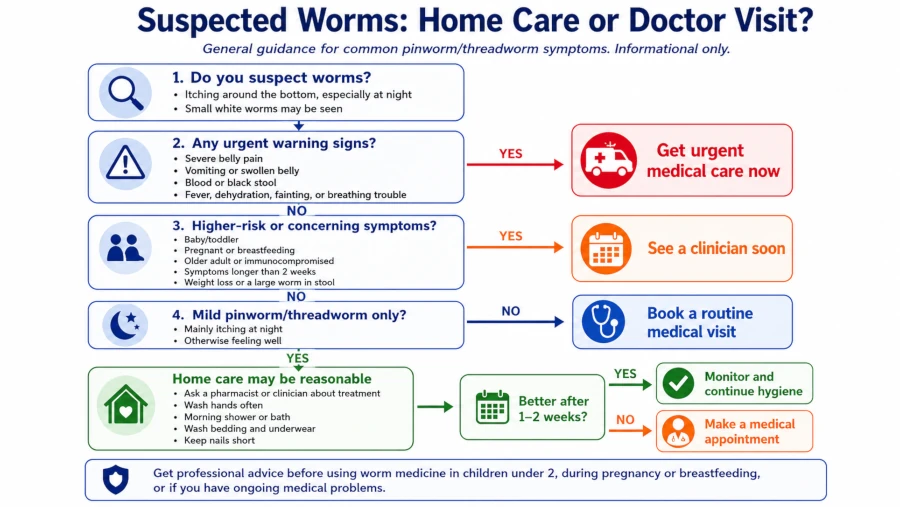
Reach out to a healthcare professional — rather than reaching for more herbs — if any of these apply:
- You can see worms or worm segments in the stool, or symptoms last more than a week or two.
- There’s belly pain, vomiting, blood in the stool, or unexplained weight loss.
- The affected person is a young child, pregnant, elderly, or has a weakened immune system.
- Itching and reinfection keep cycling through the household despite good hygiene.
Seek urgent care for severe abdominal pain, persistent vomiting, signs of dehydration, or — after taking any herbal remedy — confusion, seizures, yellowing of the skin or eyes, or a drop in how much urine you’re passing. Those last few can signal the liver or nervous-system toxicity described above and need emergency attention.
A stool test costs little, settles whether you have a parasite at all, and points to the treatment most likely to work. That’s almost always a better first move than a cleanse.
| Health Disclaimer: This article is for general education and is not a substitute for professional medical advice, diagnosis, or treatment. Intestinal parasites should be confirmed and treated under the guidance of a qualified healthcare professional. Do not use herbal remedies to self-treat a suspected infection in a child, during pregnancy or breastfeeding, or if you have liver, kidney, or other chronic health conditions, without first speaking to your doctor. Several herbs once used against worms are toxic and have caused serious harm. If you or your child develops severe abdominal pain, persistent vomiting, confusion, seizures, yellowing of the skin or eyes, or reduced urination after taking any herbal product, seek emergency care immediately. |
Frequently Asked Questions
Can herbs alone cure a parasitic infection?
Usually not reliably. Pumpkin and papaya seeds have some human evidence, but no herb matches the cure rates of standard antiparasitic medication, which is cheap and safe. Herbs are best viewed as a supportive add-on to a confirmed diagnosis and proper treatment.
Are pumpkin seeds really effective against tapeworms?
They have the best evidence of any food on this list. A human study found that raw pumpkin seeds helped people pass tapeworms, especially when combined with areca-nut extract. They’re a reasonable, low-risk complement, but a confirmed tapeworm still warrants medical care because incomplete treatment can let the worm regrow.
Do I need a “parasite cleanse” for general health?
No. There’s no good evidence that routine cleanses remove hidden parasites or improve health in people without an infection, and some cleanse herbs are harmful. If you have symptoms, get tested instead of guessing.
Which antiparasitic herbs are dangerous?
Pennyroyal, wormwood, tansy, male fern, and wormseed oil (epazote/chenopodium) are the main ones to avoid. All have caused serious poisonings, and several have been linked to deaths, including in children.
References
- Centers for Disease Control and Prevention. Clinical Overview of Pinworm Infection. 2024. View source
- Mayo Clinic. Pinworm infection — Diagnosis & treatment. 2024. View source
- Hong ST, Lee SH, et al. Treatment options and considerations for intestinal helminthic infections. J Pharm Pract. 2018 (PMC5990147). View source
- Li T, Ito A, Chen X, et al. Usefulness of pumpkin seeds combined with areca nut extract in community-based treatment of human taeniasis in northwest Sichuan Province, China. Acta Tropica. 2012;124(2):152–157. View source
- Okeniyi JAO, Ogunlesi TA, Oyelami OA, Adeyemi LA. Effectiveness of dried Carica papaya seeds against human intestinal parasitosis: a pilot study. J Med Food. 2007;10(1):194–196. View source
- Cleveland Clinic. Do papaya seeds get rid of intestinal parasites? 2021. View source
- Garlic and its effects on parasitic diseases / Antischistosomal activity of garlic and allicin (review and in-vivo data). 2018 (PMC5921551). View source
- LiverTox: Pennyroyal Oil. National Institute of Diabetes and Digestive and Kidney Diseases / NCBI Bookshelf. 2020. View source
- Poison Control (National Capital Poison Center). Pennyroyal oil: a potentially toxic folk remedy. View source
- Memorial Sloan Kettering Cancer Center. Pennyroyal — Integrative Medicine herb monograph. View source
- JAMA. Poisoning due to oil of chenopodium (American wormseed oil). View source
- ScienceDirect Topics. Dryopteris filix-mas (male fern) — toxicity and optic-nerve damage. View source
- ScienceDirect Topics. Chenopodium ambrosioides (American wormseed) — ascaridole toxicity. View source
- ScienceDirect Topics. Artemisia / thujone toxicity (wormwood, tansy). View source
