
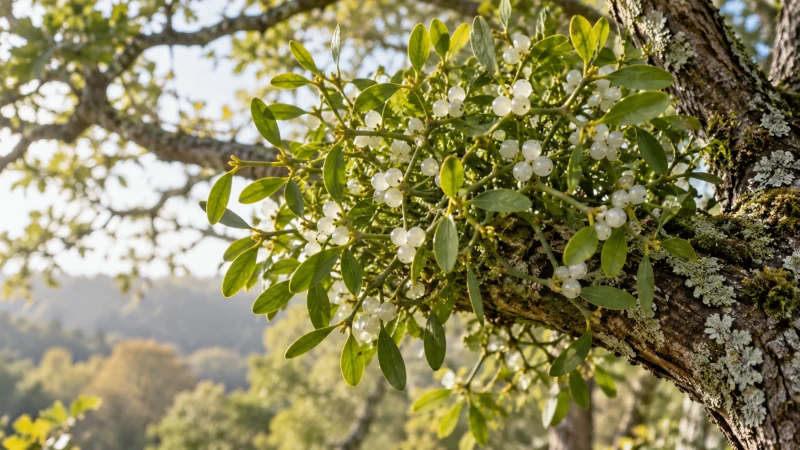
Here’s the honest answer before you scroll: the one use of mistletoe with real research behind it isn’t a tea or a capsule you’d brew at home — it’s a standardized prescription extract, given by injection, used mainly in parts of Europe alongside conventional cancer treatment. And even there, the results are genuinely mixed. When people search for mistletoe plant health benefits, they usually find century-old folk claims about blood pressure, “purifying” the blood, and shrinking tumors. Most of those claims don’t hold up to modern evidence, and one piece of traditional advice — brewing the leaves into a tea — is the exact thing that has caused the rare serious poisonings.
None of that makes mistletoe uninteresting. It’s one of the most studied complementary therapies in cancer care [NCI, 2023]. It just means the useful version of this article is the one that tells you where the evidence is real, where it’s thin, and where it’s actually risky.
European vs. American mistletoe plant — not the same plant
Two different plants share the name, and it matters. European mistletoe (Viscum album) is the one with a medicinal history and the one studied in cancer research. American mistletoe (Phoradendron) is mostly the sprig hung up at the holidays. Both are semiparasitic — they root into a host tree such as apple, oak, pine, or elm and draw water and nutrients from it [NCCIH, 2024]. They differ in chemistry and in how toxic they are, so advice about one doesn’t transfer cleanly to the other.
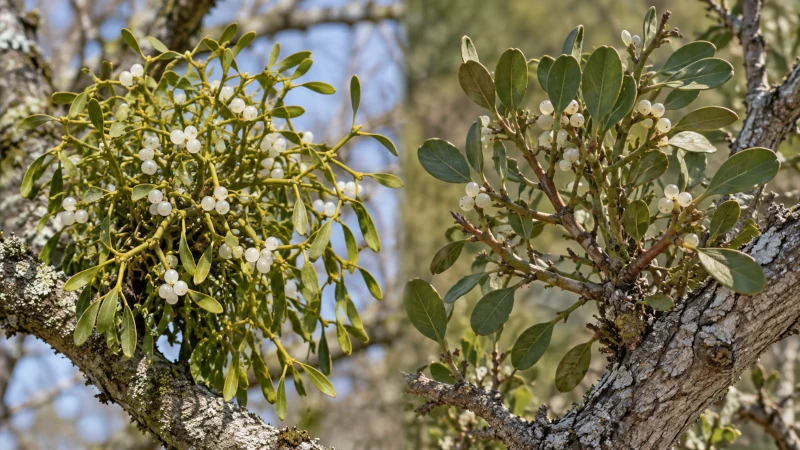
In Europe, Viscum album extracts (sold under names like Iscador, Helixor, and abnobaVISCUM) are among the most prescribed drugs for cancer patients. The approach was popularized in the 1920s by Rudolf Steiner and the anthroposophic medicine movement [MSKCC, 2026]. In the United States, injectable mistletoe is not available outside clinical trials, and the U.S. Food and Drug Administration has not approved mistletoe to treat cancer or any other condition [NCCIH, 2024].
What mistletoe is actually studied for: cancer
This is where nearly all the serious research sits — and where the honest grading matters most. Mistletoe is not a proven cancer treatment, and it should not be used as one outside of a clinical trial [NCCIH, 2024]. What’s studied is whether adding mistletoe alongside standard treatment helps people live longer, feel better, or tolerate chemotherapy and radiation more comfortably.

Where the evidence is promising but limited
Some larger studies have reported encouraging results. In early-stage breast cancer, adding mistletoe extract to standard treatment was linked to fewer adverse drug reactions, and a separate breast cancer study reported improved survival in the mistletoe group [NCI, 2023]. A retrospective colorectal cancer cohort found longer disease-free survival, fewer adverse events, and better symptom relief with long-term mistletoe as add-on therapy [NCI, 2023]. A 2013 randomized trial in advanced or metastatic pancreatic cancer reported improved survival for patients given mistletoe plus best supportive care versus supportive care alone [NCI, 2023]. Reviews from Memorial Sloan Kettering similarly note evidence that mistletoe may ease symptoms, improve quality of life, and reduce side effects of chemo- and radiotherapy [MSKCC, 2026].
Read those with the same caution the agencies use. Many mistletoe trials have real weaknesses — small numbers of patients, missing details about dosing, and design problems — which is why even positive findings can’t be treated as settled [NCI, 2023].
Where it’s mixed or shows no benefit
The picture flips in other cancers. Two randomized trials in non–small cell lung cancer found no quality-of-life difference between mistletoe and chemotherapy, and an older three-arm study found no difference in survival or tumor response [NCI, 2023]. A one-year randomized trial in melanoma found no increase in survival [NCI, 2023].
When the Cochrane Collaboration pooled the randomized evidence, its conclusion was blunt: there was not enough good-quality evidence to reach clear conclusions about whether mistletoe improves symptom control, tumor response, or survival [Cochrane, 2008]. MSK’s own summary reflects the same split — some studies suggest longer survival, others don’t, and large, rigorous trials are still needed [MSKCC, 2026].
What the lab and animal studies do (and don’t) tell you

You’ll see confident claims that mistletoe “kills cancer cells.” In the lab, that’s partly true: mistletoe contains lectins and viscotoxins that can be toxic to cells and can stimulate the immune system, and in animal models some extracts slow tumor growth [MSKCC, 2026]. That’s a reason to keep researching — not evidence that it works in people. Effects in a dish or a mouse routinely fail to translate to human benefit, which is exactly why the clinical trials above matter more than the mechanism.
Evidence at a glance
| Use | What’s claimed | Where the evidence stands |
| Cancer symptoms / quality of life (injected, add-on) | Less fatigue, better wellbeing, fewer treatment side effects | Promising but mixed — some supportive trials, many with design weaknesses [NCI, 2023] |
| Cancer survival (injected, add-on) | Living longer | Mixed / unproven — positive and null results; Cochrane found no clear conclusion [Cochrane, 2008] |
| Cancer cure (any form) | Cures or reverses cancer | Not supported — not FDA-approved; not a proven treatment [NCCIH, 2024] |
| Oral use for any condition | Teas, capsules for everyday health | Very little research — most studies are on injections, not oral use [NCCIH, 2024] |
| Blood pressure, headaches, epilepsy, arthritis | Traditional remedy | Traditional use only — long history, no solid human trials [NCI, 2023] [MSKCC, 2026] |
The traditional uses — blood pressure, headaches, and the rest
For centuries, European mistletoe was used for seizures, headaches, high blood pressure, menopausal symptoms, asthma, and arthritis [NCCIH, 2024]. That long history is why mistletoe still turns up on “natural remedy” lists today. But tradition isn’t proof, and here the modern evidence is essentially empty: very little research has looked at oral mistletoe for any of these uses [NCCIH, 2024].
Blood pressure is the one worth flagging, because it’s the claim most likely to lead someone to brew mistletoe at home. There’s no good human trial support for using mistletoe to treat hypertension, and it’s a plant that other careful reviewers put in the “avoid” column rather than the “try” column.
If lowering your blood pressure naturally is your goal, the herbs with actual randomized-trial support — and the ones to steer clear of — are covered in our guide to the best herbs for high blood pressure, and mistletoe’s traditional link to cerebral and coronary “hardening of the arteries” is addressed in our rundown of herbs that clean the arteries. The short version: skip mistletoe for both. For the traditional headache use, it’s worth knowing which types of headaches actually warrant a doctor rather than any home remedy.
Is mistletoe poisonous? The honest, two-sided answer
Mistletoe’s reputation cuts both ways, and getting this right protects you better than fear does.
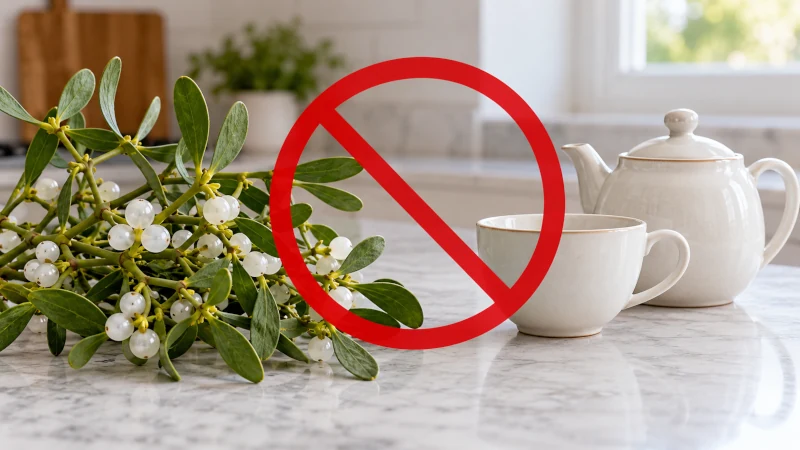
Don’t eat the berries or brew the plant. European mistletoe berries and leaves can cause serious harm taken by mouth, and eating raw mistletoe can bring on vomiting, seizures, a slowed heart rate, and — rarely — death [NCCIH, 2024] [MSKCC, 2026]. The documented fatalities from mistletoe are rare and have typically involved concentrated use, such as brewing the plant into tea [MSKCC, 2026]. That single fact is why this article does not repeat the old tea-and-infusion “recipe”: it points people toward the one preparation that has actually killed.
At the same time, an accidental nibble is usually not a disaster. American mistletoe (Phoradendron), the holiday kind, is far less dangerous than its reputation suggests. When poison-control specialists reviewed 1,754 exposures, the vast majority of people had no symptoms and there were no deaths — including those who swallowed it on purpose — and swallowing a small amount is not likely to cause serious poisoning [National Capital Poison Center]. So if a child pops a stray berry off a decoration, that’s a call to Poison Control, not a crisis. It is still true that mistletoe should never be used to decorate food, and berries and fallen leaves should be kept away from children and pets [National Capital Poison Center].
Side effects of the medical (injected) form
The prescription, injected extract has a different and generally milder safety profile than eating the plant. Reported side effects include soreness and inflammation at the injection site, headache, fever, chills, nausea, and fatigue; a few cases of severe allergic reactions, including anaphylaxis, have occurred [NCI, 2023] [NCCIH, 2024]. Most reactions are mild to moderate and dose-related [MSKCC, 2026].
Interactions, pregnancy, and who should avoid mistletoe
If you take any medication, talk to your healthcare provider before using mistletoe or any herbal product — some herbs and drugs interact in harmful ways [NCCIH, 2024]. In the lab, mistletoe inhibits the CYP3A4 enzyme that clears many medications, though this appears minimal at the doses used clinically; there’s also a published case of warfarin over-anticoagulation in a patient self-injecting mistletoe [MSKCC, 2026]. Anyone on a blood thinner, in particular, should not add mistletoe without medical guidance.
Avoid mistletoe if you are pregnant or breastfeeding. It’s probably unsafe in pregnancy — it can stimulate the uterus and may raise the risk of miscarriage — and little is known about its safety while nursing [NCCIH, 2024] [MSKCC, 2026]. More broadly, mistletoe is not something to self-administer: the researched form is a prescription drug given under supervision, and the home-brewed form is the risky one.
When to talk to a professional — and when it’s an emergency

If you have cancer and you’re drawn to mistletoe, the move is to raise it with your oncologist — not to order it online. Some complementary therapies interfere with standard treatment, and mistletoe should only be considered within a clinical trial or under a clinician who can monitor you [NCCIH, 2024] [NCI, 2023]. Never use it to replace treatment that works.
Seek urgent help in two situations. If someone swallows mistletoe and has symptoms — or if you’re unsure — contact Poison Control at 1-800-222-1222 (US) or use the online tool at poison.org; guidance is free, confidential, and available 24/7 [National Capital Poison Center]. And if anyone develops signs of a severe allergic reaction after a mistletoe injection — trouble breathing, swelling of the face or throat, hives, faintness — call 911, because anaphylaxis is a medical emergency [NCI, 2023].
What to actually do with all this
If you’re a generally healthy person hoping mistletoe tea will lower your blood pressure or “detox” your system, the evidence doesn’t support it and the safest choice is to skip it. If you’re facing cancer and want to explore mistletoe, there’s a legitimate conversation to have — but it belongs with your care team, using a standardized product, as a possible complement to treatment that’s proven to work, never a substitute. Mistletoe’s real story is a modest, still-uncertain supporting role, not a cure. Treating it that way is how you get whatever benefit the science might eventually confirm without taking on risk the science has already documented.
| Health Disclaimer This article is for general education and is not medical advice, diagnosis, or treatment. Mistletoe can have real effects and real interactions, and what’s appropriate for one person can be wrong for another. Do not start, stop, or change any supplement or medication based on this page alone. Never use mistletoe to replace conventional cancer care, and do not eat the plant or brew it as a tea. If you are pregnant or breastfeeding, take prescription drugs, or have a medical condition, talk with a qualified healthcare professional before using any herbal remedy. If you suspect mistletoe poisoning, call Poison Control at 1-800-222-1222 (US); for a severe allergic reaction, call 911. |
Frequently Asked Questions
Does mistletoe cure cancer?
No. Mistletoe is not a proven cancer treatment and is not FDA-approved for cancer or any condition. It’s studied mainly as an add-on to standard treatment in Europe, and even there the evidence on survival is mixed. It should never replace conventional care [NCCIH, 2024] [Cochrane, 2008].
Can I drink mistletoe tea for high blood pressure?
It’s not recommended. There’s no good human evidence that mistletoe treats high blood pressure, and brewing the plant into a concentrated tea is the very scenario linked to the rare serious poisonings [MSKCC, 2026] [National Capital Poison Center]. Better-studied options are covered in our best herbs for high blood pressure guide.
Is mistletoe poisonous if my child eats a berry?
American (holiday) mistletoe is much less toxic than its reputation — most accidental ingestions cause no symptoms, though stomach upset is possible. Still, keep it away from kids and pets, never use it on food, and if a child swallows any, call Poison Control at 1-800-222-1222 [National Capital Poison Center].
How is medicinal mistletoe actually given?
As a standardized extract, usually injected under the skin by a healthcare provider (less often into a vein, the chest cavity, or a tumor). Oral products exist as supplements, but almost all the research is on the injected form, and injections aren’t available in the US outside clinical trials [NCI, 2023] [MSKCC, 2026].
What are the side effects of mistletoe extract?
For the injected form: soreness or inflammation at the injection site, headache, fever, chills, nausea, and fatigue, with rare severe allergic reactions. Eating the raw plant is different and more dangerous — it can cause vomiting, seizures, and a slowed heart rate [NCI, 2023] [NCCIH, 2024].
Is mistletoe safe during pregnancy?
No. Mistletoe is probably unsafe in pregnancy because it can stimulate the uterus and may increase miscarriage risk, and its safety while breastfeeding isn’t known. Avoid it [NCCIH, 2024] [MSKCC, 2026].
References
- National Center for Complementary and Integrative Health (NCCIH). European Mistletoe: Usefulness and Safety. View source
- National Cancer Institute (NCI). Mistletoe Extracts (PDQ®) — Patient Version. Updated June 21, 2023. PMID: 26389415. View source
- Memorial Sloan Kettering Cancer Center. Mistletoe (European) — About Herbs. Updated July 16, 2026. View source
- Horneber MA, Bueschel G, Huber R, Linde K, Rostock M. Mistletoe therapy in oncology. Cochrane Database of Systematic Reviews. 2008;(2):CD003297. PMID: 18425885. View source
- National Capital Poison Center. Is mistletoe poisonous? poison.org. View source


