
If you have a box of senna tea or store-brand laxative tablets in your cabinet, you have probably met this plant already. Cassia angustifolia is Indian, or Tinnevelly, senna: a stimulant laxative that usually produces a bowel movement within 6 to 12 hours and is used in the U.S. for short-term relief of constipation [MedlinePlus, 2024]. Taken briefly and at label doses, Cassia angustifolia is one of the better-understood herbal medicines there is. Taken every day for months, it becomes a different story.

The short version: it works, it is for occasional use, and about a week is the ceiling unless a doctor tells you otherwise [NHS, 2026].
What Cassia angustifolia is
Botanists now file this shrub under the name *Senna alexandrina*; Cassia angustifolia (Indian or Tinnevelly senna) and Cassia senna, also called Cassia acutifolia (Alexandrian senna), are older names for the same medicinal plant [EMA, 2020]. It is native to North Africa and the Middle East and widely grown in India [LiverTox, 2020]. The dried leaflets and the flat pods are the parts used.
Its active compounds are anthraquinone glycosides called sennosides. Those are the same ingredients behind familiar brands such as Senokot, Ex-Lax and Fletcher’s Castoria [MedlinePlus, 2024].
Not every “senna” is this senna

Two look-alikes cause real confusion. Bladder senna (Colutea arborescens) is a different plant with toxic seeds and no standardized laxative action. Coffee senna (Cassia occidentalis) is more serious: LiverTox links it to outbreaks of severe liver, muscle and brain toxicity in children in northern India, plus a fatal adult case after two weeks of self-treatment with the leaves [LiverTox, 2020]. Buy senna as a labeled product that names the species and states its sennoside content, not as loose leaves of uncertain origin.
How senna works in your gut
Sennosides travel through your stomach and small intestine without being absorbed. In the colon, gut bacteria break them down into rhein anthrone, which irritates the bowel lining enough to set off stronger contractions. The same metabolites also reduce how much water and salt the colon pulls back out of stool, so what reaches the rectum is wetter and moves faster [LiverTox, 2020] [EMA, 2020].
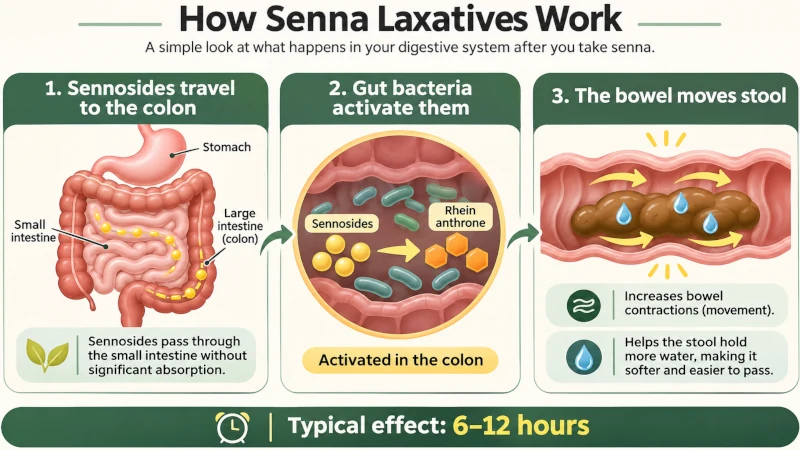
That bacterial step explains the timing. Nothing happens for several hours, which is why senna is usually taken at bedtime for a morning result [MedlinePlus, 2024].
Does Cassia angustifolia work? What the evidence says
For occasional constipation, yes — and this is the best-supported use of any herb on this site. Senna is an approved over-the-counter laxative in the U.S. [MedlinePlus, 2024], and European regulators classify senna leaf as a “well-established use” medicine, meaning at least 10 years of published evidence on effectiveness and safety. Their review included studies, mostly in older adults with long-term or severe constipation, in which senna combined with fiber worked at least as well as comparators such as lactulose [EMA, 2020].
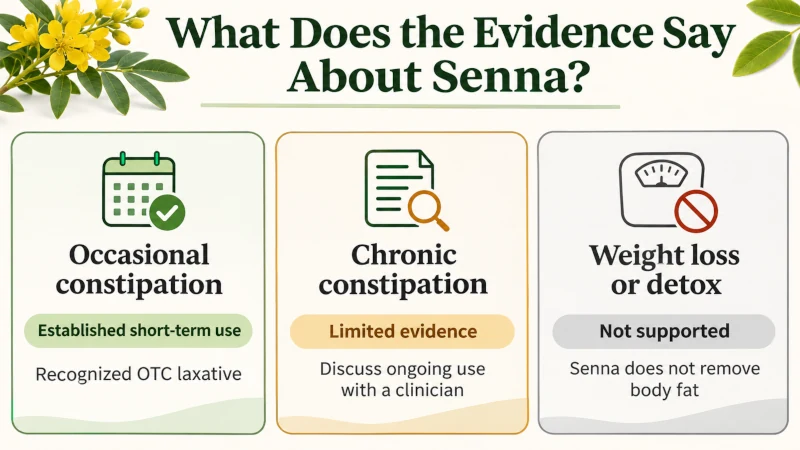
For chronic constipation, the evidence is thinner. The best trial is a 2021 double-blind study from Japan: 90 adults with chronic idiopathic constipation took senna (1.0 g), magnesium oxide (1.5 g) or a placebo for 28 days. Overall symptoms improved in 69.2% of the senna group versus 11.7% on placebo, bowel movements and quality of life improved too, and no one had a severe treatment-related side effect [Morishita et al., 2021]. It was small, short, and 93% of participants were women, so it shows senna can work for a month, not that it is safe for years.
U.S. gastroenterology guidelines reflect that. The 2023 joint AGA-ACG guideline gives senna a conditional recommendation based on low-certainty evidence, while polyethylene glycol, bisacodyl, sodium picosulfate and several prescription drugs received strong recommendations [Chang et al., 2023]. In practice, senna is a reasonable option for chronic constipation, not the default.
| Use | Evidence | What it means for you |
| Occasional constipation (short term) | Strong | Approved OTC use in the U.S.; well-established use in the EU. |
| Chronic idiopathic constipation | Limited (low certainty) | One good 4-week RCT; guideline support is conditional. Use under a doctor’s plan. |
| Bowel emptying before procedures | Established clinical use | Only as directed by your care team MedlinePlus, 2024. |
| Weight loss or “detox” | Not supported | Water and stool loss, not fat loss; a misuse pattern. |
| Worms, mouthwash, enemas | No evidence found | Not supported by any regulatory or clinical source reviewed. |
Some herbal sources also recommend senna to expel intestinal worms, as a mouthwash, or as a homemade enema. We found no clinical or regulatory support for any of those uses, and a home-brewed senna enema carries real risk with no demonstrated benefit.
How to use senna safely
Before reaching for any stimulant laxative, try the basics: more fiber, more fluids and regular activity. NIDDK advises using stimulants only when constipation is severe or other treatments have not worked [NIDDK, 2018]. Our guides to foods that help with constipation and psyllium cover the gentler first steps.
If you do use senna:
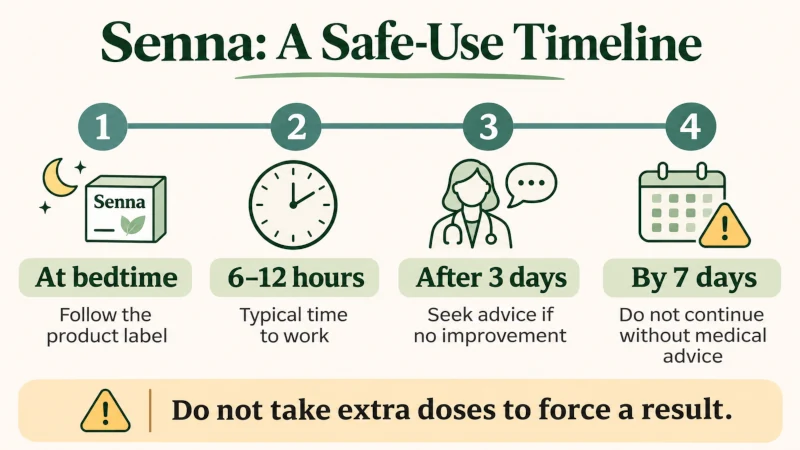
- Follow the label dose. Start at the lowest dose and increase only if needed [NHS, 2026]. LiverTox gives a typical range of 15 to 30 mg of sennosides and stresses short-term use [LiverTox, 2020].
- Take it at bedtime. Expect results in about 6 to 12 hours [MedlinePlus, 2024].
- Keep it short. Don’t use it for more than a week without talking to a doctor [MedlinePlus, 2024]. See a doctor if you are no better after 3 days [NHS, 2026]. Two or three doses a week is often enough [EMA, 2020].
- Don’t stack doses. If senna doesn’t produce a bowel movement, don’t take more; call your doctor [MedlinePlus, 2024].
- Space your medicines. Some senna products should be taken at least 2 hours before or after other oral medicines [MedlinePlus, 2024].
Senna tea vs. standardized tablets

Tea feels gentler, but it isn’t necessarily. European rules require licensed senna preparations to be standardized to a defined amount of anthraquinones [EMA, 2020]; a cup brewed from loose leaves has no such guarantee, and steeping time changes its strength. If you prefer tea, choose a labeled product and see our guide to teas for constipation for brewing and limits.
Side effects, from common to rare
Most side effects follow from how senna works. The common ones are stomach cramps, discomfort, nausea, diarrhea and faintness [MedlinePlus, 2024]. Your urine may turn yellow-brown or red-brown; that is harmless and stops when you stop taking senna [NHS, 2026].
Less often, things get serious. Stop and call your doctor right away if you notice rectal bleeding [MedlinePlus, 2024]. Frequent diarrhea over a long period can lower potassium, which shows up as muscle weakness, tiredness, peeing a lot or heart rhythm problems. An allergic reaction (swollen throat or tongue, itchy raised rash, trouble breathing) is an emergency [NHS, 2026].
Long-term or heavy use carries its own risks: the bowel can stop working properly on its own and become dependent on laxatives [EMA, 2020]. LiverTox describes “cathartic colon” (ongoing diarrhea, cramps and weight loss), electrolyte imbalance, and darkening of the colon lining [LiverTox, 2020]; EMA notes that the pigmentation usually fades after stopping [EMA, 2020].
Liver injury is rare. LiverTox rates senna a “possible rare cause” of clinically apparent liver injury, with most cases appearing after 3 to 5 months of high-dose use and resolving once the person stopped. One woman developed acute liver failure after drinking large amounts of senna tea for years. Anyone who had liver injury from senna should not restart it [LiverTox, 2020].
Medication interactions
The main concern is potassium. Because senna can lower potassium, it may not mix well with some heart medicines (for heart failure or heart rhythm problems), diuretics (“water pills”), steroids, or anything containing liquorice root [NHS, 2026]. MedlinePlus also flags mineral oil and asks you to tell your pharmacist about every prescription, supplement and herbal product you take [MedlinePlus, 2024]. A pharmacist can check your list in a few minutes.
Who should avoid senna or check first
European regulators say senna leaf must not be used if you have [EMA, 2020]:
- a bowel blockage or narrowing, or a bowel that has lost muscle tone
- appendicitis or unexplained abdominal pain
- Crohn’s disease or ulcerative colitis
- severe dehydration
NHS guidance adds caution for irritable bowel syndrome, diverticular disease, kidney or heart problems, and anyone who has reacted badly to a laxative before [NHS, 2026]. Children under 12 should only take senna if a doctor prescribes it [NHS, 2026] [EMA, 2020]. Adults 65 and older shouldn’t use senna long term without a doctor’s input [MedlinePlus, 2024].
If hemorrhoids or fissures are part of the picture, softer stool from fiber is usually the better long-term fix; our guide to herbs for hemorrhoids covers what helps.
Pregnancy and breastfeeding: sources disagree
This is a real split, not a settled question. The European Medicines Agency says senna leaf medicines must not be taken during pregnancy or while breastfeeding [EMA, 2020]. The UK’s NHS says you can usually take senna in pregnancy after speaking with a pharmacist or doctor, who may suggest diet changes or a different laxative first, and that it is fine while breastfeeding if your baby is at least a month old [NHS, 2026]. The U.S. LactMed database considers usual doses acceptable during breastfeeding [LactMed].
The practical takeaway: don’t self-start senna if you are pregnant or nursing. Ask your midwife, OB-GYN or pharmacist, who will usually try other options first.

When to stop and see a doctor
Self-care has limits. Get medical advice if you have:
- rectal bleeding (stop senna right away) [MedlinePlus, 2024]
- stomach pain, nausea, vomiting, or a sudden change in bowel habits lasting more than 2 weeks [MedlinePlus, 2024]
- no bowel movement after taking senna [MedlinePlus, 2024]
- no improvement after 3 days, or a need for senna beyond 7 days [NHS, 2026]
Call 911 for signs of a severe allergic reaction. For a suspected overdose, call Poison Control at 1-800-222-1222; call 911 if the person collapses, has a seizure, has trouble breathing or can’t be woken [MedlinePlus, 2024] [NHS, 2026].
| HEALTH DISCLAIMER: This article is for general education and is not medical advice, diagnosis or treatment. Senna is a medicine: it can cause side effects, lower potassium and interact with other drugs. Talk to a doctor or pharmacist before using it if you are pregnant or breastfeeding, giving it to a child, over 65, managing a chronic condition, or taking prescription medicines. Do not use senna for more than a week without medical advice, and seek prompt care for rectal bleeding, severe abdominal pain, vomiting or signs of an allergic reaction. |
Frequently Asked Questions
Is Cassia angustifolia the same as senna?
Yes. Cassia angustifolia is Indian (Tinnevelly) senna, now classified as Senna alexandrina along with Alexandrian senna [EMA, 2020]. It is the senna in most over-the-counter senna laxatives. Bladder senna and coffee senna are different plants.
How long does senna take to work?
Usually 6 to 12 hours, which is why most people take it at bedtime [MedlinePlus, 2024].
Can I take senna every day?
Not on your own. Use beyond a week should be discussed with a doctor, because frequent or continued use can make your bowels dependent on laxatives [MedlinePlus, 2024]. If you need help most days, a doctor can look for the cause and suggest options with stronger long-term evidence.
Is senna tea gentler than senna tablets?
Not reliably. Standardized products declare their sennoside content; homemade tea varies with the leaves and steeping time [EMA, 2020]. A labeled product makes dosing predictable.
Does senna help you lose weight?
No. LiverTox notes senna is sometimes added to “purging” and weight-loss teas, but long-term or heavy use is what leads to cathartic colon and electrolyte problems [LiverTox, 2020]. Any weight lost is water and stool.
Why is my urine darker when I take senna?
Senna can turn urine yellow-brown or red-brown. It is harmless and goes away when you stop [NHS, 2026]. Blood in the stool is different and needs a doctor.
References
- MedlinePlus (U.S. National Library of Medicine; AHFS). Senna. View source
- LiverTox: Clinical and Research Information on Drug-Induced Liver Injury. Senna. View source
- European Medicines Agency, Committee on Herbal Medicinal Products. View source
- National Institute of Diabetes and Digestive and Kidney Diseases. Treatment for Constipation. View source
- NHS. Senna. View source
- Morishita D, Tomita T, Mori S, Kimura T, Oshima T, Fukui H, Miwa H. View source
- Chang L, Chey WD, Imdad A, et al. American Gastroenterological Association-American College of Gastroenterology clinical practice guideline: pharmacological management of chronic idiopathic constipation. View source
- Drugs and Lactation Database (LactMed). Senna. National Institute of Child Health and Human Development. View source


