If you’ve come across water lily in an herbal remedy list, it’s probably filed under “calming” or, more specifically, as something used historically to lower sexual desire rather than raise it — the opposite of how most herbs get marketed. That reputation is centuries old and genuinely documented. What’s less clear, and what most pages on this plant skip past, is how much of that reputation modern science has actually confirmed.
Short version: there’s real history here, some interesting lab and animal research, and no human clinical trials. There’s also a real safety consideration that gets glossed over — this plant contains alkaloids that are not automatically gentle just because it looks pretty in a pond.
What Is the Water Lily Plant?
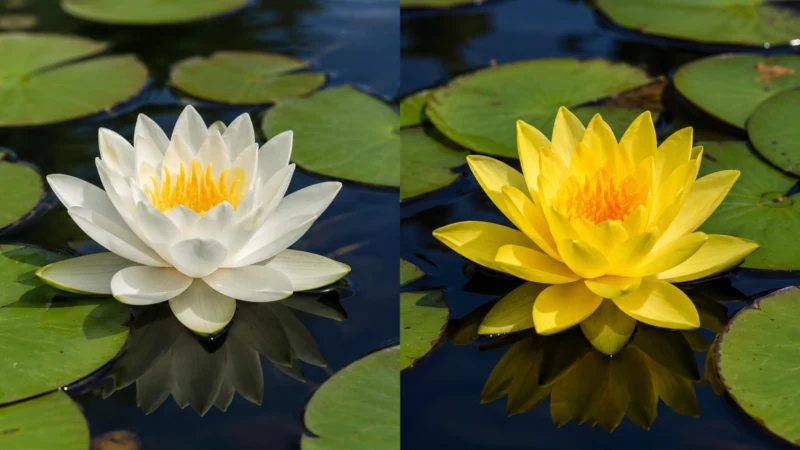
“Water lily” usually refers to one of two related plants in the water lily family, Nymphaeaceae:
- White water lily (Nymphaea alba), native across Europe to the western Himalaya and northwest Africa [Kew Plants of the World Online, 2026]
- Yellow water lily (Nuphar lutea), native from Europe to Siberia and northwest Africa [Kew Plants of the World Online, 2026]
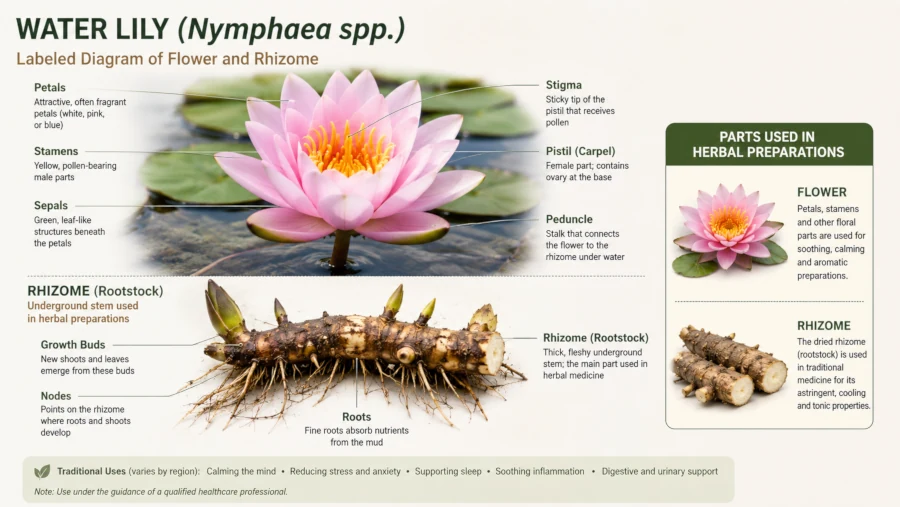
They’re different genera, not just color variants of the same plant, but herbalists have long grouped them together because their traditional uses and rough chemistry overlap. Both are rhizomatous aquatic plants — the flower and leaves float, while a thick rootstock anchors the plant in pond or riverbed mud. The flowers and rhizome are the parts used medicinally; both contain tannins and alkaloids, which is the chemistry behind most of what follows in this article, both the traditional reputation and the safety caveats.
A related plant worth mentioning up front: North American herbal databases sometimes describe “American white water lily,” which is actually a different species, Nymphaea odorata [RxList, 2021]. The traditional uses overlap loosely with European water lily, but it’s not the same plant, and research on one doesn’t automatically apply to the other.
The Traditional Story: A Calming, Libido-Dampening Herb
The most consistent thread running through old herbal texts is that water lily was used as a sedative and as what herbalists call an anaphrodisiac — something believed to reduce sexual desire, the reverse of what most “natural remedy” marketing promises today [RJPT, 2013]. Historical writers connected this to the plant’s habitat: something about a pale flower rising out of cold, still water seems to have suggested restraint to medieval and Renaissance herbalists, which is part of why water lily reportedly turns up in monastery garden records.
The clearest historical voice on this is Andrés de Laguna, a 16th-century Spanish physician and one of the more respected botanists of his era. Laguna wrote that water lily root, taken often enough, would dull sexual desire over time — a claim that has been passed down through Spanish herbal literature since [novadiet.es, 2025]. That’s a genuine historical record, not an invented one, though it’s worth being clear that it’s a 500-year-old opinion, not a clinical finding.
It’s also worth being honest that traditional accounts aren’t unanimous — some older herbal sources describe water lily’s effect as unpredictable rather than uniformly calming. Where a specific historical claim couldn’t be independently confirmed, it’s been left out of this article rather than repeated on faith.
If a genuinely calming herbal tea with more supporting human research is what you’re after, nervine herbs like chamomile, lemon balm, and passionflower have considerably more evidence behind them than water lily does.
What Modern Research Actually Shows
This is where the article needs to slow down, because “water lily has been studied” and “water lily has been studied in humans” are very different claims, and a lot of health content quietly blurs them.
Lab and animal findings on Nymphaea alba
Pharmacology reviews of Nymphaea alba describe laboratory and animal-model research into antioxidant, anti-inflammatory, hepatoprotective (liver-protective), antimicrobial, and anticonvulsant activity, largely attributed to the plant’s alkaloid, tannin, and flavonoid content [RJPT, 2013]. A separate review covering the plant’s use in Unani medicine lists similar preclinical findings — anti-inflammatory, antibacterial, and antioxidant effects observed in extracts tested on animals or in isolated cells, not in people [IJPDA, 2024].
That’s genuinely interesting groundwork. It is not the same thing as a treatment that’s been shown to work in a person drinking tea.
Nuphar lutea’s alkaloids in the lab
Yellow water lily contains a distinct family of alkaloids called thiobinupharidines. Research groups have tested purified compounds from these alkaloids against Leishmania parasites and against measles virus in cell cultures, with promising activity in both cases [PMC, 2024]. Again: cell-culture and animal research, aimed at identifying a drug candidate for future development — not evidence that the plant itself, prepared as tea, does anything comparable in a person.
You’ll sometimes see water lily credited with blood-sugar-lowering and liver-protective effects backed by “studies.” Those studies are real, but they were conducted on a different, related plant: Nymphaea stellata (also called star lotus or blue lotus), not the white or yellow water lily this article is mainly about. In alloxan-induced diabetic rats, extracts of Nymphaea stellata flowers lowered blood glucose and improved lipid markers compared to untreated animals, with a compound called nymphayol identified as the likely active ingredient [PubMed, 2008]. That’s a real and reasonably well-documented animal finding — for a different species. It’s a useful example of how “water lily” as a folk-medicine umbrella term can quietly borrow evidence from a plant that isn’t actually the one on your shelf.
Where the evidence actually stands
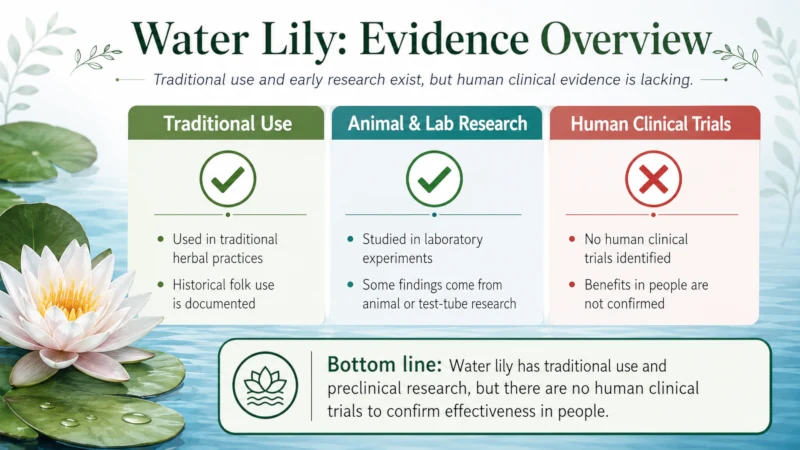
Put together, here’s an honest summary: strong traditional-use history, a handful of preclinical lab and animal studies on plant-specific alkaloids, and zero identified human clinical trials on Nymphaea alba or Nuphar lutea specifically. A major consumer drug-and-supplement reference rates the closely related American species as having “insufficient evidence to rate effectiveness” for any use, topical or oral [RxList, 2021]. That’s the most accurate one-line summary available for this plant today.
How Water Lily Has Traditionally Been Prepared
Historically, herbalists have prepared water lily as a hot-water infusion or decoction using the dried flowers or rhizome — the same general infusion and decoction methods used across herbal medicine, where flowers are typically steeped and tougher roots are simmered slightly longer to release their active compounds. Older herbal references describe roughly an ounce (about 30 g) of dried root per 10 ounces (about 300 mL) of water, taken up to a few times a day.
That description is offered here as a record of historical practice, not a recommendation. No regulatory body or clinical trial has established a safe or effective dose of water lily for any condition, and the plant’s alkaloid content means “traditional” doesn’t automatically mean “low-risk.” If you’re set on trying it, that’s a conversation for a healthcare provider or a qualified herbalist who can weigh your specific health history — not a fixed number from a 100-year-old recipe.
Safety, Side Effects, and Who Should Avoid It
This is the section that gets the least attention in most water lily content, and it shouldn’t.
- Toxicity risk with raw material or high doses. Both Nymphaea alba and Nuphar lutea rhizomes contain alkaloids and tannins described across herbal-safety sources as potentially toxic in large amounts, with nausea, vomiting, dizziness, and stomach upset reported [HerbaZest]. Raw, unprepared rhizome is considered higher-risk than a properly prepared, modest infusion.
- No established safe dosage. There simply isn’t reliable dose-ranging data for this plant [RxList, 2021].
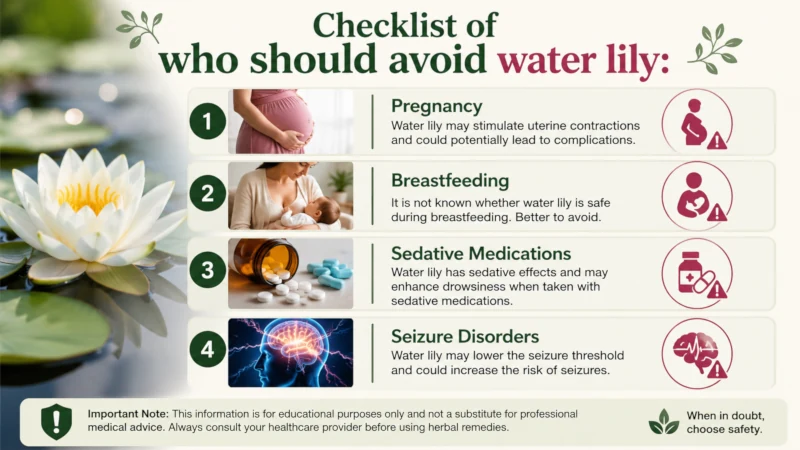
- Pregnancy and breastfeeding. Reliable safety information for use during pregnancy or breastfeeding does not exist for this plant; standard guidance is to avoid it entirely during these periods [RxList, 2021].
- Possible interaction with sedating medications. Historical herbal records caution against combining water lily with opioids, antidepressants, antipsychotics, or medications for dementia or Parkinson’s disease, and against use by people with seizure disorders — though modern research hasn’t specifically confirmed these interactions; the caution is inherited from traditional-use records, not clinical trial data [HerbaZest].
- Allergy. As with any botanical, an allergic reaction (skin irritation, itching) is possible on first exposure.
- General supplement caveat. In the United States, herbal supplements aren’t required to prove safety or effectiveness before reaching store shelves, and product quality can vary between brands — a good reason to talk to a pharmacist or doctor before adding any new herbal product, especially alongside other medications [NCCIH].
| HEALTH DISCLAIMER: This article is for educational purposes only and is not a substitute for professional medical advice, diagnosis, or treatment. Water lily (Nymphaea alba and Nuphar lutea) has not been evaluated by the FDA for safety or effectiveness, and no established safe dosage exists. Always talk to a qualified healthcare provider before using water lily or any herbal product — especially if you are pregnant, breastfeeding, managing a chronic condition, or taking prescription medication, including sedatives, antidepressants, or antipsychotics. |
When to Talk to a Doctor
Reach out to a healthcare provider before trying water lily if you’re pregnant, trying to become pregnant, or breastfeeding; if you take any CNS-active medication (sedatives, antidepressants, antipsychotics, Parkinson’s or dementia medications); or if you have a seizure disorder. If you’ve already taken water lily and experience persistent nausea, vomiting, dizziness, or an allergic reaction, stop use and contact a healthcare provider or, for a suspected poisoning, your local poison control center.
Frequently Asked Questions
Is the water lily plant safe to use as an herbal remedy?
There isn’t enough safety data to call it clearly safe or unsafe. Traditional use suggests modest, properly prepared infusions have a long history of use, but the plant’s alkaloid content means raw material or high doses carry real toxicity risk, and no dose-ranging studies exist [RxList, 2021].
What’s the actual difference between white water lily and yellow water lily?
Mainly the flower color and genus: white water lily is Nymphaea alba, yellow water lily is Nuphar lutea. They share a family (Nymphaeaceae), a rough chemical profile (alkaloids, tannins), and a similar traditional reputation, but they’re not the same plant [Kew Plants of the World Online, 2026].
Can water lily really lower blood sugar or protect the liver?
The blood-sugar research you’ll see cited was done on a related plant, Nymphaea stellata, in diabetic rats — not on Nymphaea alba or Nuphar lutea in humans [PubMed, 2008]. Liver-protective effects for Nymphaea alba have only been studied in animals as well [RJPT, 2013]. Neither claim has human evidence behind it yet.
Is water lily an aphrodisiac or the opposite?
Historically, the opposite — it’s one of the few herbs with a documented traditional reputation as an anaphrodisiac, something believed to reduce rather than boost libido [novadiet.es, 2025]. That’s a centuries-old belief, not a proven pharmacological effect.
Can pregnant or breastfeeding women use water lily?
No — this is one of the clearer safety points here. Reliable safety data for pregnancy and breastfeeding doesn’t exist for this plant, and the standard guidance is to avoid it during these periods [RxList, 2021].
Are water lily seeds (makhana) the same plant as water lily?
No. The popped “water lily seed” snacks sold as makhana or fox nuts come from Euryale ferox, a related but different genus in the same family. They’re a food product with a different safety and nutrition profile than the Nymphaea/Nuphar rhizome and flower preparations discussed in this article.
References
- Govaerts, R. et al. “Nymphaea alba L.” Plants of the World Online. Royal Botanic Gardens, Kew. 2026. View source
- Govaerts, R. et al. “Nuphar lutea (L.) Sm.” Plants of the World Online. Royal Botanic Gardens, Kew. 2026. View source
- “American White Water Lily.” RxList. Internet Brands / WebMD Network. 2021. View source
- “Using Dietary Supplements Wisely.” National Center for Complementary and Integrative Health, National Institutes of Health. View source
- “Water Lily.” HerbaZest. View source
- “Anti-Leishmania major Properties of Nuphar lutea (Yellow Water Lily) Leaf Extracts and Purified 6,6′-Dihydroxythiobinupharidine (DTBN).” Pathogens. 2024. View source
- Lakshmi, T., Madhusudhanan, N., Rajendran, R. “Nymphaea alba Linn – An Overview.” Research Journal of Pharmacy and Technology 6(9), 2013: 974–977. View source
- “A Comprehensive Review on Nilofar (Nymphaea alba Linn): Unani Perspectives and Therapeutic Potentials.” International Journal of Pharmaceutics and Drug Analysis. 2024. View source
- Sasikala, K. et al. “Antihyperglycaemic and Antihyperlipidaemic Effects of Nymphaea stellata in Alloxan-Induced Diabetic Rats.” 2008. View source
- “Alimentos Afrodisíacos y Anafrodisíacos a lo Largo de la Historia.” novadiet.es. 2025. View source
- “Andrés Laguna.” Wikipedia. 2026. View source
