
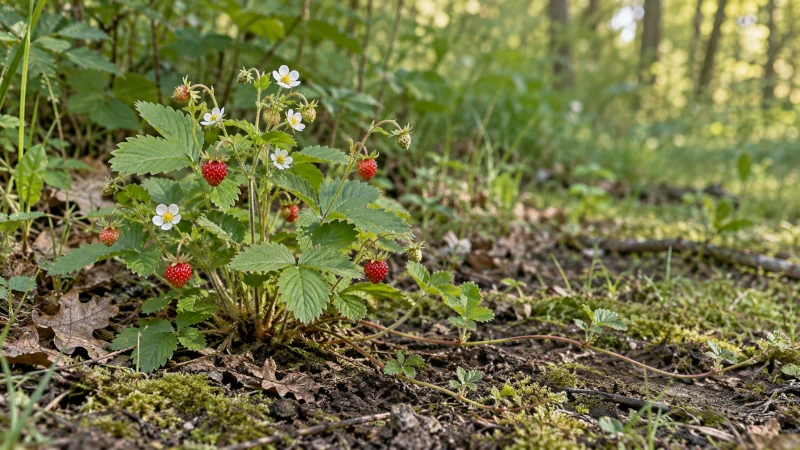
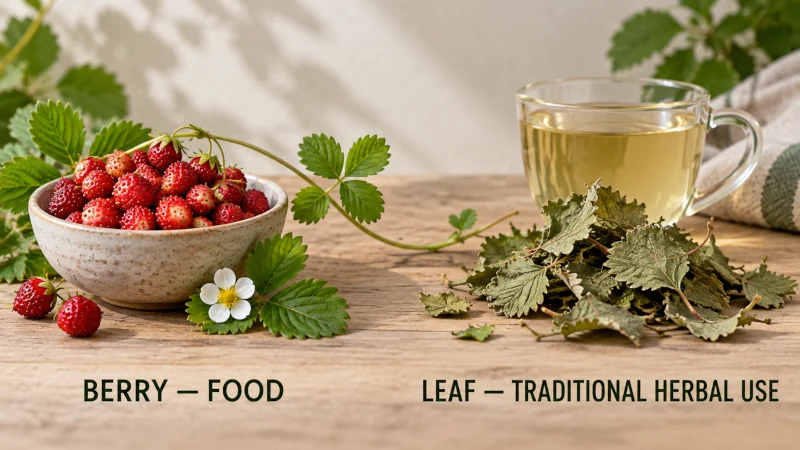
Two quite different products come off the same plant. The berry is food — good food, with more vitamin C by weight than most fruit, and nothing mysterious about it. The leaf is a herbal medicine, and it is the part European regulators have actually sat down and assessed. They approved it for two narrow uses, on the strength of long tradition rather than clinical trials (EMA, 2018).
The wild strawberry plant also carries a fair amount of old herbal advice that has aged badly. Two pieces in particular turn up again and again and should not: a three-day berry-only fast taken without water, and a home method for “curing” strawberry allergy by holding a piece of fruit under your tongue each day. The first is dangerous. The second is how you provoke the reaction you were trying to prevent.
Below is what the plant is, what the leaf is licensed for and at what dose, which traditional claims survive checking, and where the safety limits sit.
What the wild strawberry plant actually is
Fragaria vesca is a low perennial herb in the rose family, Rosaceae, spreading by above-ground runners. It has bright green leaves in threes with toothed edges, five rounded white petals, and small red “fruits.” Its native range runs across Europe to Siberia and Xinjiang, through Macaronesia, and from North America down to Guatemala; it grows in grassland, open woodland and forest edges, often on dry, stony, lime-rich ground (Kew, 2026).
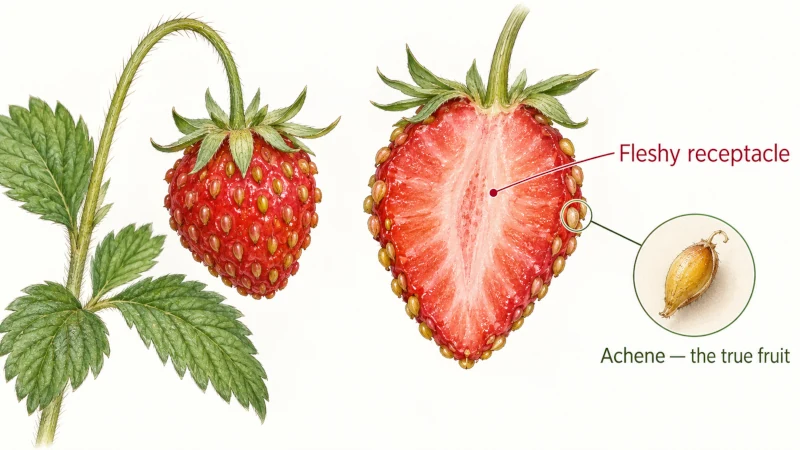
The botany matters for one reason that trips up almost every herbal write-up. The red fleshy part is not the fruit. It is receptacle tissue, and the pips studding its surface are the true fruits (Kew, 2026). So when an older text says “the actual fruits are the grains that stick to the surface,” it is right — and that is the only place the distinction changes anything practical.
Kew records the plant’s traditional medicinal use as a laxative and diuretic, and notes plainly that fruits and leaves can affect the skin, gut or airways in some people (Kew, 2026). That caution is already in the botanical record, before you reach the clinical literature.
One historical note worth keeping, because it is honest about what it is: Carl Linnaeus, the Swedish botanist, wrote that a diet built around wild strawberries relieved his gout. That is an eighteenth-century self-report by a single person. It is a nice story and it is not evidence, and the section on gout below explains why.
The berry: ordinary, excellent food
Detailed nutrient analysis exists for the cultivated strawberry (Fragaria × ananassa), not for wild-gathered F. vesca, so treat the numbers below as the closest good estimate rather than a measurement of the berries in your hand. Half a cup of sliced raw strawberries supplies about 27 calories, 6.4 g of carbohydrate, 1.7 g of fibre, 48.8 mg of vitamin C, 13 mg of calcium and 0.34 mg of iron (USDA FoodData Central, via California Dept. of Education, 2025).
That vitamin C figure is the genuinely impressive one. Adult requirements are 90 mg a day for men and 75 mg for women, rising to 85 mg in pregnancy and 120 mg while breastfeeding, with an extra 35 mg for people who smoke (NIH Office of Dietary Supplements, 2021). Half a cup gets most people past the halfway mark in one go.
Vitamin C does three things worth naming. It acts as an antioxidant, the body needs it to make collagen for wound healing, and it improves absorption of iron from plant foods (NIH ODS, 2021). That last one is the sensible version of the old “recommended for anaemia” claim: strawberries alongside beans, lentils or greens help you absorb the iron in that meal. They are not themselves a meaningful iron source, and they do not treat anaemia. If your energy is low, the first step is a blood test, not a fruit — our guide to what actually helps your blood goes through why.
The fibre is the same story in miniature. Adults need 22 to 34 g a day depending on age and sex, and berries are named among the good fruit sources (NIDDK, 2018). At 1.7 g per half cup, strawberries contribute. They are not a laxative, and the mucilage explanation older texts give for their supposed laxative action belongs to a different plant family altogether — see how that mechanism really works in marshmallow root, where it has been assessed properly.
The leaf: what Europe’s regulator approved, and what it didn’t
This is the part most pages about the wild strawberry plant miss, and it is the most useful thing on this page. Wild strawberry leaf — Fragariae folium, covering F. vesca and three relatives — has a European Union herbal monograph, adopted by the EMA’s Committee on Herbal Medicinal Products in November 2018 (EMA/HMPC/432278/2015). Two indications were accepted, both as traditional herbal medicinal products:
- To increase urine output and flush the urinary tract, as an adjunct in minor urinary complaints.
- For symptomatic treatment of mild diarrhoea.
“Traditional use” is a specific regulatory category, and the distinction carries the whole section. It means there is not enough clinical trial evidence to demonstrate effectiveness, but the effect is plausible and the preparation has been used safely for at least 30 years, including 15 within the EU. The committee stated outright that it found a lack of studies with strawberry leaf in patients (EMA, 2018). The astringency is attributed to tannin content, and even that link is inferred rather than demonstrated.
The doses regulators actually specify
| Use | Preparation | Amount | Frequency | Stop and get advice if |
| Minor urinary complaints (flushing) | Decoction of comminuted leaf in 200 ml water | 4–8 g total | Divided into 2–4 doses daily | Symptoms persist beyond 2 weeks |
| Mild diarrhoea | Infusion of comminuted leaf in 200 ml boiling water | 1 g per cup | 2–3 times daily | Symptoms persist beyond 3 days |
| Under 12 years | — | Not recommended | — | — |
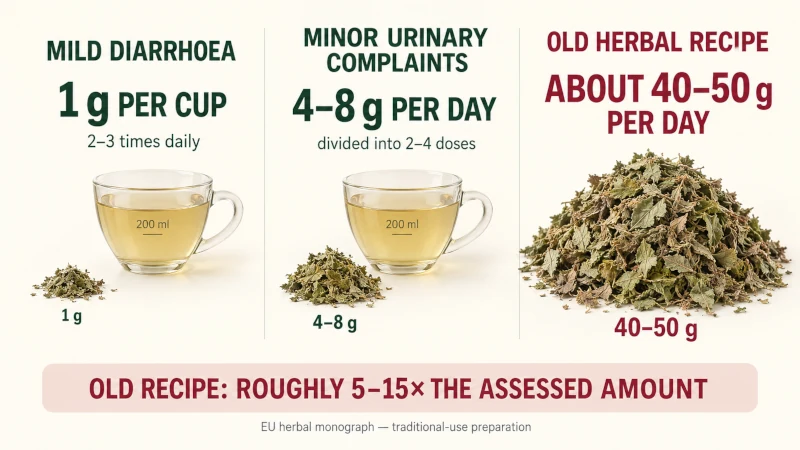
Source: EU herbal monograph on Fragaria vesca L. and related species, folium, EMA/HMPC/432278/2015, 20 November 2018.
Compare that with the recipe still circulating in older herbals — 40 to 50 grams of leaf per litre, four or five cups a day. Work the arithmetic: four or five 200 ml cups is close to a litre, so that is roughly 40 to 50 g of leaf daily. The monograph’s ceiling is 8 g for the urinary indication and about 3 g for diarrhoea. The traditional recipe is somewhere between five and fifteen times the assessed dose, depending on which use you have in mind. No safety data supports drinking it at that strength, and the monograph explicitly notes that reproductive toxicity, genotoxicity and carcinogenicity testing has never been performed on this material at all.
The monograph also does not cover gargles, mouth rinses, compresses, or anything applied to the skin. Those uses appear in folk records, but they were not assessed and no dose was set for them. If you use the leaf that way, you are outside the evidence, and you should know that rather than assume a regulator signed off on it.
Wild strawberry plant claims that don’t survive checking
| Traditional claim | Strength of evidence | What to realistically expect |
| Leaf tea flushes the urinary tract | Traditional use only; no patient studies | More urine. Not treatment for an infection. |
| Leaf tea eases mild diarrhoea | Traditional use only; no patient studies | Possibly firmer stools for a day or two. |
| Berries supply vitamin C | Strong — established nutrient composition | Half a cup covers over half an adult’s daily need. |
| Berries help with anaemia | Strong for the mechanism, none for treating anaemia | Better absorption of plant iron eaten in the same meal. |
| Berries dissolve uric acid / treat gout | Mixed and weak | No reliable effect on gout. |
| Salicylates make berries anti-inflammatory “like aspirin” | Contradicted | Dietary salicylate intake is far below a low-dose aspirin. |
| Berries are depurative and cleanse the blood | None — the premise is wrong | Your liver and kidneys already do this. |
| Poultices heal stretch marks and chilblains | None — traditional only | Cosmetic at best. |
| Three-day berry-only “cure” | None, and it carries real risk | Don’t. |
Gout and uric acid
The old claim is that strawberries are alkalising and depurative, eliminating the uric acid that inflames joints. The modern evidence does not settle where the older texts assumed it would, and the honest answer is that authorities disagree about the vitamin C part of it.
Most epidemiological studies find that higher vitamin C intake tracks with lower serum uric acid, and reports from laboratory and animal work are consistent with a physiological link. But the interventional evidence is thin, and it does not establish a benefit for preventing gout or its recurrence (Brzezińska et al., Nutrients, 2021). A large analysis of American adults similarly found dietary vitamin C inversely associated with gout — and found no association at all for vitamin C from supplements (Zou et al., Frontiers in Immunology, 2024).
The American College of Rheumatology reviewed this and concluded that the data on vitamin C were insufficient to support recommending it. Its 2020 gout guideline conditionally recommends against adding vitamin C supplements, regardless of disease activity (FitzGerald et al., Arthritis Care & Research, 2020).
Read those together and the picture is coherent rather than contradictory. Eating fruit is associated with lower urate. Taking vitamin C pills is not a gout treatment. Strawberries are a reasonable part of the first thing. Linnaeus’s gout may well have improved during a period when he was eating differently overall — that is not the same as the berries doing it.
Salicylates are not aspirin
Strawberries do contain salicylates, and older texts leap from that to “anti-inflammatory, like aspirin.” The leap does not hold. When researchers measured salicylate breakdown products in the urine of vegetarians, non-vegetarians, and people taking low-dose aspirin, vegetarians excreted more than non-vegetarians — confirming fruit and vegetables are a real dietary source — but significantly less than patients on a single 75 mg or 150 mg aspirin tablet. The authors concluded that bioavailable dietary salicylate intake is considerably lower than one low-dose aspirin (Lawrence et al., Journal of Clinical Pathology, 2003).
Eating strawberries is not a way to get an aspirin effect, and nobody should treat it as one — including anyone who has been told to take low-dose aspirin and is wondering whether fruit could stand in for it.
“Depurative” and “cleanses the blood”
Both are marketing language, not physiology. Your liver, kidneys and lungs clear waste continuously, and no food takes that job over. We go through the reasoning at length in our review of what blood-cleansing herbs actually do; the short version is that the question worth asking is not which food purifies your blood but which foods change something measurable in it.
Skin: poultices, stretch marks and chilblains
Mashed strawberries on the face, strawberry-and-milk lotion, daily rubbing of ripe berries on chilblains, compresses for stretch marks — these are cosmetic traditions with no clinical evidence behind them. F. vesca leaf extract has attracted some laboratory interest as a cosmetic antioxidant ingredient, but laboratory interest in an extract is a long way from a poultice doing anything for a scar.
Two practical cautions. Kew’s own species profile warns that the fruits and leaves can irritate skin in some people (Kew, 2026). And chilblains on hands that are not improving, or any skin change you are treating because it worries you, deserve a look from a clinician rather than a fruit.
The three-day strawberry cure: skip this one
The instruction appears in several herbals: eat half a kilo to a kilo of ripe strawberries daily for three or four days, with no other food and no water.
Do not do this. The “no water” part is the dangerous element and it is not a nuance — going days without fluids is harmful in its own right, and the advice contradicts even the sympathetic reading of the plant, since the EMA monograph for the leaf states that adequate fluid intake is required for the diuretic indication to work at all (EMA/HMPC/432278/2015).
Set the fluid restriction aside and the rest still doesn’t work. Several days of nothing but fruit means almost no protein, essentially no fat, and a large repeated sugar load. That is a bad idea for anyone managing diabetes or impaired glucose control, anyone with chronic kidney disease, anyone pregnant or breastfeeding, children, older adults at risk of muscle loss, and anyone with a history of disordered eating. The identical “grape cure” appears in the same generation of herbals and fails for the identical reasons — we take it apart in our guide to Vitis vinifera.
If more fruit appeals to you, eat more fruit alongside your meals. The benefit is in the pattern, not the fast.
Allergy: what the itching means, and why not to self-desensitise
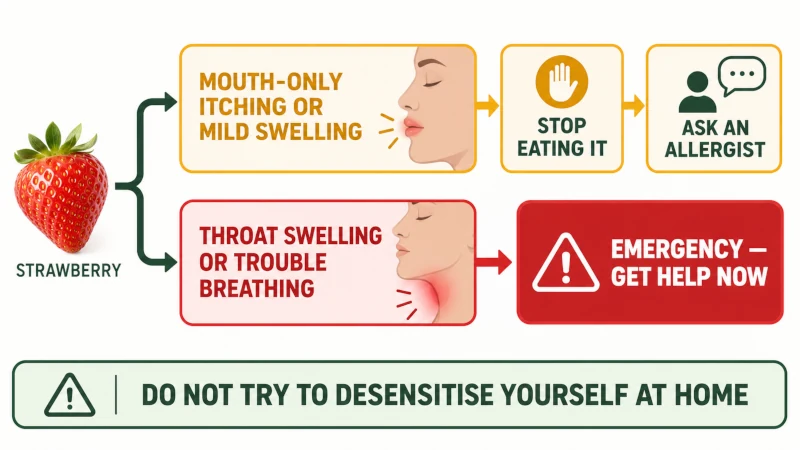
Itching after strawberries is common, and there is a specific mechanism behind it. Strawberries contain Fra a 1, a protein family structurally related to Bet v 1, the major birch pollen allergen. In people sensitised to birch pollen, IgE raised against Bet v 1 cross-reacts with Fra a 1 (Orozco-Navarrete et al., J. Agric. Food Chem., 2020). This is oral allergy syndrome, also called pollen-food allergy syndrome.
The typical picture is itching or swelling of the mouth, face, lip, tongue and throat, usually immediately after eating raw fruit, though the reaction can start more than an hour later. Rarely, it causes severe throat swelling or anaphylaxis in someone highly allergic (AAAAI, 2026). The proteins involved are heat-sensitive, which is why many people who react to raw strawberries tolerate cooked ones.
Now the part that matters most on this page. Older herbals suggest desensitising yourself by placing a piece of strawberry under your tongue every day for eight to ten days. Do not do this. What is being described is a crude form of oral immunotherapy, and an international expert panel convened by the American Academy of Allergy, Asthma & Immunology concluded that people with pollen-food allergy syndrome should be offered oral immunotherapy only in a research setting (Al-Shaikhly et al., JACI: In Practice, 2024).
Supervised, in a clinic, with emergency treatment on hand. Deliberately and repeatedly exposing yourself to a food you react to, at home, with no way to manage a reaction, is exactly the situation that guidance exists to prevent.
If strawberries reliably make your mouth itch, see an allergist. They can test what is actually driving it and tell you whether cooked fruit is safe for you.
Safety: side effects, interactions, pregnancy, who should avoid
Side effects. At the time of the European assessment, no side effects had been reported for wild strawberry leaf preparations, and none are listed in the monograph. The single contraindication is hypersensitivity to the plant itself. No interactions with other medicines have been reported, and no case of overdose (EMA/HMPC/432278/2015). Read “none reported” as what it is — an absence of recorded problems in a lightly studied material, not a demonstration of safety.
Pregnancy and breastfeeding. Safety has not been established, no fertility data exists, and use of the leaf preparation during pregnancy and lactation is not recommended (EMA/HMPC/432278/2015). Eating the berries as food is a separate question and is not a concern.
Children. The leaf is not recommended under 12 years, because adequate data does not exist (EMA/HMPC/432278/2015). Old herbals recommend strawberry leaf tea for children with diarrhoea specifically; that recommendation predates the assessment and does not survive it.
Who should not use the leaf for urinary complaints. Anyone with a condition where reduced fluid intake is advised — severe cardiac or kidney disease, for instance. A diuretic that requires you to drink more is the wrong tool when you have been told to drink less (EMA/HMPC/432278/2015).
Anyone with a birch pollen allergy. See the allergy section above.
Vitamin C, if you are supplementing it. The upper limit for adults is 2,000 mg a day from all sources combined. Too much causes diarrhoea, nausea and stomach cramps, and in people with haemochromatosis, high doses can worsen iron overload (NIH ODS, 2021). Nothing you can eat in strawberries approaches that. It is a reason to be careful with tablets, not with fruit.
Picking your own: wild strawberry and its look-alike
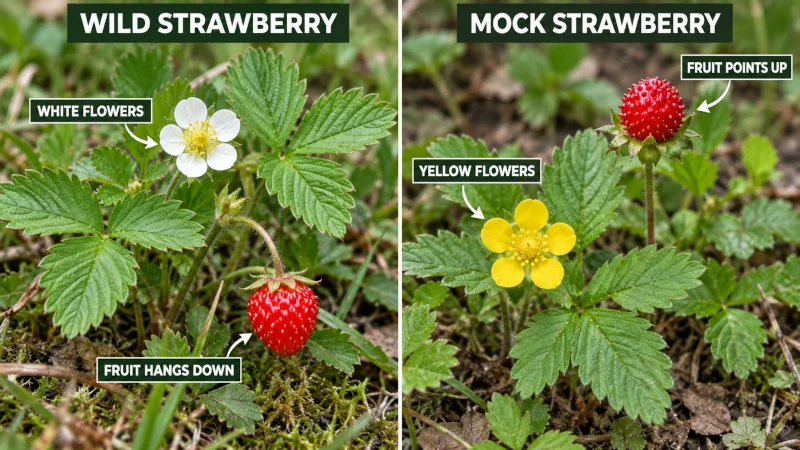
The plant most often mistaken for wild strawberry is mock strawberry (Potentilla indica, long known as Duchesnea indica), also called Indian strawberry. It grows in the same lawns and woodland edges, spreads by runners in the same way, and produces small red strawberry-shaped berries.
Three differences settle it:
- Flowers. Mock strawberry has five yellow petals. Wild strawberry has white ones.
- Fruit orientation. Mock strawberry fruit points up, away from the ground, which makes it conspicuous. Wild strawberry fruit hangs down.
- Taste. Mock strawberry berries are virtually flavourless. Wild strawberries are not.
Those distinctions come from University of Minnesota Extension, which lists mock strawberry as an invasive species and notes it may be confused with the native wild strawberry, which is also low-growing but has white petals and flavoured fruit (UMN Extension, 2019).
Wild strawberry is common, but not everywhere and not always abundant — Kew notes it is categorised as near threatened in England because of the loss of wildflower meadows (Kew, 2026). Pick lightly, and don’t gather from roadside verges or land that may have been sprayed.
Red flags: when to stop self-treating
Both indications for the leaf are for mild, short-lived problems, and the monograph sets its own stopping points.
Stop and seek advice if:
- Urinary symptoms last more than 2 weeks while you are using it.
- Diarrhoea lasts more than 3 days while you are using it.
- Fever, pain on urinating, spasms or blood in your urine develop.
- Diarrhoea keeps coming back, or your stools are bloody.
All four thresholds come directly from the EU monograph (EMA/HMPC/432278/2015).
Seek urgent care if: you have swelling of the lips, tongue or throat, difficulty breathing or swallowing, faintness, or a widespread rash after eating strawberries. These are signs of a severe allergic reaction. In the United States, call 911 and use an epinephrine auto-injector if one has been prescribed (AAAAI, 2026).
Also seek urgent assessment for signs of dehydration alongside diarrhoea — reduced urination, dizziness on standing, confusion — particularly in a child or an older adult.
| HEALTH DISCLAIMER: This article is general education and information. It is not medical advice, and it is not intended to diagnose, treat, cure or prevent any disease. Wild strawberry leaf preparations are registered on the basis of traditional use, which means their effectiveness has not been established by clinical trials. Speak with a doctor, pharmacist or other qualified health professional before using wild strawberry leaf if you are pregnant or breastfeeding, giving it to a young person, taking prescription medicine, or managing an ongoing condition — particularly heart disease, kidney disease or diabetes. Never attempt to desensitise yourself to a food you react to without medical supervision. Seek prompt medical care for swelling of the throat, difficulty breathing, blood in the urine or stool, or diarrhoea lasting more than a few days. |
Frequently Asked Questions
Is wild strawberry the same plant as the strawberry in the shops?
No. Shop strawberries are Fragaria × ananassa, a hybrid bred for size and shipping. Wild strawberry is Fragaria vesca, a separate species with much smaller fruit and, by most accounts, better flavour. Nutrient data is published for the cultivated species, so figures quoted for “strawberries” almost always come from that one.
Can wild strawberry leaf tea treat a urinary tract infection?
No. The European monograph approves it to increase urine output as an adjunct in minor urinary complaints, not as treatment for an infection, and the approval rests on traditional use rather than trial evidence (EMA, 2018). Fever, pain on urinating or blood in the urine need medical assessment.
Are the leaves safe to eat or brew?
Brewed as a tea at the amounts in the monograph — 1 g per cup for diarrhoea, 4–8 g daily as a decoction for urinary complaints — no side effects had been reported when European regulators assessed them. But they are not recommended under 12, or in pregnancy and breastfeeding, and reproductive and genotoxicity testing has never been done (EMA/HMPC/432278/2015).
Do strawberries help with gout?
Not reliably. Higher dietary vitamin C tracks with lower uric acid in population studies, but interventional evidence is weak, and the American College of Rheumatology conditionally recommends against vitamin C supplements for gout (FitzGerald et al., 2020; Brzezińska et al., 2021). Fruit as part of your diet, yes. Strawberries as gout treatment, no.
Why do strawberries make my mouth itch?
Most often oral allergy syndrome, caused by cross-reaction between birch pollen allergen Bet v 1 and the strawberry protein Fra a 1 (Orozco-Navarrete et al., 2020). Symptoms are usually confined to the mouth and throat, and cooked fruit is often tolerated, but severe reactions do occur (AAAAI, 2026). Get it assessed rather than experimenting.
How do I tell wild strawberries from mock strawberries?
White flowers and hanging fruit mean wild strawberry; yellow flowers and upward-pointing, flavourless fruit mean mock strawberry (UMN Extension, 2019).
References
- Royal Botanic Gardens, Kew. “Wild strawberry — Fragaria vesca.” Kew Science, accessed 2026. View source
- Committee on Herbal Medicinal Products (HMPC). “European Union herbal monograph on Fragaria vesca L. and related species, folium.” EMA/HMPC/432278/2015, adopted 20 November 2018. View source
- European Medicines Agency. “Fragariae folium — herbal medicinal product (wild strawberry leaf): summary of HMPC conclusions.” Page updated 12 May 2026. View source
- National Institutes of Health, Office of Dietary Supplements. “Vitamin C — Fact Sheet for Consumers.” Updated 22 March 2021. View source
- U.S. Department of Agriculture, FoodData Central, via California Department of Education Food Distribution fact sheet, “Strawberries, Clamshell.” Last reviewed 2 October 2025. View source
- National Institute of Diabetes and Digestive and Kidney Diseases. “Eating, Diet, & Nutrition for Constipation.” Last reviewed May 2018. View source
- American Academy of Allergy, Asthma & Immunology. “Oral Allergy Syndrome (OAS).” Page dated 17 June 2026. View source
- Al-Shaikhly T, Cox A, Nowak-Węgrzyn A, et al. “An International Delphi Consensus on the Management of Pollen-Food Allergy Syndrome: A Work Group Report of the AAAAI Adverse Reactions to Foods Committee.” J Allergy Clin Immunol Pract. 2024 Dec;12(12):3242–3249.e1. PMID 39488768; doi:10.1016/j.jaip.2024.09.037. View source
- Orozco-Navarrete B, Kaczmarska Z, Dupeux F, et al. “Structural Bases for the Allergenicity of Fra a 1.02 in Strawberry Fruits.” J Agric Food Chem. 2020 Sep 30;68(39):10951–10961. PMID 31774998; PMCID PMC7644122; doi:10.1021/acs.jafc.9b05714. View source
- FitzGerald JD, Dalbeth N, Mikuls T, et al. “2020 American College of Rheumatology Guideline for the Management of Gout.” Arthritis Care Res. 2020 Jun;72(6):744–760. PMID 32391934; doi:10.1002/acr.24180. View source
- Brzezińska O, Styrzyński F, Makowska J, Walczak K. “Role of Vitamin C in Prophylaxis and Treatment of Gout — A Literature Review.” Nutrients. 2021;13(2):701. doi:10.3390/nu13020701. View source
- Zou Y, Liu Y, Li S. “Association between dietary vitamin C intake and gout among American adults.” Front Immunol. 2024;15:1431323. doi:10.3389/fimmu.2024.1431323. View source
- Lawrence JR, Peter R, Baxter GJ, Robson J, Graham AB, Paterson JR. “Urinary excretion of salicyluric and salicylic acids by non-vegetarians, vegetarians, and patients taking low dose aspirin.” J Clin Pathol. 2003 Sep;56(9):651–653. PMID 12944546; PMCID PMC1770047; doi:10.1136/jcp.56.9.651. View source
- University of Minnesota Extension. “Mock strawberry.” Reviewed 2019. View source


