
Wild celery is the plant your supermarket celery was bred from, and the honest summary of its health effects is short: it’s a good food with one promising research lead and a lot of folklore attached. The strongest human evidence, a 2025 meta-analysis of small trials, suggests celery seed preparations may modestly lower blood pressure [Liu et al., 2025]. Most of the other wild celery benefits you’ll see listed, from kidney cleansing to lifting low mood, come from old herbals or animal studies.
That doesn’t make it useless. It means you can eat it for flavor, treat seed supplements as an experiment to discuss with your clinician, and take its real risks seriously: celery allergy, burn-like skin reactions in sunlight, a handful of drug interactions and, for foragers, deadly look-alikes.
What wild celery actually is
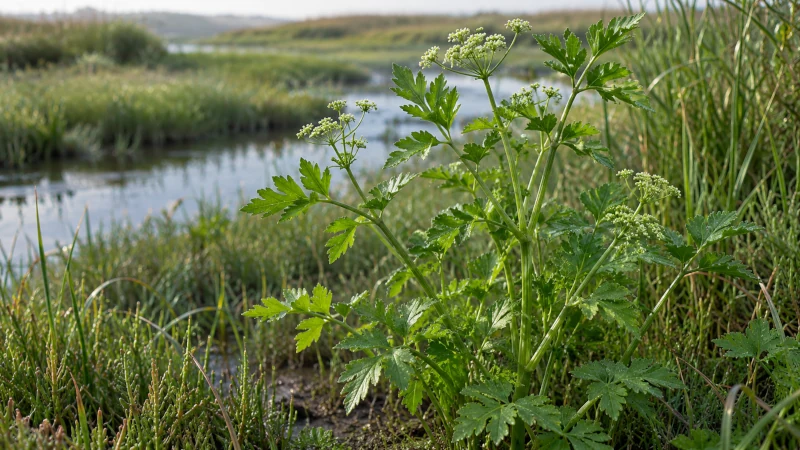
Wild celery (Apium graveolens) is the wild ancestor of both celery and celeriac. It’s a biennial in the carrot family (Apiaceae) that grows on damp ground and tolerates salty soil, which is why it turns up in salt marshes, brackish ditches and coastal meadows [RHS, n.d.]. Older books call it smallage or marsh parsley, and every part of the plant smells strongly of celery.
Herbalists use the seeds (botanically, tiny fruits), leaves, stalks and roots. Celery seed is the form in most supplements and in most of the clinical research.
| Same name, different plant. In North America, “wild celery” also means Vallisneria americana, a ribbon-leaved underwater grass that grows in fresh and slightly brackish water and feeds migrating ducks [Chesapeake Bay Program, n.d.]. It is not the herb discussed here; Drugs.com flags the same naming mix-up [Drugs.com, 2026]. |
Wild celery benefits: what the evidence supports
Here is how the main claims stack up. The strength column reflects the quality of human evidence, not how long a use has been around.
| Claim | What the research shows | Evidence strength |
| Lowers blood pressure | Meta-analysis of 9 small randomized trials found reductions; results varied widely between trials | Promising but limited |
| Lowers blood sugar and triglycerides | Same meta-analysis; only a few trials per outcome | Early-stage |
| Helps gout or lowers uric acid | Rodent studies plus one uncontrolled pilot of a six-ingredient product | Very limited |
| Diuretic, “depurative” or detox | Long traditional use; no clinical trials identified | Traditional only |
| Aphrodisiac, mood, skin, rheumatism, catarrh | No human trials identified | Insufficient |
| Brings on menstruation | Traditional use, now treated as a reason to avoid celery seed in pregnancy | A safety concern, not a benefit |
Blood pressure: the strongest signal, still modest
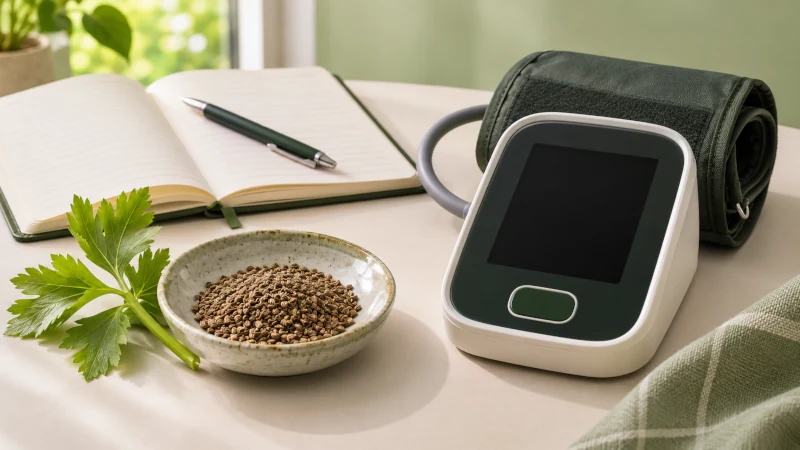
A 2025 systematic review and meta-analysis pooled nine randomized controlled trials involving 511 adults, including people with high blood pressure, prediabetes, polycystic ovary syndrome or excess weight [Liu et al., 2025]. Celery preparations lowered both systolic and diastolic pressure compared with controls. Seed preparations, and doses above 1,000 mg a day, appeared to do better than other parts of the plant.
Before reading that as “celery treats hypertension,” look at the limits the authors themselves flagged [Liu et al., 2025]:
- The trials were small and short, lasting 12 to 84 days.
- All took place in Asian populations, mostly in Iran.
- Results differed sharply from trial to trial, and the authors suspected publication bias for the systolic result.
- The paper reports standardized effect sizes rather than mmHg, so it can’t tell you how many points your own reading might drop.
Side effects in the trials were mild and uncommon (dizziness, reflux, headache), though three trials reported no safety data at all [Liu et al., 2025]. If you have high blood pressure, celery seed is not a substitute for prescribed treatment. If you and your doctor decide to try it, track your readings at home; our blood pressure guides explain how to get numbers you can trust.
Blood sugar and triglycerides
The same analysis found a modest drop in fasting blood glucose and lower triglycerides, the latter based on just three studies [Liu et al., 2025]. Total, LDL and HDL cholesterol didn’t change significantly overall. Treat this as early-stage evidence. If you take diabetes medication, the chance of extra blood-sugar lowering is a reason to check with your prescriber first [Drugs.com, 2026].
Gout and uric acid: mostly animal data
Celery seed is a popular gout remedy, and there is a plausible lead behind it. In a 2019 study, celery seed extracts lowered uric acid in mice with induced hyperuricemia and reduced ankle swelling in rats with induced gouty arthritis. Higher doses didn’t consistently help, though, and the active compounds weren’t identified [Li et al., 2019].
The only human data we found comes from a 45-day pilot study in Vietnam. Of 35 people enrolled, 27 finished. They took a manufacturer-funded tablet that combined celery seed extract with tart cherry, devil’s claw, vitamin C, folic acid and potassium citrate [Vu et al., 2021]. Uric acid fell by 25.8 µmol/L (roughly 0.4 mg/dL) and pain scores improved. With no placebo group and six active ingredients, there’s no way to credit celery for any of it.
Gout responds well to standard medical treatment, so use celery as food rather than as your plan. If you’re curious about food-based approaches, our look at cherries and gout walks through that evidence.
Diuretic and “detox” claims
Celery seed has a long traditional use as a diuretic for bladder and kidney complaints. Drugs.com’s professional monograph cites no clinical evidence for that use and concludes that clinical studies don’t support a place for celery in therapy [Drugs.com, 2026]. Even a genuine diuretic effect would mean more urine, not the removal of “toxins”; your kidneys and liver already do that job. Our guide to stinging nettle looks at the same claim for another classic broth herb.
Some herbal sources recommend celery for people with kidney failure or kidney stones. Don’t follow that advice. Using diuretic herbs to manage kidney disease or fluid buildup can be dangerous, as our overview of herbal remedies for the urinary system explains. For stones, what helps depends on the type of stone; see foods that raise kidney stone risk.
Traditional uses without good evidence
Older herbals credit wild celery with being an aphrodisiac, a pick-me-up for exhaustion and “nervous depression,” and a treatment for rheumatism, chronic catarrh, flatulence and skin complaints. We found no human trials testing any of these. That doesn’t prove them false. It means they haven’t been studied well enough to recommend.
How to use wild celery sensibly
As food
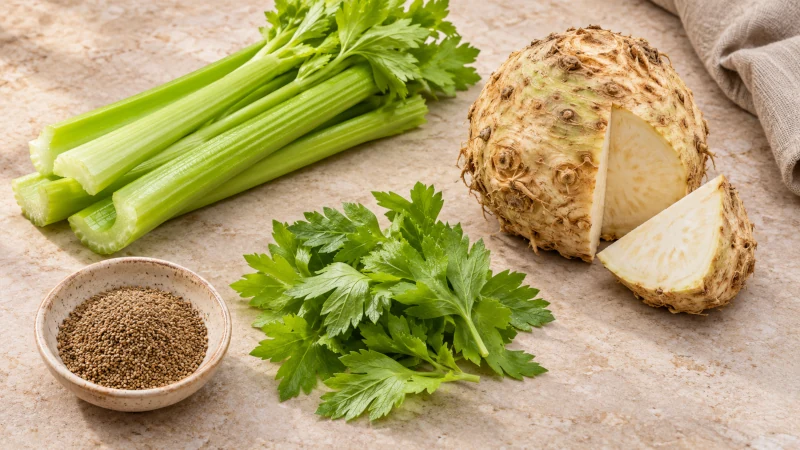
This is where wild celery is easiest to recommend. Use the leaves sparingly as a seasoning in soups and broths, eat the stalks raw or cooked, and use the seeds as a spice. The FDA classes celery seed as generally recognized as safe when used as food [Drugs.com, 2026].
If you harvest or chop a lot of wild celery, wear gloves and wash your skin before going out in the sun. The Royal Horticultural Society lists the plant as harmful to skin in sunlight [RHS, n.d.].
Celery seed supplements
There is no established dose. Capsule doses in the clinical trials ranged from about 10 mg to 2,250 mg a day, and products differed in which part of the plant they used and how it was prepared [Liu et al., 2025]. If you want to try one:
- Tell your doctor or pharmacist first, especially if you take any regular medication.
- Choose a product that has been third-party tested for identity and purity.
- Set a fixed trial period with a clear measure, such as home blood pressure readings, rather than taking it indefinitely.
- Don’t swallow celery essential oil. There’s no clinical dosing data for it, and celery oil is a recognized cause of food-induced anaphylaxis [DermNet, 2023].
Safety: side effects, interactions and who should avoid it
Celery allergy
Celery is one of the 14 allergens that UK food law requires businesses to declare [Food Standards Agency, 2026]. Celery allergy is closely tied to birch and mugwort pollen allergy. Many reactions stay limited to itching and mild swelling of the lips, mouth and throat (oral allergy syndrome), but celery can also cause hives, throat swelling, asthma and anaphylaxis, including anaphylaxis brought on by exercise after eating it [Thermo Fisher, 2021]. Dried, powdered celery spice can still trigger reactions in people allergic to the raw vegetable [Thermo Fisher, 2021], and celery oil and celery root are known causes of sudden food anaphylaxis [DermNet, 2023].
If you get hay fever from birch or mugwort pollen and notice an itchy mouth after raw celery, ask an allergist before trying concentrated celery products.
Sun sensitivity

Celery contains furanocoumarins (psoralens), compounds that make skin react to ultraviolet light. Handling celery and then getting sun can cause a burn-like, blistering rash, and levels climb when plants are infected with the fungus behind “pink rot” [DermNet, 2023]. In one Oregon outbreak, 19 grocery workers developed the reaction during a celery sale, and tanning-salon users had the worst cases [Archives of Dermatology, 1987].
Eating celery rarely causes this, but it can. A 65-year-old woman developed a severe, body-wide burn after eating a large amount of celery root and visiting a tanning salon an hour later [Ljunggren, 1990]. If you’ve had a big serving of celery root or celery soup, skip the tanning bed that day.
Medication interactions

Most interaction concerns come from case reports, lab work or theory, so treat them as possible rather than proven. They still matter if you take any of these:
| Medicine | Possible interaction | Basis |
| Thyroid hormone (levothyroxine) | Thyroid hormone (T4) levels fell after starting celery seed tablets and recovered after stopping | Two case reports [Moses, 2001] |
| Blood thinners and antiplatelet drugs | Possible added bleeding risk | Professional monograph caution [Drugs.com, 2026] |
| Diabetes medicines | Possible extra blood-sugar lowering | Professional monograph caution [Drugs.com, 2026] |
| MAO inhibitors | Possible stronger drug effect | Professional monograph caution [Drugs.com, 2026] |
| Blood pressure medicines | Could add to their effect, given the trial results above | Our inference from [Liu et al., 2025]; not studied directly |
Lab studies show celery seed extract can block CYP2D6, a liver enzyme that processes many common drugs, although Drugs.com judges meaningful interactions through that route unlikely [Drugs.com, 2026]. Take the product to your pharmacist; checking it against your medicines takes them a minute.
Pregnancy and breastfeeding
Avoid celery seed, celery oil and concentrated celery supplements if you’re pregnant. Celery seed may stimulate the uterus and has traditionally been used to bring on menstruation. It has also been used traditionally to reduce breast milk, so the same caution applies while breastfeeding [Drugs.com, 2026]. Celery eaten as an ordinary vegetable is a different matter from concentrated seed products; if you’re unsure, ask your midwife or doctor.
Kidney disease
Because of its diuretic reputation, people with acute kidney inflammation are advised to avoid supplemental celery seed [Healthline, 2019]. If you have chronic kidney disease or follow a fluid or potassium restriction, talk to your kidney specialist before using any herbal diuretic, celery included.
Foraging: the plant to fear isn’t the celery

The most dangerous thing about wild celery is mistaking something else for it. Water hemlock belongs to the same plant family as celery, parsley and carrots and is easy to confuse with edible plants [CDC, 1994]. In one reported case, a couple ate “wild celery” picked in a regional park that turned out to be poison hemlock; the wife stopped breathing about two hours later and needed a ventilator before she recovered [Poison Control, n.d.]. Water hemlock is worse still: a 2–3 cm piece of root can kill an adult, and there is no antidote [CDC, 1994].
Don’t eat any wild carrot-family plant unless an experienced forager or botanist has confirmed the identification in person. A photo app or field guide alone isn’t enough for this family.
When to get medical help
- Call emergency services for throat tightness, trouble breathing or swallowing, widespread hives, or feeling faint after eating celery.
- Call emergency services or a poison center (1-800-222-1222 in the US) right away if anyone feels unwell after eating a foraged wild plant: nausea, vomiting, drooling, sweating, muscle weakness, tremors or seizures [Poison Control, n.d.]. Don’t wait to see whether it passes.
- See a doctor for blistering or a severe burn-like rash after handling celery and being in the sun.
- See your doctor if your blood pressure readings stay high, if a joint suddenly becomes hot, red and very painful, or if you take thyroid medicine and feel unusually tired or sluggish after starting celery seed.
| HEALTH DISCLAIMER: This article is for general education and is not a substitute for advice, diagnosis or treatment from a qualified healthcare professional. Herbs and supplements can cause side effects and interact with medicines. Talk to your doctor or pharmacist before using celery seed or any herbal product, especially if you are pregnant, breastfeeding, taking prescription medication or living with a chronic condition. Never eat a wild plant you cannot identify with certainty. |
Frequently Asked Questions
Is wild celery the same as the celery I buy at the store?
They’re the same species. Supermarket celery and celeriac were bred from wild Apium graveolens [RHS, n.d.]. In North America, though, “wild celery” can also mean an unrelated underwater grass [Chesapeake Bay Program, n.d.].
Does celery juice lower blood pressure?
There’s no strong evidence for juice specifically. The trials that showed a blood pressure effect mostly used seed extracts or powders in capsules, with a few stem-and-leaf preparations [Liu et al., 2025]. Celery juice is fine as a drink; just don’t use it in place of treatment.
Can celery seed help gout?
Not on current evidence. Animal studies are encouraging [Li et al., 2019], but the only human study tested a six-ingredient product without a placebo group [Vu et al., 2021].
Is wild celery safe during pregnancy?
Celery as an everyday vegetable is a normal food, but celery seed, celery oil and celery supplements should be avoided in pregnancy because they may stimulate the uterus [Drugs.com, 2026].
Can celery seed interact with thyroid medicine?
Possibly. Two women taking levothyroxine developed low thyroid hormone levels after starting celery seed tablets, and the levels recovered after they stopped [Moses, 2001]. If you take thyroid medicine, ask your doctor before starting celery seed.
Is it safe to forage wild celery?
Only with in-person identification by someone experienced. Deadly hemlocks belong to the same family, and poison hemlock has been eaten by mistake for wild celery [Poison Control, n.d.].
References
- Liu D, Zhao H, Xu H, Hu J. Effects of celery (Apium graveolens) on blood pressure, glycemic and lipid profile in adults: a systematic review and meta-analysis of randomized controlled trials. View source
- Drugs.com. Celery (professional monograph). View source
- Moses G. Thyroxine interacts with celery seed tablets? View source
- Rademaker M. Celery. DermNet NZ. View source
- Phytophotodermatitis from celery among grocery store workers. View source
- Ljunggren B. Severe phototoxic burn following celery ingestion. View source
- Troutman WG, Soto P. Can poison hemlock be deadly? Poison Control, National Capital Poison Center. View source
- Centers for Disease Control and Prevention. View source
- Royal Horticultural Society. Apium graveolens (wild celery). View source
- Chesapeake Bay Program. Wild celery (Vallisneria americana). Field guide. View source
- Food Standards Agency. Food allergy and intolerance advice for consumers. GOV.UK. View source
- Vu N, Nguyen TTT, Parmenter BH, Thouas GA. Safety, efficacy and tolerability of a combination micronutrient and polyherbal preparation (GoutFighter) for gout: a single-arm open-label pilot study. View source
- Li S, Li L, Yan H, Jiang X, Hu W, Han N, Wang D. View source
- Thermo Fisher Scientific. Celery (f85). Allergen Encyclopedia. View source
- Zamarripa M. 6 surprising benefits of celery seeds. View source


