
That low, feathery-leaved plant with small pink flowers and long, beak-shaped seed pods in your lawn or pasture is probably storksbill. Ranchers like it as forage, and folk medicine has long used it for bleeding, wounds, and urinary complaints. The research behind those uses is thin, though. What exists comes almost entirely from lab dishes, and we found no human trials testing storksbill weed for any health condition. It is an interesting plant with plausible chemistry. It is not a proven remedy.
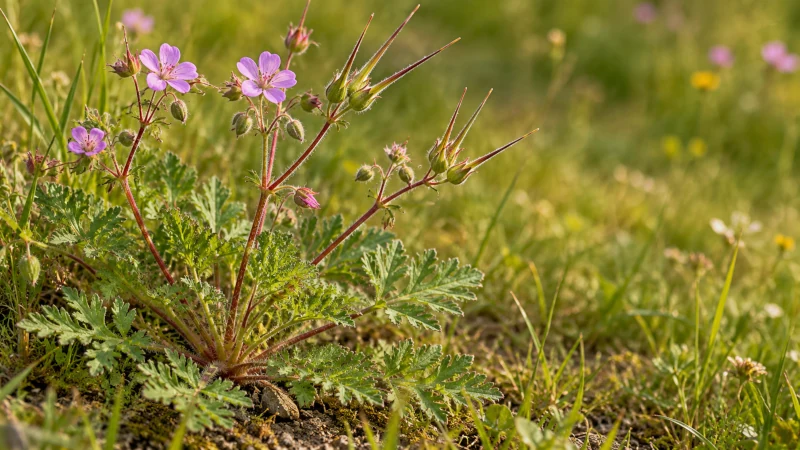
Here is how to identify it, what it contains, what each traditional use is actually based on, and when a symptom needs a doctor rather than a weed from the yard.
What is storksbill weed?
Storksbill weed is Erodium cicutarium, a member of the geranium family. Linnaeus first named it Geranium cicutarium in 1753, and that name is now treated as a synonym [POWO, 2026]. The plant is native to Macaronesia, temperate Eurasia, and northern and northeastern Africa, and it has been introduced across North, Central, and South America [POWO, 2026]. It spread through the American West early: it was already well established there before Spanish missionaries and their livestock arrived in 1769 [DiTomaso et al., 2013].
Depending on where you live, you may know it as redstem filaree, common stork’s bill, alfilaria, heronsbill, or pinweed [IUCN GISD].
Storksbill weed at a glance
| Fact | Detail |
| Scientific name | Erodium cicutarium (L.) L’Hér.; synonym Geranium cicutarium L. |
| Family | Geraniaceae (geranium family) |
| Other names | Redstem filaree, common stork’s bill, alfilaria, filaree, heronsbill, pinweed |
| Life cycle | Winter annual, sometimes biennial; starts as a flat rosette |
| Where it grows | Roadsides, pastures, lawns, rangeland, orchards, and other open, disturbed ground |
| Parts used traditionally | Aerial parts (leaves, stems, flowering tops) |
| Evidence in humans | None from clinical trials |
How to identify it
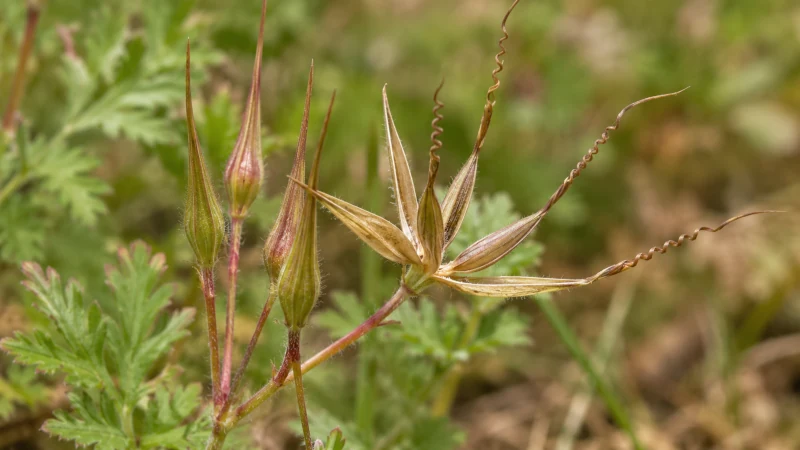
Storksbill starts the season as a rosette of hairy, fernlike leaves pressed close to the ground. Each leaf is fully divided into leaflets, and the leaflets are deeply cut. The stems are often reddish, which is where “redstem” comes from. The flowers sit in small clusters at the tips of the stalks and have five separate pink to reddish-lavender petals [UC IPM].
The fruit is the giveaway. It is long and needlelike, shaped like a stork’s beak. When ripe, it splits into five parts, each with a tail that coils as it dries [UC IPM]. That spiral tail is how the seed works itself into the soil.
If you plan to eat or use it, confirm the identification with flowers and fruit together. Feathery seedling leaves alone are easy to mistake for other plants.
A note on the names
“Storksbill” is used loosely. Herb Robert (Geranium robertianum) is a relative in a different genus, and research on it does not transfer to storksbill. The closest look-alike in the field is whitestem filaree, covered further down.
What’s in the plant
Storksbill is rich in tannins. A detailed chemical analysis of the herb identified ellagitannins such as geraniin and corilagin, flavonoids including rutin, hyperin, and isoquercitrin, and several phenolic acids [Fecka & Cisowski, 2005]. A review also lists catechins, amino acids, vitamins K and C, and essential oils [Al-Snafi, 2017].
The tannins explain most of the plant’s traditional reputation. Tannins are astringent: they tighten skin and mucous membranes, and herbal medicine has long linked that effect to slowing minor bleeding and drying weepy sores. Knowing a plant’s chemistry tells you why people thought it worked. It does not show that it does.
Traditional uses and what the evidence shows
Across the genus, Erodium species have been used in folk medicine for bleeding, skin problems, indigestion, inflammation, and urinary complaints [Munekata et al., 2019]. The same review concludes that researchers still need to connect those traditional uses to scientific evidence, including at the animal and clinical levels. That is the key point: the uses are old, and the testing barely exists.
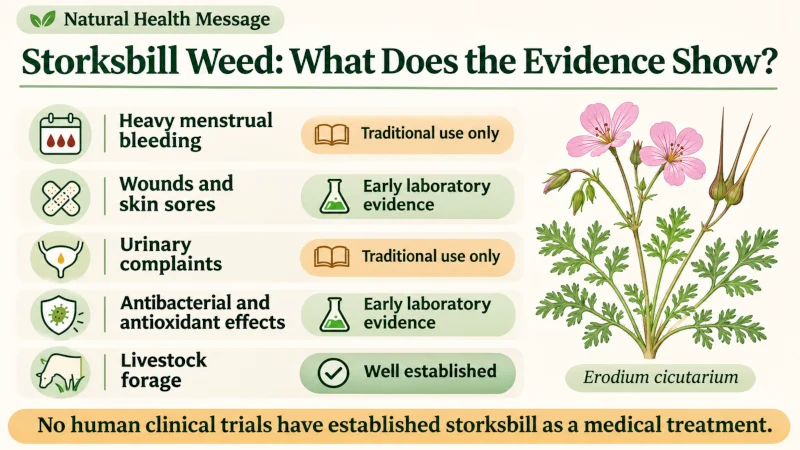
| Traditional use | What the evidence is | Strength |
| Stopping uterine or heavy menstrual bleeding | Traditional use; plausible tannin chemistry; no human or animal studies found | Traditional only |
| Minor wounds and skin sores | Traditional use; lab studies show antibacterial activity | Early lab evidence |
| Urinary complaints, “nephritis” | Traditional use only | Traditional only |
| Antiviral, antioxidant, anti-inflammatory | Lab (in vitro) studies | Early lab evidence |
| Livestock forage | Agricultural extension guidance | Well established |
Bleeding and heavy periods
Storksbill’s best-known traditional role is as a hemostatic herb, meaning one used to slow bleeding, especially from the uterus. The tannins and vitamin K make that idea plausible on paper. But we found no clinical trial, and no animal study, testing storksbill to reduce menstrual or uterine bleeding.
One review notes reports of a stimulating (spasmogenic) effect on uterine muscle [Al-Snafi, 2017]. That is not the same as stopping bleeding. It is a reason for caution in pregnancy.
Heavy periods are worth taking to a clinician rather than treating at home. They can come from fibroids, bleeding disorders, or hormonal causes that respond well to treatment. Untreated heavy or prolonged bleeding can also cause anemia [CDC]. If your periods are heavy, our guide to foods that support healthy blood and iron levels is a more useful next step than storksbill.
Cuts, scrapes, and skin
Mashed fresh leaves were traditionally applied to wounds and sores. The best modern work on this is a 2022 lab study. Researchers chose to test storksbill because of its traditional use for skin and tissue infections, and found that its extracts killed or slowed Staphylococcus aureus, including MRSA, and reduced biofilm formation in culture [Ljoljić Bilić et al., 2022].
That is a promising start, but a culture dish is not a wound. No study has tested storksbill on human skin, and crushed plant material is not sterile. For anything beyond a small, clean scrape, standard first aid is the safer choice.
Urinary complaints
Older herbals describe storksbill as a mild diuretic and recommend it for nephritis (kidney inflammation) and urinary colic. The urinary uses do show up in the traditional record [Munekata et al., 2019], but no human studies support them. Nephritis is a serious diagnosis that needs a specialist. Our overview of urinary system diseases and which ones need a doctor explains why.
Reviews list antibacterial, antifungal, antiviral, antioxidant, anti-inflammatory, and pain-relieving effects for storksbill extracts [Al-Snafi, 2017] [Munekata et al., 2019]. Nearly all of this work used concentrated extracts on cells or microbes. It is useful for researchers looking for new compounds, but it does not tell you what a cup of juice or a leaf poultice will do in your body.
Is storksbill weed edible?
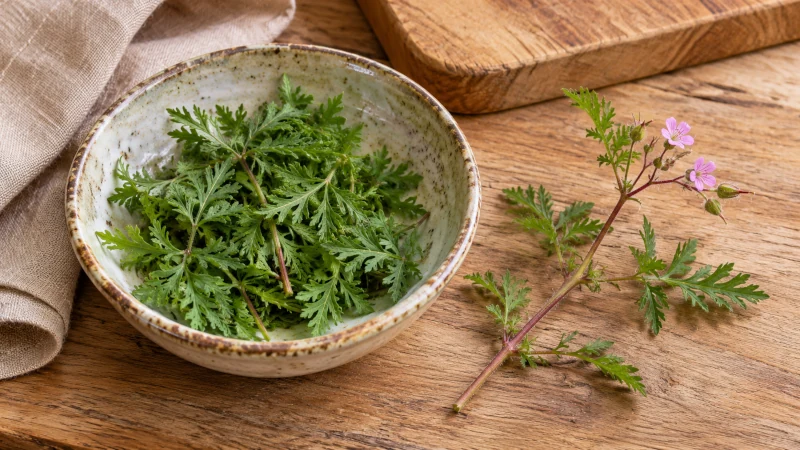
Yes, in modest amounts. Erodium leaves have been used in salads, omelets, sandwiches, sauces, and soups [Munekata et al., 2019]. Young leaves picked before the plant flowers are the usual choice. They taste mildly green and a little astringent.
Two practical cautions. First, storksbill is a common target for weed control, so pick only where you know no herbicide has been sprayed and away from roadsides. Second, treat it as an occasional wild green, not a daily supplement. Our stinging nettle guide covers the same foraging basics in more detail.
Safety, side effects, and interactions
No study has looked at storksbill’s safety in people, so its side effects are simply unknown. That is different from saying it is safe. Eaten as an occasional green, it is unlikely to cause trouble for most healthy adults. Concentrated juices, frequent use, and use alongside medications are where the unknowns matter.
One detail is worth knowing if you are low on iron. Plant polyphenols, the family tannins belong to, can reduce the absorption of iron from plant foods [NIH ODS]. People with heavy periods are exactly the group most likely to be short on iron, so a tannin-rich drink taken with meals works against them.
Who should avoid storksbill
- Pregnant people. There is no safety data, and there are reports that it stimulates uterine muscle.
- People who are breastfeeding. There is no safety data.
- Children. There is no dosing or safety information.
- Anyone with kidney disease. Do not use any herb for a kidney condition without your specialist’s input.
- Anyone with a bleeding disorder or unexplained heavy bleeding. These need a diagnosis, not a home remedy.
Possible medication interactions
No interactions have been documented in people, mostly because nobody has studied it. Two are theoretical, and worth raising with a pharmacist before you use storksbill regularly:
- Warfarin. Storksbill contains vitamin K, which can blunt warfarin. How much the plant contains is not known.
- Diuretics and blood-pressure medicines. If storksbill has the mild diuretic effect folk use claims, it could add to these drugs. This has not been tested.
A note for livestock owners
Redstem filaree provides good forage for livestock and wildlife before it matures [DiTomaso et al., 2013]. Veterinary references list Erodium among the plant genera implicated in primary photosensitization, a sunlight-triggered skin reaction in grazing animals [MSD Veterinary Manual, 2024]. In one South African study, sheep fed large amounts of the related whitestem filaree developed mild photosensitivity [Stroebel, 2002]. This is a reason to watch pale-skinned animals on filaree-heavy pasture. It is not evidence of harm in people.
When to see a doctor instead
Storksbill is not a substitute for care in any of these situations:
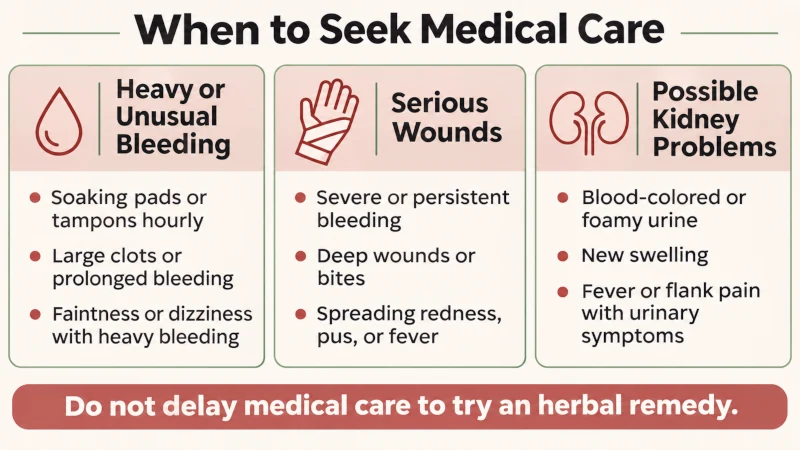
Heavy or unusual bleeding. See a healthcare provider if you soak through one or more pads or tampons every hour for several hours, need to change protection overnight, pass clots the size of a quarter or larger, have periods lasting more than seven days, or feel tired and short of breath [CDC]. Bleeding between periods or after sex also needs checking [NHS]. If you are bleeding heavily and feel faint or dizzy, get emergency care.
Wounds. Call 911 if bleeding is severe or does not stop after 10 minutes of pressure. Get medical care promptly for deep or large wounds, animal or human bites, punctures from rusty objects, or signs of infection such as spreading redness, warmth, swelling, pus, a red streak, or fever [MedlinePlus].
Urinary and kidney symptoms. Pink or cola-colored urine, foamy urine, new swelling around your eyes, ankles, or legs, or rising blood pressure can be early signs of kidney disease [NIDDK]. Fever or flank pain with urinary symptoms also needs prompt care.
Whitestem filaree (Erodium moschatum)
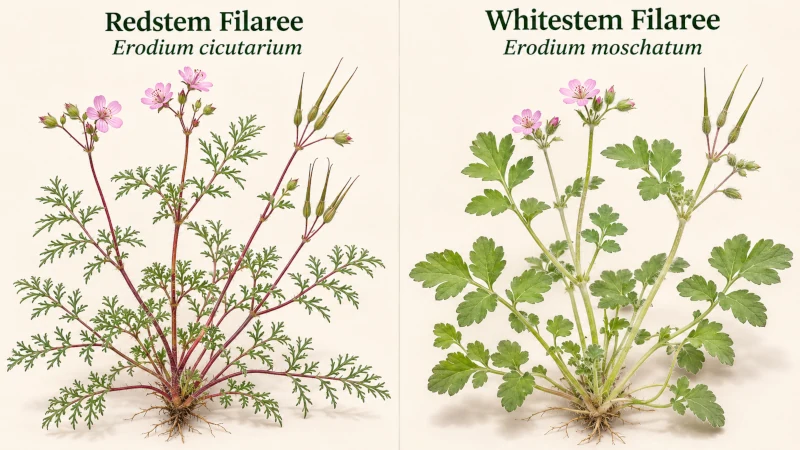
Storksbill often grows alongside its close relative, whitestem filaree (Erodium moschatum). The two look alike at first glance. Whitestem has pale stems rather than reddish ones, and its leaflets are less deeply cut [UC IPM]. Its chemistry and folk uses broadly overlap with storksbill’s, and it has even less research behind it. It is the species in the sheep photosensitivity study above.
| HEALTH DISCLAIMER: This article is for general education. It is not medical advice and is not a substitute for diagnosis or treatment by a qualified healthcare professional. Storksbill weed has not been tested in human clinical trials for any condition. Talk to your doctor or pharmacist before using it medicinally, especially if you are pregnant or breastfeeding, have a bleeding, kidney, or other chronic condition, or take prescription medicines such as warfarin or diuretics. Heavy bleeding, deep wounds, and kidney symptoms need medical evaluation. Do not delay care to try a home remedy. |
Frequently Asked Questions
Is storksbill weed poisonous?
No human poisonings turned up in the sources we reviewed, and its leaves have a history as food. Kew’s plant database does list “poison” among its recorded uses, alongside food, medicine, and animal feed, and the plant has never been tested for safety in people. Eat it in modest amounts, and only when you are sure of the identification. [POWO, 2026]
Is filaree the same as storksbill?
Yes. Redstem filaree, common stork’s bill, and alfilaria are all names for Erodium cicutarium. Whitestem filaree (Erodium moschatum) is a separate, similar species.
Can storksbill stop heavy periods?
There is no clinical evidence that it does. It has a long traditional reputation for bleeding, but heavy periods have treatable causes and can lead to anemia, so see a healthcare provider.
Can I put storksbill on a cut?
Folk medicine did, and lab studies show its extracts can slow some bacteria. It has never been tested on human wounds, and crushed leaves are not sterile. For anything more than a small, clean scrape, use standard first aid and watch for signs of infection.
How do I get rid of storksbill in my lawn?
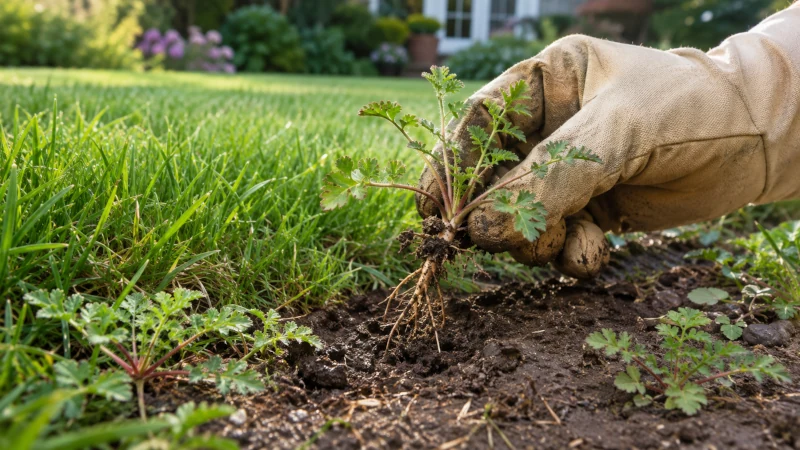
Hand-pull plants before the seeds mature, hoe young plants in beds, and use about 3 inches of mulch to reduce germination. Taller, healthy plants that shade the ground also help. [USU Extension]
References
- Al-Snafi, A. E. (2017). Therapeutic potential of Erodium cicutarium: A review. Indo American Journal of Pharmaceutical Sciences, 4(02). View source
- Centers for Disease Control and Prevention. About heavy menstrual bleeding. View source
- DiTomaso, J. M., Kyser, G. B., et al. (2013). Redstem filaree weed report. In Weed Control in Natural Areas in the Western United States. UC Weed Research & Information Center. View source
- Fecka, I., & Cisowski, W. (2005). Tannins and flavonoids from the Erodium cicutarium herb. Zeitschrift für Naturforschung B, 60(5), 555–560. View source
- IUCN Global Invasive Species Database. Erodium cicutarium. View source
- Ljoljić Bilić, V., Gašić, U. M., Milojković-Opsenica, D., et al. (2022). Antibacterial fractions from Erodium cicutarium exposed: Clinical strains of Staphylococcus aureus in focus. Antibiotics, 11(4), 492. View source
- MedlinePlus. Cuts and puncture wounds. U.S. National Library of Medicine. View source
- Bookbinder, L. (2024). Overview of photosensitization in animals. MSD Veterinary Manual. View source
- Munekata, P. E. S., Alcántara, C., Collado, M. C., et al. (2019). Ethnopharmacology, phytochemistry and biological activity of Erodium species: A review. Food Research International, 126, 108659. View source
- National Institute of Diabetes and Digestive and Kidney Diseases. Glomerular diseases. View source
- NHS. Heavy periods. View source
- NIH Office of Dietary Supplements. Iron: Fact sheet for health professionals. View source
- Plants of the World Online (2026). Erodium cicutarium (L.) L’Hér. Royal Botanic Gardens, Kew. View source
- Plants of the World Online (2026). Geranium cicutarium L. (synonym). Royal Botanic Gardens, Kew. View source
- Stroebel, J. C. (2002). Induction of photosensitivity in sheep with Erodium moschatum (L.) L’Hérit. Journal of the South African Veterinary Association, 73(2), 57–61. doi:10.4102/jsava.v73i2.556 View source
- UC Statewide IPM Program. Filarees (Erodium spp.). University of California. View source
- Utah State University Extension. Redstem filaree. View source


