
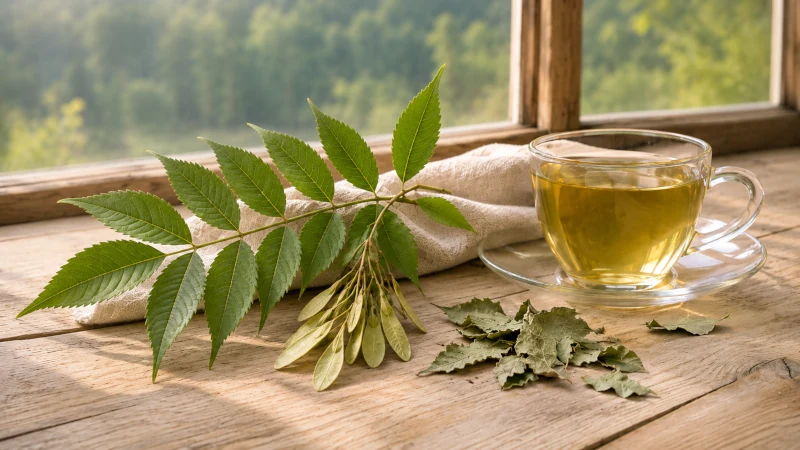
“Bird’s tongue” is an old apothecary name for the European ash tree, Fraxinus excelsior, and its leaves are still sold as an herbal tea. The bird’s tongue plant has a modest, honest case behind it: European regulators accept ash leaf tea as a traditional remedy for minor joint aches and for increasing urine flow, but no clinical trial has tested the leaf on its own [EMA, 2012]. Treat it as a gentle option for mild, short-lived complaints. It is not a treatment for gout, kidney stones, or arthritis that is getting worse.
What is the bird’s tongue plant?
The name comes from the seeds. Ash produces winged seed pods, or “keys,” and Gerard’s herbal records that apothecaries called them Lingua avis — bird’s tongue — and sometimes sparrow’s tongue [Gerard]. Modern supplement references still list Bird’s Tongue as another name for ash [RxList, Ash].
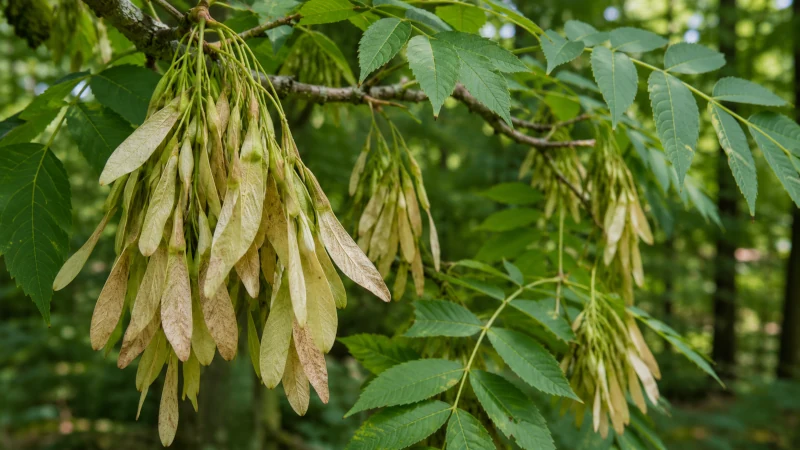
Ash belongs to the olive family, Oleaceae [Imhof et al., 2014]. The leaf is the part with official recognition: the European Union monograph covers leaf from F. excelsior or the closely related narrow-leaved ash, F. angustifolia [EMA, 2012].
| Quick facts | |
| Scientific name | Fraxinus excelsior L. (European or common ash); the EU monograph also covers F. angustifolia Vahl |
| Family | Oleaceae (olive family) |
| Other names | Bird’s tongue, common ash, European ash; frêne (French), fresno (Spanish) |
| Parts used | Leaf (main medicinal use); bark (folk use and one combination product) |
| EU status | Traditional herbal medicine for minor joint pain and for increasing urine flow in minor urinary complaints |
| Main leaf constituents | Mannitol (about 21%), mucilage, phenolic acids, flavonoids including rutoside, tannins, secoiridoids such as oleuropein, and potassium |
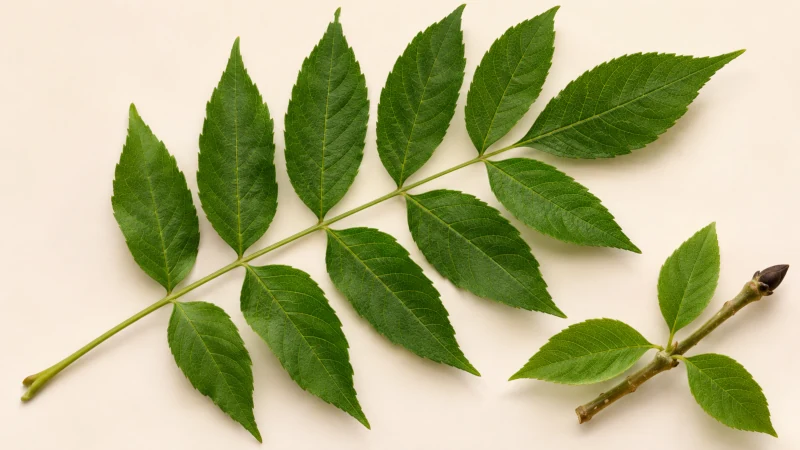
Sources: [EMA, 2012 monograph]; constituents from the [EMA, 2012 assessment report].
Where the snake legend comes from
Old texts promised far more than modern ones. Pliny the Elder wrote that ash-leaf juice was the best remedy for snakebite, and claimed that a snake trapped in a ring of ash leaves would crawl into a fire rather than cross them [Pliny, Natural History 16.24]. Gerard repeated the story centuries later [Gerard]. One translated edition of Pliny carries an editor’s note calling the snake claims fanciful and unsupported [Pliny].
Nothing in modern research suggests ash repels snakes or treats a bite. A venomous snakebite is an emergency: call 911 (or your local emergency number) and get to a hospital.
Bird’s tongue plant benefits: what the evidence supports
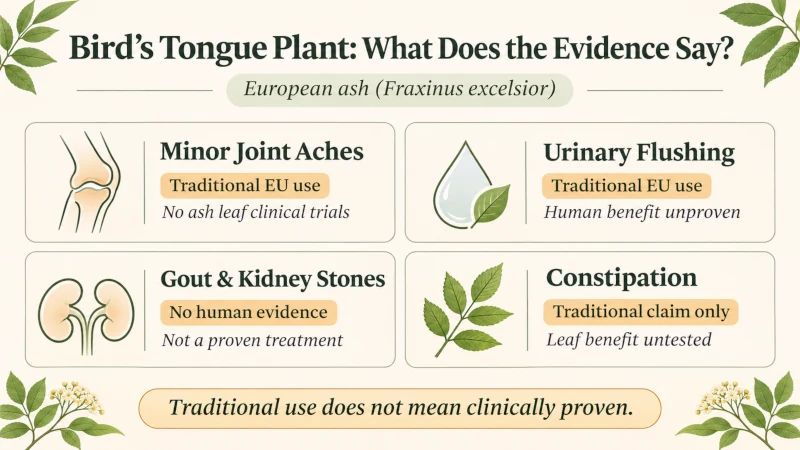
Most of what you will read about bird’s tongue comes from tradition. Here is how each claim holds up.
| Use | Evidence | What it means for you |
| Minor joint aches (leaf tea) | Traditional use, recognized in the EU. No trials of ash leaf alone. | Reasonable to try for mild aches; not proven. |
| More urine flow in minor urinary complaints (leaf tea) | Traditional use. Animal data mixed. No human data. | May support “flushing” with plenty of fluid. Not a UTI treatment. |
| Rheumatic pain (bark, in the STW1/Phytodolor combination) | Many trials of a three-herb product, largely older and manufacturer-sponsored. | Says little about ash on its own. |
| Gout, uric acid, kidney stones | No human evidence for ash leaf. | Not a substitute for medical care. |
| Constipation (leaf) | Traditional only; mannitol offers a plausible mechanism. | Untested. |
| Snakebite | Folklore. | No evidence. Seek emergency care. |
Sources: [EMA, 2012]; [Gundermann et al., 2020]; [RxList, Ash].
Minor joint aches
The EU’s Committee on Herbal Medicinal Products (HMPC) accepts ash leaf tea for relief of minor joint pain on the strength of long use — Spain alone has sold the tea since 1975 [EMA, 2012]. “Traditional use” is a specific regulatory category. It means a product has been used for decades without obvious harm and the effect is plausible. It does not mean trials show it works.
The assessors were blunt about that. They found no clinical studies of the leaf and concluded that the effectiveness of its traditional uses is not documented [EMA, 2012]. A periodic review in 2021–2022 found no new data that would change the monograph [EMA, 2022].
Lab work gives some reason for interest. Fraxinus species contain coumarins, secoiridoids, and flavonoids, and their extracts show anti-inflammatory and diuretic activity in experimental models [Kostova & Iossifova, 2007]. Findings in cells and animals often fail to carry over to people, so they can’t settle the question.
Joint pain with swelling, redness, or fever needs a doctor, not tea [EMA, 2012]. If you are comparing herbs people use for aching joints, our stinging nettle evidence review takes the same approach.
Ash bark in a combination arthritis product
Most of the clinical research involving ash uses the bark, and only as one of three ingredients. STW1, sold as Phytodolor, combines extracts of aspen, ash bark, and goldenrod. A 2020 review gathered 41 studies with 4,332 patients who had rheumatic and musculoskeletal conditions. It reported benefit over placebo, results broadly comparable to diclofenac and other NSAIDs, and fewer side effects than those drugs [Gundermann et al., 2020].
Read that with care. Many of the trials were unpublished manufacturer reports from the late 1980s and early 1990s, one author is employed by the manufacturer, the company partly funded the review, and no trial tested ash bark alone [Gundermann et al., 2020]. It explains why ash shows up in arthritis formulas. It doesn’t show that a cup of ash tea will do the same.
Fluid and minor urinary complaints
The second EU indication is as a diuretic: increasing the amount of urine to flush the urinary tract, as an add-on in minor urinary complaints [EMA, 2012]. The leaf’s potassium and high mannitol content may play a part. Animal results are mixed. In one rat study an alcohol extract increased sodium excretion while a water extract — closer to a tea — did nothing; spray-dried leaf extracts raised excretion in a dose-dependent way. There are no human data on the effect [EMA, 2012].
If you use it, drink plenty of fluid, since the whole point is to increase urine output [EMA, 2012]. Stop and get checked if symptoms last more than two weeks or you develop fever, pain when you pee, cramping, or blood in your urine [EMA, 2012]. Those can signal an infection that needs proper treatment.
Gout, uric acid, and kidney stones
Older herbal books lean hardest on these uses, and the evidence is thinnest here. The EMA assessment mentions gout only as a folk use and kidney stones only as a traditional claim with no clinical data behind it [EMA, 2012]. RxList rates the evidence for ash in gout as insufficient; the one encouraging early study used a Chinese combination of ash bark and Smilax glabra root, not European ash leaf [RxList, Ash].
Gout and kidney stones both respond to well-studied treatments, and both can damage joints or kidneys if they go undertreated. A herbal diuretic isn’t a stand-in for that care. People with serious kidney disease shouldn’t use ash leaf at all (see the safety section). If you are managing chronic kidney disease through diet, our guide to kidney-friendly foods for CKD meal plans is a better place to start.
Constipation
Older texts list ash leaf as a laxative, and its mannitol content gives a plausible reason, but the EMA assessors cite no studies supporting it [EMA, 2012]. The better-known laxative from the ash family comes from a different tree.
Manna: the laxative sap of the flowering ash
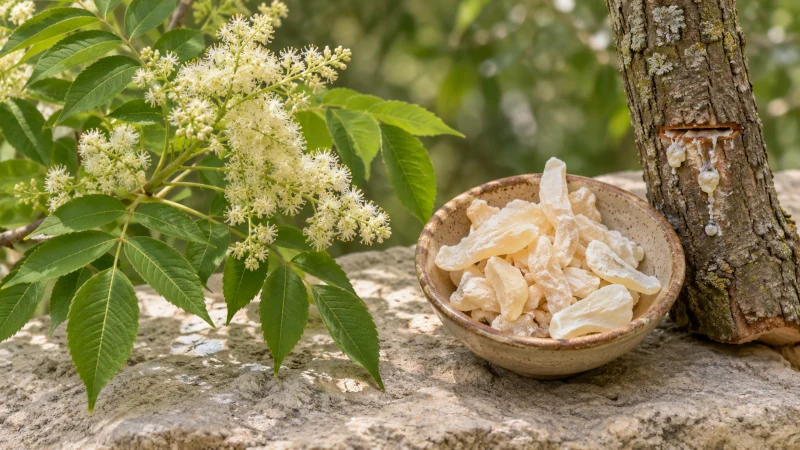
Manna is the dried sap of the manna or flowering ash, Fraxinus ornus, a southern European relative of bird’s tongue. It is rich in mannitol, a sugar alcohol that may help stool move through the intestine [RxList, Manna].
Some herbal sources call manna a highly effective laxative that is especially suitable for children. Current evidence doesn’t back either claim. The evidence is rated insufficient for constipation and for hemorrhoids, and there isn’t enough information to set a dose; follow the product label and ask a pharmacist [RxList, Manna]. Before giving any laxative to a child, check with their pediatrician.
Short-term use appears safe for most adults, though some people get nausea or gas. Don’t use it if you might have a bowel obstruction. Manna can interact with:
- Digoxin — lower potassium can increase digoxin side effects.
- Warfarin — diarrhea can strengthen warfarin’s effect and raise bleeding risk.
- Diuretics (“water pills”) — both can lower potassium, possibly too far.
Source for this section: [RxList, Manna].
If you’re weighing gentler options for occasional constipation, see our roundup of herbs for constipation. If straining is tied to hemorrhoids or a fissure, our guide to herbs for hemorrhoids and anal fissures covers what helps and when bleeding needs a doctor.
Ash bark and the “American ash” mix-up
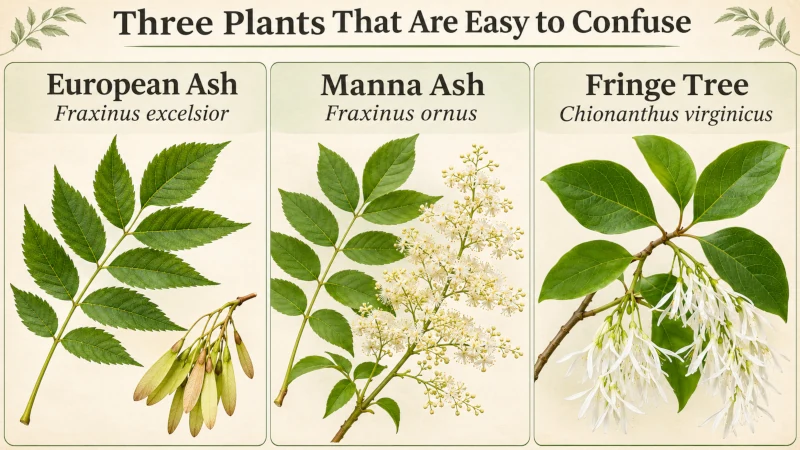
Ash bark has a long folk reputation for fever and sluggish digestion. No trial has tested it alone for either; its only clinical data come from the STW1 combination [Gundermann et al., 2020], and the evidence for ash in fever is rated insufficient [RxList, Ash].
Some herbal sources describe Chionanthus virginicus as “American ash” and recommend its bark for fever. That plant is the fringe tree, an olive-family shrub traditionally used for liver and gallbladder complaints. There is no good scientific evidence for those uses, and not enough information to know whether it is safe to take by mouth or at what dose [TRC, Fringetree]. The true American ashes are Fraxinus species such as white ash, F. americana, which supplement references list alongside European ash [RxList, Ash].
For a fever, rest, fluids, and easy food usually do more than any bark. Our guide to foods to eat when you have a fever covers what to eat and which warning signs mean it’s time to call a doctor.
How to use bird’s tongue leaf tea
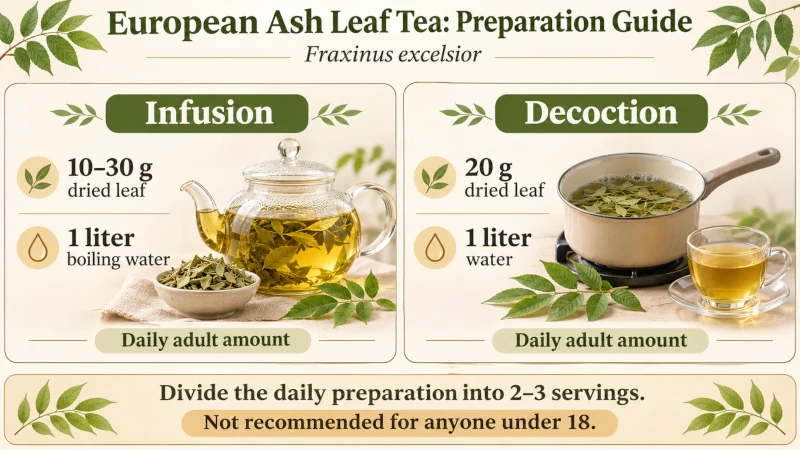
The EU monograph gives these adult amounts, each split into two or three servings across the day [EMA, 2012]:
| Preparation | Daily amount (adults) | How long before you check in with a doctor |
| Infusion (steeped) | 10–30 g of cut, dried leaf in 1 liter of boiling water | Joint aches: if symptoms persist beyond 4 weeks |
| Decoction (simmered) | 20 g of cut, dried leaf in 1 liter of water | Urinary complaints: if symptoms persist beyond 2 weeks |
Source: [EMA, 2012 monograph]. Not recommended for anyone under 18.
A liter split into three servings works out to about three mugs a day. Buy leaf labeled with the botanical name, Fraxinus excelsior or F. angustifolia, so you know you are getting ash and not fringe tree or mountain ash, which are unrelated plants.
Side effects, interactions, and who should avoid it
Ash leaf has a clean record so far. The EU monograph lists no known side effects and no reported interactions [EMA, 2012], and a 2021 search of the EU’s adverse-reaction database found no reports for ash leaf products [EMA, 2022]. That is reassuring but incomplete: toxicology data are very limited, and the assessors said the safety of therapeutic use can’t be fully established [EMA, 2012]. If you take diuretics, heart medicines, lithium, or blood thinners, ask a pharmacist before adding a herbal diuretic.
Skip bird’s tongue if you:
- Are pregnant or breastfeeding — safety hasn’t been established [EMA, 2012].
- Are under 18 [EMA, 2012].
- Have severe heart or kidney disease, or any condition where your doctor has told you to limit fluids [EMA, 2012].
- Are allergic to ash. Hypersensitivity is the one listed contraindication [EMA, 2012]. Ash pollen cross-reacts strongly with olive pollen [Imhof et al., 2014]; there are no published reports linking that to leaf tea, but if you react badly to ash or olive pollen, start cautiously or avoid it.
- Might have a bowel obstruction (applies to manna) [RxList, Manna].
When to see a doctor
Self-care with an herbal tea makes sense only for mild, clearly minor symptoms. Get medical advice promptly if you notice:
- A joint that is swollen, red, hot, or comes with fever [EMA, 2012]. A sudden, intensely painful joint can be a gout flare or an infection.
- Fever, painful urination, cramping, or blood in the urine [EMA, 2012], or pain in your side or back with fever.
- Joint aches lasting more than 4 weeks, or urinary complaints lasting more than 2 weeks, despite the tea [EMA, 2012].
- Constipation with severe belly pain, vomiting, blood in the stool, or a change in bowel habits that won’t settle.
- Any snakebite. Call emergency services right away.
HEALTH DISCLAIMER: This article is for general education and isn’t a substitute for advice, diagnosis, or treatment from a qualified healthcare professional. Herbal products vary in strength and quality and can affect medical conditions and medicines. If you are pregnant, breastfeeding, under 18, managing a chronic condition, or taking prescription medication, talk to your doctor or pharmacist before using bird’s tongue (ash) leaf, ash bark, or manna.
Frequently Asked Questions
Is the bird’s tongue plant the same as the ash tree?
Yes. “Bird’s tongue” is an old name for the European ash, Fraxinus excelsior, taken from the shape of its winged seeds [Gerard]. It is unrelated to mountain ash (rowan) and to fringe tree.
Can bird’s tongue tea help with gout?
There is no human evidence that ash leaf lowers uric acid or prevents gout attacks [RxList, Ash]. Gout needs proper medical treatment; a herbal tea shouldn’t replace it.
How long can I drink ash leaf tea?
The EU monograph doesn’t set a hard limit, but says to see a doctor if joint aches persist beyond 4 weeks or urinary complaints beyond 2 weeks [EMA, 2012].
Is manna safe for children?
There isn’t enough evidence to set a safe dose for anyone, children included [RxList, Manna]. Ask your child’s pediatrician before using manna or any other laxative.
References
- European Medicines Agency, HMPC. Community herbal monograph on Fraxinus excelsior L. or Fraxinus angustifolia Vahl, folium. View source
- European Medicines Agency, HMPC. Assessment report on Fraxinus excelsior L. or Fraxinus angustifolia Vahl, folium. View source
- European Medicines Agency, HMPC. Addendum to assessment report on Fraxinus excelsior L. View source
- European Medicines Agency. Fraxini folium — herbal medicinal product. View source
- Gundermann K-J, Müller J, Kraft K. STW1 and its versatile pharmacological and clinical effects in rheumatic disorders: a comprehensive report. View source
- Kostova I, Iossifova T. Chemical components of Fraxinus species. Fitoterapia. View source
- Imhof K, Probst E, Seifert B, Regenass S, Schmid-Grendelmeier P. Ash pollen allergy: View source
- RxList (Therapeutic Research Center content). Ash: uses, side effects, interactions. View source
- RxList (Therapeutic Research Center content). Manna: uses, side effects, interactions. View source
- Therapeutic Research Center. Fringetree (Chionanthus virginicus) monograph, via Vitally. View source
- Gerard J. The Herball, or Generall Historie of Plantes, ch. 109: Of the Ash Tree. View source
- Pliny the Elder. Natural History, Book XVI, ch. 24. View source


