

Eating well is only half of good nutrition. The other half happens after you swallow: your body has to break food down, absorb it, carry it through your bloodstream, put it to work inside your cells, and clear out what’s left. Nutrition for ideal health means paying attention to both halves: choosing good food, and knowing what can stop your body from using it.
Most of the second half runs on its own. You don’t need to micromanage digestion or “detox” your organs. But a few everyday choices make a real difference, and some common conditions and medications can quietly interfere, sometimes for years before you notice.
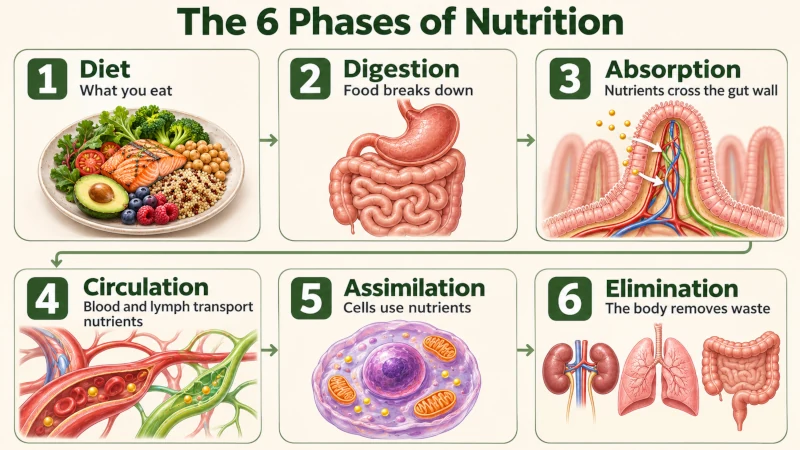
The 6 phases at a glance
| Phase | What happens | Where | What you can influence |
| 1. Diet | Everything you eat and drink, including supplements | Your plate | Food quality, fiber, nutrient pairings |
| 2. Digestion | Food is broken into amino acids, fatty acids and glycerol, and simple sugars | Mouth, stomach, small intestine, with help from the pancreas | Chewing; the rest is automatic |
| 3. Absorption | Nutrients cross the intestinal wall | Mostly the small intestine | Getting gut conditions diagnosed and treated |
| 4. Circulation | Blood and lymph carry nutrients onward | Bloodstream, liver, lymph system | Little directly |
| 5. Assimilation | Cells use nutrients for energy, growth and repair | Every cell | Eating well consistently |
| 6. Elimination | Wastes leave as urine, stool and exhaled breath | Kidneys, large intestine, lungs | Fiber, fluids, skipping unproven cleanses |
Phase 1: Diet, the phase you control most
Your diet sets the ceiling for every phase that follows. The body can’t absorb a nutrient you never ate.
Current U.S. federal guidance is built around a short message, “Eat Real Food,” and recommends cutting back on highly processed foods, especially those with refined carbohydrates, added sugars and excess sodium [ODPHP, 2026]. That doesn’t make every packaged food a problem. Frozen vegetables and plain yogurt are processed too. Our guide to which processed foods to limit and which are fine sorts out the difference, and our list of the best foods for humans covers the plant foods at the center of most healthy eating patterns.
Fiber is the highest-value change
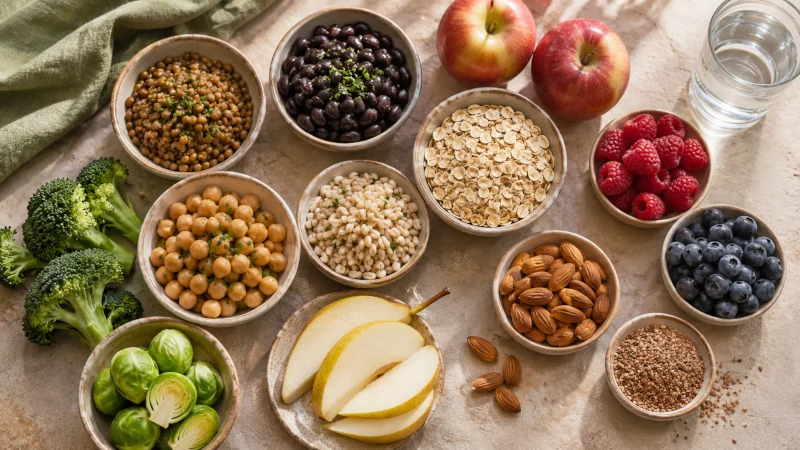
If you change one thing, make it fiber. A large series of systematic reviews and meta-analyses found the biggest drop in risk across several major chronic diseases, including heart disease, type 2 diabetes and colorectal cancer, among people eating 25 to 29 grams of fiber a day. Clinical trials in the same analysis linked higher fiber intake to lower body weight, blood pressure and cholesterol [Reynolds et al., 2019]. Much of that evidence comes from long-term observational studies, which can’t prove cause on their own, and the authors rated most of it as moderate certainty.
U.S. recommendations land in the same range: 22 to 34 grams a day for adults, depending on age and sex. Add fiber a little at a time so your body can adjust, and drink enough fluids to help it work [NIDDK, n.d.].
Some nutrients absorb better in company
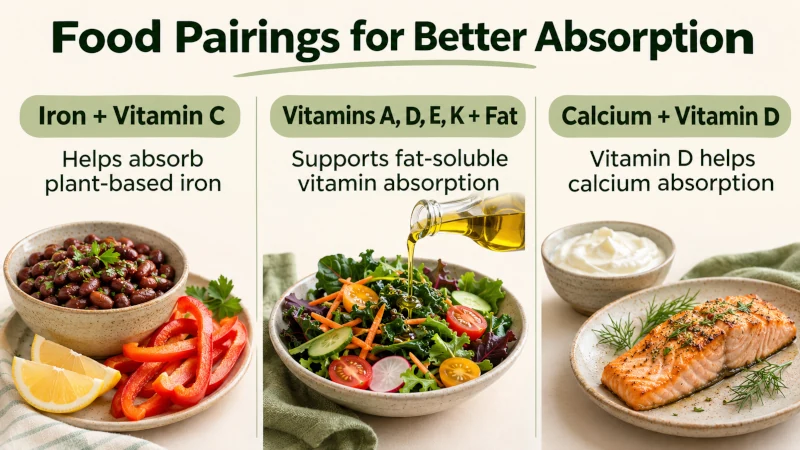
What you eat together can change how much you absorb:
- Plant iron plus vitamin C. Your body absorbs iron from beans, greens and fortified grains better when you eat them with vitamin C foods such as citrus, strawberries, sweet peppers, tomatoes or broccoli [NIH ODS, n.d.].
- Vitamins A, D, E and K plus some fat. These are fat-soluble, and dietary fat helps your body absorb them [MedlinePlus, n.d.]. A drizzle of olive oil on a salad does real work.
- Calcium plus vitamin D. Vitamin D helps your body absorb calcium [NIH ODS, n.d.].
Phase 2: Digestion
Digestion starts in your mouth. Chewing breaks food into smaller pieces, and saliva contains an enzyme that begins breaking down starch [NIDDK, n.d.]. Chewing and swallowing are the last steps you consciously control. After that, hormones and nerves take over, including a network of nerves in the gut wall itself, signaling when to release digestive juices and how fast to move food along [NIDDK, n.d.].
By the time food leaves the small intestine, it has been taken apart into pieces your body can use. Proteins become amino acids, fats become fatty acids and glycerol, and carbohydrates become simple sugars [NIDDK, n.d.]. Those simple sugars are what you measure as blood sugar after a meal.
Phase 3: Absorption
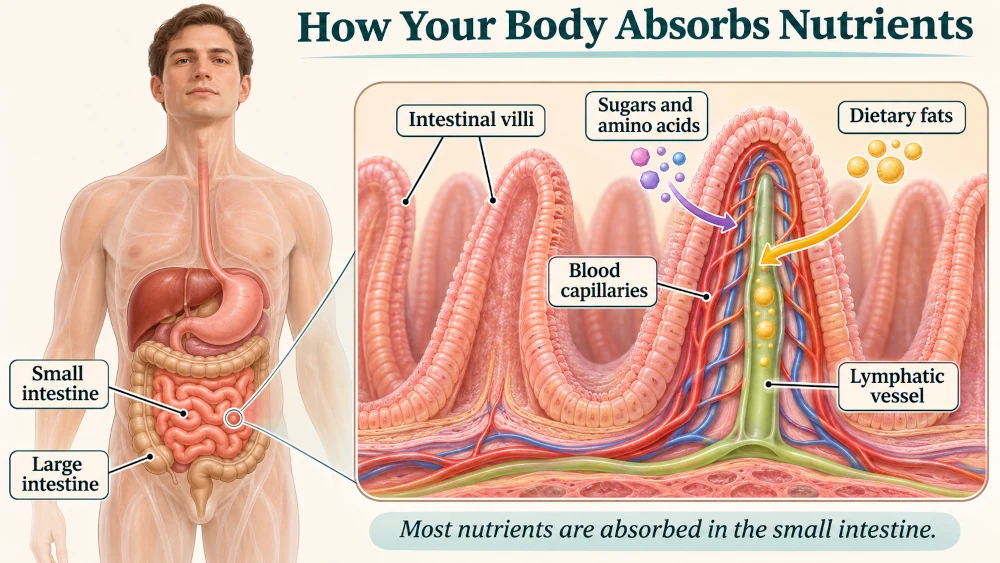
Your small intestine absorbs most of the nutrients in your food, passing water and digested nutrients into the bloodstream [NIDDK, n.d.]. The large intestine takes back water and turns what’s left into stool. Bacteria living there also help break down remaining nutrients and make vitamin K [NIDDK, n.d.].
Fats take a side route. Fatty acids and some vitamins are picked up by the lymphatic system rather than going straight into the blood [NIDDK, n.d.] [Better Health Channel, n.d.].
When absorption breaks down
Malabsorption means your body has trouble absorbing nutrients from food. Causes include celiac disease, Crohn’s disease, bacterial overgrowth in the small intestine, surgery that removes part of the stomach or intestine, and pancreas problems such as cystic fibrosis or pancreatitis. The pancreas supplies enzymes needed to absorb fat. Some medicines can contribute as well [MedlinePlus, n.d.].
In adults, the main signs are weight loss, muscle wasting and weakness. Bloating, gas, bulky or fatty stools and chronic diarrhea are common but don’t always appear [MedlinePlus, n.d.]. Weight loss in this setting is a warning sign, not a welcome side effect.
Vitamin B12: a nutrient you can eat and still miss
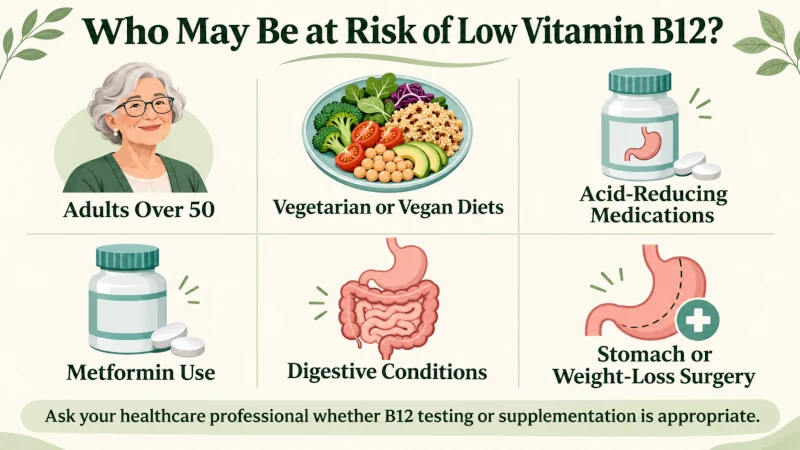
B12 shows how a nutrient can be on your plate and still not reach your cells. Absorbing it from food takes stomach acid and a protein called intrinsic factor. Many older adults don’t make enough stomach acid, which is why people over 50 are advised to get most of their B12 from fortified foods or supplements [NIH ODS, n.d.]. Others at higher risk include people with pernicious anemia, atrophic gastritis, celiac or Crohn’s disease, or weight-loss or stomach surgery, plus vegetarians and vegans, since B12 occurs naturally only in animal foods [NIH ODS, n.d.].
Medications matter here. Stomach-acid reducers such as omeprazole, lansoprazole and cimetidine can lead to B12 deficiency, and the diabetes drug metformin may reduce B12 absorption [NIH ODS, n.d.].
Because the body stores a lot of B12, symptoms can take years to appear. They include tiredness, weakness, numbness or tingling in the hands and feet, balance problems, confusion, memory problems and depression [NIH ODS, n.d.]. Nerve damage can happen even without anemia [NIH ODS, n.d.]. These symptoms overlap with other problems common later in life, including depression in older adults, so they’re worth raising with a doctor rather than writing off as age.
Phase 4: Circulation
Once nutrients cross the intestinal wall, your blood carries simple sugars, amino acids, glycerol, and some vitamins and salts to the liver first. The liver stores and processes them, then releases them as the rest of your body needs them [NIDDK, n.d.].
Think of circulation as the body’s transit system: always running, delivering supplies to every cell. For most people it needs no special support beyond the habits that keep the heart and blood vessels healthy generally.
Phase 5: Assimilation
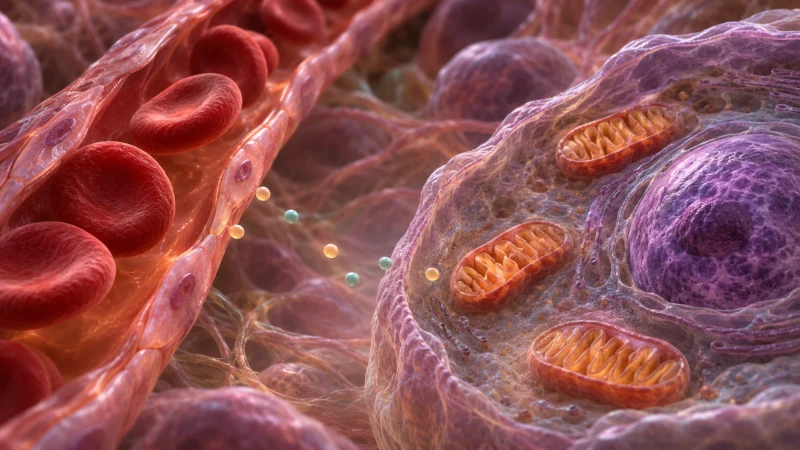
“Assimilation” is an older word for what happens when nutrients reach your cells and get used. Today it’s usually described as metabolism: the process your body uses to get or make energy from the food you eat [MedlinePlus, n.d.]. Cells also use nutrients as raw material to grow and repair themselves.
How long a nutrient stays available depends on how it’s stored. Fat-soluble vitamins (A, D, E and K) are stored in the liver, fatty tissue and muscles. Water-soluble vitamins, meaning vitamin C and the B vitamins, aren’t stored; extra amounts leave in urine, so you need a regular supply. B12 is the exception and can be stored in the liver for years [MedlinePlus, n.d.].
Two practical points follow. Eating well consistently matters more than any single “healthy” meal. And because fat-soluble vitamins accumulate rather than wash out, high-dose supplements of A, D, E or K are worth discussing with a clinician before you start.
Phase 6: Elimination
Every phase produces leftovers, and your body has several exits. Your kidneys filter about 150 quarts of blood a day, return most of it to circulation, and turn only 1 to 2 quarts into urine that carries off wastes and extra water [NIDDK, n.d.]. Your lungs breathe out carbon dioxide, a waste gas from the blood [NHLBI, n.d.]. Your large intestine turns undigested material into stool [NIDDK, n.d.].
The most useful thing you can do for this phase is unglamorous: enough fiber, added gradually, with enough fluid to help it work [NIDDK, n.d.]. If constipation is a regular problem, our guide to herbs for constipation, ranked by evidence covers what helps and what carries risk. If your gut swings both ways, see foods to eat with IBS.

Do you need a detox?
Some natural-health sources claim that waste “backs up” in the colon and slowly poisons the body, so you need cleanses, colonics or detox teas. The idea has a name: intestinal autointoxication. It was popular with physicians around 1900, but experiments in the 1910s cast doubt on whether bowel toxins actually reach the circulation, and the theory lost professional acceptance during the 1920s [Whorton, 2000].
Modern detox programs haven’t revived it. Studies in people are few and generally low quality. Colon cleansing can cause side effects, some serious, and laxatives used in detox programs can cause diarrhea that leads to dehydration. The risk is higher if you have gastrointestinal disease, have had colon surgery, or have severe hemorrhoids, kidney disease or heart disease [NCCIH, 2025].
Constipation can make you feel genuinely unwell. The answer is to treat the constipation, not to flush your colon.
When to see a doctor
Self-care is fine for occasional sluggish digestion. It isn’t enough if you notice any of the following:
- Bleeding from your rectum or blood in your stool [NIDDK, n.d.]
- Losing weight without trying [NIDDK, n.d.]
- Constipation with constant belly pain, vomiting, fever, lower back pain or inability to pass gas. See a doctor right away [NIDDK, n.d.]
- Chronic diarrhea, or bulky or fatty stools [MedlinePlus, n.d.]
- Numbness or tingling in your hands or feet, balance problems, or new confusion or memory trouble [NIH ODS, n.d.]
Ask about your B12 status if you’re over 50, take acid reducers or metformin, eat a vegetarian or vegan diet, or have had weight-loss or stomach surgery [NIH ODS, n.d.]. If you’re pregnant or breastfeeding and don’t eat animal foods, check your B12 intake with your clinician. Breastfed babies of vegan mothers can become deficient too [NIH ODS, n.d.].
| HEALTH DISCLAIMER: This article is for general education. It is not a substitute for advice, diagnosis or treatment from a qualified healthcare professional. Talk to your doctor, pharmacist or a registered dietitian before making major changes to your diet, starting a supplement, or changing any medication, especially if you are pregnant, breastfeeding, managing a chronic condition or taking prescription drugs. |
Frequently Asked Questions
What are the 6 phases of nutrition?
Diet, digestion, absorption, circulation, assimilation and elimination. In plain terms: what you eat, how it’s broken down, how it crosses the gut wall, how it travels through your body, how your cells use it, and how wastes leave.
Where are most nutrients absorbed?
In the small intestine. The large intestine mainly absorbs water and forms stool, and its bacteria make vitamin K [NIDDK, n.d.].
Can you eat a healthy diet and still be low in nutrients?
Yes. Conditions such as celiac disease, Crohn’s disease and pancreas problems can block absorption [MedlinePlus, n.d.], and age, acid-reducing medicines and metformin can lower B12 absorption [NIH ODS, n.d.].
Do I need a detox or colon cleanse?
There’s no good evidence that you do. Your kidneys, lungs and intestines already clear wastes, and colon cleansing carries risks, including dehydration [NCCIH, 2025].
How much fiber should I eat?
U.S. guidance suggests 22 to 34 grams a day for adults, depending on age and sex [NIDDK, n.d.]. A large review found the greatest benefit at 25 to 29 grams a day [Reynolds et al., 2019]. Increase slowly and drink enough fluids.
References
- Better Health Channel (Victoria State Government). Lymphatic system. View source
- MedlinePlus (U.S. National Library of Medicine). Malabsorption. View source
- MedlinePlus. Metabolic disorders. View source
- MedlinePlus. Vitamins. View source
- National Center for Complementary and Integrative Health (NCCIH). “Detoxes” and “Cleanses”: What You Need To Know. View source
- National Heart, Lung, and Blood Institute (NHLBI). How the Lungs Work. View source
- NIDDK. Your Digestive System & How It Works. View source
- NIDDK. Your Kidneys & How They Work. View source
- NIDDK. Eating, Diet, & Nutrition for Constipation. View source
- NIDDK. Symptoms & Causes of Constipation. View source
- NIH Office of Dietary Supplements. Iron: Fact Sheet for Consumers. View source
- NIH Office of Dietary Supplements. Vitamin B12: Fact Sheet for Consumers. View source
- NIH Office of Dietary Supplements. Vitamin D: Fact Sheet for Consumers. View source
- Office of Disease Prevention and Health Promotion (ODPHP). Current Dietary Guidelines View source
- Reynolds A, Mann J, Cummings J, Winter N, Mete E, Te Morenga L. Carbohydrate quality and human health: a series of systematic reviews and meta-analyses. View source
- Whorton J. Civilisation and the colon: constipation as the “disease of diseases.” View source


