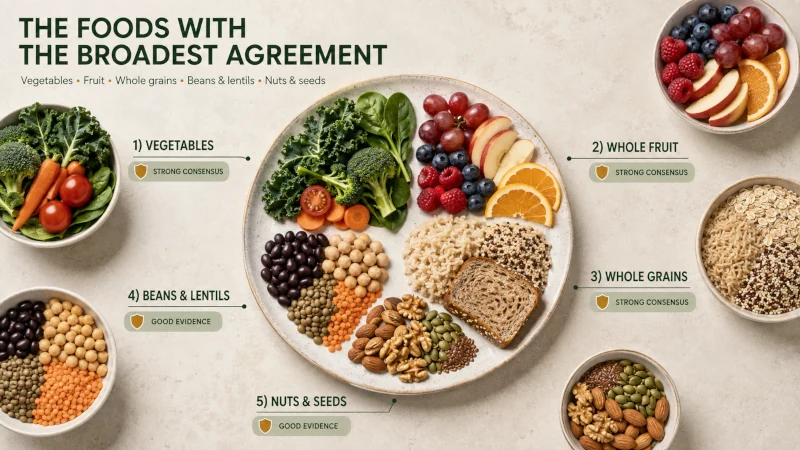
Five foods show up on nearly every credible list of the best foods for humans: vegetables, fruit, whole grains, beans and lentils, and nuts. Health agencies that agree on almost nothing else agree on these. If you eat more of them and less of everything that comes in a wrapper, you have captured most of the available benefit.
The argument starts after that.
In January 2026 the United States released the Dietary Guidelines for Americans, 2025–2030, and it looked different from the four editions before it. It raised protein targets, welcomed full-fat dairy and butter back to the table, and told people to “eat real food” [USDA & HHS, 2026]. Within days, nutrition scientists at Harvard, Stanford and the Center for Science in the Public Interest published sharp criticism [Harvard, 2026] [Stanford, 2026] [CSPI, 2026]. Reasonable readers came away confused.
Underneath the noise, the picture is steadier than it looks.
The best foods for humans that almost nobody argues about
| Food | What the evidence shows | Strength |
| Vegetables — especially leafy greens and cruciferous | Pooled cohort studies: more than 5 servings of fruit and vegetables daily is linked to roughly 20% lower risk of coronary heart disease and stroke versus fewer than 3 | Strong |
| Fruit — whole, not juice | Each additional daily serving of fruit or vegetables is associated with about 4% lower cardiovascular death risk | Strong |
| Whole grains | 70 g daily linked to 22% lower total mortality and 23% lower cardiovascular mortality in a meta-analysis of over 786,000 people | Strong |
| Beans, lentils, peas | Highest versus lowest intake associated with 10% lower cardiovascular disease and coronary heart disease risk (RR 0.90, 95% CI 0.84–0.97); no effect found for stroke | Good |
| Nuts and seeds | One ounce five or more times weekly linked to 14% lower cardiovascular disease and 20% lower coronary heart disease risk across 210,000 people followed up to 32 years | Good |
Sources: Harvard Nutrition Source for vegetables, fruit, whole grains and nuts; Marventano 2017 for legumes.
Two honest caveats about that table. Almost all of these figures come from observational cohort studies, which show association rather than proof of cause. People who eat more vegetables also tend to smoke less, move more and have more money, and no statistical adjustment removes all of that. And the numbers are population averages — nobody is promising you personally a 22% risk reduction.
What makes the evidence persuasive anyway is that it points the same direction across different countries, decades, study designs and outcomes. That consistency is the reason these five survive every revision of every guideline, including the contested 2026 one, which still asks for three servings of vegetables and two of fruit a day.
Patterns matter more than any single food
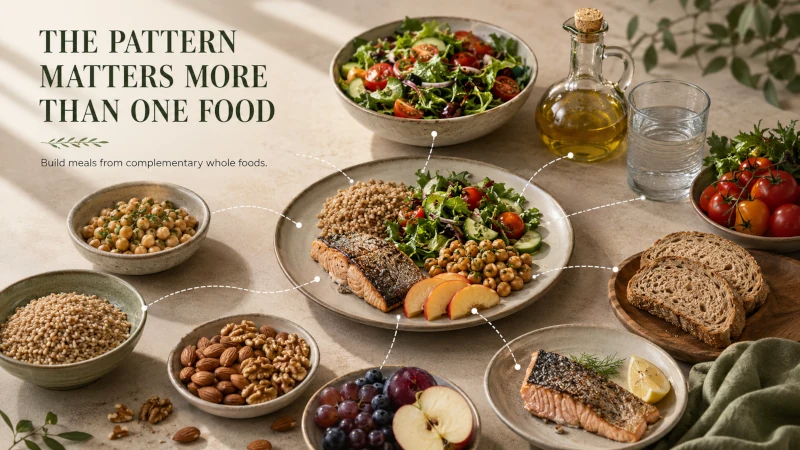
No food does much on its own. What changes outcomes is the overall pattern, and the strongest evidence for that comes from a trial rather than a survey.
The PREDIMED study randomly assigned 7,447 adults at high cardiovascular risk to a Mediterranean diet with extra-virgin olive oil, the same diet with nuts, or a lower-fat control diet. Both Mediterranean groups had fewer heart attacks, strokes and cardiovascular deaths — hazard ratios of 0.69 and 0.72, about a 30% reduction [Estruch, 2018].
That trial also shows what trustworthy science looks like when it goes wrong. The original 2013 publication was retracted in 2018 after irregularities in how participants were randomised: some households were enrolled together, one site randomised clinics rather than individuals, and randomisation tables were used inconsistently [NEJM, 2018]. The authors reanalysed the data, dropped 1,588 participants whose assignment was questionable, and republished. The conclusions held [Harvard, 2018].
Two things follow. Confidence in a dietary pattern should never rest on one paper. And an older version of this article cited the retracted 2013 paper — a mistake we have corrected here rather than quietly deleted. Our heart-healthy diet guide covers the Mediterranean and DASH patterns in practical detail.
Where nutrition experts genuinely disagree
This is the part most articles skip. Three questions are live, and anyone telling you they are settled is overselling.
How much protein you need. The 2025–2030 Guidelines recommend 1.2–1.6 g per kilogram of body weight daily [USDA & HHS, 2026]. The American Heart Association still cites the RDA of 0.8 g/kg, or 10–35% of calories, and recommends favouring beans, lentils, nuts, seeds and soy, with fish and smaller amounts of lean meat [AHA]. Stanford’s response noted that most Americans already meet their protein needs [Stanford, 2026]. Harvard’s Frank Hu warned that “substantially raising overall protein intake without distinguishing between different protein sources may have unintended long-term health implications” [Harvard, 2026]. Nobody disputes that protein is essential. The dispute is whether most people are short of it, and what it should come from.
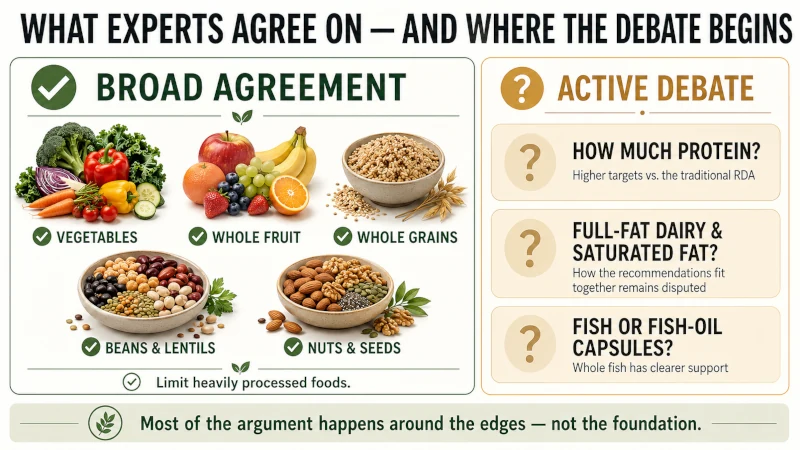
Saturated fat and full-fat dairy. The 2025–2030 Guidelines keep the 10%-of-calories cap on saturated fat while recommending three daily servings of full-fat dairy and describing butter and beef tallow as acceptable fats [USDA & HHS, 2026]. Harvard’s analysis pointed out the arithmetic problem: three full-fat dairy servings use roughly 17 of the ~22 grams of saturated fat that cap allows, leaving almost nothing for cooking [Harvard, 2026]. Stanford called meeting both targets “difficult, if not impossible” [Stanford, 2026]. CSPI, an advocacy group, was blunter, calling the framing of butter and tallow as healthy fats “blatant misinformation” [CSPI, 2026]. This one is unresolved, and how it resolves matters for what you put on toast.
Fish oil capsules. Eating fish is well supported. Supplements are murkier. In the VITAL trial, omega-3 supplements produced a statistically significant 28% reduction in total heart attacks but did not affect all-cause mortality, cardiovascular events overall, stroke or arrhythmia [NIH ODS]. Prescription-strength doses show larger effects. For most people, fish itself is the better bet than a capsule.
When guidance splits like this, look at what both sides still hold: vegetables, fruit, whole grains, beans, nuts, less ultra-processed food. The contested territory is smaller than the volume of the argument suggests.
What to eat less of
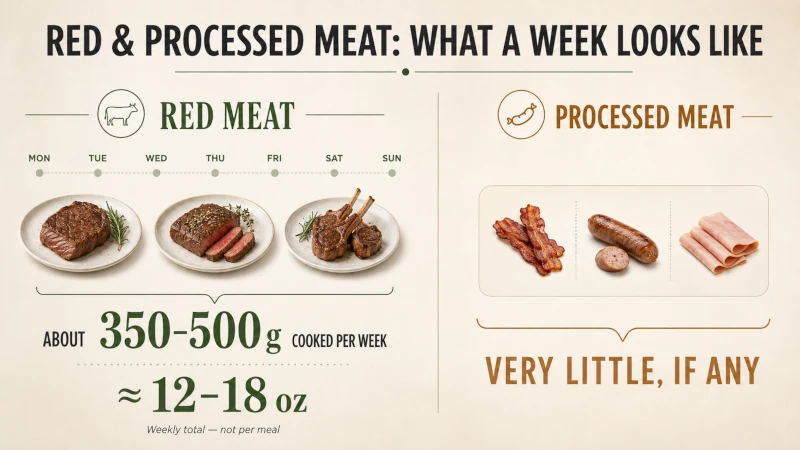
The evidence for limiting these is stronger and less contested than most of the arguments above.
Processed meat. The International Agency for Research on Cancer classifies processed meat as Group 1, carcinogenic to humans, with about an 18% higher colorectal cancer risk per 50 g eaten daily [WHO/IARC, 2015]. That classification describes how certain scientists are that it causes cancer, not how dangerous it is — the same category holds tobacco, and the risks are nowhere near equivalent. WHO makes this point explicitly. The World Cancer Research Fund recommends “very little, if any” processed meat [WCRF, 2018].
Red meat. Classified Group 2A, probably carcinogenic [WHO/IARC, 2015]. WCRF suggests capping unprocessed red meat at about three portions weekly, roughly 350–500 g (12–18 oz) cooked [WCRF, 2018]. We go through the graded evidence food by food in our guide to a cancer-preventing diet.
Ultra-processed food. A 2024 umbrella review covering 45 pooled analyses and nearly 10 million people linked higher intake to 32 of 45 health outcomes examined. Evidence was graded “convincing” for cardiovascular disease mortality, common mental disorders and type 2 diabetes — but under GRADE, most pooled analyses rated low or very low quality, and the authors flagged substantial heterogeneity [Lane, 2024]. Directionally consistent, methodologically imperfect. Our guide to what has gone wrong with the modern diet covers this in more depth.
Salt. WHO recommends under 5 g of salt (2 g sodium) daily; global average intake in 2021 was about 11 g, and an estimated 1.7 million deaths in 2023 were associated with excess sodium [WHO, 2026]. Most of it is not from the salt shaker — see how to lower salt and sugar without eating bland food.
Added sugar. WHO recommends free sugars below 10% of calories, about 50 g daily, with further benefit below 5% [WHO, 2026]. The 2025–2030 Guidelines go further, stating no amount of added sugar is recommended [USDA & HHS, 2026].
Animal foods that earn a place
An older version of this article argued that plant foods prevent and cure disease while animal foods do not, except in rare cases. That claim does not survive contact with the evidence, and we have dropped it. Several animal foods have real support.
Fish. Oily fish supplies EPA and DHA, which the body makes from plant-derived ALA at a conversion rate under 15% [NIH ODS]. The NHS suggests at least two portions of fish weekly, one of them oily [NHS].
Eggs. Nutrient-dense and, for most people, fine daily. Our full guide to eggs covers the cholesterol question properly.
Yogurt and fermented foods. The old claim that yogurt boosts immunity overstates what is known. NCCIH is clear that effects are strain-specific: if one Lactobacillus helps with something, that says nothing about a different strain [NCCIH, 2019]. Yogurt is a good food. Treat immunity claims on the label sceptically.
Honey. Pleasant, mildly useful for coughs, and still sugar. Royal jelly, propolis and bee pollen are widely sold as tonics, but the evidence for those claims is thin — NIH’s LiverTox notes the proposed activities “have not been convincingly shown in humans” — and they carry real allergy risk, including reported anaphylaxis [NIH LiverTox].
Liver. Genuinely rich in iron and B12, and genuinely risky in quantity. A single 3-oz serving of beef liver contains about 6,582 mcg RAE of preformed vitamin A — 731% of the Daily Value, and more than double the adult upper limit of 3,000 mcg [NIH ODS]. Excess preformed vitamin A causes birth defects, which is why the NHS tells pregnant women to avoid liver entirely [NHS]. Eat it occasionally if you like it, not daily, and not in pregnancy.
On design, and what this page rests on
The original version of this article opened with an engineer specifying the right fuel for an engine he built, and asked whether human nutrition works the same way. Many readers here believe it does — that the foods described in the opening chapters of Genesis were given deliberately, and that the fit between what plants make and what people need is not coincidence.
That belief is not what the recommendations above rest on. Every claim on this page stands or falls on the studies cited beside it, and would stand or fall the same way for a reader who holds no such belief. What can be said fairly is narrower and more interesting: when researchers with no theological commitments follow the outcome data, they keep arriving at a diet built mostly from plants. Readers can draw their own conclusions about why.
If you eat mostly plants, mind these four nutrients
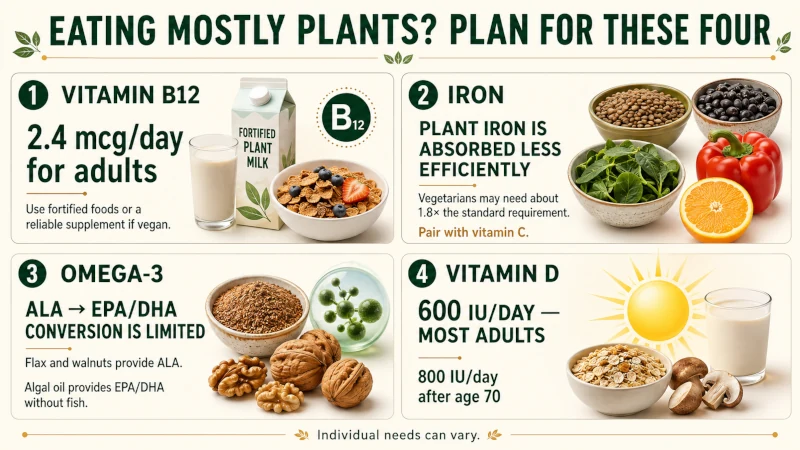
The Academy of Nutrition and Dietetics holds that well-planned vegetarian and vegan diets are appropriate at every life stage and are associated with lower risk of heart disease, type 2 diabetes, hypertension and obesity [Melina, 2016]. “Well-planned” is load-bearing.
Vitamin B12 is the one you cannot improvise. Plant foods do not naturally contain it [NIH ODS]. The old version of this article claimed vegetarians somehow avoid deficiency for reasons that are not understood — that is wrong, and it was the most dangerous sentence on the page. Vegans need fortified foods or a supplement, full stop. Adults need 2.4 mcg daily, 2.6 in pregnancy, 2.8 while breastfeeding. Metformin and proton pump inhibitors both reduce absorption, so long-term users should have levels checked whatever they eat. See our guide to food sources of vitamin B12.
Iron from plants is absorbed less efficiently, and vegetarians need about 1.8 times the standard requirement. Vitamin C at the same meal helps considerably; tea and coffee with meals hinder it [NIH ODS].
Omega-3s. ALA from flax and walnuts converts poorly. Algal oil is the practical vegan source of EPA and DHA [NIH ODS].
Vitamin D. Few foods supply much. Adults need 15 mcg (600 IU) daily, 20 mcg (800 IU) after 70, with an upper limit of 100 mcg (4,000 IU) [NIH ODS].
Calcium, iodine and zinc deserve attention too, though they are easier to cover with fortified foods and variety.
Safety: who needs to be more careful
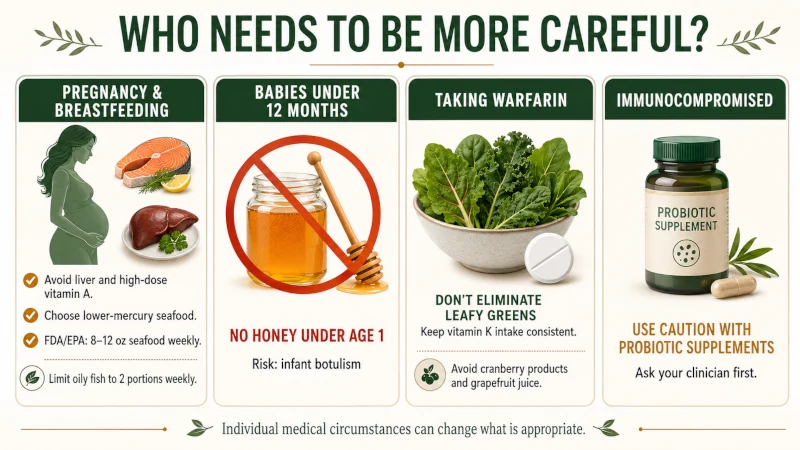
Pregnancy and breastfeeding. Avoid liver and high-dose vitamin A. Limit oily fish to two portions weekly, and avoid king mackerel, marlin, orange roughy, shark, swordfish, Gulf of Mexico tilefish and bigeye tuna. FDA and EPA advise 8–12 oz weekly of lower-mercury seafood [FDA, 2024] [NHS].
Infants under 12 months. No honey, in any form, including honey-dipped pacifiers. It can cause infant botulism [CDC].
If you take warfarin. Vitamin K in leafy greens affects how warfarin works. You do not have to avoid greens — you have to keep intake steady and tell your anticoagulant clinic. Avoid cranberry products and grapefruit juice [NHS].
If you are immunocompromised or seriously ill. Probiotic supplements carry infection risk, and severe or fatal infections have been reported in premature infants [NCCIH, 2019]. Fermented foods in normal amounts are a different matter, but check with your clinician.
If you take fish oil at high doses. Doses of 2–15 g/day of EPA and DHA may increase bleeding time. FDA considers up to 5 g/day from supplements safe, and anyone on anticoagulants should be monitored [NIH ODS].
Antioxidant supplements are not concentrated vegetables. High-dose beta-carotene raises lung cancer risk in smokers; high-dose vitamin E has been linked to prostate cancer and one type of stroke [MedlinePlus].
Allergies. Royal jelly, propolis and bee pollen have caused asthma attacks and anaphylaxis, particularly in people with existing allergies or atopic disease [NIH LiverTox].
When food is not the answer
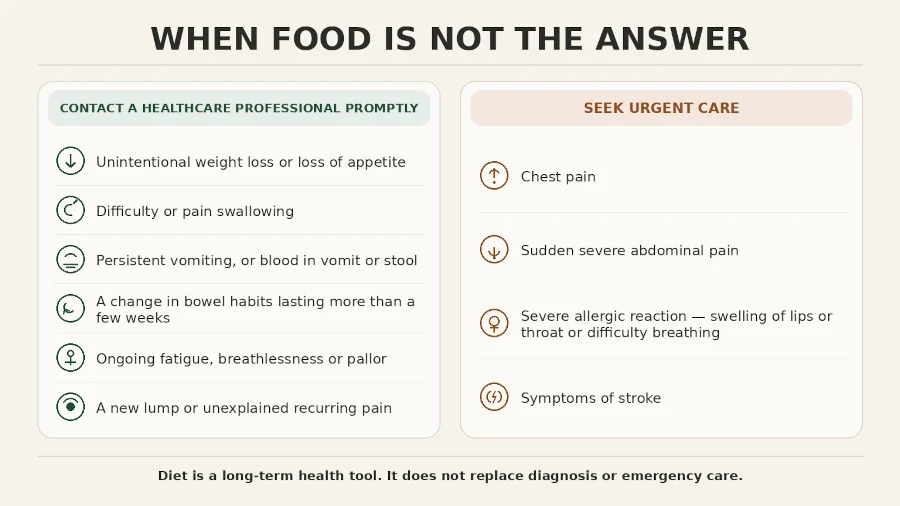
Diet is a long-term lever. It does not substitute for diagnosis. Contact a healthcare professional promptly if you have:
- Weight loss you did not intend, especially with loss of appetite [NHS]
- Difficulty or pain swallowing, or food sticking
- Persistent vomiting, or blood in vomit or stool
- A change in bowel habit lasting more than a few weeks
- Ongoing fatigue, breathlessness or pallor, which may indicate anaemia
- Any new lump, or unexplained pain that keeps returning
Seek urgent care for chest pain, sudden severe abdominal pain, signs of a severe allergic reaction (swelling of lips or throat, difficulty breathing), or symptoms of stroke.
If you have kidney disease, diabetes, heart failure or an eating disorder history, or you take regular medication, talk to your clinician or a registered dietitian before making large dietary changes. Guidance that is right for the general population can be wrong for you.
| HEALTH DISCLAIMER: This article is for education and general information. It is not medical advice, and it is not a substitute for diagnosis or treatment from a qualified professional. Nutrition research changes, and individual needs vary with age, medication, pregnancy and existing conditions. If you are pregnant, breastfeeding, managing a health condition, or taking medication, speak with your doctor, pharmacist or a registered dietitian before making significant changes to what you eat or starting any supplement. |
Frequently Asked Questions
Is there one single best food for humans?
No. No food supplies everything people need, and the outcome data consistently favours overall patterns rather than individual items. The closest thing to a universal answer is a category rather than a food: vegetables, eaten regularly and in variety.
Do humans need meat?
Not strictly. The Academy of Nutrition and Dietetics states that well-planned vegetarian and vegan diets are nutritionally adequate at all life stages [Melina, 2016]. “Well-planned” means a reliable B12 source and attention to iron, omega-3s, vitamin D, calcium, iodine and zinc. Meat makes adequacy easier to reach; it is not the only route there.
Why did the 2026 US Dietary Guidelines change so much?
The 2025–2030 edition raised protein targets, welcomed full-fat dairy and named butter and beef tallow among acceptable fats [USDA & HHS, 2026]. CSPI states the departments set aside much of the advisory committee’s scientific review [CSPI, 2026]. Harvard and Stanford both flagged internal contradictions, particularly between the saturated fat cap and the dairy recommendation [Harvard, 2026] [Stanford, 2026]. Judge the specific claims rather than the label on the document.
Are raw foods better than cooked?
Neither is categorically better. Cooking lowers some heat-sensitive vitamins, makes certain other plant compounds easier to absorb, and kills pathogens. Eating both is more useful than picking a side.
Is organic produce more nutritious?
The evidence on nutrient differences is mixed, and the stronger argument for organic concerns pesticide residues rather than nutrition. Eating more vegetables of any kind matters far more than which kind. Cost should never be the reason someone eats fewer.
How quickly would I notice a difference?
Blood pressure and blood lipids can shift within weeks of a substantial change. Cardiovascular and cancer risk reduction accumulates over years. Neither timeline is a reason to wait.
References
- Harvard T.H. Chan School of Public Health. Vegetables and Fruits. The Nutrition Source. n.d. View source
- Harvard T.H. Chan School of Public Health. Whole Grains. The Nutrition Source. n.d. View source
- Harvard T.H. Chan School of Public Health. Nuts for the Heart. The Nutrition Source. n.d. View source
- Marventano S, Izquierdo Pulido M, Sánchez-González C, et al. Legume consumption and CVD risk: a systematic review and meta-analysis. Public Health Nutr. 2017;20(2):245–254. doi:10.1017/S1368980016002299 View source
- Estruch R, Ros E, Salas-Salvadó J, et al. Primary Prevention of Cardiovascular Disease with a Mediterranean Diet Supplemented with Extra-Virgin Olive Oil or Nuts. N Engl J Med. 2018;378:e34. PMID 29897866. doi:10.1056/NEJMoa1800389 View source
- Retraction and Republication: Primary Prevention of Cardiovascular Disease with a Mediterranean Diet. N Engl J Med 2013;368:1279-90. N Engl J Med. 2018;378:2441–2442. PMID 29897867. doi:10.1056/NEJMc1806491 View source
- Harvard T.H. Chan School of Public Health. PREDIMED Study Retraction and Republication. 22 June 2018. View source
- U.S. Department of Agriculture & U.S. Department of Health and Human Services. Dietary Guidelines for Americans, 2025–2030. 2026. View source
- Harvard T.H. Chan School of Public Health. Dietary Guidelines for Americans 2025–2030: progress on added sugar, protein hype, saturated fat contradictions. 9 January 2026. View source
- Stanford Medicine Nutrition. What the 2025–2030 Dietary Guidelines Get Right — and Where They Fall Short. 2026. View source
- Center for Science in the Public Interest. New Dietary Guidelines undercut science and sow confusion. 2026. View source
- American Heart Association. Protein: What’s Enough? n.d. View source
- World Health Organization / IARC. Cancer: carcinogenicity of the consumption of red meat and processed meat. 2015. View source
- World Cancer Research Fund. Limit red and processed meat — recommendation evidence. 2018. View source
- Lane MM, Gamage E, Du S, et al. Ultra-processed food exposure and adverse health outcomes: umbrella review of epidemiological meta-analyses. BMJ. 2024;384:e077310. doi:10.1136/bmj-2023-077310 View source
- World Health Organization. Sodium reduction. Fact sheet, updated 11 May 2026. View source
- World Health Organization. Healthy diet. Fact sheet, 26 January 2026. View source
- NIH Office of Dietary Supplements. Omega-3 Fatty Acids — Health Professional Fact Sheet. n.d. View source
- NIH Office of Dietary Supplements. Vitamin B12 — Health Professional Fact Sheet. n.d. View source
- NIH Office of Dietary Supplements. Iron — Health Professional Fact Sheet. n.d. View source
- NIH Office of Dietary Supplements. Vitamin D — Health Professional Fact Sheet. n.d. View source
- NIH Office of Dietary Supplements. Vitamin A and Carotenoids — Health Professional Fact Sheet. n.d. View source
- National Center for Complementary and Integrative Health. Probiotics: What You Need To Know. Last updated August 2019. View source
- LiverTox: Clinical and Research Information on Drug-Induced Liver Injury. Bee Products: Beeswax, Bee Pollen, Propolis. NCBI Bookshelf NBK580275. View source
- Melina V, Craig W, Levin S. Position of the Academy of Nutrition and Dietetics: Vegetarian Diets. J Acad Nutr Diet. 2016;116(12):1970–1980. PMID 27886704. doi:10.1016/j.jand.2016.09.025 View source
- U.S. Food and Drug Administration & U.S. Environmental Protection Agency. Advice about Eating Fish. Content current as of 5 March 2024. View source
- NHS. Eating a balanced diet. n.d. View source
- NHS. Foods to avoid in pregnancy. n.d. View source
- NHS. Warfarin. n.d. View source
- NHS. Unintentional weight loss. n.d. View source
- Centers for Disease Control and Prevention. Preventing Botulism. n.d. View source
- MedlinePlus, U.S. National Library of Medicine. Antioxidants. n.d. View source
