
Your body needs two categories of nutrients, and it needs them in wildly different amounts. Carbohydrate, fat, and protein you eat by the gram, and they supply every calorie you take in. Vitamins and minerals you eat by the milligram or microgram, and they supply no calories at all. That split is the whole idea behind macronutrients and micronutrients — and it explains how someone can eat more than enough calories and still be short on iron.
The useful question isn’t which group matters more. It’s whether the foods carrying your calories are also carrying your vitamins and minerals. Refined grains, added sugars, and fried snacks deliver plenty of the first and very little of the second. Vegetables, beans, eggs, fish, nuts, and whole grains deliver both.
Macronutrients and micronutrients at a glance
| Macronutrients | Micronutrients | |
| What they are | Carbohydrate, fat, protein | Vitamins and minerals |
| Daily amounts | Grams to hundreds of grams | Micrograms to milligrams |
| Supply calories? | Yes — all of them | No |
| Main jobs | Fuel, tissue building, hormone and cell-membrane structure | Run the chemical reactions that release and use that fuel |
| On a Nutrition Facts label | Listed in grams | Listed in mg or mcg, with a %DV |
| A shortfall looks like | Weight change, muscle loss, low energy | Something specific — anemia, weak bones, poor immune response |
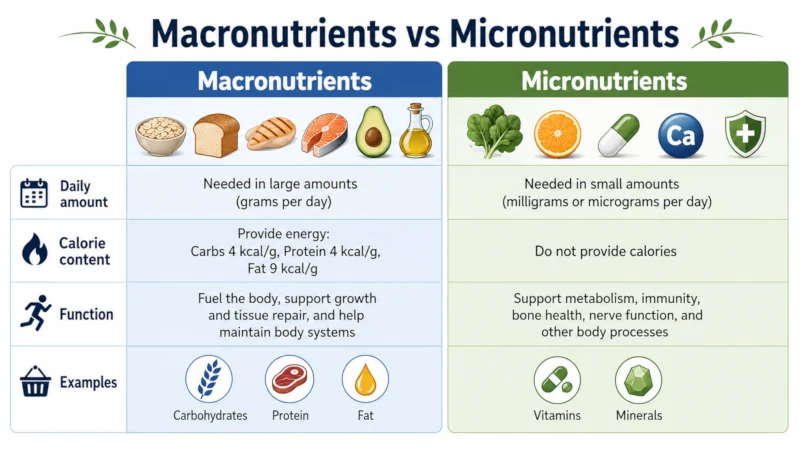
Macronutrients: the three nutrients that carry your calories
Macronutrients are the ones you need in gram quantities. Carbohydrate and protein each supply roughly 4 calories per gram, and fat roughly 9 — the standard conversions sitting behind every nutrition label.
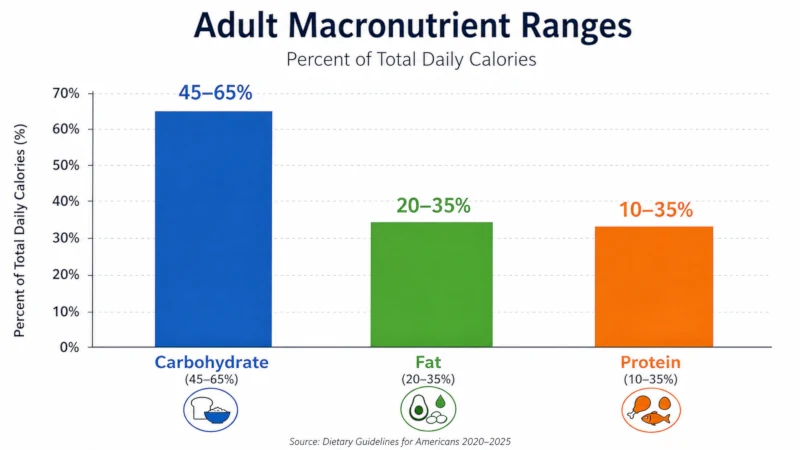
There is no single correct ratio between them. The Food and Nutrition Board of the National Academies publishes Acceptable Macronutrient Distribution Ranges: proportions of total calories associated with lower chronic disease risk while still meeting nutrient needs.
| Macronutrient | Adults | Children 4–18 | Children 1–3 |
| Carbohydrate | 45–65% of calories | 45–65% | 45–65% |
| Fat | 20–35% of calories | 25–35% | 30–40% |
| Protein | 10–35% of calories | 10–30% | 5–20% |
Source: Institute of Medicine Dietary Reference Intakes, Acceptable Macronutrient Distribution Ranges. Ranges are wide on purpose — several very different eating patterns fit inside them.
The FDA turns a middle-of-the-range pattern into grams on the label. On a 2,000-calorie reference diet the Daily Values are 275 g total carbohydrate, 78 g fat, and 50 g protein, plus 28 g dietary fiber, with saturated fat capped at 20 g, added sugars at 50 g, and sodium at 2,300 mg [FDA Daily Value reference guide, 2024]. Those are labeling benchmarks for the general population, not a prescription for you.
Carbohydrate
Carbohydrate is the body’s most convenient fuel, and it arrives in three forms: starches, sugars, and fiber. The familiar “simple versus complex” split is a rough guide at best. A better question is how processed the food is and how much fiber came along with it — which is why lentils and white bread behave so differently despite both being starch.
The 2025–2030 Dietary Guidelines for Americans ask people to prioritize fiber-rich whole grains at 2 to 4 servings a day and to significantly reduce highly processed refined carbohydrates such as white bread, packaged ready-to-eat breakfast items, flour tortillas, and crackers [USDA & HHS Dietary Guidelines, 2026]. For everyday food examples, our comprehensive list of carbohydrate foods breaks down the better and worse sources.
Added sugar is where the two federal reference points visibly diverge. The FDA’s label Daily Value lists 50 g of added sugars. The Dietary Guidelines state that no amount of added sugars is recommended as part of a healthy diet, and that a single meal should contain no more than 10 g. Both are official; they are answering different questions — one sets a labeling benchmark, the other gives dietary advice. If cutting back is the goal, these practical swaps for lowering salt and sugar are a more useful starting point than a number.
Fat
Dietary fat does not automatically become body fat. Fat builds cell membranes, supports hormone production, and is the vehicle that carries vitamins A, D, E, and K into your body — a very low-fat diet can quietly compromise absorption of all four.
The current guidelines describe healthy fats as plentiful in whole foods: meats, poultry, eggs, omega-3-rich seafood, nuts, seeds, full-fat dairy, olives, and avocados. When adding fat in cooking, they suggest prioritizing oils with essential fatty acids such as olive oil, with butter or beef tallow as other options, and they keep the long-standing ceiling of 10% of daily calories from saturated fat [USDA & HHS Dietary Guidelines, 2026].
The same document adds something worth taking seriously: more high-quality research is needed to determine which types of dietary fats best support long-term health. That is an unusually frank admission in a federal guideline, and a fair signal that the fat debate is less settled than confident voices on either side suggest.
Artificial trans fat is the exception, and it is largely a solved problem in the US. The FDA determined in 2015 that partially hydrogenated oils — the main source of industrially produced trans fat — are no longer generally recognized as safe, with January 1, 2021 as the final compliance date for removing them from the food supply. Trans fat has not vanished entirely: small amounts occur naturally in meat and dairy, and very low levels appear in other edible oils [FDA final determination on partially hydrogenated oils].
Protein: where current guidance openly disagrees
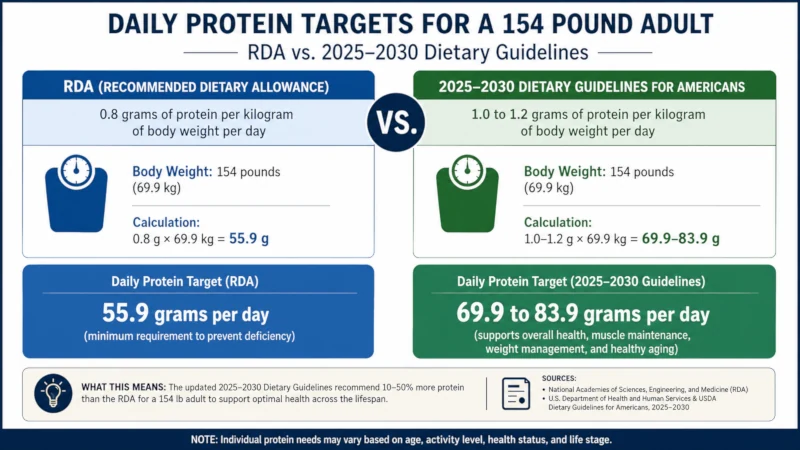
Three respected US reference points give three different answers on protein, and the gap between them is large enough that pretending otherwise would be misleading.
| Reference point | What it says | For a 154 lb (70 kg) adult |
| RDA (Food and Nutrition Board) | 0.8 g per kg of body weight per day | About 56 g |
| AMDR (Food and Nutrition Board) | 10–35% of total calories | About 50–175 g on 2,000 calories |
| Dietary Guidelines 2025–2030 | 1.2–1.6 g per kg per day, with protein prioritized at every meal | About 84–112 g |
Neither end is an error. The RDA was built to answer a narrow question — the least protein that keeps nearly all healthy adults out of deficit. The newer guidance answers a broader one about muscle, bone, and appetite across a lifespan. The case for the higher end is strongest in older adults, who need equal or greater amounts of protein even as their calorie needs fall.
What that means practically: most healthy adults will land somewhere in the 60–110 g range, and hitting the high end matters more if you are older, recovering from illness, or doing resistance training. If you have chronic kidney disease or another chronic condition, do not adopt a high-protein target from general guidance — the Dietary Guidelines themselves advise asking your clinician whether the recommendations need adapting for you [USDA & HHS Dietary Guidelines, 2026].
Micronutrients: small amounts, very specific jobs
Micronutrients don’t fuel you. They make the fuel usable. Each one has a narrow set of jobs, which is why a shortfall tends to produce a specific problem rather than general malaise — too little iron shows up as anemia, too little vitamin D as poor calcium absorption and weak bone.
Vitamins
Vitamins split by how they travel. The fat-soluble four — A, D, E, and K — are absorbed with dietary fat and stored in the liver and fat tissue, so an excess can accumulate over time. The water-soluble ones — vitamin C and the B complex — are mostly flushed out, so regular intake matters more and toxicity is less common, though not impossible at supplement doses.
Minerals
Major minerals such as calcium, magnesium, potassium, phosphorus, sodium, and chloride are needed in hundreds or thousands of milligrams a day. Trace minerals such as iron, zinc, iodine, selenium, copper, and manganese are needed in milligrams or micrograms — tiny amounts that are still non-negotiable.
Daily Values for a selection of micronutrients, on the US label:
| Nutrient | Daily Value | Food groups that supply it |
| Calcium | 1,300 mg | Dairy; some leafy greens and fortified foods |
| Potassium | 4,700 mg | Vegetables, fruits, beans and lentils |
| Magnesium | 420 mg | Nuts, seeds, whole grains, legumes |
| Iron | 18 mg | Meats, legumes, dark leafy greens |
| Zinc | 11 mg | Meats, seafood, seeds, legumes |
| Iodine | 150 mcg | Seafood, dairy, iodized salt |
| Vitamin A | 900 mcg RAE | Vitamin A–rich vegetables, eggs, dairy |
| Vitamin C | 90 mg | Fruits and vegetables |
| Vitamin D | 20 mcg | Fatty fish, eggs, fortified dairy |
| Vitamin B12 | 2.4 mcg | Meats, poultry, eggs, dairy |
| Folate | 400 mcg DFE | Leafy greens, legumes, fortified grains |
| Choline | 550 mg | Eggs, meats, legumes |
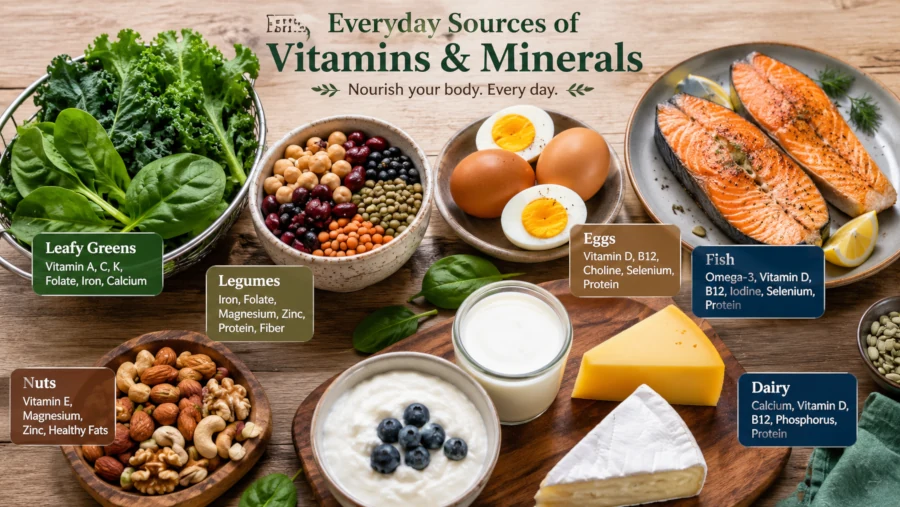
Daily Values from the FDA Daily Value reference guide, 2024. Food groups are illustrative, drawn from the categories named in the 2025–2030 Dietary Guidelines. Individual requirements vary by age and sex; the NIH Office of Dietary Supplements publishes the age- and sex-specific figures.
How to read a Nutrition Facts label without doing math
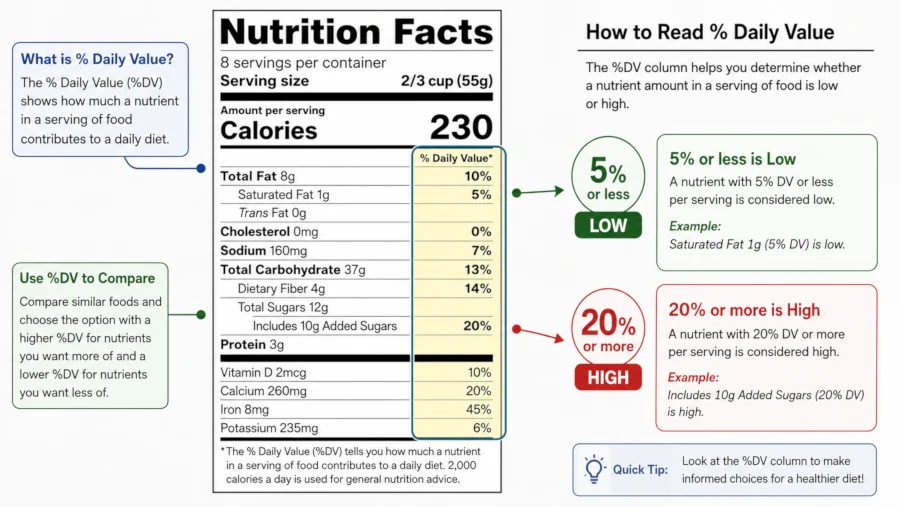
The %DV column does the arithmetic for you. As a general guide, 5% DV or less of a nutrient per serving is low, and 20% DV or more is high. The FDA’s practical advice is to more often choose foods higher in dietary fiber, vitamin D, calcium, iron, and potassium, and lower in saturated fat, sodium, and added sugars [FDA Daily Value reference guide, 2024].
Those four micronutrients get named because they are the ones required on the label — not because the other twenty stopped mattering. Manufacturers may list additional vitamins and minerals voluntarily.
Who is most likely to fall short
Nutrient gaps cluster in predictable groups. The 2025–2030 Dietary Guidelines flag these directly:
- Pregnancy — needs rise across the board, with iron, folate, and iodine the top priorities. Ask your clinician about a daily prenatal vitamin.
- Breastfeeding — higher energy and nutrient needs, with emphasis on vitamin B12–rich protein foods, omega-3–rich seafood, folate-rich legumes, and vitamin A–rich vegetables.
- Infants — all breastfed infants, and those taking less than 32 ounces of formula a day, should receive 400 IU of vitamin D daily starting shortly after birth. Some infants also need iron. Both are conversations to have with a pediatrician.
- Adolescents — rapid growth raises needs for energy, protein, calcium, and iron, with iron especially relevant for girls after menstruation begins.
- Older adults — calorie needs often drop while requirements for protein, vitamin B12, vitamin D, and calcium stay the same or rise, which squeezes the margin for error.
- Vegetarians and vegans — vegetarian diets often fall short in vitamins D and E, choline, and iron; vegan diets show broader shortfalls including vitamins A, D, E, B6 and B12, riboflavin, niacin, choline, calcium, iron, magnesium, phosphorus, potassium, zinc, and protein. Periodic monitoring of iron, B12, vitamin D, calcium, and iodine is the sensible approach.
All of the above: [USDA & HHS Dietary Guidelines for Americans, 2025–2030].
Supplements: what they reliably do, and what they don’t
Some supplements have clear, specific value. The NIH Office of Dietary Supplements points to calcium and vitamin D for bone strength and reducing bone loss, folic acid for lowering the risk of certain birth defects, omega-3 fatty acids from fish oil for some people with heart disease, and the AREDS combination for slowing vision loss in age-related macular degeneration [NIH Office of Dietary Supplements, 2023]. The US Preventive Services Task Force separately recommends 400 to 800 mcg of folic acid daily for anyone planning or capable of pregnancy.
What supplements have not shown is general disease prevention in healthy adults. The USPSTF recommends against beta carotene and vitamin E for preventing cardiovascular disease or cancer — a Grade D recommendation — and concludes the evidence is insufficient either way for multivitamins and for single or paired nutrients. Pooled data from nine trials covering 51,550 people found no association between multivitamin use and all-cause mortality; four trials suggested a small reduction in cancer incidence (odds ratio 0.93, 95% CI 0.87–0.99), a result the Task Force judged too limited to act on [USPSTF recommendation statement, 2022].
An important limit on that finding: it applies to community-dwelling, non-pregnant adults. It does not apply to children, people who are pregnant or may become pregnant, people who are chronically ill or hospitalized, or anyone with a known nutritional deficiency. If a blood test shows you are low in something, that is a different situation entirely.
Realistic expectation, then: a supplement is a good tool for closing a documented gap and a poor tool for buying general health insurance. It cannot substitute for the variety of foods a healthy eating pattern provides.
Safety, side effects, and interactions
More is not better. Side effects are most likely at high doses, when supplements replace prescribed medicines, or when you take several products at once — and fortified breakfast cereals and drinks quietly add to the total [NIH Office of Dietary Supplements, 2023].
Common side effects of excess
- Too much vitamin A can cause headaches and liver damage, reduce bone strength, and cause birth defects. The USPSTF notes that even moderate supplemental doses may reduce bone mineral density.
- Excess iron causes nausea and vomiting and may damage the liver and other organs.
- High-dose vitamin D carries a risk of hypercalcemia and kidney stones; in observational data that risk was tied to doses of 1,000 IU a day or more.
- Beta carotene supplements at 20–30 mg a day increased lung cancer risk in people who smoke or had workplace asbestos exposure.
Medication interactions
- Vitamin K reduces the ability of the blood thinner warfarin to prevent clotting.
- St. John’s wort speeds the breakdown of many medicines, including some antidepressants, birth control pills, heart medications, anti-HIV medications, and transplant drugs.
- Antioxidant supplements such as vitamins C and E might reduce the effectiveness of some types of cancer chemotherapy.
- Some supplements increase bleeding risk or change your response to anesthesia — tell your surgical team what you take.
Pregnancy, breastfeeding, and children
Be cautious about taking dietary supplements beyond a standard prenatal supplement if you are pregnant or nursing, and be careful about giving supplements to a child unless a healthcare provider recommends it. Many products have simply not been well tested for safety in these groups.
Who should be especially careful
- Anyone taking warfarin or another anticoagulant.
- Anyone in active cancer treatment.
- People who smoke or have had asbestos exposure — avoid beta carotene supplements.
- People with chronic kidney disease, liver disease, or another chronic condition.
- Anyone scheduled for surgery.
- Anyone already taking multiple supplements or eating heavily fortified foods.
On quality: the FDA requires Good Manufacturing Practices, and independent programs run by ConsumerLab.com, NSF International, and U.S. Pharmacopeia test products and allow a seal on those that pass. A seal indicates the product was properly manufactured and contains what the label says — it does not guarantee the product is safe or effective for you. Keep a written list of everything you take and share it with your doctor, dentist, pharmacist, and dietitian [NIH Office of Dietary Supplements, 2023]. Report a bad reaction to your provider and to the FDA at 800-FDA-1088.
When to talk to a healthcare professional
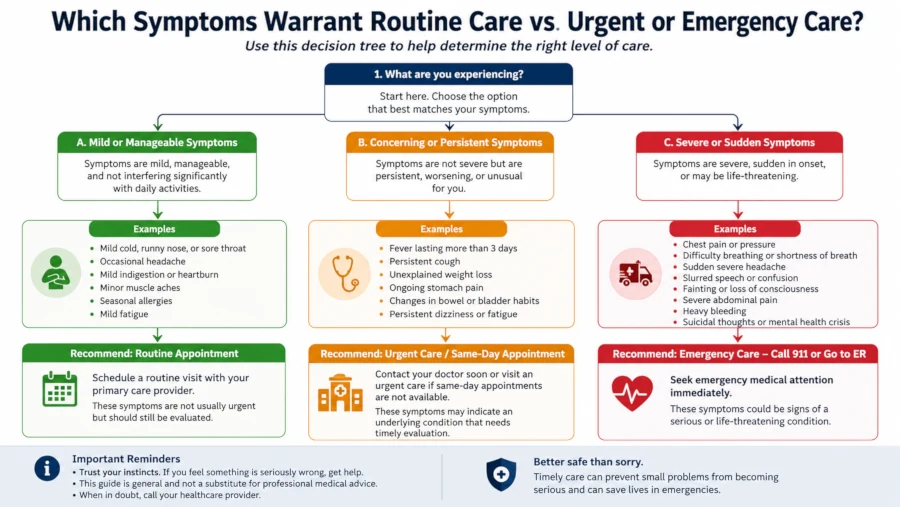
Nutrient deficiencies are diagnosed with blood tests, not guesswork. Make an appointment if you have persistent fatigue, unexplained weight loss, breathlessness on ordinary exertion, unusual bruising or bleeding, numbness or tingling in your hands or feet, poor wound healing, repeated infections, hair loss, or bone pain. Each of these has many possible causes, and a nutrient panel rules a good number of them in or out quickly.
Seek urgent or emergency care — call 911 or go to an emergency room — for chest pain, severe shortness of breath, fainting, seizures, sudden confusion or a change in alertness, or severe vomiting that leaves you unable to keep fluids down. If a child swallows iron-containing supplements or a large dose of any vitamin, contact Poison Control or emergency services immediately; iron in particular can cause vomiting and organ damage.
Talk with a clinician or registered dietitian before making large changes if you are pregnant or breastfeeding, take prescription medication, manage a chronic condition, or are considering a substantially higher-protein or very low-carbohydrate pattern. For day-to-day habits that don’t require a consultation, our broader nutrition guidelines for life cover portioning, meal timing, and building the habit slowly.
| Health Disclaimer: This article is general health education, not medical advice, and it does not replace evaluation, diagnosis, or treatment by a qualified healthcare professional. Nutrient needs vary with age, sex, body size, activity, pregnancy, medications, and medical conditions. Talk with your doctor, a registered dietitian, or your pharmacist before starting a supplement, making large changes to your protein or carbohydrate intake, or giving any supplement to a child — especially if you are pregnant or breastfeeding, take prescription medication, or manage a chronic condition such as kidney disease, liver disease, or diabetes. Do not delay or disregard professional medical advice because of something you read here. |
Frequently Asked Questions
What is the main difference between macronutrients and micronutrients?
Quantity and function. Macronutrients — carbohydrate, fat, and protein — are needed in grams and supply all of your calories. Micronutrients — vitamins and minerals — are needed in milligrams or micrograms and supply none, but they run the reactions that turn those calories into usable energy and tissue.
Can you be overweight and still be deficient in micronutrients?
Yes. Calories and micronutrients travel separately. A diet built on refined grains, added sugars, and fried foods can easily meet or exceed calorie needs while falling short on iron, vitamin D, potassium, or magnesium. That is why the current guidelines emphasize nutrient density rather than calories alone.
How much protein should I eat per day?
It depends which reference you use, and they differ. The RDA is 0.8 g per kilogram of body weight — about 56 g for a 154 lb adult. The 2025–2030 Dietary Guidelines recommend 1.2–1.6 g per kilogram, roughly 84–112 g for the same person. Most healthy adults do well somewhere in that span, leaning higher with age or resistance training. If you have kidney disease, your clinician sets the number.
Do I need a multivitamin?
Most healthy adults eating a varied diet do not have evidence that a multivitamin prevents cardiovascular disease or cancer — the USPSTF found the evidence insufficient in either direction. A multivitamin makes more sense if you have a diagnosed deficiency, are pregnant or planning pregnancy, follow a vegan diet, are an older adult with reduced intake, or have a condition affecting absorption. That is a decision to make with a clinician, ideally after a blood test.
Are carbohydrates bad for you?
No — carbohydrate quality is what varies. Whole grains, legumes, vegetables, and fruit arrive with fiber and micronutrients attached. Refined flours and added sugars arrive largely without them. The guidelines ask people to reduce the second group, not the category as a whole. Some people with specific chronic conditions do better on a lower-carbohydrate pattern, which is a conversation to have with a clinician.
References
- U.S. Food and Drug Administration. Daily Value on the Nutrition and Supplement Facts Labels. FDA, 2024. → View source
- U.S. Department of Health and Human Services & U.S. Department of Agriculture. Dietary Guidelines for Americans, 2025–2030. 10th Edition. January 2026. → View source
- Office of Disease Prevention and Health Promotion. Current Dietary Guidelines. ODPHP, HHS, 2026. → View source
- Institute of Medicine, Food and Nutrition Board. Dietary Reference Intakes: Acceptable Macronutrient Distribution Ranges. National Academies Press (summary tables), source report 2002/2005. → View source
- National Institutes of Health, Office of Dietary Supplements. Nutrient Recommendations and Databases. NIH ODS. → View source
- National Institutes of Health, Office of Dietary Supplements. Dietary Supplements: What You Need to Know. NIH ODS, updated January 4, 2023. → View source
- US Preventive Services Task Force. Vitamin, Mineral, and Multivitamin Supplementation to Prevent Cardiovascular Disease and Cancer: Recommendation Statement. JAMA, June 21, 2022. → View source
- U.S. Food and Drug Administration. Final Determination Regarding Partially Hydrogenated Oils (Removing Trans Fat). FDA, 2015; administrative actions completed 2023. → View source
