

Most cravings aren’t your body asking for a missing nutrient. Research on food cravings keeps landing in the same place: what you crave is shaped far more by habit, mood, sleep, what you’ve seen and smelled lately, and the foods you’re trying to avoid than by a vitamin or mineral shortfall [Hill, 2007]. There are a few real exceptions — an urge to chew ice, for one, deserves a blood test — and those are worth knowing. The rest you can work with.
Are Food Cravings a Sign of a Nutritional Deficiency?
Usually not. The deficiency idea is appealing because it makes the craving sound wise. The evidence points elsewhere.
Take chocolate, the most commonly craved food in North America. It contains magnesium, so a chocolate craving is often read as a sign you’re low. In a classic experiment, chocolate cravers were given one of several options the moment a craving hit: a chocolate bar, white chocolate (the calories and texture without cocoa’s active compounds), cocoa capsules (the active compounds without the taste), or a placebo. The capsules did virtually nothing. Real chocolate worked, and white chocolate helped partway [Michener & Rozin, 1994]. People wanted the experience of eating chocolate, not something inside it.
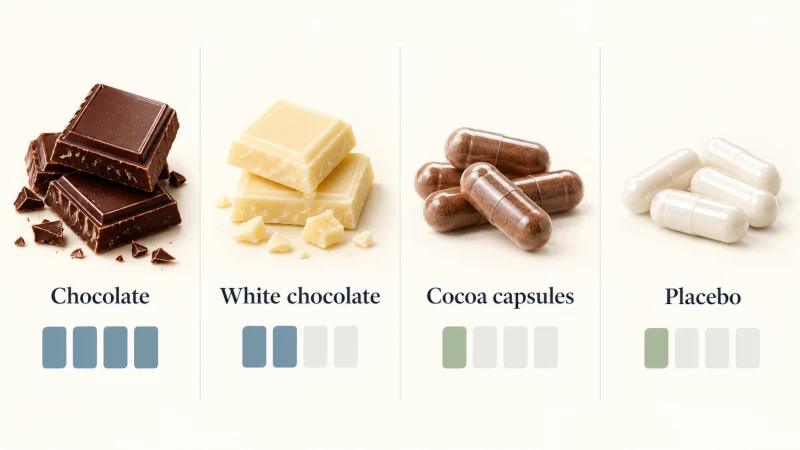
If magnesium were the target, chocolate wouldn’t be first in line anyway. The foods that top federal magnesium tables are pumpkin seeds, chia seeds, almonds, spinach and beans, and symptomatic magnesium deficiency from diet alone is uncommon in healthy people because the kidneys hold on to it [NIH Office of Dietary Supplements, 2026]. If you do want more, our guide to magnesium-rich foods lists the best sources.
Cravings also turn up when nutrition is complete. When young adults lived for five days on a nutritionally adequate but monotonous liquid diet, their cravings increased — mostly for foods that tasted nothing like what they’d been drinking. The researchers concluded that nutritional deprivation isn’t needed for a craving to appear [Pelchat & Schaefer, 2000].
Culture tells the same story. Chocolate is the most craved food in the U.S., but hardly anyone in Egypt reports craving it, and rice is the most widely craved food among women in Japan. American women report chocolate cravings far more often than American men; in Spain, the gap between the sexes is much smaller [Orloff & Hormes, 2014]. Bodies don’t differ that much across borders. Food cultures do.
Even the familiar “I need chocolate before my period” pattern looks more cultural than hormonal. If shifting hormones drove it, chocolate cravings should fall sharply after menopause. In a survey of women from the same university, they fell only modestly — by 13.4%, against the roughly 38% a purely hormonal cause would predict [Hormes & Rozin, 2009].
| How strong is this evidence? Consistent but modest. Most of it comes from surveys and small laboratory studies, several decades old. Together they make a deficiency explanation unlikely for everyday cravings — they don’t rule out the specific exceptions below. |
When a Craving Can Point to Something Medical
A small number of cravings deserve a closer look. None of them is the everyday urge for something sweet.
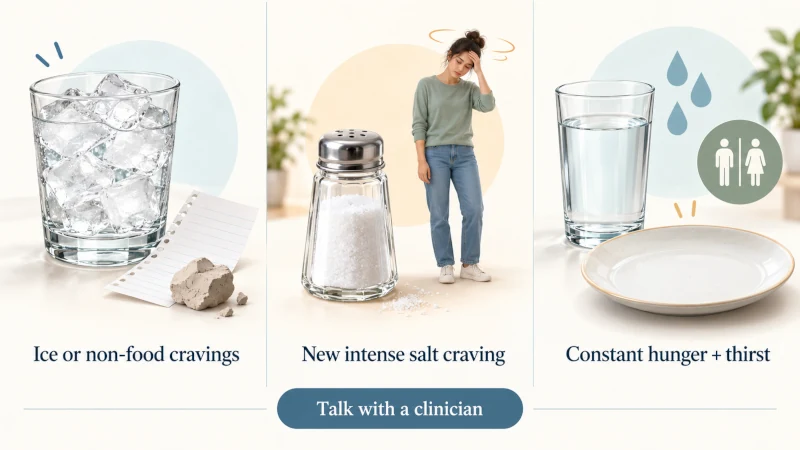
Chewing ice, clay, starch or other non-foods
Regularly eating things that aren’t food — ice, dirt, clay, laundry starch, paper — is called pica. It can happen during pregnancy, and in some cases a lack of iron or zinc may trigger it [MedlinePlus, 2026]. The link with ice is the best documented. Among 262 non-pregnant adults being treated with intravenous iron for iron deficiency or depletion, 45% reported pica, and 87% of those described eating ice [Barton et al., 2010]. That group was already sick enough to need IV iron, so the numbers don’t describe the general public. A review of pica in pregnancy found the data on causes limited overall, with some evidence that ice-eating occurs during iron deficiency [Young, 2010].
Pica has risks of its own — lead poisoning, infection and blockages in the stomach or intestines, depending on what’s eaten [MedlinePlus, 2026]. If you find yourself crunching ice compulsively or wanting non-food items, tell a clinician and ask about blood work for iron. Don’t self-treat with iron pills: high doses can cause nausea, stomach pain and constipation, and accidental iron overdose is a leading cause of fatal poisoning in children under 6, so keep any iron products out of reach [NIH Office of Dietary Supplements, 2023].
An intense, new craving for salt
Craving salt along with extreme fatigue and weakness, dizziness when standing, weight loss with low appetite, or darkening of the skin can be a sign of Addison disease, in which the adrenal glands don’t make enough hormones [MedlinePlus, 2025]. It’s uncommon. Liking salty chips is not a symptom; the cluster is what matters.
Being hungry all the time, with thirst
Constant hunger isn’t really a craving, but people often describe it that way. Increased thirst and hunger, frequent urination and losing weight without trying are common diabetes symptoms [CDC, 2024]. That combination calls for a blood sugar test, not more willpower.
| Craving pattern | What it may point to | What to do |
| Eating ice, clay, starch, paper or other non-foods for a month or more | Pica; sometimes low iron or zinc | See a clinician; ask about iron and zinc testing |
| New, intense salt craving with fatigue, dizziness on standing, weight loss or darker skin | Rarely, adrenal insufficiency (Addison disease) | Prompt medical evaluation |
| Constant hunger with heavy thirst, frequent urination or unexplained weight loss | Possible diabetes | Ask for a blood sugar test |
| Sweet, salty or chocolate cravings with no other symptoms | Usually cues, habit, mood, sleep or restriction | Try the strategies below |
What Actually Drives Most Food Cravings
Researchers describe cravings as intense, specific desires closely tied to liking — usually for very palatable foods — that don’t always end in eating [Hill, 2007]. Several ordinary forces turn them up.
What you see, smell and expect
Food ads, the smell of a bakery, a scroll past someone’s dessert: your brain learns to answer these cues with wanting. A meta-analysis pooling 45 reports and 3,292 participants found that reactions to food cues, and the cravings they spark, predicted later eating and weight gain, with a medium-sized effect that explained about 11% of the variation [Boswell & Kober, 2016]. Real, but most of the picture lies elsewhere.
Habit and routine
If you always eat popcorn at the movies, the movie itself starts to cue popcorn. Cravings that arrive at the same time or place each day — 3 p.m. at your desk, the couch after dinner — are often learned associations of exactly this kind, the conditioning process the cue research describes [Boswell & Kober, 2016]. What was learned can be weakened, slowly, by changing the routine.
Forbidding a food (the evidence is mixed)
The common claim that dieting always makes cravings worse is only half right, and the studies genuinely disagree depending on the kind of restriction. When women were asked to avoid chocolate for a week, those who were habitual “restrained eaters” later ate more chocolate than any other group and reported more cravings overall [Polivy et al., 2005]. On the other side, a meta-analysis of weight-loss studies in people with obesity found that sustained calorie restriction — at least 12 weeks — lowered cravings, including for sweet and high-fat foods [Kahathuduwa et al., 2017].
One reasonable reading: banning a single favorite food in the short term tends to backfire, especially if you’re already preoccupied with eating “right,” while a steady eating pattern held over months may quiet cravings. The evidence can’t yet tell you which applies to you.
Stress and low mood
In a study of 619 adults, people under more chronic stress reported more food cravings, and cravings partly accounted for the link between stress and higher body weight [Chao et al., 2015]. It was a one-time snapshot, so it shows an association rather than proof that stress causes cravings.
Short sleep
After a night without sleep, people in a brain-imaging study wanted high-calorie foods more, while brain areas that weigh choices were less active [Greer et al., 2013]. That was a small lab study of a full night’s sleep loss, not an ordinary short night, but it’s a reasonable reason to put sleep on the list.
Your gut microbes (interesting, unproven)
You may have read that gut bacteria “manipulate” you into craving what they want to eat. That idea comes from a 2014 hypothesis paper that laid out how it could work and called for studies to test it [Alcock et al., 2014]. It hasn’t been shown in people. A later review argued that in a diverse gut community, bacteria spending resources to steer their host would likely be outcompeted, and found no clear evidence of manipulation [Johnson & Foster, 2018]. Gut microbes do communicate with the brain; whether they drive your cravings is an open question. Be skeptical of supplements that promise to end cravings by “rebalancing” your gut.
Food Cravings During Pregnancy

An estimated 50–90% of U.S. women have food cravings during pregnancy, most often for sweets, high-calorie savory foods and fast food [Orloff & Hormes, 2014]. If cravings were the body’s way of meeting a growing baby’s needs, you’d expect them to target nutrient-dense foods and to build as the pregnancy advanced. Instead they usually appear by the end of the first trimester and peak in the second, well before most fetal growth — one reason reviewers find little support for the deficiency explanation [Orloff & Hormes, 2014].
Craving foods while pregnant is normal. Craving things that aren’t food is different: pica can occur in pregnancy and may be linked to low iron or zinc [MedlinePlus, 2026], so mention it to your prenatal provider. Iron needs rise in pregnancy, and NIH advises pregnant women to talk with their provider and take an iron supplement if it’s recommended [NIH Office of Dietary Supplements, 2023].
Craving or Hunger? How to Tell
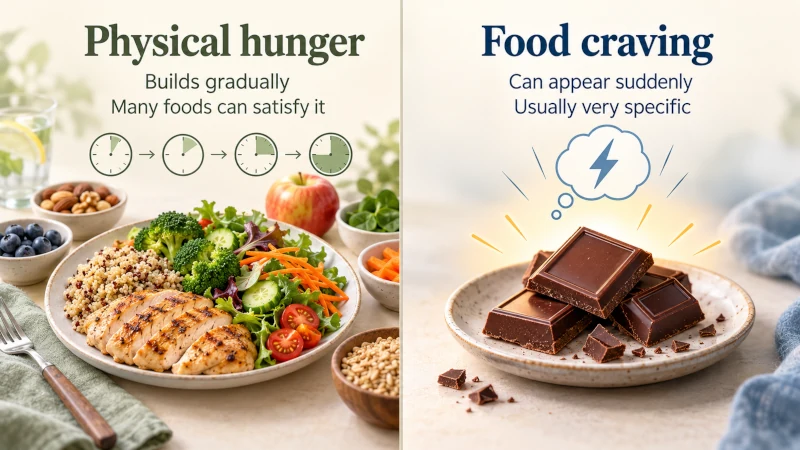
Hunger builds gradually, and almost any food will do. A craving is specific — that food, often right now — and it can arrive soon after a meal [Orloff & Hormes, 2014]. Before deciding what to do, check how hungry you actually are; the intuitive eating hunger scale is a simple 1–10 way to do it. If you’re genuinely hungry, eat a real meal. A craving stacked on top of hunger is much harder to ride out.
How to Manage Food Cravings
None of these is a cure, and the evidence behind each is modest. They are low-risk, and you can combine them.
Don’t skip meals, and put some protein in breakfast. In a small pilot study of 20 young women with overweight or obesity who usually skipped breakfast, eating breakfast reduced cravings after the meal, and a higher-protein version (35 g) reduced them more than a normal-protein one (13 g) [Hoertel et al., 2014]. It’s one small study in a specific group, so treat it as a reasonable experiment. Our overview of macronutrients and micronutrients covers what a balanced plate looks like.
Change the cues. If a craving shows up with a place or a screen, change the setup: keep the craved snack out of sight or out of the house, eat away from the TV, mute the food accounts you scroll past. This follows from the cue research above; no trial has tested these exact tweaks.
Give it a few minutes, and keep your mind busy. Cravings tend to pass. In a real-world study, three minutes of a visually demanding game (Tetris) lowered craving strength — from about 70% to 56% on the study’s rating scale — although it didn’t reduce how often people gave in [Skorka-Brown et al., 2015].
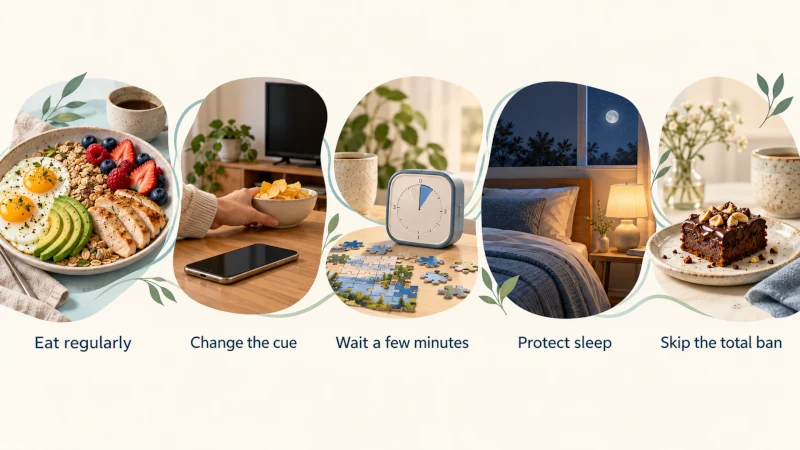
Protect your sleep. Given the sleep-deprivation findings [Greer et al., 2013], a regular bedtime is a cheap thing to try when cravings are worst after a bad night.
Skip the total ban. Because short-term deprivation can backfire for people with strict food rules [Polivy et al., 2005], planning a reasonable portion of a food you love often works better than forbidding it.
Cut sugar and salt gradually. Tastes tend to adjust when intake drops slowly; our guide to lowering salt and sugar without making food bland has specific swaps.
When to Talk to a Doctor
Make an appointment if you notice any of the following:
- You’ve been eating ice, clay, dirt, starch, paper or other non-foods for a month or more, or you see a child doing it [MedlinePlus, 2026].
- A strong salt craving comes with fatigue, dizziness on standing, unexplained weight loss or darkening skin [MedlinePlus, 2025].
- You’re hungry all the time and also very thirsty, urinating often or losing weight without trying [CDC, 2024].
- You regularly eat large amounts quickly, feel unable to stop, eat until uncomfortably full or alone out of embarrassment, and feel disgusted or guilty afterward — common signs of binge eating disorder [NIDDK, 2021].
- You’re pregnant and craving non-food items.
Get emergency care for signs of adrenal crisis — abdominal pain, trouble breathing, dizziness or lightheadedness, low blood pressure or reduced consciousness [MedlinePlus, 2025] — or if a child may have swallowed iron supplements [NIH Office of Dietary Supplements, 2023]. Call 911 or go to the nearest emergency room.
For eating-disorder support in the U.S., the National Alliance for Eating Disorders runs a free helpline staffed by licensed therapists at 866-662-1235, 9 a.m.–7 p.m. ET, Monday through Friday [National Alliance for Eating Disorders, 2026].
| Health Disclaimer: This article is general health education, not medical advice, and it doesn’t replace evaluation, diagnosis or treatment by a qualified healthcare professional. Unusual cravings — especially for ice or other non-food items, or a strong salt craving with fatigue or dizziness — can have medical causes that need testing. Don’t start iron or other supplements to treat a craving without talking to a clinician first, and be extra careful if you are pregnant or breastfeeding, take prescription medication, or have a history of disordered eating. If you think you may have a medical emergency, call 911. |
Frequently Asked Questions
Does craving chocolate mean I’m low on magnesium?
There’s no good evidence for it. In a controlled experiment, capsules containing cocoa’s active compounds did virtually nothing for chocolate cravings, while eating real chocolate did [Michener & Rozin, 1994]. Foods much richer in magnesium, like pumpkin seeds and spinach, are rarely craved [NIH Office of Dietary Supplements, 2026].
Why do I crave ice?
Occasionally chewing ice is common. A persistent, compulsive urge to eat ice is a form of pica that is associated with iron deficiency in some people [Barton et al., 2010]. Ask a clinician about blood work rather than starting iron on your own [NIH Office of Dietary Supplements, 2023].
Are pregnancy cravings a sign my baby needs something?
Probably not. Pregnancy cravings tend to be for sweets and high-calorie foods and usually start before most fetal growth [Orloff & Hormes, 2014]. Cravings for non-food items are the exception — tell your prenatal provider [MedlinePlus, 2026].
Why are my cravings worse at night?
Evening cravings often follow cues and routine — the couch, the TV, the end of a long day [Boswell & Kober, 2016] — and can be stronger after skipped meals. In a small pilot study, eating breakfast reduced cravings in young women who usually skipped it [Hoertel et al., 2014].
Do food cravings ever go away?
They tend to ease with age; older adults report fewer cravings than younger adults [Pelchat, 1997]. In people with obesity, sustained calorie restriction lasting months has been linked to fewer cravings [Kahathuduwa et al., 2017], and cravings tied to a routine can weaken once that routine changes.
References
- Hill AJ. The psychology of food craving. Proc Nutr Soc. 2007;66(2):277-285. PMID 17466108. View source
- Michener W, Rozin P. Pharmacological versus sensory factors in the satiation of chocolate craving. Physiol Behav. 1994;56(3):419-422. PMID 7972390. View source
- Pelchat ML, Schaefer S. Dietary monotony and food cravings in young and elderly adults. Physiol Behav. 2000;68:353-359. doi:10.1016/S0031-9384(99)00190-0. View source
- Pelchat ML. Food cravings in young and elderly adults. Appetite. 1997;28(2):103-113. PMID 9158846. View source
- Orloff NC, Hormes JM. Pickles and ice cream! Food cravings in pregnancy: hypotheses, preliminary evidence, and directions for future research. Front Psychol. 2014;5:1076. doi:10.3389/fpsyg.2014.01076. View source
- Hormes JM, Rozin P. Perimenstrual chocolate craving. What happens after menopause? Appetite. 2009;53(2):256-259. doi:10.1016/j.appet.2009.07.003. View source
- NIH Office of Dietary Supplements. Magnesium: Fact Sheet for Health Professionals. View source
- Barton JC, Barton JC, Bertoli LF. Pica associated with iron deficiency or depletion: clinical and laboratory correlates in 262 non-pregnant adult outpatients. BMC Blood Disord. 2010;10:9. PMID 21176208. View source
- Young SL. Pica in pregnancy: new ideas about an old condition. Annu Rev Nutr. 2010;30:403-422. doi:10.1146/annurev.nutr.012809.104713. View source
- MedlinePlus Medical Encyclopedia. Pica. View source
- MedlinePlus Medical Encyclopedia. Addison disease. View source
- Centers for Disease Control and Prevention. Symptoms of Diabetes. View source
- NIH Office of Dietary Supplements. Iron: Fact Sheet for Consumers. View source
- Boswell RG, Kober H. Food cue reactivity and craving predict eating and weight gain: a meta-analytic review. View source
- Polivy J, Coleman J, Herman CP. The effect of deprivation on food cravings and eating behavior in restrained and unrestrained eaters. Int J Eat Disord. 2005;38(4):301-309. PMID 16261600. View source
- Kahathuduwa CN, Binks M, Martin CK, Dawson JA. Extended calorie restriction suppresses overall and specific food cravings: View source
- Chao A, Grilo CM, White MA, Sinha R. Food cravings mediate the relationship between chronic stress and body mass index. View source
- Greer SM, Goldstein AN, Walker MP. The impact of sleep deprivation on food desire in the human brain. Nat Commun. View source
- Alcock J, Maley CC, Aktipis CA. Is eating behavior manipulated by the gastrointestinal microbiota? Evolutionary pressures and potential mechanisms. BioEssays. View source
- Johnson KV-A, Foster KR. Why does the microbiome affect behaviour? View source
- Hoertel HA, Will MJ, Leidy HJ. A randomized crossover, pilot study examining the effects of a normal protein vs. high protein breakfast on food cravings and reward signals in overweight/obese “breakfast skipping,” late-adolescent girls. View source
- Skorka-Brown J, Andrade J, Whalley B, May J. Playing Tetris decreases drug and other cravings in real world settings. View source
- National Institute of Diabetes and Digestive and Kidney Diseases. Symptoms & Causes of Binge Eating Disorder. View source


