
Licorice root has been used as medicine for thousands of years, and a few of its traditional uses do hold up. There is reasonable evidence it can soothe a sore throat and calm mouth ulcers, and topical forms may help some skin conditions.
But most of the bigger claims you will read about licorice root benefits rest on weak or preliminary evidence, and the plant carries a genuine safety catch that does not get mentioned often enough: a compound called glycyrrhizin can raise your blood pressure and drop your potassium, sometimes dangerously. So the honest version of “what is licorice root good for” comes with an asterisk. Here is what the research actually supports, what it does not, and who should steer clear.
What licorice root actually is
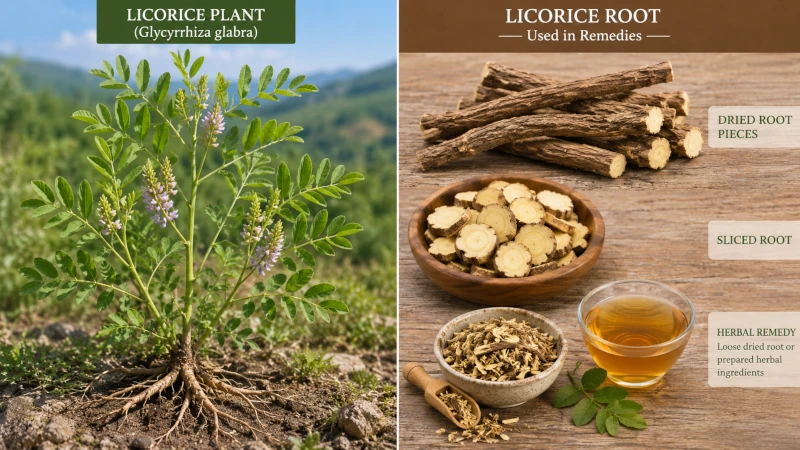
Licorice comes from the root of Glycyrrhiza glabra, a legume that grows across the Mediterranean, the Middle East, and parts of Asia [NCCIH, 2025]. Its signature flavor comes from glycyrrhizin (also called glycyrrhizic acid), a compound roughly 50 times sweeter than sugar [AHA, 2022].
That same compound drives most of licorice’s effects on the body — both the ones people hope for and the ones that send a small number of people to the hospital. Its other notable constituents are a group of flavonoids; despite what some plant write-ups claim, licorice does not contain atropine.
One practical note before you go shopping: a lot of what is sold as “licorice” in the United States contains no real licorice at all. Anise oil, which tastes similar, is often used instead [NCCIH, 2025]. If you are buying licorice for a specific reason, check that the label actually lists licorice or Glycyrrhiza.
Licorice root benefits: what the evidence says
Here is the uncomfortable truth most benefit lists skip. According to the U.S. National Center for Complementary and Integrative Health, there is not enough high-quality evidence to clearly support licorice for any single health condition [NCCIH, 2025]. That does not mean it does nothing — it means the research is thinner than the confident headlines suggest. The uses below are sorted by how much evidence stands behind them.
Sore throat and mouth ulcers — the best-supported uses
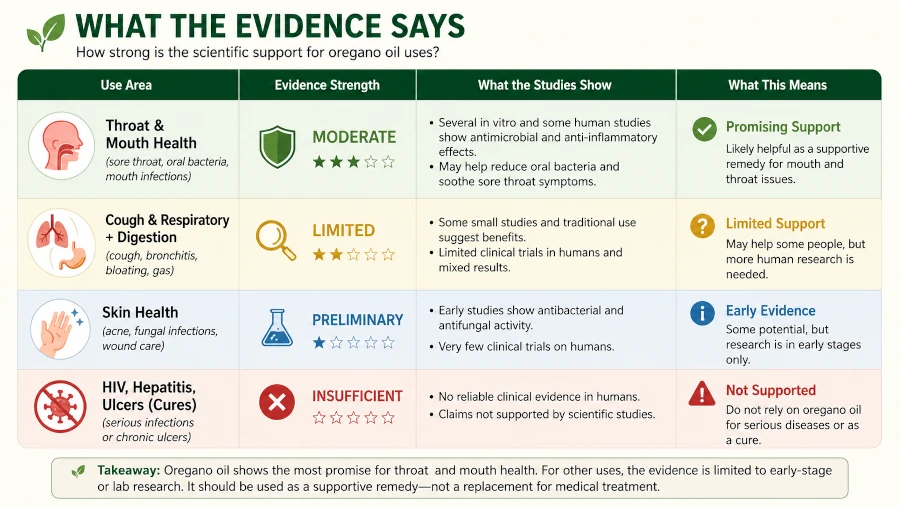
This is where licorice has its strongest case. A licorice mouth rinse or gargle may reduce the size and pain of recurrent canker sores, and a topical licorice form may shrink them [NCCIH, 2025]. There is also reasonable evidence that gargling with licorice or using licorice lozenges before surgery can prevent or ease the sore throat people often get from a breathing tube during anesthesia [NCCIH, 2025]. These are modest, specific benefits backed by actual controlled studies — not a cure-all for every throat complaint.
Coughs and respiratory comfort
Licorice has been a cough and chest remedy for centuries, and that tradition is not baseless. The Merck Manual notes evidence that licorice taken as a lozenge can ease the symptoms of a chronic cough [Merck Manual, 2025]. It has long been used for hoarseness, bronchitis, and chest congestion, though strong trials for those specific uses are limited [NCCIH, 2025]. If you want to read more about plants used this way, see our guide to herbs for the lungs.
Indigestion, ulcers, and gut symptoms
Licorice’s reputation as a stomach remedy is real but more complicated than older articles make it sound. The evidence that licorice on its own helps digestive symptoms is unclear [NCCIH, 2025]. Where it looks more promising is in combination: licorice taken with other herbs has been found to relieve symptoms of indigestion and irritable bowel syndrome [Merck Manual, 2025].
As for stomach and duodenal ulcers — a benefit you will see stated flatly all over the internet — the current verdict is more cautious. There is not enough evidence to confirm licorice treats ulcers [Merck Manual, 2025]. A glycyrrhizin-free form called deglycyrrhizinated licorice, or DGL, is often recommended for heartburn and ulcer symptoms because it avoids the blood-pressure problem, but proof of benefit is still limited [NCCIH, 2025]. For more traditional digestive remedies, see our overview of herbs for stomach issues.
Skin (topical use)
Applied to the skin, licorice may help. Preliminary research suggests gels containing licorice root could ease symptoms of atopic dermatitis (eczema) and assist burn healing, though the studies are early and more work is needed to confirm both benefit and safety [NCCIH, 2025]. Topical licorice can also irritate the skin in some people [NCCIH, 2025].
What licorice root has not been shown to do
Older articles — including the one this page replaces — credit licorice with a long list of dramatic powers: clearing HIV, stopping hepatitis C from turning into cirrhosis or cancer, outperforming codeine, detoxifying poisons, shrinking an enlarged prostate, fixing chronic fatigue.
These claims either come from test-tube and animal studies that have not been confirmed in people, or they simply are not supported. The Merck Manual is blunt that there is not enough evidence to say licorice helps with hepatitis C or liver-disease complications [Merck Manual, 2025], and the NIH’s review reaches the same insufficient-evidence conclusion across the board [NCCIH, 2025]. Treat any single-ingredient “miracle” framing as a reason for skepticism, not excitement.
The catch: glycyrrhizin, blood pressure, and your heart
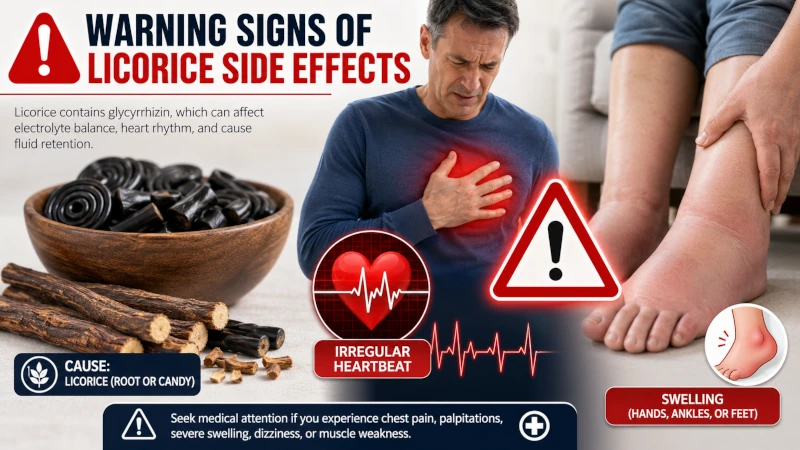
This is the part that turns licorice from a harmless-sounding herb into something you need to respect. Glycyrrhizin blocks an enzyme that normally protects your kidneys from cortisol. With that brake released, your body holds on to sodium and water and flushes out potassium — which pushes blood pressure up and potassium down [NCCIH, 2025] [Merck Manual, 2025]. Doctors call the result pseudohyperaldosteronism; you may feel it as some combination of high blood pressure, swelling, muscle weakness, and, in serious cases, an irregular heartbeat [Medsafe, 2019].
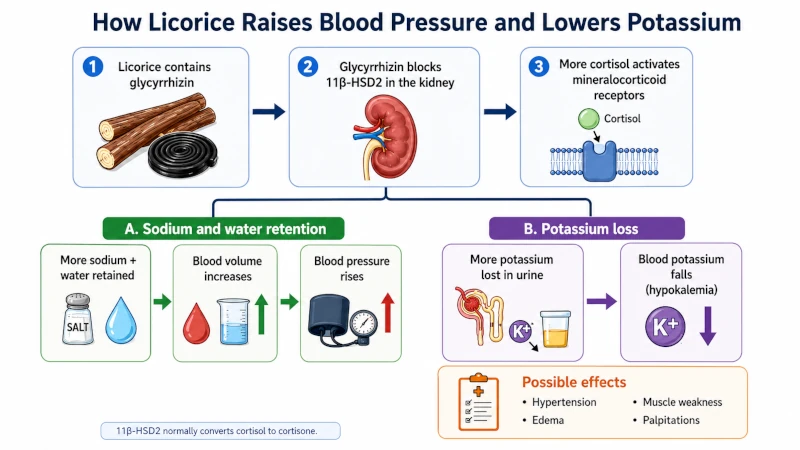
The doses involved are not exotic. The FDA has warned that if you are 40 or older, eating about two ounces of black licorice a day for two weeks could land you in the hospital with an irregular heart rhythm [FDA, 2017]. A systematic review pooling multiple studies found that consistent licorice intake measurably raised blood pressure and lowered potassium [Penninkilampi et al., 2017]. And even small amounts can cause trouble if you eat a lot of salt or already have high blood pressure, heart disease, or kidney problems [NCCIH, 2025].
European food-safety guidance has suggested keeping glycyrrhizin intake under about 100 mg a day — roughly 60 to 70 grams of licorice sweets — as a general ceiling [Medsafe, 2019]. For most people these effects reverse once they stop [AHA, 2022]. The catch within the catch is that some people never connect their symptoms to a candy or a daily tea, and keep going.
Side effects and who should avoid licorice root
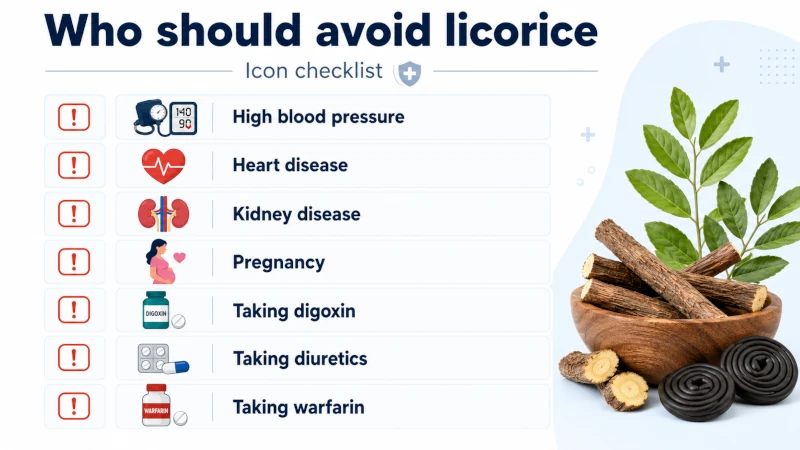
At normal food amounts, licorice causes few problems for most people [Merck Manual, 2025]. The risks climb with higher doses, longer use, and certain health conditions. Avoid glycyrrhizin-containing licorice — or talk to your doctor first — if you:
- Have high blood pressure, heart disease, or a heart-rhythm problem [NCCIH, 2025] [Merck Manual, 2025]
- Have kidney disease or low potassium [Medsafe, 2019]
- Are pregnant or breastfeeding (see below) [NCCIH, 2025]
- Take any of the medications in the next section
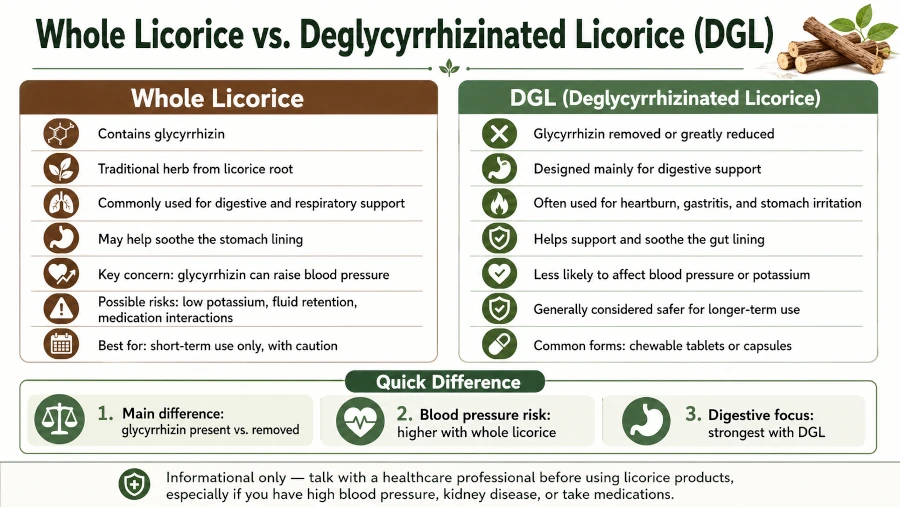
DGL (deglycyrrhizinated licorice) sidesteps most of this because the glycyrrhizin is largely removed, and oral DGL may be safe for up to about four months [NCCIH, 2025]. Topical licorice is generally fine short-term but can irritate skin [NCCIH, 2025]. People who already manage high blood pressure should be especially cautious, since licorice works against you here.
Drug interactions worth knowing
Because glycyrrhizin lowers potassium and shifts fluid balance, licorice can collide with several common medications:
- Digoxin (Lanoxin): low potassium from licorice can raise the risk of digoxin toxicity — a potentially dangerous situation for people taking it for heart failure or rhythm problems [AHA, 2024] [Merck Manual, 2025].
- Blood pressure medications and diuretics: licorice can blunt their effect, and pairing it with potassium-wasting diuretics can deepen potassium loss [AHA, 2024] [Merck Manual, 2025].
- Warfarin: licorice may make warfarin less effective, raising clot risk [Merck Manual, 2025].
- Corticosteroids: licorice can amplify their effects and side effects [NCCIH, 2025] [Merck Manual, 2025].
- Other drugs, including some chemotherapy agents and hormone medications, may also interact [Merck Manual, 2025].
If you take prescription medication, treat licorice supplements as something to clear with your pharmacist or doctor first — not as a harmless add-on.
Licorice root during pregnancy and breastfeeding
This one deserves a clear answer: skip it. Consuming oral licorice in large amounts during pregnancy — on the order of 250 grams a week — is considered unsafe and has been linked to a higher risk of delivering before 38 weeks [NCCIH, 2025]. A study of women in Finland also associated heavy licorice consumption in pregnancy with poorer cognitive performance in their children years later [AHA, 2022]. Major references advise that pregnant women avoid licorice altogether [Merck Manual, 2025]. Because teas and supplements often do not list how much glycyrrhizin they contain, the safe move is to avoid licorice products rather than guess. For breastfeeding, there simply is not enough information to call it safe [NCCIH, 2025].
How licorice root is used (and a note on dosing)
Licorice shows up as teas, lozenges, capsules, liquid extracts, tinctures, and topical gels [Merck Manual, 2025]. The most useful distinction when shopping is whole licorice versus DGL: whole licorice (with glycyrrhizin) carries the blood-pressure risk, while DGL is processed to remove most of it and is the form usually suggested when the goal is digestive comfort [NCCIH, 2025] [Merck Manual, 2025].
This article will not hand you a precise dose, and you should be wary of any consumer page that does. Safe and effective amounts depend on the form, the glycyrrhizin content, your health, and your medications — which is exactly why dosing is a conversation to have with a healthcare professional or pharmacist. If you do use a glycyrrhizin-containing product, keep the duration short, follow the label, and do not stack it on top of black licorice candy or licorice tea.
When to talk to a healthcare professional
Get medical advice before using licorice if you take any prescription medication or have a heart, blood-pressure, kidney, or hormone condition. Stop and seek care promptly if, after using licorice, you notice muscle weakness or cramping, an irregular or pounding heartbeat, unusual swelling in your face, hands, or ankles, a severe headache, or persistent fatigue — these can signal low potassium or rising blood pressure [FDA, 2017] [Medsafe, 2019]. An irregular heartbeat with fainting or chest pain is an emergency — call your local emergency number rather than waiting it out.
| Health Disclaimer: This article is for general education and information only. It is not medical advice and is not a substitute for diagnosis or treatment from a qualified healthcare professional. Licorice root can affect blood pressure, potassium, and the way some medications work. If you are pregnant or breastfeeding, take prescription medicine, or have a heart, blood-pressure, kidney, or hormone condition, talk to your doctor or pharmacist before using any licorice or other herbal product. If you think you are having a medical emergency, call your local emergency number. |
Frequently Asked Questions
Is licorice root good for you?
It can be, for narrow uses. The best evidence supports licorice for soothing sore throats and mouth ulcers, with weaker support for cough, digestion, and topical skin use [NCCIH, 2025]. It is not a general tonic, and whole licorice carries real blood-pressure and heart risks at higher or prolonged doses.
What does licorice root do to blood pressure?
Glycyrrhizin in whole licorice causes the body to retain sodium and water and lose potassium, which can raise blood pressure — sometimes significantly [Merck Manual, 2025]. People with hypertension should avoid it or use the glycyrrhizin-free DGL form.
What is the difference between licorice and DGL?
DGL (deglycyrrhizinated licorice) has had most of the glycyrrhizin removed — about one-tenth of the usual amount remains — so it avoids the blood-pressure and potassium effects of whole licorice [Merck Manual, 2025]. It is the form usually chosen for digestive complaints.
How much licorice root is safe per day?
There is no official supplement dose, but regulators have pointed to keeping glycyrrhizin under roughly 100 mg a day as a general ceiling, and the FDA warns that about two ounces of black licorice daily for two weeks can be enough to cause heart-rhythm problems in adults over 40 [Medsafe, 2019] [FDA, 2017]. Ask a professional about the right amount for you.
Can I take licorice root if I’m pregnant?
No. Heavy licorice intake in pregnancy is considered unsafe and is linked to earlier delivery and possible effects on the child, so the standard advice is to avoid it [NCCIH, 2025] [Merck Manual, 2025].
Does black licorice candy count?
If it contains real licorice extract, yes — the glycyrrhizin is the same. Many U.S. candies use anise flavoring instead and do not carry the same risk, so check the label [NCCIH, 2025].
References
- National Center for Complementary and Integrative Health (NCCIH). “Licorice Root: Usefulness and Safety.” Last updated April 2025. View source
- U.S. Food and Drug Administration. “Black Licorice: Trick or Treat?” Consumer Update, 2017. Original FDA page is archived (canonical URL now returns 404); warning text quoted via the American Heart Association. View source
- American Heart Association News. “Black licorice is a candy that should inspire caution.” October 28, 2022. View source
- American Heart Association. “Medication Interactions: Food, Supplements and Other Drugs.” Last reviewed January 18, 2024. View source
- Shane-McWhorter L. “Licorice.” Merck Manual Consumer Version. Reviewed/revised July 2025. View source
- Medsafe (New Zealand Medicines and Medical Devices Safety Authority). “Liquorice – All sorts of side effects and interactions.” Prescriber Update 40(4):87, December 2019. View source
- Penninkilampi R, Eslick EM, Eslick GD. “The association between consistent licorice ingestion, hypertension and hypokalaemia: a systematic review and meta-analysis.” J Hum Hypertens. 2017;31(11):699–707. PMID 28660884. View source
