
Most of the foods that cause allergies come down to a short list. Nine foods are behind roughly 90% of allergic reactions in the United States, even though more than 160 foods have been reported to trigger them [USDA FSIS, 2024]. Knowing which foods carry the most risk — and how a real allergy differs from the far more common food intolerance — is what keeps a reaction from catching you off guard.
A food allergy is an immune-system reaction. Your body treats a normally harmless food protein as a threat, makes IgE antibodies against it, and releases histamine and other chemicals the next time you eat it [Mayo Clinic, 2024]. That response can show up on the skin, in the gut, in the airways, or — at its worst — across the whole body at once. About 6% of US adults and children have a diagnosed food allergy [CDC, 2023].
Food allergy vs. food intolerance: not the same thing
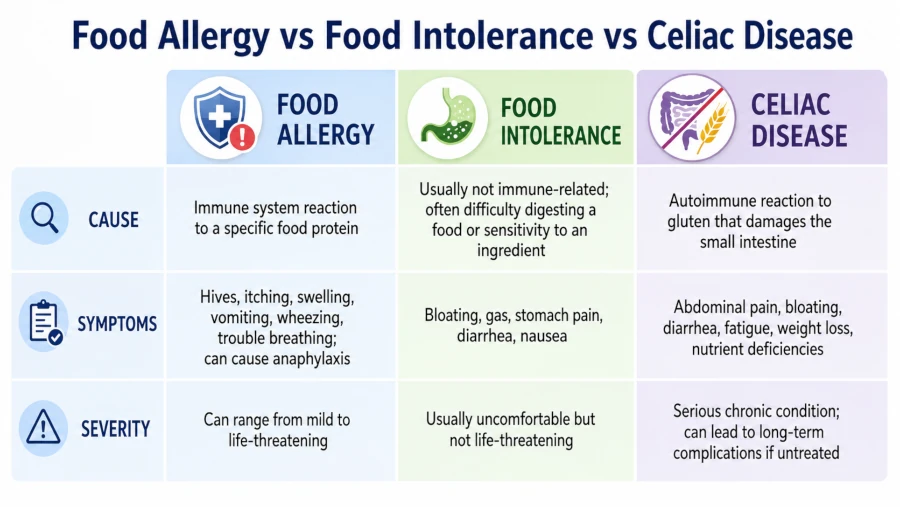
This distinction matters more than almost anything else on this page, because it changes how dangerous a reaction can be. A food allergy involves the immune system. Even a trace of the food can set it off, and a reaction can escalate to anaphylaxis, which is life-threatening [Mayo Clinic, 2024].
A food intolerance is a digestive problem, not an immune one. Lactose intolerance is the classic case: the body doesn’t make enough of the enzyme that breaks down milk sugar, so milk causes bloating, gas, and diarrhea — uncomfortable, but not dangerous, and never anaphylaxis [Mayo Clinic, 2024]. Most physical reactions to food are intolerances, not allergies. If everyday bloating is your main complaint, focusing on foods that support healthy digestion may help more than allergy testing.
Celiac disease sits in its own category. It is driven by the immune system, like an allergy, but the damage happens in the small intestine, and people with celiac disease are not at risk of anaphylaxis [Mayo Clinic, 2024].
| Food allergy | Food intolerance | |
| What’s involved | Immune system (IgE antibodies) | Digestive system / missing enzyme |
| Amount to react | Even a trace can trigger it | Usually a larger amount |
| Typical symptoms | Hives, swelling, vomiting, wheezing, drop in blood pressure | Bloating, gas, cramps, diarrhea |
| Worst case | Anaphylaxis (can be fatal) | Discomfort, not life-threatening |
| Examples | Peanut, milk, shellfish allergy | Lactose intolerance, sulfite sensitivity |
The nine foods behind most allergic reactions
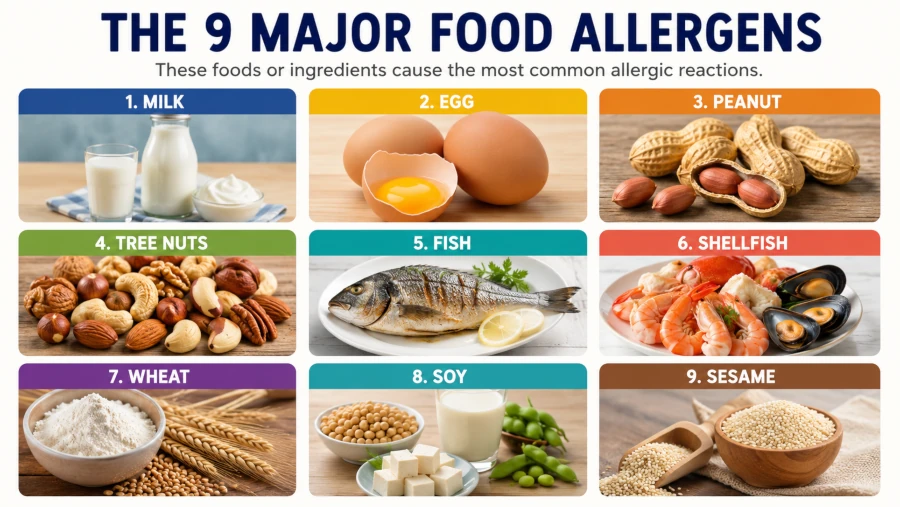
In 2004, US law named eight foods as major food allergens. Sesame became the ninth in 2023 under the FASTER Act, which is why packaged foods now have to label it by name [FDA, 2024]. Together these nine — often called the Big 9 — account for about 90% of food-allergic reactions [USDA FSIS, 2024].
| Allergen | Who it most affects | Often outgrown? |
| Cow’s milk | Infants and young children — the most common childhood food allergy | Often, by school age |
| Egg | Infants and young children | Often, by adolescence |
| Peanut | Children and adults | Usually lifelong |
| Tree nuts | Children and adults (almond, walnut, cashew, pistachio, pecan, etc.) | Usually lifelong |
| Fish | More often begins in adulthood | Usually lifelong |
| Crustacean shellfish | More often begins in adulthood (shrimp, crab, lobster) | Usually lifelong |
| Wheat | Mostly young children | Often, in childhood |
| Soy | Mostly infants and young children | Often outgrown |
| Sesame | Children and adults | Often persists |
Milk
Cow’s milk allergy is the most common food allergy in babies and young children [FARE, 2024]. It is a reaction to milk proteins — casein and whey — and it is not the same as lactose intolerance, even though the two get mixed up constantly. The allergy can cause eczema, vomiting, diarrhea, and wheezing; the intolerance mainly causes gas and loose stools. Most children outgrow the allergy.
Egg
Egg allergy is also mostly a childhood condition, and the trigger is usually proteins in the egg white rather than the yolk. Skin reactions and stomach upset are typical, and many children outgrow it. A lot of egg-allergic kids can tolerate egg baked into muffins or cake, because heat changes the proteins — but that is something to confirm with an allergist, not test at the kitchen table.
Peanut
Peanut allergy behaves differently. It tends to start in childhood and last for life, and it is one of the more common causes of severe, anaphylactic reactions [Mayo Clinic, 2024]. Peanuts are legumes, not tree nuts, but many people with a peanut allergy are told to avoid tree nuts too because of the risk of cross-contact.
There is a real good-news development here. The 2015 LEAP trial found that introducing peanut to high-risk babies early — rather than avoiding it — cut the rate of peanut allergy by about 81%, and US guidelines were rewritten in 2017 to recommend early introduction [NIH, 2017]. If your baby has severe eczema or an egg allergy, ask your doctor how and when to do this safely.
Tree nuts
Tree nuts — almonds, walnuts, cashews, pistachios, pecans, hazelnuts, Brazil nuts — are a separate group from peanuts. Reacting to one tree nut raises the odds of reacting to others, and like peanut allergy, tree nut allergy is usually lifelong and can be severe.
Fish and shellfish
Fish and shellfish allergies often appear for the first time in adulthood and tend to stick around for life. “Shellfish” splits into two groups: crustaceans (shrimp, crab, lobster) and mollusks (clams, mussels, oysters, scallops). Crustacean shellfish is one of the nine major allergens. A shrimp allergy doesn’t automatically mean you’ll react to fish, since the two are biologically unrelated. Shellfish allergy is among the most common food allergies in US adults [FARE, 2024].
Wheat
Wheat allergy is most common in young children and is often outgrown. It is worth separating from two other wheat-related conditions. Celiac disease is an autoimmune reaction to gluten that damages the gut but does not cause anaphylaxis [Mayo Clinic, 2024]. And in a rarer condition called wheat-dependent exercise-induced anaphylaxis, a reaction happens only when wheat is eaten and followed by exercise. These are different problems with different management, so the right diagnosis matters. If gluten turns out to be the issue, a list of naturally gluten-free foods can make day-to-day eating easier.
Soy
Soy allergy usually appears in infancy and is frequently outgrown by childhood. Reactions are often milder than with peanut, though severe ones can happen. Soy turns up in many processed foods, so label-reading is the main challenge.
Sesame
Sesame is the newest addition to the major-allergen list. Reactions can be severe, and sesame hides under names like tahini and inside “spice” or “flavor” blends — which is exactly why the 2023 labeling rule was such a practical win for people who have to avoid it [FDA, 2024].
Foods and additives that cause reactions but aren’t classic allergies
Plenty of foods cause unpleasant reactions through routes that aren’t a true IgE allergy. They are real and can be worth avoiding, but the mechanism — and usually the danger level — is different.
Histamine and other amines: aged cheese, wine, cured meats
Aged and cured cheeses, red wine, and cured meats are high in naturally occurring amines such as histamine and tyramine. In people who are sensitive — often because they are low on the enzyme that breaks histamine down — these can trigger flushing, headache, hives, or a stuffy nose. This is histamine intolerance, not a cheese or wine “allergy,” and it is dose-related: a small amount may be fine while a large one isn’t. Chocolate gets blamed often too, but true allergy to cocoa itself is rare; reactions are more often due to the milk, soy, or nuts mixed into it.
Sulfites and other additives
Sulfites — used to preserve dried fruit, wine, and some processed foods — can trigger asthma symptoms in sensitive people, which is why they must be declared on labels above a set level [Mayo Clinic, 2024]. Certain food dyes and benzoates are also reported to cause hives or worsen asthma in a minority of people. These are sensitivities rather than allergies. Because some of these reactions show up as wheezing, managing asthma well — including a diet built around foods that support lung health — can help, though it never replaces avoiding the trigger.
Why raw apples and carrots make your mouth itch
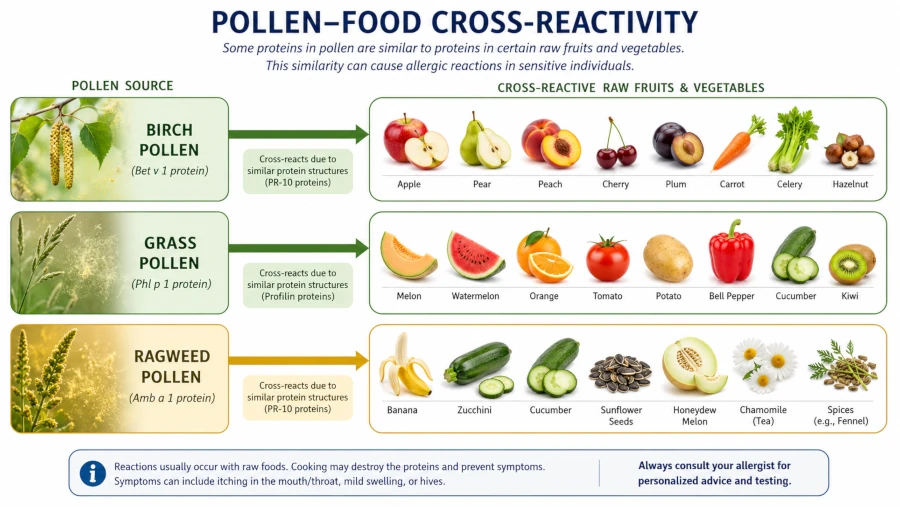
If biting into a raw apple, a carrot, a peach, or a slice of melon makes your lips or the roof of your mouth itch, you may have pollen-food allergy syndrome, also called oral allergy syndrome. It comes from a mix-up: your immune system reacts to pollen, and certain raw fruits and vegetables contain proteins close enough to that pollen to set off the same alarm [ACAAI, 2022].
A few patterns are common. Birch-pollen allergy cross-reacts with apple, cherry, peach, pear, carrot, celery, kiwi, hazelnut, and almond; grass pollen with melon, tomato, and orange; ragweed with banana, melon, cucumber, and zucchini [ACAAI, 2022]. Cooking usually fixes it, because heat changes the proteins — which is why someone who can’t eat a raw apple can often eat apple pie.
The symptoms are normally mild and short-lived, limited to the mouth and throat. But if a reaction ever spreads beyond the mouth — hives, trouble breathing, vomiting — treat it as a possible true allergy and see an allergist [ACAAI, 2022].
Alpha-gal syndrome: a red-meat allergy that starts with a tick bite
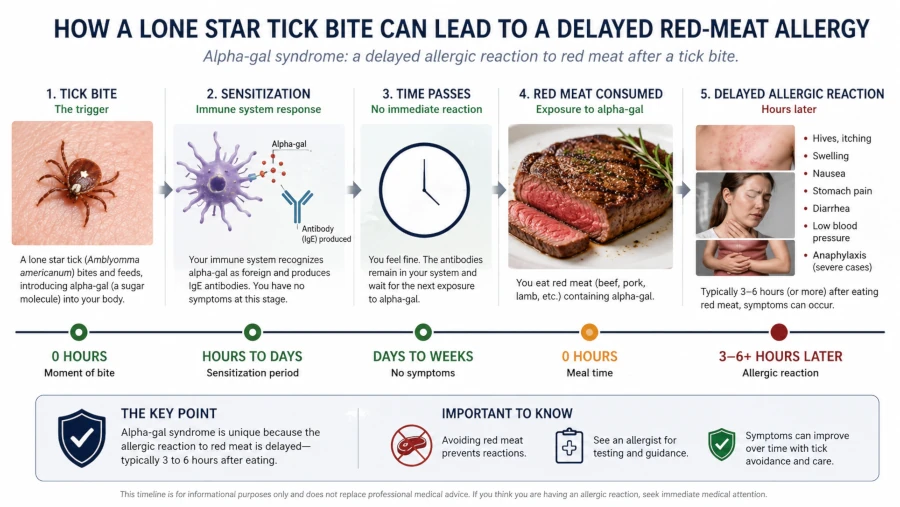
For most of history, red meat barely registered as an allergen. That changed with the discovery of alpha-gal syndrome. A bite from the lone star tick can sensitize the immune system to a sugar called alpha-gal found in mammal meat — beef, pork, lamb, venison — and in some dairy and gelatin products [CDC, 2024].
Two things make it unusual. The reaction is delayed, often hitting 2 to 6 hours after a meal rather than within minutes, which makes it hard to connect to food at all. And it can be serious. The CDC estimates that as many as 450,000 Americans may have been affected since 2010, with many cases going undiagnosed [CDC, 2024]. People with alpha-gal syndrome can usually still eat poultry and fish, and preventing further tick bites is part of managing it.
What a food allergy reaction looks like
Symptoms usually appear within minutes to about two hours of eating the food [ACAAI, 2020]. They can involve one part of the body or several at once:
- Skin: hives, itching, swelling, an eczema flare, flushing
- Mouth and gut: itchy mouth, nausea, vomiting, stomach cramps, diarrhea
- Airways: sneezing, congestion, wheezing, coughing, chest tightness
- Whole body: a sudden drop in blood pressure, dizziness, or fainting
A first reaction being mild doesn’t guarantee the next one will be. Allergic reactions are unpredictable, and someone who once had only hives can have a severe reaction another time [Mayo Clinic, 2024].
Red flags: when a food reaction is an emergency
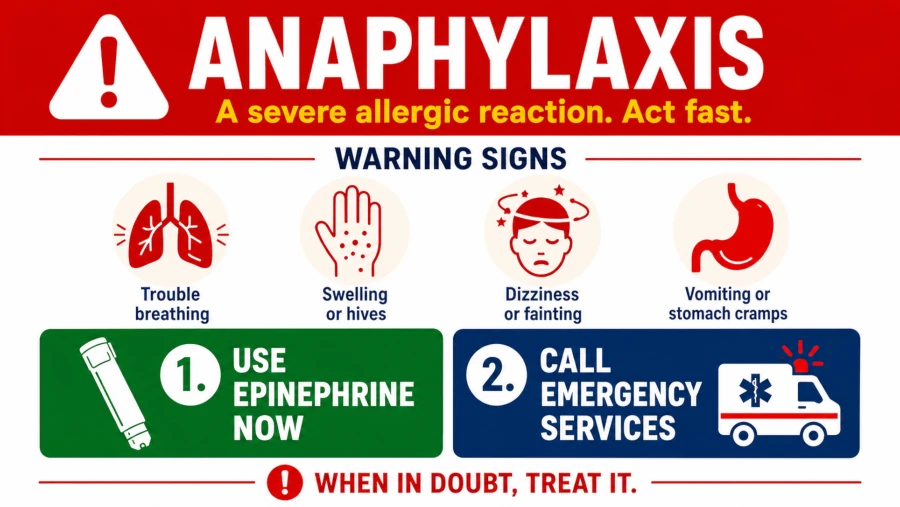
Anaphylaxis is a severe, whole-body allergic reaction that can come on within seconds to minutes and can be fatal without fast treatment [Mayo Clinic, 2025]. Call emergency services right away if you or someone else has any of these after eating:
- trouble breathing, wheezing, or noisy breathing
- swelling of the tongue, throat, or lips, or trouble swallowing
- a tight throat or a hoarse voice
- widespread hives together with vomiting
- dizziness, fainting, or a sudden weak, rapid pulse
- a feeling that something is very wrong
The treatment is epinephrine — an auto-injector such as an EpiPen — given without delay, followed by a trip to the emergency room, because symptoms can return even after they ease [Mayo Clinic, 2025]. If epinephrine is available, use it first and then call for help; don’t wait to see whether the reaction worsens.
Anyone who has reacted to food should see a board-certified allergist. Skin-prick tests, blood tests for specific IgE, and — when needed — a supervised oral food challenge can pin down the trigger [FARE, 2024]. Be cautious with “food sensitivity” panels that measure IgG: major allergy societies say these don’t diagnose food allergy and can lead people to cut out foods for no reason.
Living with food allergies: what to expect
There is no cure for food allergy yet, so avoidance is still the foundation — reading every label, asking about ingredients when eating out, and carrying epinephrine if you have been prescribed it [FARE, 2024]. A few realistic expectations:
- Some allergies fade. Milk, egg, wheat, and soy allergies are often outgrown in childhood; peanut, tree nut, fish, and shellfish allergies usually last for life.
- Trace amounts count. With a true allergy, “just a little” isn’t safe the way it can be with an intolerance.
- Treatments are advancing. Oral immunotherapy — eating tiny, slowly increasing doses under medical supervision — can lower the severity of reactions for some people, though it is a long process and not a cure.
- Early introduction helps prevent some allergies. Giving babies age-appropriate forms of peanut and egg early, rather than holding off, lowers the risk of developing those allergies.
If you suspect a food allergy, the safest next step is an allergist — not an elimination diet you design alone, which can miss the real trigger or strip out nutrients you need.
| Health Disclaimer This article is for general education and is not medical advice. It can’t diagnose you, and it isn’t a substitute for care from a qualified health professional who knows your history. Food allergies can be life-threatening, so if you think you or your child has one, see a doctor or a board-certified allergist before changing your diet. If you are pregnant or breastfeeding, have a chronic condition, or take medication, check with your clinician before making changes. If you are having a severe reaction — trouble breathing, throat or tongue swelling, fainting — use epinephrine if it has been prescribed and call emergency services immediately. |
Frequently Asked Questions
What are the most common foods that cause allergies?
Nine foods cause about 90% of allergic reactions: cow’s milk, egg, peanut, tree nuts, fish, crustacean shellfish, wheat, soy, and sesame. Milk and egg are the most common in young children; peanut, tree nut, fish, and shellfish allergies are more likely to last into adulthood.
What’s the difference between a food allergy and a food intolerance?
An allergy is an immune reaction that can be triggered by even a trace of food and can lead to anaphylaxis. An intolerance is a digestive issue — like lactose intolerance — that usually needs a larger amount, causes gut symptoms, and is not life-threatening.
Can you suddenly develop a food allergy as an adult?
Yes. Shellfish and fish allergies often appear for the first time in adulthood, and alpha-gal syndrome — a red-meat allergy triggered by a tick bite — is an adult-onset example. New or unexplained reactions are worth checking with an allergist.
Why does my mouth itch when I eat raw fruit but not when it’s cooked?
That pattern points to oral allergy syndrome, where pollen-related proteins in raw fruits and vegetables irritate the mouth and throat. Cooking changes those proteins, so the cooked version is usually fine. If symptoms ever go beyond the mouth, see an allergist.
Can food allergies be cured?
Not yet. Many childhood allergies (milk, egg, wheat, soy) are outgrown, and oral immunotherapy can reduce reaction severity for some people, but avoidance and carrying prescribed epinephrine remain the core of management.
Are “food sensitivity” (IgG) blood tests useful for diagnosing allergies?
Major allergy organizations advise against them. IgG tests don’t diagnose true food allergy and can lead to unnecessary food restriction. Skin-prick testing, specific-IgE blood tests, and supervised oral food challenges are the validated tools.
References
- U.S. Food and Drug Administration. Food Allergies. FDA, 2024. → View source
- U.S. Department of Agriculture, FSIS. Food Allergies: The “Big 9.” 2024. → View source
- Mayo Clinic. Food allergy vs. food intolerance: What’s the difference? 2024. → View source
- Mayo Clinic. Anaphylaxis — Symptoms & causes. 2025. → View source
- CDC / National Center for Health Statistics. More Than a Quarter of U.S. Adults and Children Have at Least One Allergy. 2023. → View source
- Centers for Disease Control and Prevention. Alpha-gal Syndrome. 2024. → View source
- American College of Allergy, Asthma & Immunology. Pollen Food Allergy Syndrome (Oral Allergy Syndrome). 2022. → View source
- American College of Allergy, Asthma & Immunology. Food Allergies: Causes, Symptoms & Treatment. 2020. → View source
- Food Allergy Research & Education (FARE). Food Allergy Facts and Statistics. 2024. → View source
- National Institutes of Health (NIAID). NIH-sponsored expert panel issues clinical guidelines to prevent peanut allergy. 2017. → View source
- Iweala OI, Choudhary SK, Commins SP, et al. Food Allergies (StatPearls). 2025. → View source
- Warren CM, Jiang J, Gupta RS. Epidemiology and Burden of Food Allergy. Curr Allergy Asthma Rep. 2020. → View source
