
Most men in the United States already get enough of most nutrients from food. The shortfalls that show up over and over in national survey data are narrower than the supplement aisle suggests, and they cluster around a handful of nutrients: vitamin D, magnesium and potassium, plus vitamin B12 once absorption starts to slip with age or medication. Those are the men’s essential vitamins and minerals actually worth your attention.
What follows is organized around that reality. For each nutrient: how much you need, how often men fall short, what the evidence supports, and where it stops. Where the science is thin, this page says so.
Vitamins and minerals: Where men actually fall short
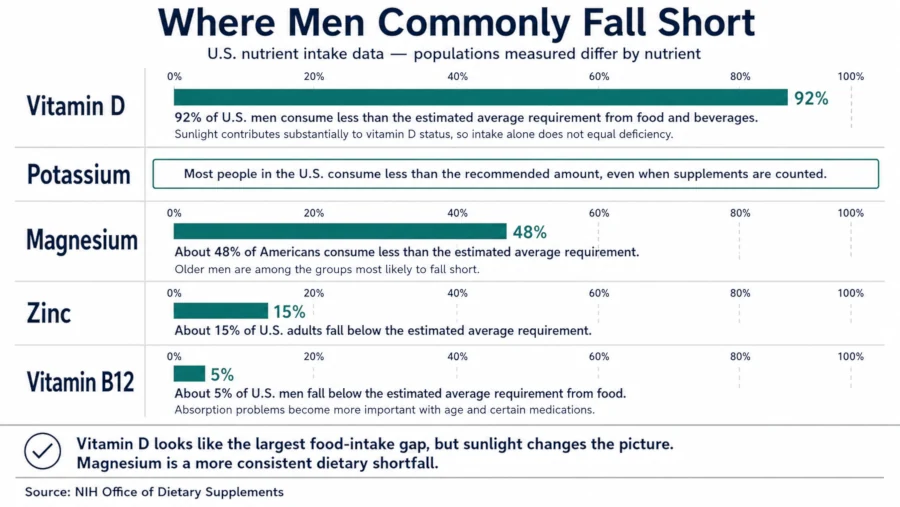
| Nutrient | Adult male target | How often men fall short | Everyday food sources |
| Vitamin D | 600 IU (15 mcg); 800 IU after 70 | 92% of men take in less than the estimated average requirement from food and drink, though blood levels tell a milder story | Salmon, trout, fortified milk and cereal, egg yolks, UV-treated mushrooms |
| Magnesium | 400 mg (19–30); 420 mg (31+) | About 48% of Americans of all ages fall below the estimated average requirement; men 71 and older are most likely to be low | Pumpkin seeds, chia, almonds, spinach, black beans, whole grains |
| Potassium | 3,400 mg | Most people in the U.S. fall below the recommended amount, even counting supplements | Potatoes, beans, lentils, dried apricots, spinach, milk, yogurt, fish |
| Vitamin B12 | 2.4 mcg | Only about 5% of men fall below the estimated average requirement from food — but absorption fails with age and certain drugs | Beef, clams, salmon, tuna, dairy, eggs, fortified cereal and nutritional yeast |
| Zinc | 11 mg | About 15% of U.S. adults fall below the estimated average requirement; men average 13 mg a day from food | Oysters, beef, crab, pork, fortified cereal, pumpkin seeds |
| Calcium | 1,000 mg; 1,200 mg after 70 | Shortfalls concentrate in specific groups rather than men generally | Milk, yogurt, cheese, canned sardines and salmon with bones, kale, fortified beverages |
Two things are worth noticing in that table. Only one of these nutrients is a genuine, population-wide gap for men — magnesium. And the nutrient where men are most likely to run into trouble, vitamin B12, is not an eating problem at all.
Vitamin D: the one worth an actual conversation
Vitamin D moves calcium out of your gut and into your bones. Without enough of it, bones can become thin, brittle or misshapen, and low levels can leave muscles weak and painful [NIH Office of Dietary Supplements, vitamin D, 2026].
The recommended intake is 15 mcg (600 IU) a day for men through age 70, rising to 20 mcg (800 IU) after that [NIH Office of Dietary Supplements, vitamin D, 2026]. Food alone rarely gets you there — 92% of American men take in less than the estimated average requirement of 400 IU from food and drink [NIH Office of Dietary Supplements, vitamin D, 2026]. Sunlight fills most of the gap, which is why blood levels look better than intake data suggests: in a national survey of 2011–2014, most Americans had sufficient vitamin D, with 18% at risk of inadequacy and 5% at risk of deficiency [NIH Office of Dietary Supplements, vitamin D, 2026].
Those averages hide a real disparity. Roughly 17.5% of non-Hispanic Black Americans were at risk of deficiency, compared with 7.6% of non-Hispanic Asian, 5.9% of Hispanic and 2.1% of non-Hispanic White Americans [NIH Office of Dietary Supplements, vitamin D, 2026]. Other men more likely to run low: anyone who spends most daylight hours indoors, men with a BMI of 30 or higher (body fat sequesters the vitamin), men who have had gastric bypass surgery, and men with conditions that impair fat absorption [NIH Office of Dietary Supplements, vitamin D, 2026].
What supplements do — and don’t do
This is where honest reporting matters. The VITAL trial gave 2,000 IU of vitamin D3 daily to 25,871 men aged 50 and older and women aged 55 and older for a median of 5.3 years. Rates of breast, prostate and colorectal cancer did not differ from placebo, and the supplements did not significantly reduce heart attacks, strokes or cardiovascular deaths [NIH Office of Dietary Supplements, vitamin D, 2026]. A companion analysis found no reduction in total, hip or nonvertebral fractures either [NIH Office of Dietary Supplements, vitamin D, 2026]. Most participants already had adequate vitamin D at the start, which is the key caveat: this tested topping up men who were mostly fine, not treating deficiency.
On prostate cancer specifically, the evidence is genuinely mixed rather than reassuring in one direction. Several studies published around 2014 suggested that higher vitamin D levels might raise risk — one meta-analysis of 21 studies covering 11,941 men with prostate cancer found a 17% higher risk at higher levels. Since then, several analyses, including one pooling 19 prospective studies, have found no relationship at all [NIH Office of Dietary Supplements, vitamin D, 2026]. Nobody should be presenting either direction as settled.
Screening is also less routine than the marketing implies. The U.S. Preventive Services Task Force found insufficient evidence to weigh the benefits and harms of screening asymptomatic adults for vitamin D deficiency, and no national professional organization recommends population screening [NIH Office of Dietary Supplements, vitamin D, 2026]. If you have a reason to suspect a shortfall — one of the risk factors above, or bone or muscle symptoms — that is a conversation to have with your doctor, not a test to order off a website.
If you do supplement, vitamin D3 raises and holds blood levels better than D2 [NIH Office of Dietary Supplements, vitamin D, 2026]. The ceiling for adults is 100 mcg (4,000 IU) a day from all sources [NIH Office of Dietary Supplements, vitamin D, 2026]. And the claim that vitamin D raises testosterone does not appear among the health outcomes the NIH review examines; treat it as unestablished.
Magnesium: the most commonly under-eaten mineral here
Magnesium is a cofactor in more than 300 enzyme systems, including the ones that run muscle and nerve signaling, blood glucose control and blood pressure regulation [NIH Office of Dietary Supplements, magnesium, 2026]. Adult men need 400 mg a day through age 30 and 420 mg from 31 onward — the highest requirement of any nutrient on this page [NIH Office of Dietary Supplements, magnesium, 2026].
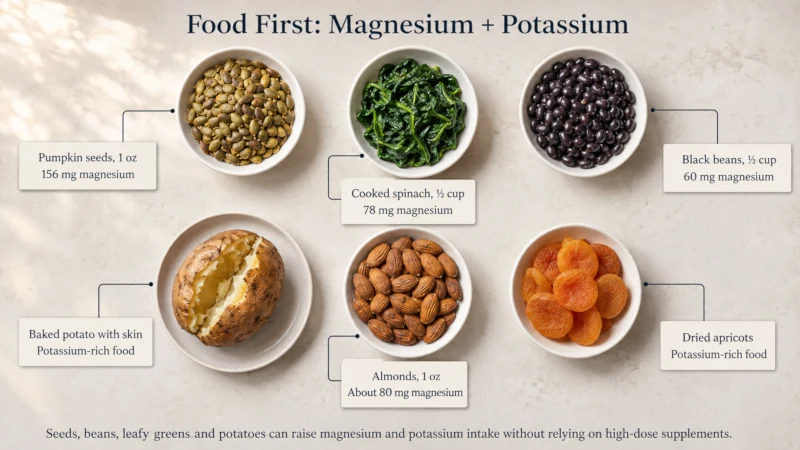
It is also the one most men miss. About 48% of Americans take in less magnesium from food and drink than they need, and men aged 71 and older are among the groups most likely to be low [NIH Office of Dietary Supplements, magnesium, 2026]. The fix is a grocery problem rather than a pharmacy one: an ounce of pumpkin seeds carries roughly 156 mg, half a cup of boiled spinach about 78 mg, and half a cup of black beans about 60 mg [NIH Office of Dietary Supplements, magnesium, 2026]. Our guide to which foods deliver the most magnesium per serving lays out the full chart.
Where magnesium gets oversold is performance. Correcting a real deficiency matters — low magnesium can cause muscle contractions, cramps and abnormal heart rhythms [NIH Office of Dietary Supplements, magnesium, 2026] — but that is not the same as an ergogenic aid, and enhanced athletic performance is not among the outcomes the NIH review finds evidence for. For blood pressure, supplement trials show a small effect: one Cochrane review of 12 trials in 545 people with hypertension found only a 2.2 mmHg reduction in diastolic pressure [NIH Office of Dietary Supplements, magnesium, 2026].
In 2022 the FDA allowed a qualified health claim for magnesium and blood pressure while stating plainly that the evidence is inconsistent and inconclusive [NIH Office of Dietary Supplements, magnesium, 2026]. Migraine is the strongest case: the American Academy of Neurology and the American Headache Society concluded magnesium is probably effective for prevention — but at doses that exceed the safe supplement ceiling, so that is a decision for your doctor [NIH Office of Dietary Supplements, magnesium, 2026].
The ceiling to remember is 350 mg a day from supplements and magnesium-containing medicines, which does not include magnesium from food [NIH Office of Dietary Supplements, magnesium, 2026]. Above it, diarrhea, nausea and cramping are common. Anyone with reduced kidney function should not supplement magnesium without medical supervision, because the ability to clear the excess is what keeps it safe [NIH Office of Dietary Supplements, magnesium, 2026].
Potassium: the shortfall almost nobody flags
Adult men need 3,400 mg of potassium a day, more than any other mineral here, and most people in the U.S. fall short even when supplements are counted [NIH Office of Dietary Supplements, potassium, 2021]. Getting too little raises blood pressure, pulls calcium out of bone, and increases the risk of kidney stones [NIH Office of Dietary Supplements, potassium, 2021].
Food is effectively the only route. Most potassium supplements provide no more than 99 mg per serving, which is about 3% of a day’s requirement [NIH Office of Dietary Supplements, potassium, 2021]. Potatoes, beans, lentils, dried apricots, spinach, milk, yogurt and fish do the real work. If blood pressure is what brought you here, our roundup of nutrients studied for lowering blood pressure covers where each one sits in the evidence.
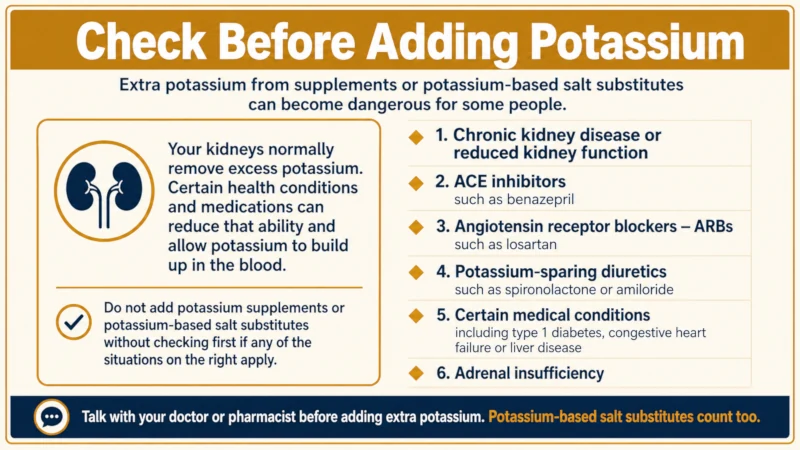
Potassium also carries the sharpest safety warning on this page. In healthy people with normal kidney function, excess potassium simply leaves in the urine. In people with chronic kidney disease, or those taking ACE inhibitors, angiotensin receptor blockers or potassium-sparing diuretics, it can build to dangerous levels — a condition called hyperkalemia — even at typical dietary intakes [NIH Office of Dietary Supplements, potassium, 2021]. Type 1 diabetes, congestive heart failure, liver disease and adrenal insufficiency raise that risk too. The same applies to potassium-based salt substitutes, which are easy to pick up without thinking of them as a supplement at all [NIH Office of Dietary Supplements, potassium, 2021]. If you take blood pressure medication, ask your doctor before adding either.
Vitamin B12: an absorption problem, not an intake problem
Men eat plenty of B12. The average intake for men aged 20 and older is 5.84 mcg a day against a requirement of 2.4 mcg, and only about 5% of U.S. men fall below the estimated average requirement [NIH Office of Dietary Supplements, vitamin B12, 2025]. So why does it keep appearing on men’s health lists?
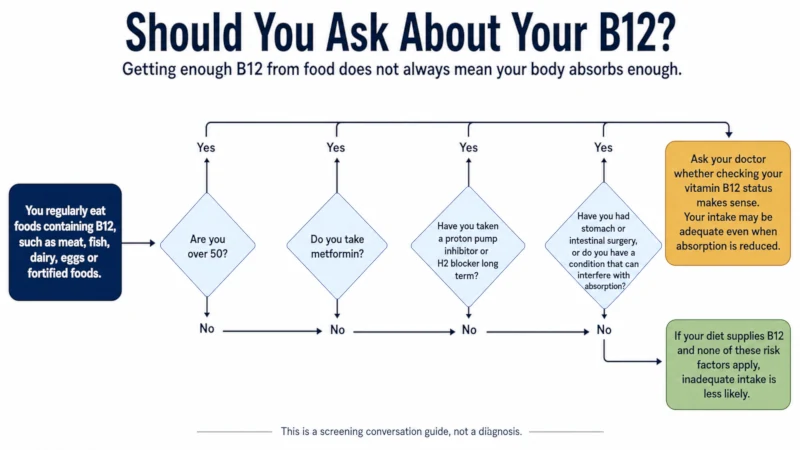
Because eating it and absorbing it are different problems. Getting B12 out of food requires stomach acid and a protein called intrinsic factor. Atrophic gastritis, which affects 8% to 9% of adults over 65, reduces both [NIH Office of Dietary Supplements, vitamin B12, 2025]. Depending on the definition used, between 3% and 43% of community-dwelling older adults are B12 deficient [NIH Office of Dietary Supplements, vitamin B12, 2025].
Metformin lowers absorption and can significantly reduce blood levels, and long-term proton pump inhibitors and H2 blockers do the same by slowing acid release [NIH Office of Dietary Supplements, vitamin B12, 2025]. If you are over 50, on metformin, or have been on an acid reducer for years, this is the nutrient to raise at your next appointment.
Deficiency is worth catching early. It can cause fatigue, palpitations, pale skin, weight loss, a sore tongue, and numbness or tingling in the hands and feet — and those neurological changes can appear without anemia, so waiting for a low blood count can mean waiting past the point where damage reverses [NIH Office of Dietary Supplements, vitamin B12, 2025].
The energy claim, though, does not hold. The NIH review states directly that B12 supplementation appears to have no beneficial effect on performance in people who are not deficient [NIH Office of Dietary Supplements, vitamin B12, 2025]. Nor does supplementation with B12, alone or with folic acid and B6, improve cognitive function in older adults, even though it reliably lowers homocysteine [NIH Office of Dietary Supplements, vitamin B12, 2025].
There is one men-specific caution worth knowing about mega-doses: in a cohort of 77,118 adults, taking at least 55 mcg a day of supplemental B12 for an average of ten years was associated with a 40% higher risk of lung cancer in men, with no such association in women [NIH Office of Dietary Supplements, vitamin B12, 2025]. That is observational rather than proof of cause, but it is a reason not to reach for a 1,000 mcg tablet without a reason. Our breakdown of how the eight B vitamins differ covers the rest of the family.
Zinc: real for men, but not a testosterone dial
Adult men need 11 mg of zinc a day and average about 13 mg from food, so most men are covered — though roughly 15% of U.S. adults fall below the estimated average requirement [NIH Office of Dietary Supplements, zinc, 2026]. Oysters carry more zinc per serving than any other food, but beef supplies 20% of the zinc in the American diet simply because people eat so much of it [NIH Office of Dietary Supplements, zinc, 2026].
Zinc genuinely matters for men. Deficiency affects the reproductive system among others, and in children can lead to reproductive problems in adulthood [NIH Office of Dietary Supplements, zinc, 2026]. It also blunts wound healing, dulls taste and smell, and in older adults affects cognitive and psychological function [NIH Office of Dietary Supplements, zinc, 2026]. What the evidence does not show is that extra zinc pushes anything higher. The NIH review of zinc and health covers colds, childhood pneumonia and diarrhea, HIV, macular degeneration and type 2 diabetes — testosterone is not among the outcomes it finds evidence for.
The best-supported use in adults is modest: a 2024 Cochrane review of 34 trials in 8,526 participants concluded that zinc may shorten a cold by about two days once you already have one, while making little or no difference to whether you catch one — all on low to very low certainty evidence [NIH Office of Dietary Supplements, zinc, 2026].
The ceiling is 40 mg a day from food and supplements combined [NIH Office of Dietary Supplements, zinc, 2026]. Taking 50 mg or more for weeks interferes with copper absorption, reduces immune function and lowers HDL cholesterol [NIH Office of Dietary Supplements, zinc, 2026]. Very high doses (around 142 mg a day) can also disrupt magnesium balance [NIH Office of Dietary Supplements, zinc, 2026]. A fuller guide to zinc covers forms, food sources and interactions in more depth.
Calcium: men lose bone too, and more is not better
Bone loses calcium slowly after about age 30, and although bone loss is more common in women, it affects men as well [NIH Office of Dietary Supplements, calcium, 2023]. Men need 1,000 mg a day through age 70 and 1,200 mg after that [NIH Office of Dietary Supplements, calcium, 2023].
Food first is not a slogan here — it is a safety point. Some studies have found that men with high intakes of calcium from dairy foods have an increased risk of prostate cancer, and the NIH notes more broadly that high calcium intakes might raise the risk of both heart disease and prostate cancer [NIH Office of Dietary Supplements, calcium, 2023]. Whether calcium supplements help bone is also less settled than the aisle suggests: some trials show improved bone mineral density in older adults and others do not, and whether supplements prevent fractures remains unclear [NIH Office of Dietary Supplements, calcium, 2023].
If you do supplement, absorption drops above 500 mg at a time, so splitting the dose beats taking it all at once [NIH Office of Dietary Supplements, calcium, 2023]. Calcium carbonate needs food; calcium citrate does not, which matters if you have low stomach acid [NIH Office of Dietary Supplements, calcium, 2023]. Upper limits are 2,500 mg a day from all sources through age 50 and 2,000 mg after that [NIH Office of Dietary Supplements, calcium, 2023]. Beyond dairy, non-dairy calcium sources include canned fish with soft bones, kale, broccoli, tofu and fortified beverages.
Folate and vitamin C: where the claims outrun the evidence
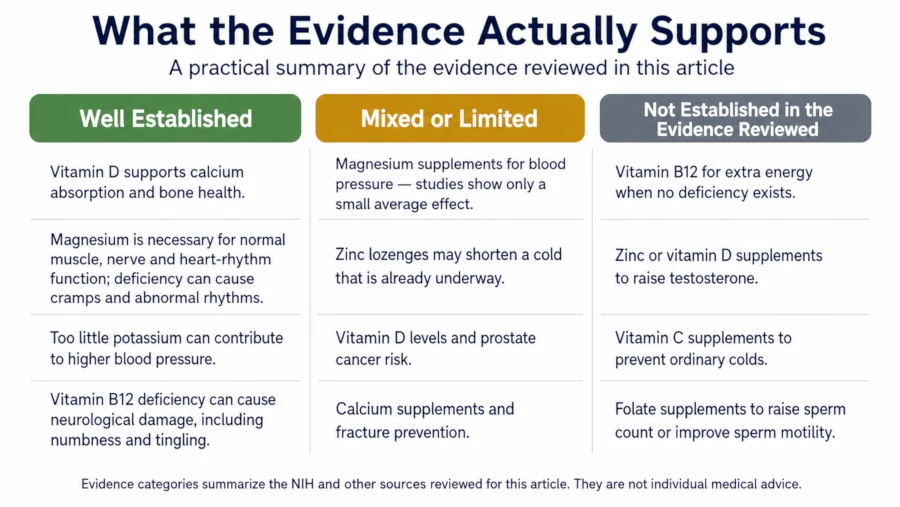
Folate deserves a place on this page, but not for the reasons it usually gets one. Adults need 400 mcg DFE a day, and most Americans get enough since folic acid fortification of enriched grains began in 1998 [NIH Office of Dietary Supplements, folate, 2022]. Folic acid supplements lower homocysteine, but they do not directly decrease the risk of heart disease; some studies suggest folic acid combined with other B vitamins helps prevent stroke [NIH Office of Dietary Supplements, folate, 2022].
Two cautions carry more practical weight than any benefit claim. Large folate doses can mask a B12 deficiency by correcting the anemia while nerve damage continues untreated, which is exactly the scenario older men and men on metformin should avoid [NIH Office of Dietary Supplements, folate, 2022]. And while folate from food may reduce the risk of several cancers, high-dose folic acid taken after a cancer has started — colorectal cancer in particular — might speed its progression, so the 1,000 mcg upper limit matters especially for anyone with a history of colorectal adenomas [NIH Office of Dietary Supplements, folate, 2022].
Claims that folate improves male fertility, raises sperm count or improves sperm motility are not supported by any of the government sources reviewed for this article. Treat them as unestablished rather than proven. [UNVERIFIED — no supporting evidence located in NIH sources; claim not made here]
Vitamin C is straightforward. Men need 90 mg a day, plus 35 mg more if you smoke, because smoke increases the vitamin C the body uses to repair free-radical damage [NIH Office of Dietary Supplements, vitamin C, 2021]. Deficiency is rare in the U.S. Vitamin C improves iron absorption from plant foods and is needed to make collagen for wound healing [NIH Office of Dietary Supplements, vitamin C, 2021].
On colds, the research is unromantic: supplements do not reduce the risk of catching one. People who take vitamin C regularly may have slightly shorter or milder colds, but starting it after symptoms begin does not appear to help [NIH Office of Dietary Supplements, vitamin C, 2021]. Claims that vitamin C lowers uric acid, prevents gout or reduces prostate risk are not supported by the NIH fact sheet and are not repeated here. The upper limit is 2,000 mg a day; above that, diarrhea, nausea and stomach cramps are common [NIH Office of Dietary Supplements, vitamin C, 2021]. One caution matters more for men than the label suggests: in hemochromatosis, which causes the body to store too much iron, high-dose vitamin C can worsen iron overload and damage tissue [NIH Office of Dietary Supplements, vitamin C, 2021].
Safety: limits, interactions and who should check first
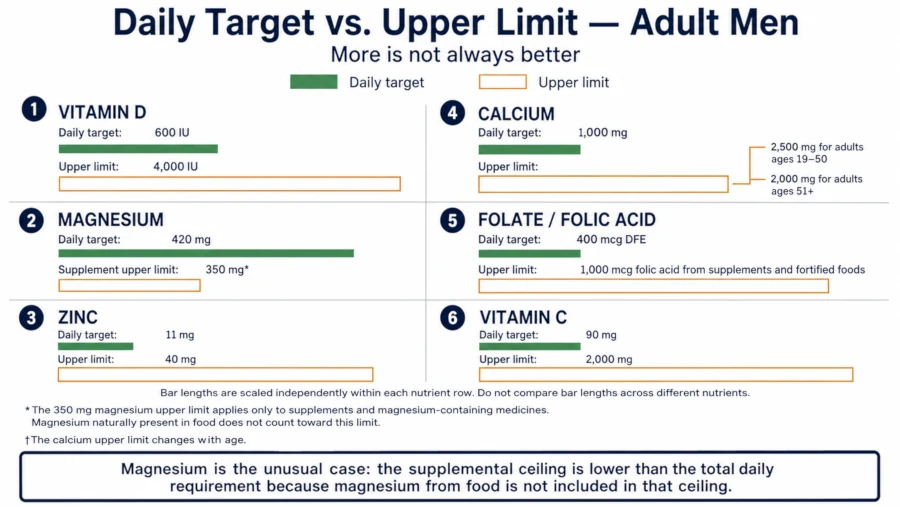
Daily upper limits for adult men
| Nutrient | Upper limit | What the limit covers |
| Vitamin D | 100 mcg (4,000 IU)/day | All sources. Excess causes hypercalcemia; in extreme cases kidney failure and arrhythmias. |
| Magnesium | 350 mg/day | Supplements and magnesium-containing medicines only, not food. Diarrhea and cramping are the usual first signs. |
| Zinc | 40 mg/day | Food and supplements combined. 50 mg or more for weeks blocks copper absorption and lowers HDL. |
| Calcium | 2,500 mg/day (19–50); 2,000 mg (51+) | All sources. Absorption is best at 500 mg or less at a time. |
| Folic acid | 1,000 mcg/day | Supplements and fortified foods. Can mask B12 deficiency above this. |
| Vitamin C | 2,000 mg/day | All sources. Diarrhea, nausea and cramps above the limit. |
| Vitamin B12 | None established | Low toxicity potential; the body does not store the excess. |
| Potassium | None established | No upper limit for healthy kidneys, but see the hyperkalemia risks below. |
Medication interactions worth knowing
| Medication | Nutrient | What happens |
| Metformin | Vitamin B12 | Reduces absorption and can significantly lower blood levels over time. |
| Proton pump inhibitors and H2 blockers | Vitamin B12; magnesium | Less stomach acid means less B12 released from food; prolonged PPI use (typically over a year) can cause low magnesium. |
| ACE inhibitors, ARBs, potassium-sparing diuretics | Potassium | Reduce potassium loss in urine and can push levels dangerously high, especially with kidney problems. |
| Thiazide diuretics | Vitamin D and calcium; zinc | Combined with vitamin D can cause hypercalcemia; separately, thiazides increase zinc loss in urine. |
| Statins | Vitamin D | Statins may reduce vitamin D synthesis, and high vitamin D intakes may reduce the potency of atorvastatin, lovastatin and simvastatin. |
| Orlistat | Vitamin D | Reduces absorption of vitamin D from food and supplements. |
| Corticosteroids (e.g. prednisone) | Vitamin D and calcium | Reduce calcium absorption and impair vitamin D metabolism. |
| Levothyroxine | Calcium | Poorly absorbed if taken within 4 hours of a calcium carbonate supplement. |
| Quinolone and tetracycline antibiotics | Magnesium, zinc, calcium | Absorption of both the drug and the mineral drops. Separate doses by at least 2 hours before or 4–6 hours after. |
| Bisphosphonates (e.g. alendronate) | Magnesium, calcium | Magnesium-rich supplements reduce absorption; separate by at least 2 hours. |
| Lithium | Calcium | Long-term use, or use with calcium supplements, can raise blood calcium abnormally. |
Pregnancy and breastfeeding
This page is written for adult men, and the targets above do not transfer. Requirements and cautions change in pregnancy and breastfeeding: the folate recommendation rises to 600 mcg DFE in pregnancy and 500 mcg DFE while breastfeeding, and everyone who could become pregnant should take 400 mcg of folic acid daily from supplements or fortified food [NIH Office of Dietary Supplements, folate, 2022]. Supplements get shared in households more often than anyone admits. A men’s formula is not a substitute for a prenatal one, and high-dose single-nutrient products should not be taken during pregnancy without medical advice.
Who should talk to a professional before starting
- Anyone with reduced kidney function or kidney disease — magnesium and potassium both depend on the kidneys to clear the excess [NIH Office of Dietary Supplements, magnesium, 2026] [NIH Office of Dietary Supplements, potassium, 2021]
- Anyone taking blood pressure medication, particularly ACE inhibitors, ARBs or potassium-sparing diuretics, before adding potassium or a potassium-based salt substitute [NIH Office of Dietary Supplements, potassium, 2021]
- Anyone on metformin or a long-term acid reducer, who should ask specifically about B12 status [NIH Office of Dietary Supplements, vitamin B12, 2025]
- Anyone with hemochromatosis, before taking high-dose vitamin C [NIH Office of Dietary Supplements, vitamin C, 2021]
- Anyone with a history of colorectal adenomas, before exceeding 1,000 mcg of folic acid [NIH Office of Dietary Supplements, folate, 2022]
- Anyone taking levothyroxine, lithium, bisphosphonates, or quinolone or tetracycline antibiotics, about timing [NIH Office of Dietary Supplements, calcium, 2023] [NIH Office of Dietary Supplements, magnesium, 2026]
- Anyone being treated for cancer, before taking vitamin C or other antioxidant supplements, especially in high doses [NIH Office of Dietary Supplements, vitamin C, 2021]
When symptoms need care, not a supplement
Call 911 for chest pain, severe shortness of breath, fainting, sudden confusion or slurred speech, or a very slow or irregular heartbeat.
Get prompt medical attention — primary care or urgent care, not a supplement — for any of the following:
- New or worsening numbness, tingling or burning in the hands or feet, trouble with balance, or memory and personality changes, which can signal B12 deficiency
- Persistent fatigue, pale skin, palpitations or unexplained weight loss
- Severe one-sided flank pain, or blood in the urine, which can indicate kidney stones
- Nausea, muscle weakness or an irregular heart rate after starting a potassium supplement or salt substitute
- Trouble urinating, a weak stream, or urinary frequency at night — prostate symptoms deserve a diagnosis rather than a supplement
- Bone pain, muscle weakness or a fracture from a minor fall
| Health Disclaimer: This article is general education, not medical advice, diagnosis or treatment. Nutrient needs vary from one person to the next, and vitamin and mineral deficiencies are confirmed with blood tests and a clinical assessment rather than from a symptom list. Talk to a doctor, pharmacist or registered dietitian before starting any supplement — particularly if you take prescription medication, have kidney disease, liver disease or a heart condition, are being treated for cancer, or are preparing for surgery. Do not start, stop or change a prescription based on anything here. Supplements are not a treatment for any disease. If you have symptoms such as chest pain, severe shortness of breath, fainting, sudden confusion, slurred speech or an irregular heartbeat, call 911. |
Frequently Asked Questions
Do men actually need a multivitamin?
Most men eating a varied diet do not. The federal Dietary Guidelines position, echoed across the NIH fact sheets, is that nutritional needs should be met primarily through food, with fortified foods and supplements useful when that is not possible [NIH Office of Dietary Supplements, vitamin D, 2026]. The exceptions on this page are specific: low magnesium and potassium intakes, limited sun exposure or darker skin for vitamin D, and impaired B12 absorption after 50 or on metformin or long-term acid reducers [NIH Office of Dietary Supplements, magnesium, 2026] [NIH Office of Dietary Supplements, potassium, 2021] [NIH Office of Dietary Supplements, vitamin B12, 2025].
Will a supplement raise my testosterone?
No supplement on this page has established evidence for that. Zinc is required for normal reproductive function and a genuine deficiency can disrupt it [NIH Office of Dietary Supplements, zinc, 2026], but testosterone is not among the outcomes the NIH reviews of zinc or vitamin D find evidence for. Correcting a shortfall is not the same as pushing a normal level higher.
Which vitamin should men over 50 pay most attention to?
Vitamin B12, because the issue is absorption rather than intake. Between 3% and 43% of older adults are deficient depending on the definition used, atrophic gastritis affects 8% to 9% of adults over 65, and metformin and long-term acid reducers both lower absorption [NIH Office of Dietary Supplements, vitamin B12, 2025]. Magnesium is a close second: men aged 71 and older are among the groups most likely to fall short [NIH Office of Dietary Supplements, magnesium, 2026].
Does vitamin C prevent colds?
Not for most people. Vitamin C supplements do not reduce the risk of getting a cold. Those who take it regularly may have slightly shorter or milder colds, but starting it once symptoms appear does not appear to help [NIH Office of Dietary Supplements, vitamin C, 2021]. Zinc lozenges have a modestly better record for shortening a cold already underway [NIH Office of Dietary Supplements, zinc, 2026].
Is it possible to take too much of these?
Yes, and the numbers are lower than most labels suggest. Zinc above 40 mg a day blocks copper absorption and lowers HDL [NIH Office of Dietary Supplements, zinc, 2026]. Supplemental magnesium above 350 mg causes diarrhea and cramping and can be dangerous with impaired kidneys [NIH Office of Dietary Supplements, magnesium, 2026]. Folic acid above 1,000 mcg can mask a B12 deficiency [NIH Office of Dietary Supplements, folate, 2022]. Vitamin D above 4,000 IU risks hypercalcemia [NIH Office of Dietary Supplements, vitamin D, 2026]. And high calcium intakes have been linked to increased prostate cancer risk in some studies [NIH Office of Dietary Supplements, calcium, 2023].
What is the single most useful change?
Add seeds, beans and leafy greens to meals you already eat. That one move raises magnesium and potassium at the same time — the two nutrients where men are most reliably short — and neither carries the ceiling problems that supplements do [NIH Office of Dietary Supplements, magnesium, 2026] [NIH Office of Dietary Supplements, potassium, 2021].
References
- National Institutes of Health, Office of Dietary Supplements. Vitamin D: Fact Sheet for Health Professionals. Updated 2026. View source
- National Institutes of Health, Office of Dietary Supplements. Vitamin B12: Fact Sheet for Health Professionals. Updated July 2, 2025. View source
- National Institutes of Health, Office of Dietary Supplements. Magnesium: Fact Sheet for Health Professionals. Updated January 6, 2026. View source
- National Institutes of Health, Office of Dietary Supplements. Zinc: Fact Sheet for Health Professionals. Updated January 6, 2026. View source
- National Institutes of Health, Office of Dietary Supplements. Potassium: Fact Sheet for Consumers. Updated March 22, 2021. View source
- National Institutes of Health, Office of Dietary Supplements. Calcium: Fact Sheet for Consumers. Updated September 14, 2023. View source
- National Institutes of Health, Office of Dietary Supplements. Folate: Fact Sheet for Consumers. Updated November 1, 2022. View source
- National Institutes of Health, Office of Dietary Supplements. Vitamin C: Fact Sheet for Consumers. Updated March 22, 2021. View source
