
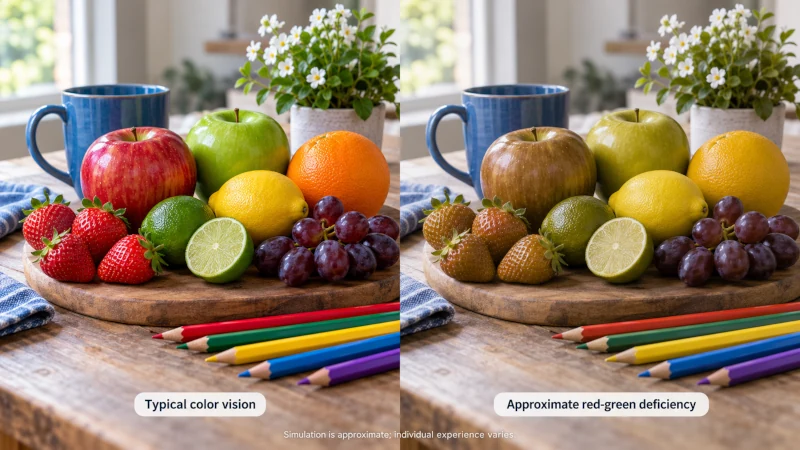
If you have color blindness, your eyes read some colors differently from most people’s, usually reds and greens, less often blues and yellows. It’s common, it’s usually inherited, and in its usual forms it doesn’t blur your vision. Color blindness that runs in families can’t be cured, and no vitamin, herb, or diet changes it [National Eye Institute, 2025]. What helps is knowing your type, using a few practical tools, and recognizing the one situation that needs prompt attention: a new change in how you see color.
What color blindness is and what it isn’t
Your retina has two kinds of light-sensing cells. Rods handle dim light. Cones handle bright light and color, and they come in three types, each most sensitive to a different part of the spectrum: long wavelengths (yellow-orange), middle wavelengths (yellow-green), and short wavelengths (blue-violet). Your brain compares the signals from all three to build every color you see [MedlinePlus Genetics, color vision deficiency].
Color blindness, which doctors call color vision deficiency, happens when one type of cone is missing, doesn’t work, or responds to a shifted range of light [American Academy of Ophthalmology, 2013]. The name oversells it. Most people with it see plenty of color; they confuse particular shades. Seeing no color at all is rare [National Eye Institute, 2025].
The common red-green and blue-yellow forms change how colors look, not how sharp things are [MedlinePlus Genetics, color vision deficiency]. Symptoms are often mild enough that people don’t realize they have it until a test picks it up [National Eye Institute, 2025].
Types of color blindness
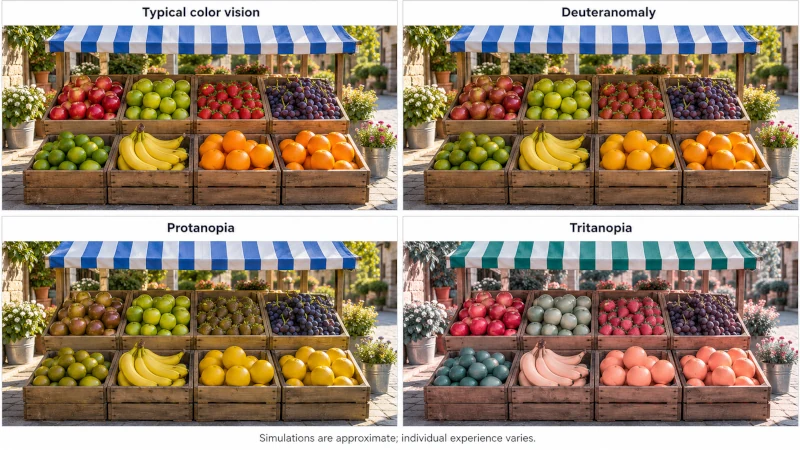
Red-green color blindness is by far the most common family, and its mildest type is also its most frequent. The proportions below come from Colour Blind Awareness, a UK charity; the blue-yellow figure comes from the US National Library of Medicine.
| Type | What’s different | What it tends to look like | How common |
| Deuteranomaly (red-green) | Green-sensitive cones respond abnormally | Some greens look redder; usually mild | Most common type, about 5% of men |
| Protanomaly (red-green) | Red-sensitive cones respond abnormally | Some reds look greener and less bright; usually mild | About 1% of men |
| Deuteranopia and protanopia (red-green) | Green or red cones don’t function | Can’t tell red from green at all | About 1% of men each |
| Tritanomaly and tritanopia (blue-yellow) | Blue-sensitive cones are affected | Blue vs. green and yellow vs. red or pink confusion; colors look duller in tritanopia | Fewer than 1 in 10,000 people |
| Complete color blindness (monochromacy, achromatopsia) | No working color cones, or only one type | Little or no color; may also cause blurry vision and light sensitivity | Rare |
Sources: [National Eye Institute, types of color vision deficiency, 2023]; [Colour Blind Awareness (UK), 2022]; [MedlinePlus Genetics, color vision deficiency].
“Red-green” undersells the confusion. People with these types commonly mix up reds, greens, browns, and oranges, and may confuse some blues with purples, because the red part of purple doesn’t fully register [Colour Blind Awareness (UK), 2022]. Very severe forms can come with quick side-to-side eye movements (nystagmus) or sensitivity to light [National Eye Institute, 2025].
How common is color blindness?
Among people with Northern European ancestry, red-green color blindness affects about 1 in 12 males and 1 in 200 females, and it’s less common in almost every other population studied [MedlinePlus Genetics, color vision deficiency]. Blue-yellow types affect men and women equally and occur in fewer than 1 in 10,000 people worldwide. Blue cone monochromacy, a severe form, affects about 1 in 100,000 [MedlinePlus Genetics, color vision deficiency].
What causes color blindness
Inherited color blindness
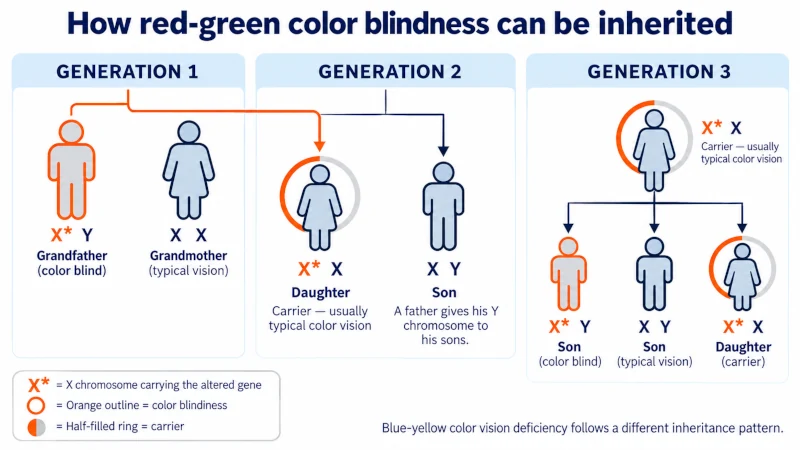
Most people with color blindness are born with it [National Eye Institute, 2025]. Red-green types come from changes in two genes, OPN1LW and OPN1MW, that carry the instructions for the red- and green-sensing cone pigments. Both genes sit on the X chromosome [MedlinePlus Genetics, color vision deficiency].
That location explains the gap between men and women. Males have one X chromosome, so one altered copy is enough. Females have two, and usually both must carry the change; if only one does, the typical copy compensates and she becomes a carrier with no symptoms who can still pass it on [Henry Ford Health, 2024]. A few patterns follow from this:
- A father with red-green color blindness can’t pass it to his sons, because sons inherit his Y chromosome, not his X [MedlinePlus Genetics, color vision deficiency].
- His daughters become carriers, and their sons can inherit it. That’s why it can look as if color blindness “skips a generation” when the gene was there all along [Henry Ford Health, 2024].
- A woman has red-green color blindness herself when she inherits the change from both sides, for example from an affected father and a carrier mother [Henry Ford Health, 2024].
Blue-yellow types work differently. They come from the OPN1SW gene on a non-sex chromosome and follow an autosomal dominant pattern, so one altered copy is enough and men and women are affected equally [MedlinePlus Genetics, color vision deficiency]. Inherited color blindness stays the same throughout life; it doesn’t get better or worse [National Eye Institute, causes of color vision deficiency, 2025].
Acquired color vision changes
You can also develop color vision problems later in life when a disease or injury affects the retina, the optic nerve, or the parts of the brain that process color [National Eye Institute, causes of color vision deficiency, 2025]. Known causes include:
- Eye diseases, such as glaucoma, age-related macular degeneration, and retinal detachment [National Eye Institute, causes of color vision deficiency, 2025].
- Cataracts and aging. The eye’s lens can darken and yellow over time, which makes some colors, especially dark ones, harder to tell apart [Prevent Blindness, 2024].
- Other health conditions, including diabetes, Alzheimer’s disease, and multiple sclerosis [National Eye Institute, 2025].
- Some medicines, including hydroxychloroquine (Plaquenil) and chloroquine [National Eye Institute, causes of color vision deficiency, 2025]; [MedlinePlus Genetics, color vision deficiency].
- Chemical exposure, such as organic solvents [MedlinePlus Genetics, color vision deficiency].
- Injury and treatment, including laser eye injuries, some brain tumors, and radiation treatment [National Eye Institute, 2025].
Unlike the inherited form, acquired color vision loss can get worse, or sometimes better, over time [Colour Blind Awareness (UK), 2022]. A change in your color vision can be the first sign of a more serious eye problem, which is why it calls for an exam rather than a workaround [American Academy of Ophthalmology, 2013].
| If you take hydroxychloroquine (Plaquenil) Hydroxychloroquine is widely used for lupus, rheumatoid arthritis, and related conditions. Retinal damage from it is uncommon in the early years at recommended doses, but it can’t be undone. The American Academy of Ophthalmology recommends a baseline eye exam soon after you start and yearly screening after that; for people at recommended doses with no major risk factors, yearly screening can usually wait until the fifth year [American Academy of Ophthalmology screening recommendations, 2016]. The same guidance notes that color vision tests aren’t reliable for catching this damage early, so don’t wait to notice color changes. Keep your screening appointments, and don’t stop or change your dose without talking to the doctor who prescribed it. |
How color blindness is diagnosed
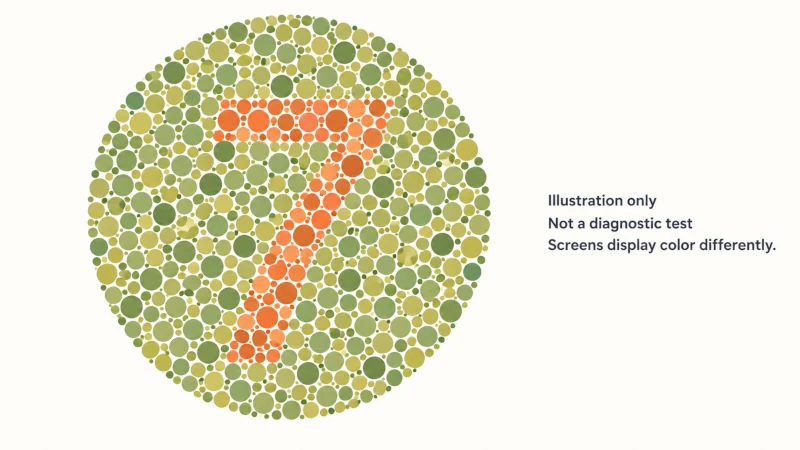
A color vision test with an eye doctor is quick and painless. In the most common version, you look at circles made of colored dots with a number, letter, or line hidden inside. The shape is easy to see with typical color vision and hard to see with a deficiency [National Eye Institute, 2025]. These are often called Ishihara plates.
Plate tests have limits. The standard Ishihara plates are designed around red-green deficiency and can’t diagnose blue-yellow or complete color blindness, so a diagnosis based only on them sometimes needs a second opinion from a clinic that does fuller color vision testing [Colour Blind Awareness (UK), 2022]. Eye doctors also use arrangement tests, in which you put colored caps in order by shade, along with discrimination tests that help pin down the type and severity [Gómez-Robledo et al., Optics Express, 2018].
Free online color blindness tests can flag a possible problem, but screens display colors differently, so treat an online result as a reason to book an exam rather than a diagnosis. Leave color-enhancing glasses at home when you go; they’re designed to change how colors look.
Prevent Blindness recommends testing for anyone with a family history of color vision problems, anyone who notices trouble seeing colors, and anyone whose job requires identifying colors correctly [Prevent Blindness, 2024].
Testing children
Color blindness can be tricky to spot in children, and some kids try to hide it. Get your child tested if color blindness runs in the family or if they seem to have trouble learning colors. Their eye doctor can do it, and some schools offer screening [National Eye Institute, 2025]. Any child who’s struggling in school should have their vision checked, including color vision [Prevent Blindness, 2024].
Is there a cure? Treatment and tools that help
There’s no cure for inherited color blindness, and most people adjust to it well [National Eye Institute, 2025]. Acquired color vision loss is a different case: treatment means treating the cause. If a medicine is responsible, your doctor may lower the dose or switch you to something else [National Eye Institute, 2025].
Color-enhancing glasses and contact lenses
Special glasses and contact lenses can make some colors easier to tell apart by increasing the contrast between them [National Eye Institute, 2025]. How much they help is genuinely disputed, and the two best-known studies point in different directions:
- Evidence that they help. In a 2020 study in Current Biology, people with the milder red-green types wore notch-filter glasses (EnChroma) or placebo glasses for two weeks. The filter group showed stronger responses to color contrast, and the gain was still there when they were retested without the glasses. People with typical color vision, and the placebo condition, showed no such change [Werner et al., Current Biology, 2020].
- Evidence that they don’t. A 2018 study in Optics Express ran people through the standard types of color vision tests with and without the same brand of glasses. The glasses shifted how colors looked, but they didn’t improve test results or make anyone’s color vision more like typical color vision [Gómez-Robledo et al., Optics Express, 2018].
Taken together, these glasses don’t correct color blindness and won’t help you pass a color vision exam. Some people with milder red-green types enjoy how vivid colors look through them. If you’re curious, ask your eye doctor whether your type is a reasonable candidate, and buy from a seller with a return policy so you can judge for yourself.
Phone apps and screen settings
Color-identifying apps let you take a photo with your phone or tablet, tap part of the image, and see the name of the color [National Eye Institute, 2025]. Most phones and computers also have color-filter options in their accessibility settings that shift the display toward colors that are easier for you to separate.
Everyday workarounds
Many people with color blindness learn to identify colors by brightness or location instead of hue [Prevent Blindness, 2024]. A few habits make daily life easier:
- Traffic signals: learn the position of each light rather than relying on its color.
- Clothes: ask for help labeling items when you buy them, or sort your closet into labeled bins so outfits don’t depend on color matching.
- Cooking: use a food thermometer instead of judging meat by color.
- Charts, maps, and wiring: ask for versions that use labels, patterns, or symbols alongside color.
Gene therapy: promising, not available
Research suggests gene therapy may eventually help a severe type of color vision deficiency [National Eye Institute, 2025]. It isn’t an available treatment today, so be wary of anyone selling a “cure.”
Vitamins, herbs, and natural remedies for color blindness
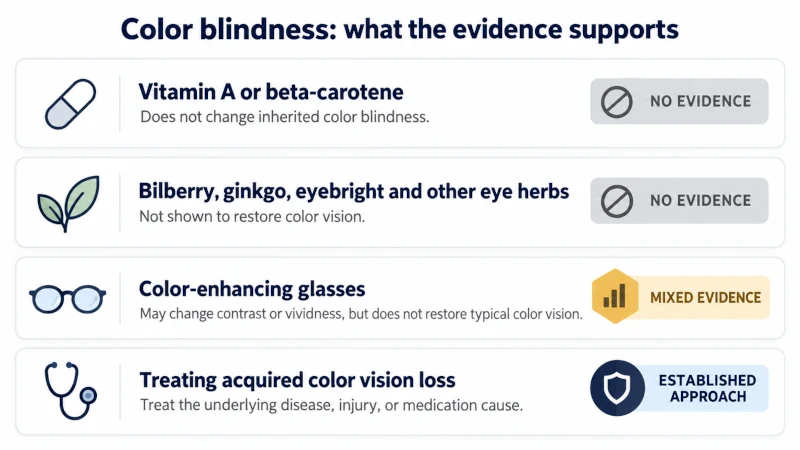
No supplement, herb, or diet can change inherited color blindness. It comes from the genes that build your cone pigments [MedlinePlus Genetics, color vision deficiency], and nutrients can’t alter those genes.
Vitamin A comes up most often because it matters for vision in general. The body needs it for normal eyesight, and not getting enough causes xerophthalmia, an inability to see in low light that can lead to blindness if it isn’t treated [NIH Office of Dietary Supplements, 2025]. That’s a night vision problem, not a color vision problem. Vitamin A deficiency is also rare in the United States, because most people get enough from food [NIH Office of Dietary Supplements, 2025]. If you’re curious about what true deficiency does to the eye, our guide to Bitot’s spots and vitamin A deficiency covers the warning signs.
| Approach | Evidence for color blindness | What to know |
| Vitamin A or beta-carotene supplements | None for inherited color blindness | Corrects vision problems only when you’re actually deficient; high doses can be harmful |
| Bilberry, ginkgo, eyebright, and other “eye herbs” | None | Not shown to improve eyesight; see our review of herbs for eye health |
| Color-enhancing glasses | Mixed | May make some colors stand out for milder red-green types; don’t restore typical color vision |
| Treating the cause of acquired color vision loss | Established approach | Addressing the underlying eye disease or medicine is the treatment |
Vitamin A safety before you take a supplement
If you’re considering vitamin A for any reason, these points come from the NIH Office of Dietary Supplements [NIH Office of Dietary Supplements, 2025]:
- Realistic expectations: Supplements help people who are deficient. They won’t change inherited color blindness or improve vision that’s already normal.
- Side effects of too much: Excess preformed vitamin A, usually from supplements, can cause severe headache, blurred vision, nausea, dizziness, muscle aches, and coordination problems. In severe cases it can lead to coma and death.
- The daily upper limit: For adults, it’s 3,000 mcg of preformed vitamin A from all sources combined, including food, drinks, and supplements. Limits for children are lower.
- Pregnancy and breastfeeding: Too much preformed vitamin A during pregnancy can cause birth defects. If you’re pregnant, might be, or are breastfeeding, don’t take high-dose preformed vitamin A supplements.
- Smokers: High-dose beta-carotene supplements have been linked to a higher risk of lung cancer and death in people who smoke, used to smoke, or were exposed to asbestos.
- Medication interactions: Orlistat (Alli, Xenical) can lower vitamin A absorption. Acitretin (Soriatane) and bexarotene (Targretin) are made from vitamin A, and combining them with a vitamin A supplement can push blood levels dangerously high.
Before starting any vitamin A supplement, talk with your doctor or pharmacist, and bring a list of everything you take. Our guide to vitamin A benefits and how much is safe covers food sources and daily needs in more detail.
Living with color blindness
Most people with color vision deficiency don’t have problems with everyday activities [National Eye Institute, 2025]. Where friction does show up, it’s predictable.
At school. Color-heavy lessons, like reading colored writing on a board, can be hard, and children may need help with some classroom activities [National Eye Institute, 2025]. Tell your child’s teacher. Labels, patterns, and high-contrast materials fix most problems.
At work. Adults may need accommodations in jobs that rely on telling colors apart, such as graphic design [National Eye Institute, 2025]. If you’re weighing a career where color identification matters, get a formal color vision test before you commit to training, and check the field’s requirements early.
Day to day. Plenty of people never think about it until a color-coded chart or a clothing choice trips them up. Asking someone “which one is the green one?” is ordinary, not embarrassing.
When to see a doctor about color vision
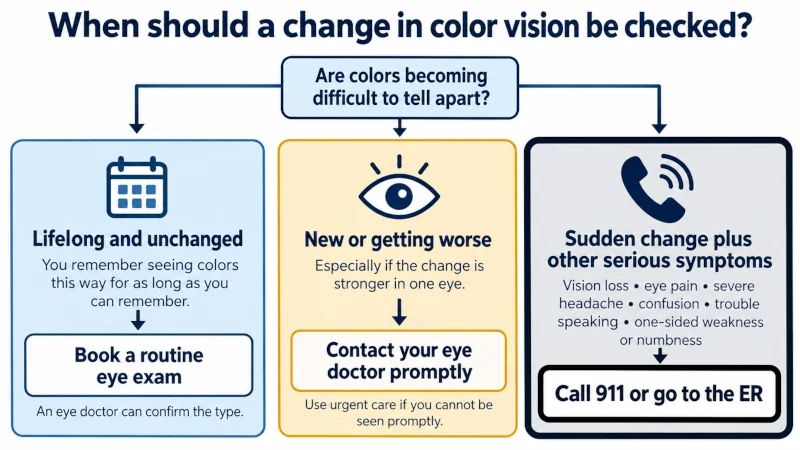
Book a routine eye exam if you’ve never had your color vision tested and you notice trouble with colors, if your child has a family history of color blindness or struggles to learn colors, if your job requires accurate color identification, or if you take hydroxychloroquine. Your eye doctor can be an optometrist or an ophthalmologist.
Contact your eye doctor promptly if you notice any new change in your color vision, especially in one eye. A change in color perception can signal a more serious condition and should be checked by an ophthalmologist [American Academy of Ophthalmology, 2013]; some of the underlying causes are serious, so don’t wait to see whether it passes [Henry Ford Health, 2024]. If you can’t reach your eye doctor the same day, go to urgent care.
Call 911 or go to the ER if a change in color vision comes on suddenly along with vision loss, eye pain, a severe headache, confusion, trouble speaking, or weakness or numbness on one side of the body.
For more on eye symptoms and when they need care, browse our Eye & Vision guides.
| Health Disclaimer: This article is for general education and isn’t a substitute for medical advice, diagnosis, or treatment. Inherited color blindness can’t be cured by any supplement, herb, or diet. A new or changing problem with color vision can signal an eye or health condition and should be checked by a doctor. Talk to your doctor or pharmacist before starting vitamin A or any supplement, especially if you’re pregnant, breastfeeding, smoke, or take prescription medicines. Don’t stop or change a prescribed medicine, including hydroxychloroquine, without talking to the doctor who prescribed it. For sudden vision loss or other emergency symptoms, call 911. |
Frequently Asked Questions
Can color blindness be cured?
Not the inherited kind. It’s caused by the genes that build your cone pigments, and no current treatment changes them. Gene therapy is being studied but isn’t available. Acquired color vision loss may improve if the underlying cause is treated.
Can women be color blind?
Yes, though it’s much less common. Red-green color blindness affects about 1 in 200 women of Northern European ancestry. Many more women are carriers who have typical color vision but can pass the gene to their sons.
Do color blind glasses work?
They can make some colors look more vivid for people with milder red-green types, and one study found improved color contrast responses after two weeks of use. Another found they didn’t improve color vision test scores. They don’t restore typical color vision.
Can vitamin A fix color blindness?
No. Vitamin A deficiency causes trouble seeing in dim light, not color blindness, and it’s rare in the US. High-dose supplements carry real risks, including birth defects if taken during pregnancy.
Can color blindness get worse over time?
Inherited color blindness stays the same for life. Color vision that changes, especially in one eye, points to an acquired cause such as cataracts, another eye disease, or a medicine, and needs an eye exam.
How do I get a color blindness test?
Ask your optometrist or ophthalmologist. The test takes a few minutes. Online tests can flag a problem but can’t diagnose one, because screens display color inconsistently.
References
- National Eye Institute. “Color Blindness.” National Institutes of Health. View source
- National Eye Institute. “Types of Color Vision Deficiency.” National Institutes of Health.View source
- National Eye Institute. “Causes of Color Vision Deficiency.” National Institutes of Health. View source
- MedlinePlus Genetics. “Color vision deficiency.” National Library of Medicine. View source
- American Academy of Ophthalmology. “What Is Color Blindness?” EyeSmart. View source
- Prevent Blindness. “Color Blindness (Color Vision Deficiency).” View source
- Colour Blind Awareness (UK). “Types of Colour Blindness.” View source
- Henry Ford Health. “Why Men Are More Likely To Be Colorblind.” Reviewed by Dhruv Sethi, MD. View source
- Werner JS, Marsh-Armstrong B, Knoblauch K. “Adaptive Changes in Color Vision from Long-Term Filter Usage in Anomalous but Not Normal Trichromacy.” Current Biology. 2020;30:3011–3015.e4. DOI: 10.1016/j.cub.2020.05.054. View source
- Gómez-Robledo L, Valero EM, Huertas R, Martínez-Domingo MA, Hernández-Andrés J. “Do EnChroma glasses improve color vision for colorblind subjects?” Optics Express. 2018;26(22):28693–28703. DOI: 10.1364/OE.26.028693. View source
- NIH Office of Dietary Supplements. “Vitamin A and Carotenoids: Fact Sheet for Consumers.” View source
- American Academy of Ophthalmology Hoskins Center for Quality Eye Care. “Recommendations on Screening for Chloroquine and Hydroxychloroquine Retinopathy.” Ophthalmology. 2016;123:1386–1394. View source


