
Lazy eye is one of the most treatable causes of vision loss in children, as long as it is caught early. Amblyopia happens when the brain and one eye stop working together properly during childhood. The brain learns to rely on the stronger eye, and vision in the weaker eye never fully develops. It affects up to 3 out of 100 children and is the most common cause of vision loss in kids, but early treatment works well and usually prevents long-term problems [NEI amblyopia guide, 2024].
What is amblyopia?
Amblyopia is reduced vision, usually in one eye and occasionally in both, that glasses alone can’t fully correct. The eye itself is often healthy. The problem is in how the brain learned to process the image from that eye while vision was still developing [AAPOS amblyopia guide, 2024].
In early childhood, the brain is still wiring itself to see. If one eye sends a blurry or misaligned picture, the brain starts to ignore it and leans on the other eye instead. Mayo Clinic notes that amblyopia generally develops between birth and about age 7 [Mayo Clinic on lazy eye, 2025]. Left untreated, the vision loss can become permanent.
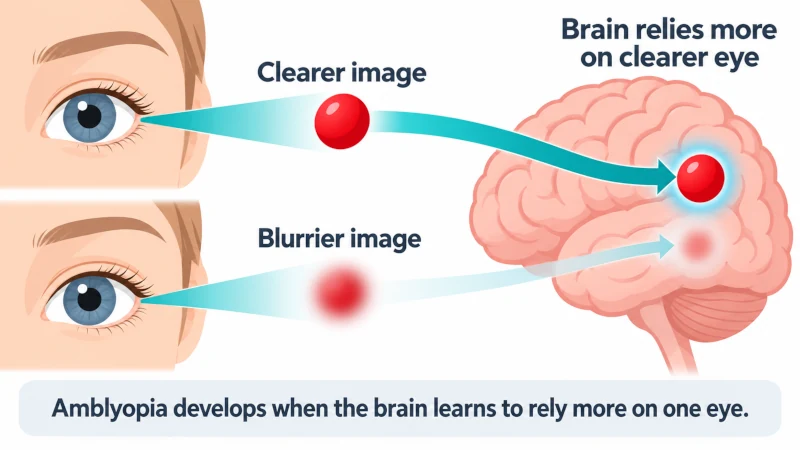
The nickname is misleading in two ways. The eye isn’t lazy, and a child can’t make it work harder by trying [NEI amblyopia guide, 2024]. And the affected eye often looks completely normal, with no visible wandering at all, which is exactly why amblyopia is easy to miss [AAPOS amblyopia guide, 2024].
What causes amblyopia?
Doctors can’t always pinpoint a cause. When they can, it usually traces back to one of three problems that give the brain a poor-quality image from one eye [NEI amblyopia guide, 2024].
Sources differ on which cause is most common. Mayo Clinic names eye-muscle imbalance (strabismus), while AAPOS names refractive amblyopia. In one large US trial of children younger than 7, the split was close to even: 38% strabismus, 37% unequal focusing (anisometropia), and 24% both [PEDIG clinical profile study, 2002].
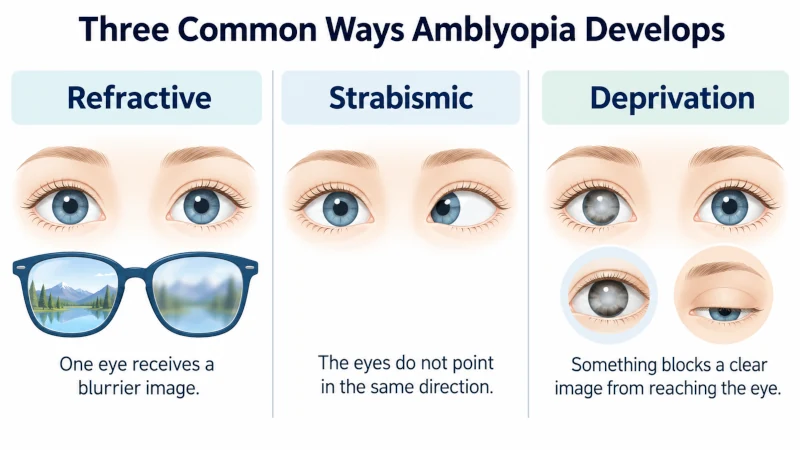
Refractive amblyopia
This type develops when one eye needs a much stronger glasses prescription than the other, most often from farsightedness, sometimes from nearsightedness or astigmatism. The brain favors the sharper image and tunes out the blurry one [Mayo Clinic on lazy eye, 2025]. Because both eyes look normal and the child sees well with the good eye, refractive amblyopia usually goes unnoticed without a vision test [AAPOS amblyopia guide, 2024].
Strabismic amblyopia
In strabismus, the eyes don’t line up. One eye may drift in, out, up, or down. To avoid seeing double, the brain starts to “turn off” signals from the misaligned eye [AAPOS amblyopia guide, 2024]. Some children have both strabismus and a large difference in prescription between the eyes.
Deprivation amblyopia
Less often, something physically blocks light from reaching the back of the eye: a cloudy lens (childhood cataract), a droopy eyelid covering the pupil (ptosis), or a scar on the cornea [AAPOS amblyopia guide, 2024]. This is usually the most severe type. In babies it needs urgent treatment to prevent permanent vision loss [Mayo Clinic on lazy eye, 2025].
Who is more likely to develop it
Amblyopia is more common in children who [NEI amblyopia guide, 2024]:
- were born prematurely
- were smaller than average at birth
- have a family history of amblyopia, childhood cataracts, or other eye conditions
- have developmental disabilities
The US Preventive Services Task Force also lists maternal smoking during pregnancy and maternal substance use among the factors linked to amblyopia, strabismus, or refractive errors [USPSTF vision screening recommendation, 2017]. If you smoke and are pregnant or planning a pregnancy, this step-by-step plan to stop smoking walks through support and medicines, and your doctor can help you choose options that are safe in pregnancy.
Signs of amblyopia to watch for
Children rarely complain. They use the eye that sees well and have no idea the other eye is different [AAPOS amblyopia guide, 2024]. Still, some signs are worth noticing [Mayo Clinic on lazy eye, 2025]:
- an eye that wanders inward or outward
- eyes that don’t seem to work together
- squinting or shutting one eye
- tilting the head to look at things
- poor depth perception, such as trouble judging how near or far something is
- an abnormal result on a school or pediatric vision screening
The absence of these signs doesn’t rule amblyopia out. Many parents don’t learn about it until an eye exam finds it [NEI amblyopia guide, 2024].
How amblyopia is found and diagnosed
Screening is the safety net. The US Preventive Services Task Force recommends vision screening at least once for every child between ages 3 and 5 to catch amblyopia or its risk factors (a grade B recommendation, with an update in progress) [USPSTF vision screening recommendation, 2017]. Mayo Clinic recommends a complete eye exam for all children in that same age window [Mayo Clinic on lazy eye, 2025].
Checks start well before age 3. Pediatricians look for cataracts at birth, watch whether babies follow objects and keep their eyes straight, and may use handheld photoscreening devices in toddlers. Once children can name shapes or letters, they can do eye-chart testing [AAPOS amblyopia guide, 2024]. The American Optometric Association recommends comprehensive eye exams at 6 months, at 3 years, and before first grade [USPSTF vision screening recommendation, 2017].
If a screening flags a problem, the next step is a full exam, often with a pediatric ophthalmologist or optometrist. The doctor checks each eye’s vision, alignment, and prescription, and usually uses dilating drops that blur vision for several hours or up to a day [Mayo Clinic on lazy eye treatment, 2025].
Amblyopia treatment: what works
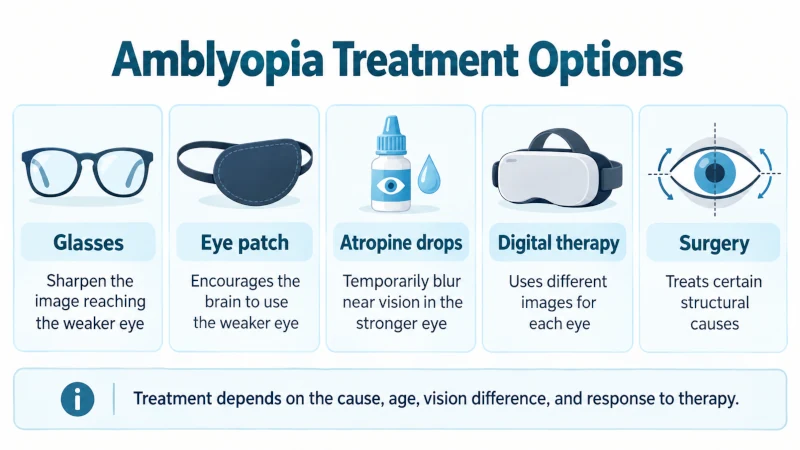
Treatment has two jobs: fix whatever is blurring or blocking the weaker eye, then make the brain use that eye so its vision can catch up [NEI amblyopia guide, 2024].
| Treatment | How it works | What the evidence shows | Trade-offs |
| Glasses or contacts | Give the weaker eye a sharp image | In untreated refractive amblyopia (ages 3 to under 7), glasses alone improved vision by 2+ lines in 77% of children and resolved it in 27% | Must be worn consistently; often not enough on its own |
| Eye patch | Covers the stronger eye so the brain uses the weaker one | For moderate amblyopia, 2 hours a day worked about as well as 6 hours | Skin irritation; kids may resist or peek |
| Atropine drops | Blur near vision in the stronger eye | About as effective as patching in trials | Light sensitivity, eye irritation; rare flushing, dry mouth, fast heartbeat |
| Binocular digital therapy | Headset shows each eye a different version of videos | Beat glasses alone in a small 12-week trial; not yet shown better than patching | Newer, costlier, coverage uncertain |
| Surgery | Treats cataract, droopy eyelid, or eye misalignment | Addresses the cause; patching or drops usually still needed | Surgical risks; not a stand-alone fix |
Sources for the table: glasses [Cotter et al., Ophthalmology, 2006]; patching dose [Repka et al., Archives of Ophthalmology, 2003]; atropine [PEDIG atropine vs patching trial, 2002] and [Cochrane review of patching vs atropine, 2019]; side effects [Mayo Clinic on lazy eye treatment, 2025] and [AAO on virtual reality for lazy eye, 2022]; surgery [AAPOS amblyopia guide, 2024].
Glasses or contact lenses come first
If a prescription problem is behind the amblyopia, correcting it is step one. For some children that is all it takes. In a trial of 84 children ages 3 to under 7 with untreated refractive amblyopia, glasses alone improved vision by at least two lines on the eye chart in 77% of them and cleared the amblyopia in 27% [Cotter et al., Ophthalmology, 2006]. Children whose amblyopia persists after a period in glasses usually move on to patching or drops.
Eye patching
A patch over the stronger eye forces the brain to use the weaker one. Some children need only 2 hours a day, while others need it during most waking hours [NEI amblyopia guide, 2024]. For moderate amblyopia in children 3 to 7, a randomized trial found that 2 hours of daily patching, paired with at least an hour of close-up activities, improved vision about as much as 6 hours [Repka et al., Archives of Ophthalmology, 2003]. Your child’s eye doctor will set the hours based on how weak the eye is and on past treatment [AAPOS amblyopia guide, 2024].
Stick-on patches work best. Elastic “pirate” patches make it easy to peek around the edge, which undermines treatment. Children who wear glasses can use patches designed for glasses or a frosted filter (a Bangerter foil) on the lens [AAPOS amblyopia guide, 2024]. Rarely, patching too long can reduce vision in the covered eye, which is why follow-up visits matter. This is usually reversible [Mayo Clinic on lazy eye treatment, 2025].
Atropine eye drops
Instead of a patch, the doctor may prescribe atropine drops for the stronger eye, used daily or only on weekends. The drops temporarily blur that eye’s near vision, which pushes the brain toward the weaker eye [Mayo Clinic on lazy eye treatment, 2025].
The evidence here is strong. In a trial of 419 children younger than 7, vision in the amblyopic eye improved by an average of 3.16 lines with patching and 2.84 lines with atropine after six months, a difference researchers judged clinically small [PEDIG atropine vs patching trial, 2002]. A Cochrane review concluded that atropine appears to be as effective as patching, and found skin and eyelid irritation more common with patches [Cochrane review of patching vs atropine, 2019].
Atropine has its own downsides. Common side effects are light sensitivity and eye irritation [Mayo Clinic on lazy eye treatment, 2025]. Rarely, it can cause flushing, dry mouth, or a rapid heartbeat [AAO on virtual reality for lazy eye, 2022]. Drops may also work less well when the stronger eye is nearsighted or when amblyopia is severe [AAPOS amblyopia guide, 2024]. Store them out of children’s reach and use them only as prescribed.
Binocular digital therapy
Newer treatments use a virtual reality headset or special glasses while a child watches shows. The device blurs the picture to the stronger eye and splits the image so the brain needs both eyes to see the whole scene. The first FDA-approved option, Luminopia, is used one hour a day, six days a week. In a small trial, children who used it with glasses for 12 weeks gained more vision than children in glasses alone. As of the American Academy of Ophthalmology’s 2022 review, it had been used successfully in children ages 4 to 7, but it hadn’t been directly compared with patching or drops [AAO on virtual reality for lazy eye, 2022].
AAPOS describes these treatments as FDA-approved, popular with kids, and seemingly about as effective as patching, while noting that researchers are still working out which types of amblyopia they suit best [AAPOS amblyopia guide, 2024]. Treat the evidence as promising but still developing. Cost and insurance coverage vary, so ask your child’s eye doctor whether it fits your situation.
Surgery
Surgery treats the underlying problem when it is structural: removing a childhood cataract, lifting a droopy eyelid, or straightening eyes that still cross or drift despite glasses [Mayo Clinic on lazy eye treatment, 2025]. Straightening the eyes improves alignment, but it doesn’t retrain the brain on its own. Most children still need patching or drops before or after surgery [AAPOS amblyopia guide, 2024].
What about eye exercises and vision therapy?
You’ll find vision therapy programs, eye exercises, and apps marketed for lazy eye. The evidence for using them in place of standard treatment is thin. Mayo Clinic notes that activity-based treatments such as drawing, puzzles, or computer games are available, but their benefit when added to other treatments hasn’t been proved [Mayo Clinic on lazy eye treatment, 2025]. When the US Preventive Services Task Force reviewed amblyopia treatment for young children, it found no eligible studies of vision therapy to evaluate [USPSTF vision screening recommendation, 2017].
Close-up activities during patching are a different matter. Coloring, reading, or handheld games while the patch is on are commonly recommended and were part of the patching trials described above. If someone suggests exercises instead of glasses, patching, or drops, get a second opinion from a pediatric ophthalmologist before switching.
How long treatment takes, and why it can come back
Vision may start improving within a few weeks, but the best results usually take months [NEI amblyopia guide, 2024]. Treatment can last from six months to two years, and amblyopia returns in up to 25% of children, so regular follow-up continues after vision improves [Mayo Clinic on lazy eye treatment, 2025]. A lighter maintenance schedule of patching or occasional drops may be needed for months or years. Not every child reaches 20/20, but most see real improvement [AAPOS amblyopia guide, 2024].
Is it ever too late to treat amblyopia?
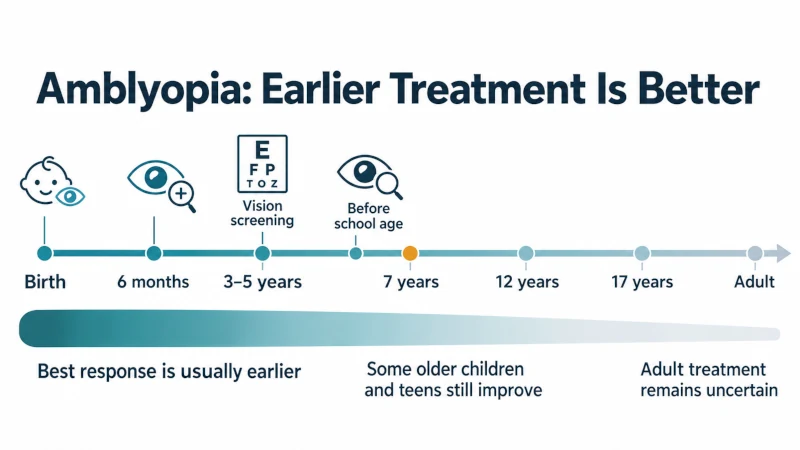
Earlier is better, but age 7 is not a hard cutoff. Mayo Clinic says the best results come when treatment starts before 7, and that about half of children ages 7 to 17 still respond [Mayo Clinic on lazy eye treatment, 2025].
The main evidence comes from a national trial of 507 children and teens ages 7 to 17. Among 7- to 12-year-olds, 53% of those who got patching, near activities, and atropine drops improved by two or more lines, compared with 25% who got new glasses alone [Scheiman et al., Archives of Ophthalmology, 2005]. In teens 13 to 17, the overall difference was small (25% vs. 23%). But among teens who had never been treated before, 47% improved with patching versus 20% with glasses alone. Most participants still didn’t reach 20/20 [NEI news release on older children, 2005].
For adults, the picture is less hopeful. NEI says treatment is usually less effective in adults than in children [NEI amblyopia guide, 2024], while AAPOS states that current treatments don’t work for adults [AAPOS amblyopia guide, 2024]. Research is ongoing. A 2025 NEI-funded study restored the brain’s response to the amblyopic eye in adult mice, but it has not been tested in people [NEI research news on adult amblyopia, 2025]. Be cautious with any program that promises to fix adult lazy eye.
If you live with amblyopia in one eye, protecting your good eye matters. AAPOS recommends safety glasses for sports and risky activities [AAPOS amblyopia guide, 2024]. The USPSTF estimates the lifetime risk of vision loss for people with amblyopia at 1.2% or higher [USPSTF vision screening recommendation, 2017].
Can amblyopia be treated naturally?
If “natural” means without medicine, the most proven options already qualify. Glasses and patching are drug-free, and together they treat most children.
If “natural” means vitamins, herbs, or diet, the answer is no. Amblyopia is a problem of how the brain learned to see, not a nutrient shortage. No vitamin, supplement, or special diet appears among the treatments recommended by NEI, Mayo Clinic, or AAPOS [NEI amblyopia guide, 2024] [Mayo Clinic on lazy eye treatment, 2025] [AAPOS amblyopia guide, 2024]. You may see claims online that B vitamins or vitamin injections can fix a lazy eye. They are not a recognized amblyopia treatment, and spending months on them can use up the years when standard treatment works best. Talk to your child’s doctor or a pharmacist before giving any supplement.
A balanced diet still supports overall eye health, and our guide to natural remedies for eye problems covers what helps everyday eye comfort. If you’re weighing a specific supplement, our review of herbs for eye health grades the evidence and flags safety concerns. Neither replaces amblyopia treatment.
Making patching and drops work at home
Treatment only works if it happens, and most of it happens at home. These tips come from AAPOS [AAPOS amblyopia guide, 2024]:
- Pair the patch with fun. Favorite shows, games, coloring, or tablet time make patch time easier. Any activity counts as long as your child is awake with eyes open.
- Expect pushback, and use rewards. Many children dislike the patch at first. Persistence and small rewards help.
- Consider school hours. Teachers can often help, and patching at school usually doesn’t require changing activities, though some kids may need a front-row seat.
- Use a patch that seals well. Adhesive patches block peeking better than elastic ones.
- Keep the follow-up visits. The doctor adjusts the plan as vision changes.
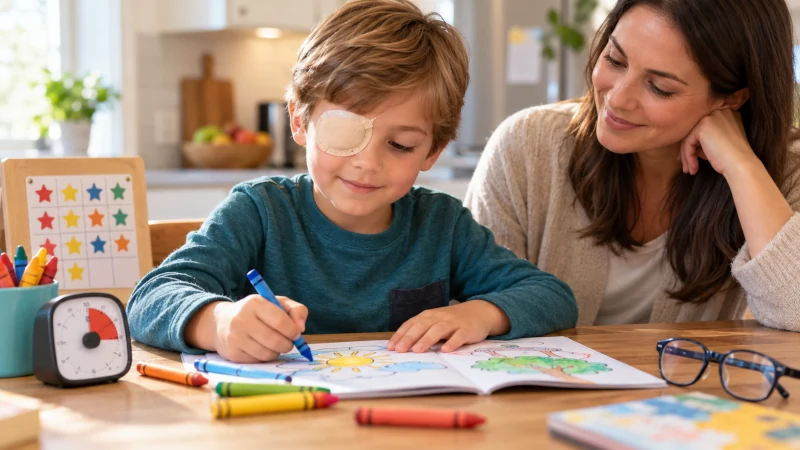
Glasses need the same consistency: they only help while they’re on.
For more on childhood and adult eye conditions, browse our Eye & Vision guides.
When to see a doctor right away
Book a prompt appointment with your child’s doctor or an eye doctor if:
- your baby’s eye seems to wander after the first few weeks of life [Mayo Clinic on lazy eye, 2025]
- your child squints, shuts one eye, tilts their head to see, or fails a vision screening
- there is a family history of lazy eye, crossed eyes, or childhood cataracts
- vision seems to slip after amblyopia treatment has ended
Seek care the same day for a baby with a cloudy-looking pupil or an eyelid that droops over the pupil, since deprivation amblyopia in infancy needs urgent treatment [Mayo Clinic on lazy eye, 2025].
Go to the ER, or call 911, for new double vision that doesn’t go away within a few hours, or double vision with eye pain, dizziness, muscle weakness, slurred speech, or confusion. Sudden double vision is not typical amblyopia and can signal a stroke or another serious problem [Cleveland Clinic on double vision, 2024].
| Health Disclaimer: This article is for general education and is not a substitute for diagnosis or treatment from a doctor. Amblyopia treatment should be planned and monitored by an eye doctor, usually a pediatric ophthalmologist or optometrist, because the right approach depends on the cause, the child’s age, and how treatment is going. Don’t stop or change prescribed patching, drops, or glasses without talking to your child’s doctor. Talk with a doctor or pharmacist before giving your child any vitamin or supplement. Go to the ER or call 911 for sudden double vision with other symptoms, sudden vision loss, or an eye injury. |
Frequently Asked Questions
Can amblyopia fix itself without treatment?
It’s unlikely. Untreated amblyopia isn’t expected to resolve on its own, and treatment becomes less effective with age [USPSTF vision screening recommendation, 2017]. If a screening or exam finds it, start treatment rather than waiting.
Is a lazy eye the same as a crossed eye?
Not exactly. A crossed or wandering eye is strabismus, which is one cause of amblyopia. Many children with amblyopia have perfectly straight eyes, and their problem is a difference in prescription between the eyes [AAPOS amblyopia guide, 2024].
How many hours a day does a child need to wear an eye patch?
It varies. Some children need 2 hours a day and others need it most of their waking hours [NEI amblyopia guide, 2024]. For moderate amblyopia, 2 hours worked about as well as 6 hours in a trial of children ages 3 to 7 [Repka et al., Archives of Ophthalmology, 2003]. Follow the schedule your child’s eye doctor sets.
Are atropine drops safe for young children?
They are a well-studied option that works about as well as patching [Cochrane review of patching vs atropine, 2019]. Light sensitivity and eye irritation are common, and rare reactions include flushing, dry mouth, and a fast heartbeat [Mayo Clinic on lazy eye treatment, 2025] [AAO on virtual reality for lazy eye, 2022]. Call your child’s doctor if you notice any of these.
Can adults fix a lazy eye?
Current treatments work much less well in adults, and AAPOS says they don’t work for adults [AAPOS amblyopia guide, 2024]. Adults can still get the underlying problem checked, update their glasses, and protect the good eye. New approaches are being studied, but so far mainly in animals [NEI research news on adult amblyopia, 2025].
References
- National Eye Institute. “Amblyopia (Lazy Eye).” National Institutes of Health; last updated November 26, 2024. View source
- Mayo Clinic Staff. “Lazy eye (amblyopia): Symptoms and causes.” Mayo Clinic; April 16, 2025. View source
- Mayo Clinic Staff. “Lazy eye (amblyopia): Diagnosis and treatment.” Mayo Clinic; April 16, 2025. View source
- American Association for Pediatric Ophthalmology and Strabismus. “Amblyopia.” AAPOS; updated January 2024. View source
- US Preventive Services Task Force. “Vision in Children Ages 6 Months to 5 Years: Screening.” View source
- Pediatric Eye Disease Investigator Group. “A randomized trial of atropine vs. patching for treatment of moderate amblyopia in children.” Archives of Ophthalmology. 2002;120(3):268-278. PMID 11879129. View source
- Pediatric Eye Disease Investigator Group. “The clinical profile of moderate amblyopia in children younger than 7 years.” View source
- Repka MX, et al.; Pediatric Eye Disease Investigator Group. “A randomized trial of patching regimens for treatment of moderate amblyopia in children.” Archives of Ophthalmology. 2003;121(5):603-611. PMID 12742836. View source
- Cotter SA, et al.; Pediatric Eye Disease Investigator Group. “Treatment of anisometropic amblyopia in children with refractive correction.” View source
- Scheiman MM, Hertle RW, Beck RW, et al.; Pediatric Eye Disease Investigator Group. “Randomized trial of treatment of amblyopia in children aged 7 to 17 years.” Archives of Ophthalmology. 2005;123(4):437-447. PMID 15824215. View source
- National Eye Institute. “Older Children Can Benefit From Treatment For Childhood’s Most Common Eye Disorder.” April 11, 2005. View source
- Li T, et al. “Conventional occlusion versus pharmacologic penalization for amblyopia.” Cochrane Database of Systematic Reviews. 2019;8:CD006460. View source
- American Academy of Ophthalmology. “Can Virtual Reality Correct Lazy Eye (Amblyopia)?” View source
- National Eye Institute. “NIH-funded study shows how vision can be rebooted in adults with amblyopia.” View source
- Cleveland Clinic. “Diplopia (Double Vision).” View source


