
If you have irritable bowel syndrome and keep seeing an anti-inflammatory diet recommended, here’s the honest answer: it may help, and the evidence for it got noticeably better in 2025, but probably not because it calms inflammation. IBS can be painful, yet it doesn’t damage your digestive tract [NIDDK, 2017b]. That’s what separates it from inflammatory bowel disease (IBD), where inflammation is the core problem.
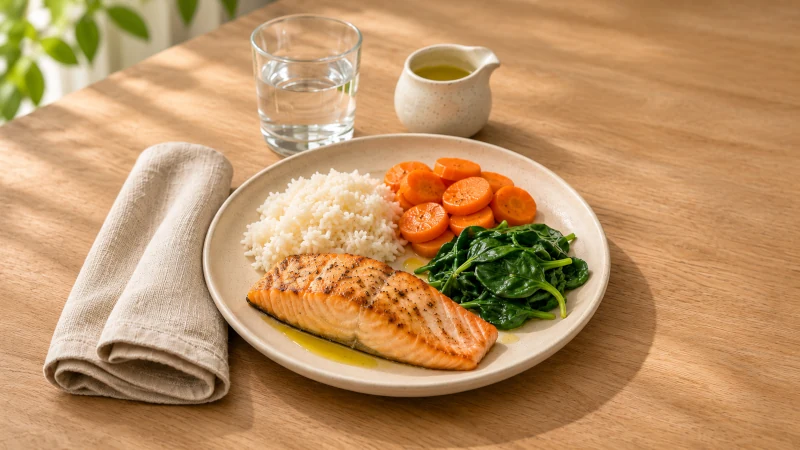
The best-tested version of an anti-inflammatory diet for IBS is the Mediterranean diet. In a 2025 randomized trial, it beat standard IBS diet advice over six weeks [Bamidele et al., 2025]. The low FODMAP diet still has the deepest research base for IBS [Chey et al., 2022], but it’s restrictive and works best with a dietitian. Below is what the studies found, how to try a Mediterranean-style approach without setting off symptoms, and when to switch strategies.
| Quick answer: IBS is not an inflammatory disease, so “fighting inflammation” isn’t a proven way to treat it.A Mediterranean-style diet helped more people than standard IBS advice in a six-week trial: 62% vs. 42% had a meaningful drop in symptoms [Bamidele et al., 2025].Start with regular meals and modest changes; add fiber and beans slowly.If that isn’t enough, a dietitian-guided low FODMAP trial is the next step. |
Why an anti-inflammatory diet might help IBS, even though IBS isn’t inflammatory
IBS is a group of symptoms that show up together: repeated belly pain plus changes in bowel movements, such as diarrhea, constipation, or both [NIDDK, 2017a]. Doctors diagnose it from that symptom pattern. There’s no visible damage or disease in the gut to point to [NIDDK, 2017a].
IBD is different. In ulcerative colitis or Crohn’s disease, the gut lining is inflamed and damaged, and diet advice is built around that. If you’ve been diagnosed with ulcerative colitis, our guide to the diet for ulcerative colitis is the better place to start.
Why a so-called anti-inflammatory diet would ease IBS isn’t known yet. The researchers behind the biggest trial said the mechanism is unclear, and they called for studies on whether the diet works through the gut microbiome and the gut–brain connection [AGA News, Dec 2025]. What matters for you is more practical: does your pain, bloating, and bowel pattern improve? That is what the studies measured.
What the research on an anti-inflammatory diet for IBS shows
The 2025 UK trial: Mediterranean diet vs. standard IBS advice
Researchers at the University of Sheffield randomly assigned 139 adults with IBS to six weeks of either a Mediterranean diet or traditional dietary advice, the standard first-line advice given in the UK [Bamidele et al., 2025]. The Mediterranean group ate plenty of fruit, vegetables, pulses (beans, lentils, chickpeas), whole grains, nuts, fish, and olive oil. The comparison group followed British Dietetic Association advice: sensible eating habits and avoiding excess fatty, spicy, and processed foods, caffeine, fizzy drinks, and alcohol [ACP Gastroenterology Monitor, 2025].
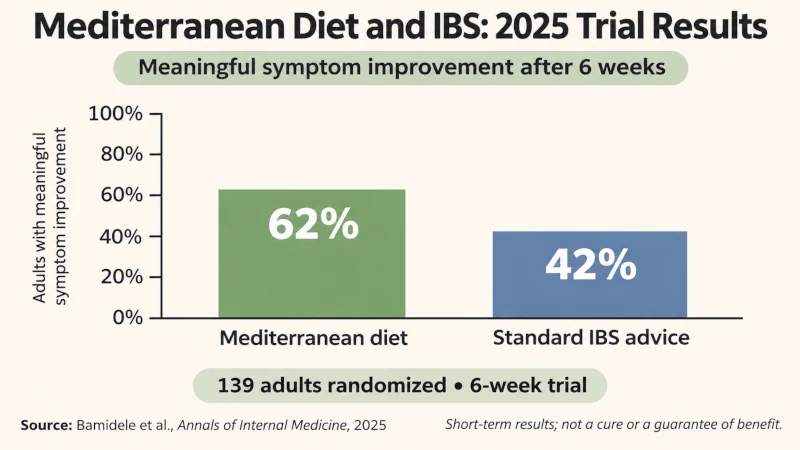
After six weeks, 62% of the Mediterranean group had a clinically meaningful drop in symptoms (at least 50 points on a standard IBS severity scale), compared with 42% of the standard-advice group [Bamidele et al., 2025]. Average symptom scores also fell further on the Mediterranean diet. Mood, quality of life, and how satisfied people were with their diet didn’t differ between groups [Bamidele et al., 2025].
One finding surprised people. The Mediterranean group ate more fiber and more oligosaccharides, one of the FODMAP families [AGA News, Oct 2025], so it wasn’t a disguised low FODMAP diet, and it still helped more people.
The limits are real, though. The trial lasted six weeks, so there are no long-term data [Bamidele et al., 2025]. Participants knew which diet they were on, and people under 18 or over 65 weren’t included [AGA News, Dec 2025]. And some participants dropped out saying the diet made their symptoms worse [ACP Gastroenterology Monitor, 2025]. It’s a strong trial, but it’s one trial.
The Michigan pilot: Mediterranean diet vs. low FODMAP
A small University of Michigan study compared a Mediterranean diet with the strict first phase of the low FODMAP diet for four weeks in people with diarrhea-predominant or mixed IBS [Michigan Medicine, 2025]. Twenty patients finished. Pain improved enough to meet the study’s target in 73% of the Mediterranean group and 81.8% of the low FODMAP group, and low FODMAP did better on overall symptom severity [Michigan Medicine, 2025; Singh et al., 2025]. With so few people, this can’t settle which diet is better. It does suggest the Mediterranean approach is worth a proper head-to-head trial.
How the main IBS diet options compare
One honest note before the table: the two big US gastroenterology groups describe the low FODMAP evidence differently. The American Gastroenterological Association calls it the most evidence-based diet for IBS [Chey et al., 2022]. The American College of Gastroenterology recommends a limited trial but rates the quality of the underlying evidence as very low [Lacy et al., 2021]. Both can be true. Low FODMAP has more trials than any other IBS diet, but diet studies are hard to blind and often small.
| Approach | What it involves | Evidence in IBS | Main drawbacks |
| Standard IBS advice | Regular meals; limit caffeine, alcohol, fizzy drinks, fatty and spicy food | Guideline first-line advice; helps a subset of people [AGA, n.d.] | Modest effect for many |
| Mediterranean (anti-inflammatory) pattern | Vegetables, fruit, whole grains, pulses, nuts, fish, olive oil | Promising: one 139-person RCT and one 20-person pilot, both short-term [Bamidele et al., 2025; Michigan Medicine, 2025] | Long-term effect unknown; pulses and wheat can trigger symptoms |
| Low FODMAP | Short restriction, then reintroduction and personalization | Most-studied IBS diet [Chey et al., 2022]; evidence quality rated very low by ACG [Lacy et al., 2021] | Restrictive; best with a dietitian; not for everyone |
| Soluble fiber | For example, oats or a soluble fiber supplement | Strong recommendation, moderate-quality evidence [Lacy et al., 2021] | Gas and bloating if added too fast |
| Gluten-free | Avoiding wheat, rye, barley | Randomized trials mixed [Chey et al., 2022] | Unclear benefit; get checked for celiac disease first |
For a deeper side-by-side, see our anti-inflammatory diet vs. low FODMAP diet comparison.
How to try an anti-inflammatory diet for IBS without a flare
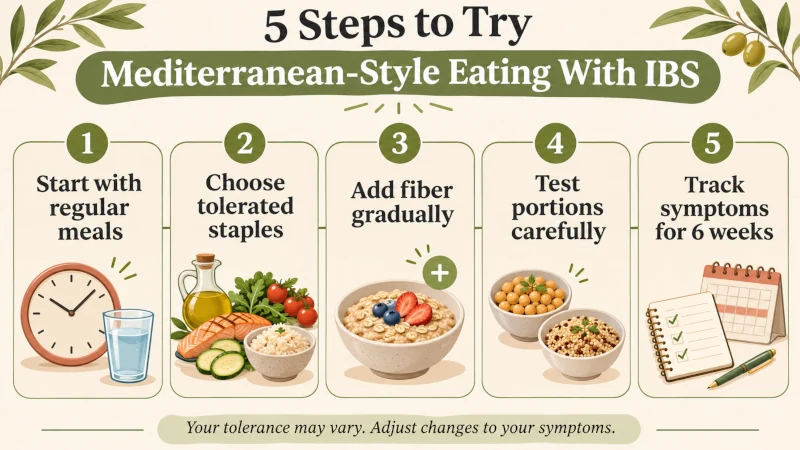
The aim is to move toward a Mediterranean-style pattern slowly enough that you can tell what’s helping and what isn’t.
- Fix the basics first. NICE, the UK health guidance body, advises people with IBS to eat regular meals and take time over them, drink at least 8 cups of fluid a day (mostly water or other non-caffeinated drinks), keep tea and coffee to about 3 cups a day, and cut back on alcohol and fizzy drinks [NICE, 2017]. Trimming heavily processed foods fits here too, since that was part of the standard advice in the trial [ACP Gastroenterology Monitor, 2025].
- Swap in Mediterranean staples. Make olive oil your main cooking fat, eat fish regularly, and build meals around vegetables, fruit, and whole grains you already tolerate. For ready-made ideas, try these IBS-aware anti-inflammatory recipes.
- Raise fiber gradually. Adding fiber by about 2 to 3 grams a day may help prevent gas and bloating [NIDDK, 2017c]. Soluble fiber, found in oats, beans, and fruit, tends to help IBS more than the insoluble kind [NIDDK, 2017c; Lacy et al., 2021].
- Introduce beans and wheat-based whole grains carefully. They’re central to the Mediterranean diet, but most beans and legumes, wheat, rye, and barley are high in FODMAPs [ACG, 2026]. Start with small portions. Canned, rinsed chickpeas and lentils appear on ACG’s low-FODMAP list, while NIDDK lists lentils among FODMAP-containing foods [ACG, 2026; NIDDK, 2017c]. ACG stresses that portion size can move a food from low to high FODMAP [ACG, 2026], so the amount you eat matters as much as the food.
- Give it a set trial period and keep notes. AGA advises trying any specific diet for a set length of time and moving on if it doesn’t help [Chey et al., 2022]. Six weeks matches the trial [Bamidele et al., 2025]. Track pain, bloating, stool changes, and urgency in a simple diary so you’re judging by pattern, not by one bad day.
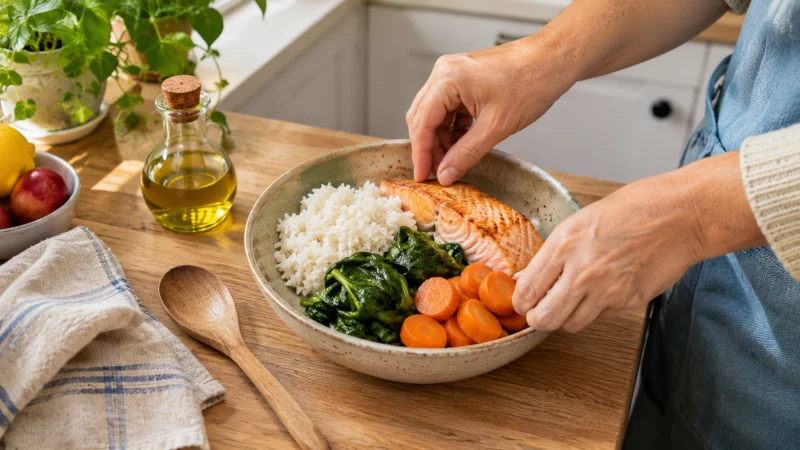
Foods to build around, and foods that commonly cause trouble
No food is safe for everyone with IBS, and tolerance depends on portion size. The left column below comes from ACG’s list of low-FODMAP foods, which many people find easier; the right column lists common high-FODMAP foods from ACG and NIDDK [ACG, 2026; NIDDK, 2017c]. The Mediterranean diet in the trial included some right-column foods, like beans and whole wheat, so treat that column as “test carefully,” not “never eat.”
| Food group | Often easier to tolerate | Common triggers to test carefully |
| Protein | Chicken, turkey, eggs, fish and seafood, firm tofu, tempeh | Most beans and legumes, baked beans, falafel, processed meats like salami and sausage |
| Grains and starches | Oatmeal, rice, quinoa, potato, sourdough bread, corn tortillas | Wheat, rye, barley |
| Fruit | Unripe banana, blueberries, kiwifruit, orange, mandarin, pineapple, grapes | Apples and apple juice, pears, mango, cherries, watermelon, apricots |
| Vegetables | Carrots, spinach, tomato, cucumber, eggplant, bok choy, broccoli, kale | Garlic, onions and shallots, leeks, cauliflower, asparagus, button mushrooms |
| Dairy and alternatives | Most hard cheeses, lactose-free products, almond milk | Milk, soft cheese, yogurt, ice cream, soy milk |
| Drinks | Water, coffee, most teas | High-fructose sodas and juices; chamomile, fennel, and chai teas |
| Sweeteners | — | Honey, high-fructose corn syrup, sugar alcohols ending in “-ol” such as sorbitol and xylitol [NIDDK, 2017c] |
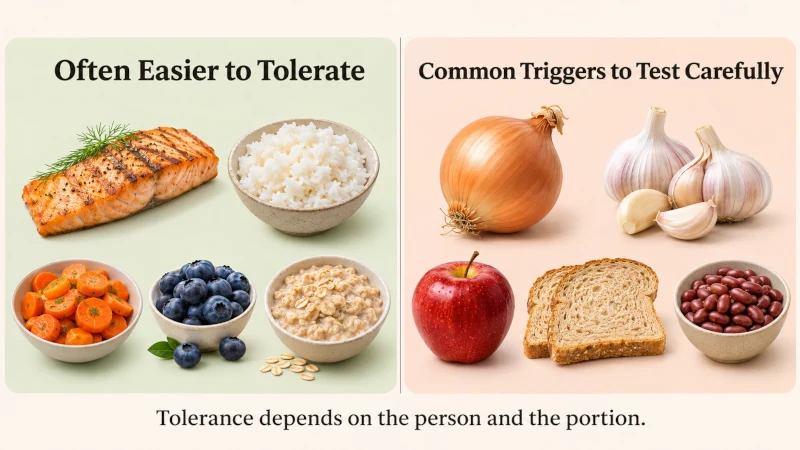
Olive oil, a Mediterranean cornerstone, is a fat and contains no carbohydrates, so it isn’t a FODMAP concern. Garlic and onion are worth extra attention because they hide in sauces, stocks, and spice blends; ACG suggests checking labels for them [ACG, 2026]. For more detail, see our guides to foods to eat with IBS and IBS foods to avoid.
When low FODMAP makes more sense
If a few weeks of Mediterranean-style eating and standard advice haven’t helped enough, a structured low FODMAP diet is the usual next step. It isn’t meant to be permanent. Monash University, which developed it, describes three steps: swap high-FODMAP foods for low-FODMAP ones, test FODMAP groups one at a time, then settle into a personalized long-term diet that restricts only what you need to [Monash University, n.d.].
Sources differ a little on how long the strict phase should last: 2 to 4 weeks according to ACG’s patient guide [ACG, 2026], no more than 4 to 6 weeks according to AGA [AGA, n.d.], and 2 to 6 weeks according to Monash [Monash University, n.d.]. All three agree on the bigger point: keep it short, and do it with a dietitian who knows IBS [ACG, 2026; Monash University, n.d.].
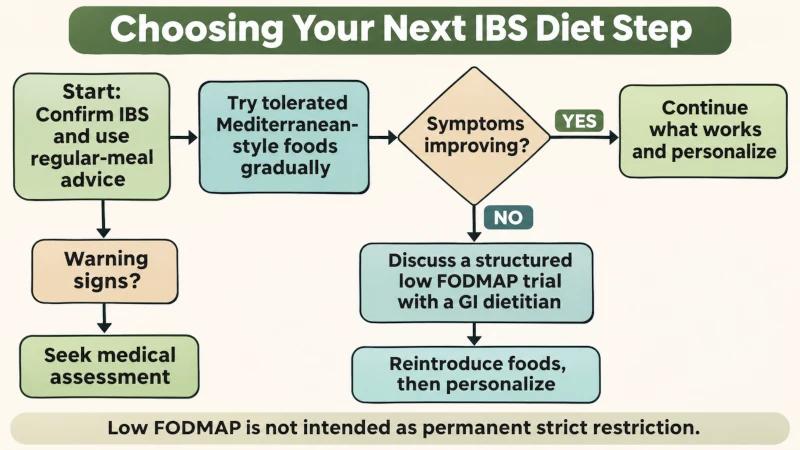
Restrictive diets aren’t a good fit for everyone. AGA lists people at risk of malnutrition, people who are food insecure, people with an eating disorder, and people who eat few trigger foods as poor candidates [Chey et al., 2022]. ACG adds people with complex medical histories [ACG, 2026]. For them, a Mediterranean-style pattern or standard advice may be the safer route.
Who should be careful, and when to see a doctor
Set realistic expectations. Even in the successful trial, nearly 4 in 10 people on the Mediterranean diet didn’t reach a meaningful improvement [Bamidele et al., 2025]. Diet can ease IBS; it doesn’t cure it.
Expect some adjustment. More fiber and more beans can mean more gas and bloating at first, which is why gradual increases are advised [NIDDK, 2017c]. If symptoms clearly get worse and stay worse, stop and reassess. Some trial participants did [ACP Gastroenterology Monitor, 2025].
Watch your relationship with food. If you notice you’re cutting out more and more foods, feeling anxious about eating, or losing weight, talk to your doctor. AGA calls careful screening for disordered eating critical before restrictive diets [AGA, n.d.].
Check in first if you’re pregnant, breastfeeding, or managing another condition. We didn’t find IBS-specific diet guidance for pregnancy or breastfeeding in the sources reviewed. A Mediterranean-style pattern is generally flexible, but cutting out whole food groups during pregnancy, or with diabetes, kidney disease, or a history of eating disorders, is a conversation to have with your clinician or a dietitian. Diet changes don’t replace prescribed IBS treatment, so don’t stop medicines without asking.
See a doctor promptly if you have any of these. They can point to something other than IBS [NIDDK, 2017d; Lacy et al., 2021]:
- bleeding from the rectum, or bloody or black, tarry stools
- weight loss you can’t explain
- anemia (low iron or low blood count on a blood test)
- symptoms that first start when you’re older
- a family history of IBD, colon cancer, or other significant digestive disease
Get urgent care for heavy bleeding, severe belly pain that doesn’t ease, or bleeding with dizziness or fainting.
| HEALTH DISCLAIMER: This article is for general education and isn’t a substitute for medical advice, diagnosis, or treatment. IBS symptoms can overlap with other conditions, so get a diagnosis before treating yourself. Talk with your doctor or a registered dietitian before making major diet changes, especially if you are pregnant or breastfeeding, take regular medication, have another medical condition, have a history of disordered eating, or notice bleeding, unexplained weight loss, or worsening symptoms. |
Frequently Asked Questions
Is IBS an inflammatory condition?
Not in the way IBD is. IBS causes pain and bowel changes without visible damage to the digestive tract [NIDDK, 2017b]. In people with IBS symptoms and diarrhea, ACG suggests a stool test called fecal calprotectin to help rule out IBD [Lacy et al., 2021].
How long should I try a Mediterranean-style diet before deciding if it works?
About six weeks is reasonable. That’s how long the main trial lasted, and symptom improvements in both groups showed up as early as week two [AGA News, Dec 2025]. If you’ve seen no change by then, talk to your clinician about the next step.
Can I combine an anti-inflammatory diet with low FODMAP?
Many people end up with something like that. Low FODMAP is designed to finish with a personalized, less restrictive diet [Monash University, n.d.], and Mediterranean-style meals can be built from the foods you tolerate. Researchers have said longer studies comparing the two approaches are still needed [Michigan Medicine, 2025].
Should I go gluten-free for IBS?
The evidence is unclear. Some people with IBS feel worse after eating gluten even without celiac disease [NIDDK, 2017c], but randomized trials of gluten-free diets have mixed results [Chey et al., 2022]. If you have diarrhea, ask about celiac testing; ACG recommends it for people with IBS and diarrhea symptoms [Lacy et al., 2021].
Does fiber help IBS or make it worse?
It depends on the type. ACG suggests soluble fiber, not insoluble fiber, for overall IBS symptoms [Lacy et al., 2021]. Add it slowly, by about 2 to 3 grams a day, to limit gas and bloating [NIDDK, 2017c].
References
- National Institute of Diabetes and Digestive and Kidney Diseases. Irritable Bowel Syndrome (IBS). View source
- National Institute of Diabetes and Digestive and Kidney Diseases. Symptoms & Causes of Irritable Bowel Syndrome. View source
- National Institute of Diabetes and Digestive and Kidney Diseases. Eating, Diet, & Nutrition for Irritable Bowel Syndrome. View source
- National Institute of Diabetes and Digestive and Kidney Diseases. Diagnosis of Irritable Bowel Syndrome. View source
- Chey WD, Hashash JG, Manning L, Chang L. AGA Clinical Practice Update on the Role of Diet in Irritable Bowel Syndrome: View source
- American Gastroenterological Association. The role of diet in irritable bowel syndrome (IBS). Clinical guidance summary, View source
- Lacy BE, Pimentel M, Brenner DM, Chey WD, Keefer LA, Long MD, Moshiree B. ACG Clinical Guideline: Management of Irritable Bowel Syndrome. View source
- American College of Gastroenterology. Low-FODMAP Diet (patient education). View source
- Monash University. Starting the Low FODMAP Diet. Monash FODMAP, undated. View source
- National Institute for Health and Care Excellence. Irritable bowel syndrome in adults: diagnosis and management (CG61), Recommendations. View source
- Bamidele JO, Brownlow GM, Flack RM, Buckle RL, Shaw CC, Shiha MG, Aziz I. The Mediterranean Diet for Irritable Bowel Syndrome: View source
- Singh P, Dean G, Iram S, et al. Efficacy of Mediterranean Diet vs. Low-FODMAP Diet in Patients With Nonconstipated Irritable Bowel Syndrome: View source
- Michigan Medicine Health Lab. Mediterranean diet provides symptom relief for patients with IBS in pilot study. View source
- ACP Gastroenterology Monitor. Mediterranean diet could be an effective first-line intervention for IBS. View source
- AGA News. Mediterranean vs traditional diet for IBS. View source
- AGA News. Mediterranean diet beats traditional dietary advice in IBS. View source


