

Artificial insemination is a fertility treatment that places specially prepared sperm directly inside the uterus around the time you ovulate, giving sperm a shorter trip to the egg and a better shot at fertilization. Today the term almost always means intrauterine insemination, or IUI — the same procedure a doctor may call artificial insemination [Mayo Clinic, 2023]. It is one of the least invasive fertility treatments, it takes only a few minutes, and it can use a partner’s sperm or a donor’s.
It is not a fix for every cause of infertility, and its per-cycle odds are modest. But for the right situation — unexplained infertility, mild male-factor issues, certain cervical problems, or building a family with donor sperm — it is often the first treatment worth trying before anything more involved. Here is how it works, who it tends to help, what the procedure and recovery are actually like, and when to talk to a doctor.
Trouble conceiving is more common than many people expect: in the United States, about 1 in 5 married women aged 15 to 49 with no prior births do not get pregnant after a year of trying, and about 1 in 4 have difficulty getting pregnant or carrying to term [CDC, 2024]. If that is you, there are real options — and IUI is one of the gentler ones.
What artificial insemination is
During natural conception, sperm travel from the vagina, through the cervix, into the uterus, and up a fallopian tube, where fertilization happens if an egg is waiting. The cervix naturally filters out most sperm, so only a small fraction ever reach the tubes [ASRM, 2021]. Artificial insemination skips that bottleneck: a clinician places washed, concentrated sperm directly into the uterus near ovulation, shortening the journey and putting far more healthy sperm close to the egg [Mayo Clinic, 2023].
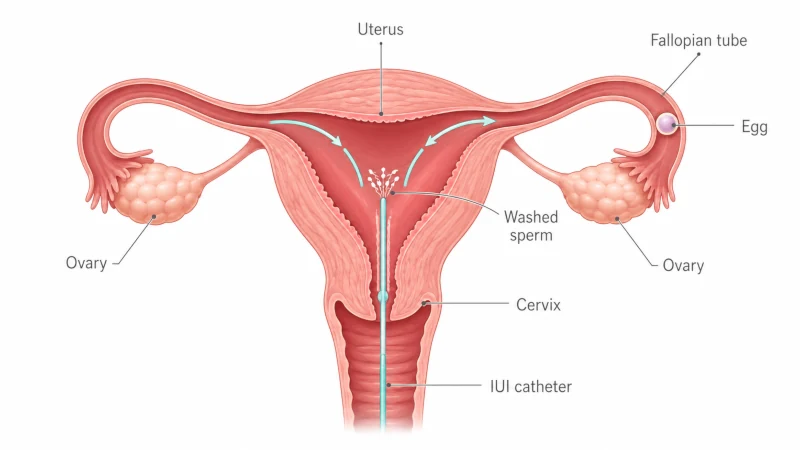
“Washing” is the key preparation step. In a lab, the semen sample is processed to concentrate the healthiest, most active sperm and remove the surrounding fluid — which matters, because seminal fluid can cause painful cramping if placed in the uterus. The process can take up to two hours [ASRM, 2021].
You may also see older or informal terms like intracervical insemination (sperm placed at the cervix) or “at-home insemination.” IUI performed by a clinician is the version with the most evidence behind it, and it is what most people mean today by artificial insemination.
Partner sperm or donor sperm
IUI can use sperm from a partner or from a donor. Donor insemination is a standard path for single women, same-sex female couples, and couples where the male partner has no usable sperm or carries a genetic condition he does not want to pass on [ASRM, 2021] [CDC, 2024]. Donor sperm comes from screened, certified sperm banks — more on those safety checks below.
Who artificial insemination can help — and who it can’t
IUI tends to work best when the sperm mainly need a shorter path to the egg and the reproductive system is otherwise in good working order. Doctors commonly use it for:
- Unexplained infertility, often paired with medication that helps the ovaries release eggs — one of the most common reasons for IUI [ASRM, 2021] [Mayo Clinic, 2023].
- Mild male-factor infertility — a slightly low sperm count or motility, where concentrating the best sperm can make the difference [Mayo Clinic, 2023].
- Cervical factors, such as scarring or thick mucus that blocks sperm; IUI bypasses the cervix entirely [ASRM, 2021].
- Ovulation problems, alongside medication to trigger ovulation [Mayo Clinic, 2023].
- Ejaculation or delivery problems, including retrograde ejaculation or erectile difficulties [ASRM, 2021].
- Donor sperm, for single people, same-sex female couples, or male-factor situations [CDC, 2024].
- Semen allergy, a rare reaction to proteins in semen that washing can remove [Mayo Clinic, 2023].
It is not the right tool for everyone. IUI works poorly when sperm are very few or severely abnormal, and it does not help when the fallopian tubes are severely damaged or blocked, or with moderate-to-severe endometriosis or a history of serious pelvic infection. In those cases, IVF or another approach is usually more effective [ASRM, 2021]. To understand the female-side conditions that can be involved, our overview of female-factor causes of infertility covers ovulation problems, endometriosis, and more.
What happens during IUI, step by step
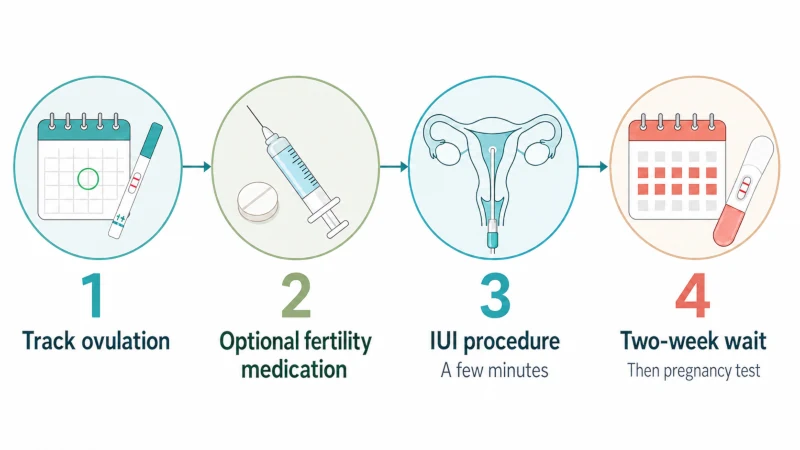
Tracking ovulation and timing
Because timing is everything, the cycle starts by pinpointing ovulation. You might use an at-home urine kit that detects the luteinizing hormone (LH) surge, have a transvaginal ultrasound to watch the follicles grow, or receive a trigger shot of hCG so the ovary releases an egg at a set time. Most inseminations happen a day or two after ovulation signs appear [Mayo Clinic, 2023].
With or without fertility medication
IUI can be done in a natural cycle or with fertility medication. Oral medications such as clomiphene or letrozole, or injectable hormones called gonadotropins, prompt the ovaries to mature one or more eggs, which can raise the odds — especially for unexplained infertility [CDC, 2024] [ASRM, 2021]. The trade-off: stimulating the ovaries raises the chance of twins or higher-order multiples, so your team watches follicle growth closely and may postpone the insemination if too many eggs are developing [Mayo Clinic, 2023].
The insemination and the two-week wait
The procedure itself is quick and usually painless. You lie on an exam table, the clinician uses a speculum to see the cervix, threads a thin catheter through the cervix into the uterus, and slowly injects the prepared sperm. It takes just a few minutes, needs no anesthesia, and you can return to your day right afterward. Some people feel mild cramping, and light spotting for a day or two is normal [ASRM, 2021] [Mayo Clinic, 2023].
Then comes the hard part: waiting. Take a home pregnancy test about two weeks later. Testing sooner can give a false negative (hormones are not high enough yet) or a false positive (if an hCG trigger shot is still in your system). A follow-up blood test is more accurate [Mayo Clinic, 2023].
How well artificial insemination works
Success is modest per cycle and depends heavily on your age, the underlying diagnosis, and whether fertility medication is used [ASRM, 2021]. Published per-cycle pregnancy rates vary widely — commonly in the rough range of 5% to 20%, with younger patients and favorable diagnoses at the higher end. Rather than fixate on a single number, it helps to know the pattern: for unexplained infertility, IUI combined with ovulation medication roughly doubles the pregnancy rate compared with no treatment [ASRM, 2021].
| What affects success | Why it matters |
| Age | Fertility declines with age, and egg quality is the biggest single factor in the odds of any given cycle [CDC, 2024]. |
| Diagnosis | IUI does best for unexplained, cervical-factor, and mild male-factor infertility; it does poorly for severe male factor, blocked tubes, or moderate-to-severe endometriosis [ASRM, 2021]. |
| Fertility medication | Adding ovulation medication can improve the odds — and raises the chance of multiples [ASRM, 2021]. |
| Number of cycles | Because each cycle’s odds are limited, results add up over several attempts [Mayo Clinic, 2023]. |
Because each cycle’s odds are limited, IUI is usually repeated. Doctors often run the same treatment for three to six cycles to give it a fair chance before moving on [Mayo Clinic, 2023]. One reassuring fact: IUI does not raise the risk of birth defects. The background rate is about 2% to 4% for all babies, whether conceived naturally or through IUI [ASRM, 2021].
Risks and side effects
IUI is a simple, low-risk procedure, and serious problems are uncommon [Mayo Clinic, 2023]. What to expect and watch for:
- Cramping and spotting. Mild cramps during or after the procedure, and light spotting for a day or two, are common and harmless [ASRM, 2021].
- Infection. There is a small risk of infection after any procedure that passes a catheter through the cervix [Mayo Clinic, 2023].
- Multiple pregnancy. IUI on its own does not raise the odds of twins or triplets — but adding fertility medication does. Multiples carry higher risks, including preterm labor and low birth weight [Mayo Clinic, 2023].
- Ovarian overstimulation. Injectable fertility drugs can overstimulate the ovaries; if too many follicles develop, your clinic may cancel or postpone the cycle to keep you safe [Mayo Clinic, 2023].
Call your doctor if you develop a fever, severe or worsening pelvic pain, or heavy bleeding — or, if you took injectable medication, rapid abdominal swelling, nausea, or shortness of breath, which can signal ovarian hyperstimulation and needs prompt attention.
Using donor sperm safely
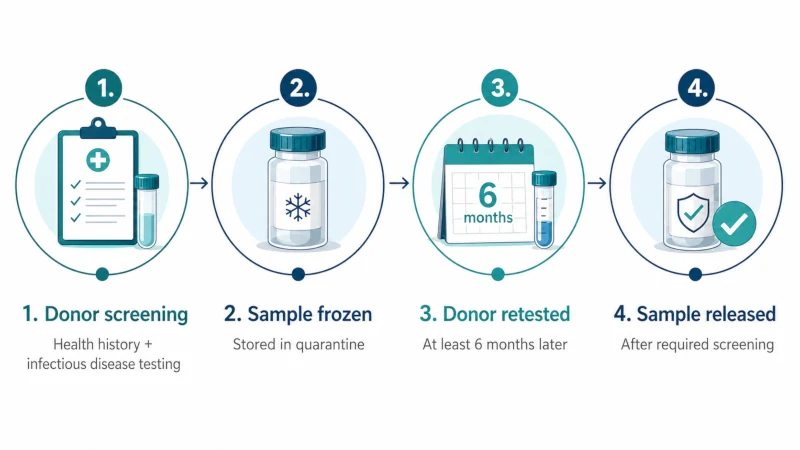
If you are using donor sperm, screening is where the safety comes from. The U.S. Food and Drug Administration regulates donor sperm as human tissue and requires sperm banks to screen and test donors for infectious diseases — including HIV, hepatitis B and C, syphilis, chlamydia, gonorrhea, HTLV, and CMV [FDA, 21 CFR 1271.85].
For anonymous donors, there is an added safeguard: the donated sperm is frozen and quarantined, and the donor is retested at least six months after donation before the sample can be released. Known or directed donors (someone you choose) follow different testing timelines [FDA, 21 CFR 1271.85]. Working with an established sperm bank and a fertility clinic keeps these protections in place, and your clinic can walk you through genetic-carrier screening options.
IUI or IVF: which comes first?
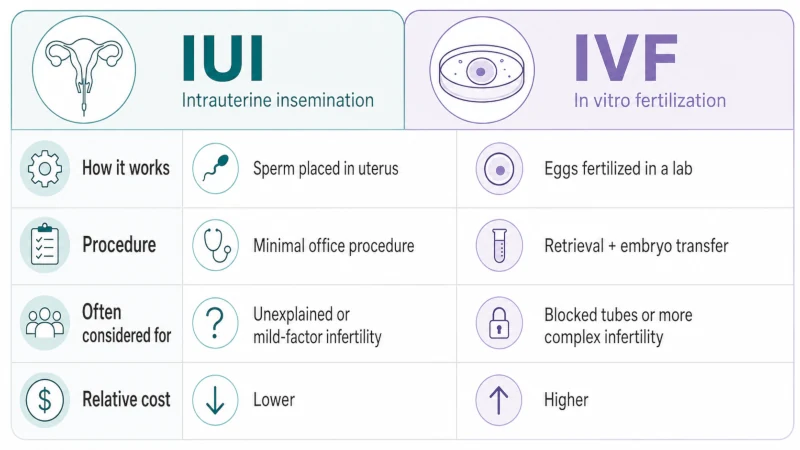
IUI and IVF are different levels of intervention. IUI places sperm in the uterus and lets fertilization happen inside the body. IVF (in vitro fertilization) retrieves eggs, combines them with sperm in a lab, and transfers a resulting embryo to the uterus — it is more involved, more expensive, and generally more effective per cycle [CDC, 2024].
| IUI | IVF | |
| How it works | Prepared sperm placed in the uterus; fertilization happens in the body [Mayo Clinic, 2023]. | Eggs retrieved and fertilized in a lab; embryo transferred to the uterus [CDC, 2024]. |
| Invasiveness | Minimal; a few-minute office procedure [Mayo Clinic, 2023]. | More involved; egg retrieval and hormone injections [CDC, 2024]. |
| Best suited for | Unexplained, cervical-factor, mild male-factor; donor sperm [ASRM, 2021]. | Blocked tubes, severe male factor, significant endometriosis [CDC, 2024]. |
| Relative cost | Lower. | Higher. |
For many people, IUI is the sensible first step: simpler, gentler, and far less costly. If several IUI cycles do not work, or if the diagnosis points to blocked tubes, severe male-factor infertility, or significant endometriosis, IVF is often the better route [CDC, 2024] [ASRM, 2021]. Cost and insurance coverage vary a lot by state and plan, so check your benefits before you start.
Giving yourself the best shot
No supplement or lifestyle change replaces medical treatment, but a few evidence-based habits support fertility and a healthy pregnancy. Both partners benefit from not smoking, keeping alcohol modest, and reaching a healthy weight — all linked to fertility [CDC, 2024]. If you could become pregnant, starting a daily prenatal with folic acid before conception is standard advice, and eating well matters too; our guide to eating well while you’re trying to conceive has practical meal ideas. For men weighing their options, our evidence-based look at men’s reproductive health separates what actually helps from marketing.
Above all, do not wait too long to get evaluated if things are not working — age is the single biggest factor in fertility, and time matters.
When to see a doctor
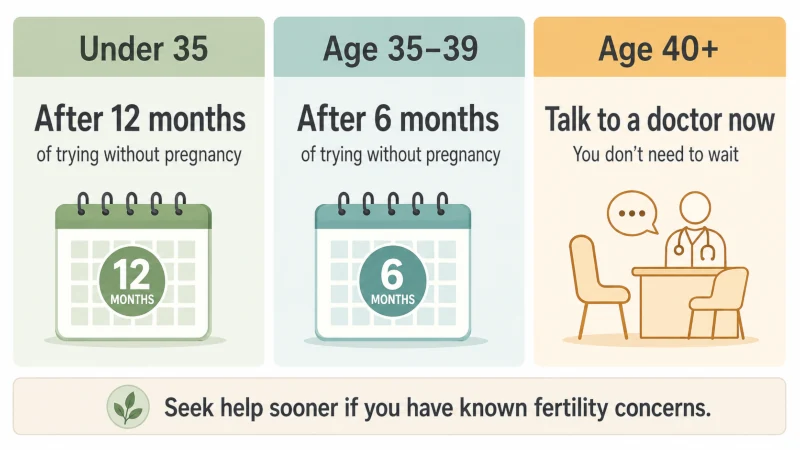
General guidance in the U.S.: if you are under 35 and have been having regular, unprotected sex for a year without conceiving, it is time for a fertility evaluation. If you are 35 or older, see a doctor after six months. If you are over 40, seek help right away [CDC, 2024].
Do not wait the full timeline if any of these apply [CDC, 2024]:
- Irregular or absent periods
- Endometriosis or very painful periods
- A history of pelvic inflammatory disease
- Known or suspected uterine or tubal disease
- More than one miscarriage
- For a male partner: testicular injury, prior hernia surgery, past chemotherapy, sexual dysfunction, or a history of infertility with another partner
The specialist who manages infertility is a reproductive endocrinologist, and an evaluation usually starts with a semen analysis, ovulation testing, and a check of the fallopian tubes [CDC, 2024]. Getting evaluated does not commit you to high-tech treatment — it just tells you where you stand. You can find more of our reproductive health guides for related topics.
| Health Disclaimer: This article is for general education and is not medical advice. It cannot replace a diagnosis, treatment plan, or personal guidance from a qualified doctor. Fertility care is highly individual, and the right approach depends on your situation. Talk to a doctor or reproductive endocrinologist before starting any treatment, and seek prompt care for warning signs such as fever, severe pelvic pain, or heavy bleeding — or, after injectable fertility medication, rapid abdominal swelling or shortness of breath. If you are pregnant, breastfeeding, or have a medical condition, check with your doctor before taking any supplement. |
Frequently Asked Questions
Is artificial insemination the same as IUI?
Yes, in modern use. “Artificial insemination” is the everyday term; intrauterine insemination (IUI) is the specific, evidence-backed procedure doctors perform, placing washed sperm directly in the uterus [Mayo Clinic, 2023].
Does IUI hurt?
Usually not. Most people feel little more than mild cramping, similar to a Pap smear, and it is over in a few minutes. Light spotting afterward is normal [ASRM, 2021].
How many rounds of IUI should I try?
Many doctors run three to six cycles before considering other options, since each cycle’s odds are limited but add up over several attempts [Mayo Clinic, 2023].
Can I do artificial insemination at home?
At-home kits exist, but clinician-performed IUI has the most evidence and safety oversight — especially the sperm-washing step and, with donor sperm, the FDA-required screening [ASRM, 2021] [FDA, 21 CFR 1271.85].
Will fertility medication with IUI give me twins?
It can raise the chance. IUI alone does not increase the odds of multiples, but adding ovulation medication does, which is why your clinic monitors follicle growth closely [Mayo Clinic, 2023].
Is donor sperm safe?
Sperm banks must screen and test donors for infectious diseases under FDA rules, and anonymous donors’ samples are quarantined and the donor retested at least six months later before release [FDA, 21 CFR 1271.85].
References
- Mayo Clinic. “Intrauterine insemination (IUI).” Mayo Foundation for Medical Education and Research, updated September 12, 2023. View source
- American Society for Reproductive Medicine (ASRM). “Intrauterine Insemination (IUI)” patient fact sheet, ReproductiveFacts.org, revised 2021. View source
- Centers for Disease Control and Prevention (CDC). “Infertility: Frequently Asked Questions.” Division of Reproductive Health, updated 2024. View source
- U.S. Food and Drug Administration. Donor testing requirements for reproductive tissue, 21 CFR § 1271.85 (Human Cells, Tissues, and Cellular and Tissue-Based Products), current text. View source
