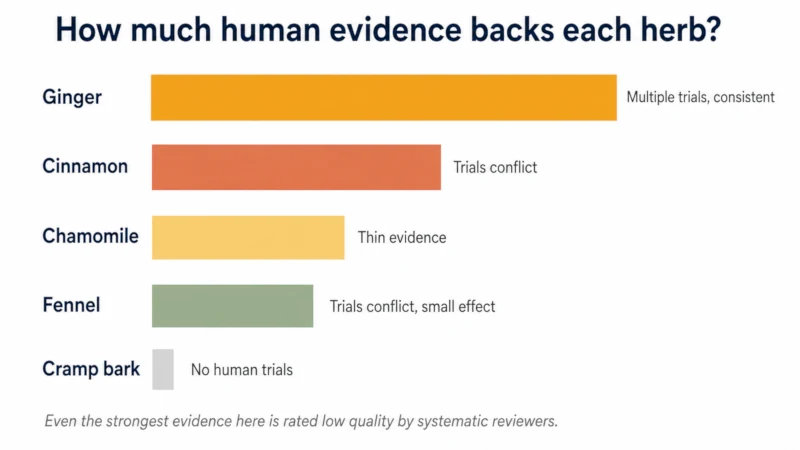
The short version: ginger is the only one of the popular herbs for menstrual cramps with a real stack of human trials behind it, and in several small studies it worked about as well as ibuprofen. Cinnamon and chamomile look promising, but the reviews contradict each other. Fennel is weaker than its reputation. Cramp bark, despite the name, has never been tested in a clinical trial in people.
That gap — between what an herb is famous for and what has actually been measured — is the whole story on this page. Below, each herb is sorted by how much human evidence stands behind it, with the doses that were actually studied, the realistic size of the benefit, and the specific reasons some people should skip it.
One thing before any of it: herbs are for ordinary period cramps. If your pain is severe, getting worse year over year, doesn’t respond to over-the-counter painkillers, or shows up outside your period, that pattern points toward something a doctor needs to look for, and no tea is going to fix it.
Why period cramps hurt in the first place
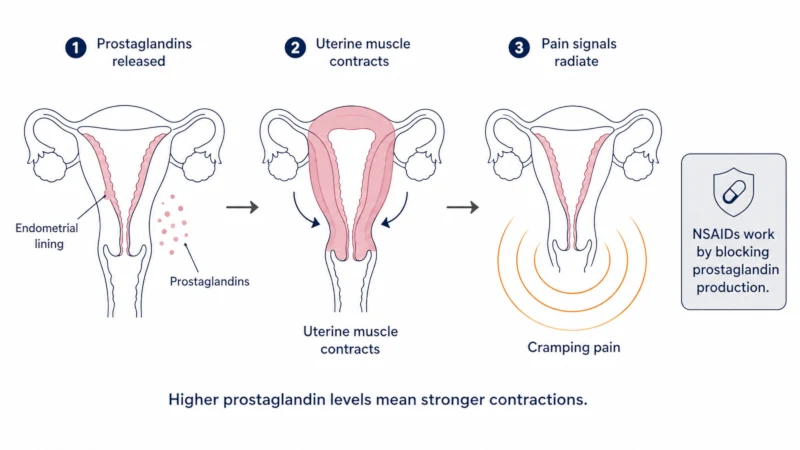
During your period, the lining of your uterus releases prostaglandins — signaling chemicals that make the uterine muscle contract and squeeze the lining out. Higher prostaglandin levels mean stronger contractions, and stronger contractions mean more pain [Cleveland Clinic on prostaglandins, 2023]. This is also why ibuprofen and naproxen help: they block prostaglandin production directly rather than just muffling the pain signal [MedlinePlus, 2024].
Most period pain works this way, and it’s called primary dysmenorrhea — pain with no underlying disease behind it. Secondary dysmenorrhea is pain driven by a condition such as endometriosis, adenomyosis, fibroids, or pelvic inflammatory disease, and it tends to start earlier in the cycle, last longer, and worsen over time [Cleveland Clinic on dysmenorrhea, 2023]. Our guide to what dysmenorrhea is and how the two types differ covers that distinction in more depth.
It matters here specifically. Anything anti-inflammatory has at least a plausible route to easing primary dysmenorrhea. Nothing on this page treats endometriosis or fibroids.
How to read the evidence on herbs for menstrual cramps
Almost every herb in this category has at least one enthusiastic study attached to it. What separates them is how many, how well run, and whether they agree. Four tiers:
- Multiple human trials, consistent direction. More than one randomized trial, all pointing the same way.
- Human trials that conflict. Real studies exist and reach opposite conclusions.
- Thin human evidence. One or two small trials, usually unblinded, often from a single research group.
- Traditional use only. Long history of use, no clinical trials in people.
| Herb | Evidence tier | Dose used in trials | Main caution |
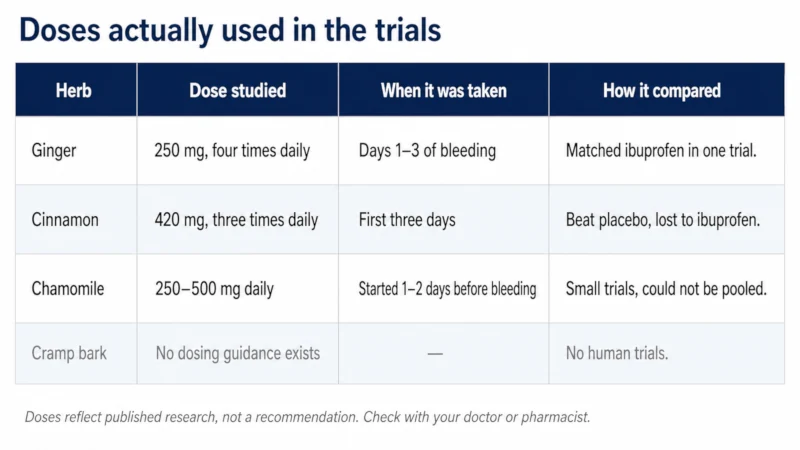
| Ginger | Multiple trials, consistent | 250 mg four times daily, days 1–3 | Bleeding risk with anticoagulants |
| Cinnamon | Trials conflict | 420 mg three times daily | Coumarin in cassia; liver, at high doses |
| Chamomile | Thin | 250–500 mg/day, or tea | Ragweed-family allergy; warfarin |
| Fennel | Trials conflict; effect small | Varied and poorly reported | Estrogenic; avoid in pregnancy |
| Cramp bark | Traditional use only | No dosing guidance exists | Untested; no human safety data |
The most rigorous overall look at this question is a Cochrane review of 27 randomized trials covering 3,101 women and 12 different herbs. Its conclusion was blunt: “There is no high quality evidence to support the effectiveness of any dietary supplement for dysmenorrhoea, and evidence of safety is lacking” [Cochrane review of dietary supplements for dysmenorrhoea, 2016]. Modest, low-quality signals did show up for fenugreek, ginger, valerian, zataria, zinc, fish oil and vitamin B1. Keep that ceiling in mind for everything that follows.
The herbs, one by one
Ginger — the best-supported option
Ginger has been tested more than any other herb here, and the trials mostly agree. A 2021 meta-analysis of seven randomized trials found ginger reduced pain intensity more than placebo, and found no statistical difference between ginger and NSAIDs on pain severity — though results varied enormously between studies and the authors flagged methodological quality as a problem [Jelly, Cureus, 2021]. A 2025 meta-analysis of ten ginger trials in 658 women found the same direction: a significant drop in pain intensity (SMD −1.03), with no effect on how long the pain lasted [Sarmadi et al., Journal of Nursing and Midwifery Sciences, 2025].
The trial people usually mean when they say ginger works as well as ibuprofen gave 150 students either 250 mg of ginger rhizome powder four times a day for the first three days of their period, 250 mg of mefenamic acid, or 400 mg of ibuprofen on the same schedule. There was no difference between the three groups in pain severity, pain relief, or satisfaction, and no serious side effects in any group [Ozgoli et al., Journal of Alternative and Complementary Medicine, 2009].
Realistic expectation: around a gram of ginger a day, started when bleeding starts and continued two to three days, may take the edge off the pain. It is less likely to change how long the cramping lasts. If it works for you, you’ll know within a cycle or two. Ginger also has better-established value for nausea than for pain, which is useful if your period comes with a queasy stomach [NCCIH on ginger, 2025] — we cover that in more detail in our guide to herbs for stomach issues.
Safety. Heartburn, diarrhea, abdominal discomfort and mouth or throat irritation are the common complaints [NCCIH, 2025]. Bleeding is the bigger issue. Ginger inhibits platelet aggregation, so supplement-strength doses alongside warfarin or another anticoagulant may raise bleeding risk, and case reports include over-anticoagulation and serious bleeds. It may also add to the bleeding risk of NSAIDs, lower blood sugar alongside diabetes medication, and it should be stopped before surgery [Memorial Sloan Kettering, About Herbs: Ginger, 2022].
Sources genuinely disagree on how much this matters day to day: NCCIH’s ginger page doesn’t single out blood thinners at all, while Memorial Sloan Kettering lists warfarin as a reason to avoid ginger supplements outright. If you take a blood thinner, treat that disagreement as a reason to ask your doctor or pharmacist rather than to pick whichever answer is more convenient.
Cinnamon — real trials that disagree
Two meta-analyses looked at overlapping sets of cinnamon studies and reached opposite conclusions. One pooled nine trials in 647 women and found cinnamon significantly reduced pain compared with placebo — and was the only one of the three herbs it examined to also shorten how long the pain lasted [Xu et al., Journal of International Medical Research, 2020]. The other, published five years later, pooled four cinnamon trials in 156 women and found no significant effect on either pain intensity or duration [Sarmadi et al., 2025].
The underlying trials give a sense of the ceiling. In a double-blind study of 114 students, 420 mg of cinnamon three times daily beat placebo on both pain severity and duration — but ibuprofen beat cinnamon at every time point measured [Jaafarpour et al., Journal of Clinical and Diagnostic Research, 2015]. So: possibly some benefit, smaller than an NSAID, on evidence that doesn’t hold together.
Safety. Cinnamon sprinkled on oatmeal is not a concern. Supplement doses can be. Most cinnamon sold in the US is cassia, which contains coumarin, and liver problems tied to coumarin have been reported — the risk climbs with prolonged use and matters most if you already have liver disease. Ceylon cinnamon in large amounts is not considered safe during pregnancy, and interactions with anticancer medicines have been reported [NCCIH on cinnamon, 2024]. NCCIH also notes that research doesn’t clearly support cinnamon for any health condition, including the blood-sugar claims often attached to it.
Chamomile — thin evidence, low risk
A systematic review of seven trials in 1,033 participants found every included study reported chamomile reducing period pain, at doses of roughly 250–500 mg a day (one trial used 400 mg every six hours), usually started a day or two before bleeding and continued through the first few days. The authors couldn’t pool the numbers — doses, preparations and timing varied too much — and nearly all the trials came from one country [systematic review of chamomile for primary dysmenorrhea, International Journal of Community Based Nursing and Midwifery]. Chamomile didn’t make the shortlist of supplements with even a low-quality signal in the Cochrane review [Cochrane, 2016], and NCCIH’s own assessment is that chamomile studies “have not produced sufficient reliable evidence to rate clinical usefulness” [NCCIH on chamomile, 2024].
Where that leaves you: chamomile tea is cheap, pleasant and low-risk, and there’s a fair chance it helps a little. Treat it as comfort with a possible bonus rather than as treatment.
Safety. Allergy is the thing to watch. If you react to ragweed, chrysanthemums, marigolds or daisies, you’re more likely to react to chamomile. Interactions with warfarin and with drugs metabolized by the liver have been reported, and little is known about chamomile during pregnancy or breastfeeding [NCCIH, 2024].
Fennel — weaker than its reputation
Fennel is where the gap between reputation and data is widest. The 2020 meta-analysis did find a benefit over placebo, but the smallest of the three herbs it examined [Xu et al., 2020]. The 2025 meta-analysis pooled four fennel trials in 107 women and found no significant effect on pain at all [Sarmadi et al., 2025]. A professional monograph summarizing the Cochrane evidence puts it plainly: no consistent evidence of effectiveness versus placebo [Drugs.com natural products monograph: Fennel, 2025].
Safety. Fennel needs more care than its “it’s basically a vegetable” image suggests. It has estrogenic activity, and there are four published case reports of premature breast development in young girls with raised estradiol after drinking fennel tea. The monograph’s guidance for pregnancy and breastfeeding is a flat “avoid use,” citing documented adverse reactions and emmenagogue effects [Drugs.com, 2025]. Eating fennel as food is a different question from taking concentrated fennel supplements.
Cramp bark — a name, not a finding
Cramp bark (Viburnum opulus) gets recommended constantly for period pain, largely on the strength of what it is called. The clinical picture is short: “No clinical trials are available to support these uses,” and “clinical studies are lacking to provide dosing guidance” [Drugs.com natural products monograph: Cramp bark, 2025]. Animal work does show uterine relaxant activity, which is why the idea persists — but relaxed animal uterine tissue is a long way from a measured human outcome.
There is also no adverse-effect data at all, and no safety information for pregnancy or breastfeeding. That deserves reading correctly: an absence of reported harms is not evidence of safety, it is an absence of study. One laboratory study found cramp bark inhibits the CYP1A2 and CYP2C19 liver enzymes, which could in principle affect medication levels, though the clinical significance is unconfirmed [Drugs.com, 2025]. If you try it, know that you are operating on tradition alone.
The rest of the list
Fenugreek, valerian and zataria each showed a modest benefit in the Cochrane review, on evidence the reviewers rated low or very low quality [Cochrane, 2016]. That isn’t nothing, but it’s a weaker footing than ginger’s. Dill, damask rose, guava, rhubarb and uzara were examined too; none emerged with a usable signal. Our roundup of herbs traditionally used in women’s health covers the wider traditional picture, much of which has never been formally tested.
Two herbs to be careful with
Not everything in the women’s-health aisle is benign, and a couple of items turn up on period-pain lists where they don’t belong.
Blue cohosh. Widely listed as a menstrual remedy, and the item on this page with genuine safety concerns. There are no quality clinical trials supporting any therapeutic use, and the plant is described as potentially toxic to humans and to a developing fetus. Reported cardiovascular reactions include heart attack, stroke and rapid heart rate, particularly in infants born to women who took it. The guidance for pregnancy is “avoid use; adverse effects have been documented” [Drugs.com natural products monograph: Blue cohosh, 2025]. Our profile of blue cohosh’s traditional uses and its risks has the fuller background.
Dong quai. May enhance the anticoagulant effect of warfarin, with case reports of bleeding, and should be avoided during pregnancy and breastfeeding because of reported uterine stimulant activity [Drugs.com natural products monograph: Dong quai, 2025].
What to pair herbs with — where the evidence is actually better
Two non-herbal options have more support than anything above, and neither requires a supplement.
Heat. A meta-analysis of six randomized trials found heat at 40–45°C beat no heat for period pain, and pooled results from two trials found heat patches performed at least as well as oral pain relievers. The authors called the evidence suggestive rather than conclusive, given the small samples [Jo & Lee, Scientific Reports, 2018]. A heating pad or adhesive heat wrap on your lower abdomen is a cheap first move.
Movement. A Cochrane review of exercise for period pain pooled ten trials in 754 women and found exercise may produce a large reduction in pain intensity compared with doing nothing — roughly 25 mm on a 100 mm scale — on low-quality evidence [Armour et al., Cochrane review of exercise for dysmenorrhoea, 2019]. Most of the programs studied were modest: around half an hour, three times a week.
Rest, stress-reduction techniques and massage are also part of standard clinical advice for cramps [Cleveland Clinic, 2023]. If you use a diluted essential-oil blend for abdominal massage, our guide to essential oils and safe dilution ratios covers doing it without irritating your skin — bearing in mind that the massage is the part with a rationale behind it, not the oil.
And it’s worth being unsentimental about NSAIDs. They act on the mechanism that causes the pain, they cost very little, and taking one at the first twinge rather than waiting for the pain to build usually works better. Herbs are a reasonable option if NSAIDs upset your stomach or you’d rather not take them. They are not a superior one.
Using herbs for cramps safely
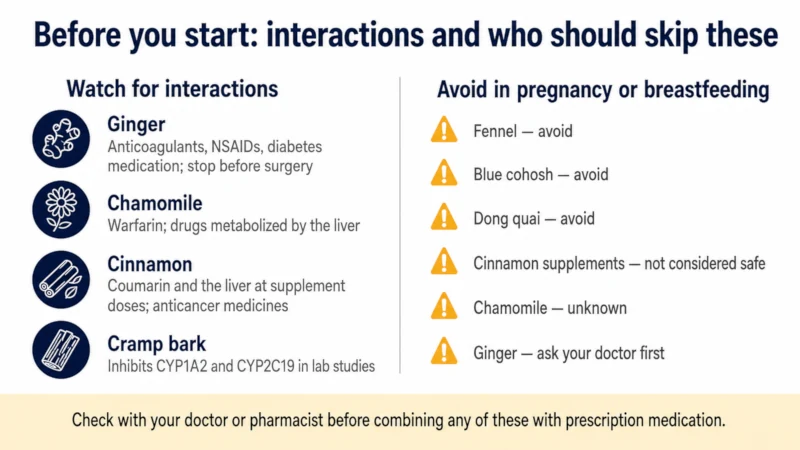
Talk to your doctor or pharmacist first if you take any regular medication. Blood thinners, diabetes drugs and anything metabolized by the liver come up most often. This isn’t a formality — ginger with blood thinners is a documented interaction with case reports behind it.
Pregnancy and breastfeeding change the answer entirely. Fennel: avoid. Blue cohosh: avoid. Dong quai: avoid. Cinnamon in supplement amounts: not considered safe. Chamomile: unknown. Ginger supplements may be safe in pregnancy, but check with your doctor before using them. Culinary amounts of a spice are a separate question from a concentrated capsule.
Who should skip herbal supplements for cramps entirely: anyone pregnant, trying to conceive, or breastfeeding; anyone taking an anticoagulant; anyone with liver disease (cinnamon in particular); anyone with a ragweed-family allergy (chamomile); anyone with surgery scheduled in the next two weeks (ginger); and anyone under 18 without a doctor’s input.
Supplements aren’t verified for accuracy before they’re sold in the US. Look for third-party testing on the label and buy from companies that publish what’s in the bottle. Skip proprietary blends that don’t disclose amounts — you can’t assess a dose you can’t see.
Start with one herb at a time. Add three at once and you won’t know which one helped, or which one caused the problem. Note the dose, the cycle day you started, and what actually changed.
Give it two or three cycles, then stop if nothing has changed. These aren’t slow-building tonics. The trials measured their effects within a single period.
When cramps need a doctor, not a tea
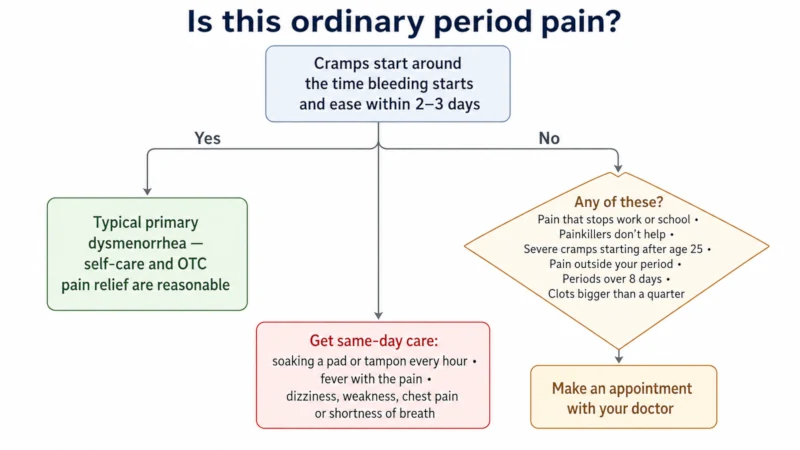
Ordinary period cramps start around the time bleeding starts and ease within two to three days. Anything that doesn’t fit that pattern deserves an appointment.
Make an appointment if:
- cramps stop you from getting to work or school
- over-the-counter painkillers don’t touch the pain
- severe cramping started after age 25
- you have pelvic pain outside your period
- the pain has been getting worse year over year
- your periods last longer than eight days
- you pass blood clots bigger than a quarter
Get same-day care if:
- you’re soaking through a pad or tampon every hour for several hours in a row
- you have a fever along with the pain
- you feel dizzy, weak, short of breath, or have chest pain — signs that blood loss may have left you anemic
Sources for the lists above: Cleveland Clinic, 2023; MedlinePlus, 2024; Office on Women’s Health, 2025.
Endometriosis, adenomyosis, fibroids, ovarian cysts and pelvic inflammatory disease all show up as bad period pain, and all of them are treatable once someone identifies them [Office on Women’s Health, 2025]. Years of quiet self-management with tea is the most expensive way to handle that.
| Health Disclaimer: This article is for general education and is not medical advice, diagnosis, or treatment. Herbs and supplements can interact with prescription medication and are not right for everyone, particularly during pregnancy and breastfeeding. Talk with your doctor, pharmacist, or a registered dietitian before starting any herbal supplement, especially if you take regular medication or have an ongoing health condition. If you have severe or worsening pelvic pain, contact your doctor. Nothing described here diagnoses, treats, cures, or prevents any disease. |
Frequently Asked Questions
Which herb works best for menstrual cramps?
Ginger, judged by the amount and consistency of human evidence rather than by tradition. Several randomized trials and two recent meta-analyses point the same direction, and in at least one head-to-head trial it matched ibuprofen. That said, even ginger’s evidence base was rated low quality by Cochrane reviewers, so “best supported” here means best of a modest field.
How much ginger did the studies actually use?
The most-cited trial used 250 mg of ginger rhizome powder four times a day — one gram total — starting on the first day of bleeding and continuing for three days. A 2025 meta-analysis found benefit at both 250 mg and 1,000 mg daily. Fresh ginger tea is a different and far less predictable dose, since the amount of gingerol you extract depends on how much root you use and how long you steep it.
Can I take herbs alongside ibuprofen or hormonal birth control?
Ask a pharmacist before combining anything, especially ginger. Ginger may add to the bleeding risk of NSAIDs, so taking both together isn’t automatically safe just because each is available over the counter. Hormonal contraceptives raise fewer specific concerns with these herbs, but a pharmacist can check your exact prescription in about two minutes and it’s free.
Does chamomile tea contain enough to do anything?
Nobody can tell you precisely. The trials that found a benefit mostly used measured capsule doses, not tea, and the amount of active compound in a cup varies with the brand, the grind and the steeping time. Chamomile tea is low-risk and worth trying if you like it; just don’t assume a bag steeped for two minutes delivers what a 400 mg capsule did in a study.
Is cramp bark worth trying, given the name?
The name came first and the evidence never followed. There are no human clinical trials, no dosing guidance, and no adverse-effect data — which also means nobody has established that it’s safe, only that harms haven’t been studied. If you want to try it anyway, tell your doctor, particularly if you take medication metabolized by the liver.
How long should I give an herb before giving up on it?
Two or three cycles. The trials measured their effects within a single period, so an herb that’s going to help you should show something by the second month. If it hasn’t, the honest move is to stop paying for it and talk to your doctor about what else is on the table — including whether something other than primary dysmenorrhea is driving your pain.
References
- Cleveland Clinic. “Prostaglandins.” Cleveland Clinic, 2023. View source
- Cleveland Clinic. “Dysmenorrhea.” Cleveland Clinic, last reviewed May 22, 2023. View source
- MedlinePlus. “Period Pain.” National Library of Medicine, updated August 12, 2024. View source
- Office on Women’s Health. “Period Problems.” U.S. Department of Health and Human Services, updated September 26, 2025. View source
- Pattanittum P, et al. “Dietary Supplements for Dysmenorrhoea.” Cochrane Database of Systematic Reviews, 2016, CD002124. DOI: 10.1002/14651858.CD002124.pub2. View source
- Armour M, Ee CC, Naidoo D, et al. “Exercise for Dysmenorrhoea.” Cochrane Database of Systematic Reviews, 2019, CD004142.pub4. DOI: 10.1002/14651858.CD004142.pub4. View source
- Jelly P. “Efficacy of Ginger in the Treatment of Primary Dysmenorrhea: A Systematic Review and Meta-analysis.” Cureus, 2021. DOI: 10.7759/cureus.13743. View source
- Sarmadi NA, Yousefi SS, Azadbakht M, Fakhri M. “The Effect of Ginger, Cinnamon, and Fennel on Primary Dysmenorrhea: A Systematic Review and Meta-Analysis.” Journal of Nursing and Midwifery Sciences, 2025. DOI: 10.5812/jnms-158132. View source
- Xu Y, Yang Q, Wang X. “Efficacy of Herbal Medicine (Cinnamon/Fennel/Ginger) for Primary Dysmenorrhea: A Systematic Review and Meta-analysis of Randomized Controlled Trials.” Journal of International Medical Research, 2020;48(6). DOI: 10.1177/0300060520936179. View source
- Ozgoli G, Goli M, Moattar F. “Comparison of Effects of Ginger, Mefenamic Acid, and Ibuprofen on Pain in Women with Primary Dysmenorrhea.” The Journal of Alternative and Complementary Medicine, 2009;15(2):129–132. DOI: 10.1089/acm.2008.0311. View source
- 11. Jaafarpour M, Hatefi M, Khani A, Khajavikhan J. “Comparative Effect of Cinnamon and Ibuprofen for Treatment of Primary Dysmenorrhea: A Randomized Double-Blind Clinical Trial.” Journal of Clinical and Diagnostic Research, 2015;9(4):QC04–QC07. View source — Status: Verified (publisher abstract page; DOI suffix rendered incompletely on source page, so it is not reproduced here)
- 12. “The Effect of Chamomile on Pain and Menstrual Bleeding in Primary Dysmenorrhea: A Systematic Review.” International Journal of Community Based Nursing and Midwifery. View source — Status: Partial — full text opened and content confirmed (7 trials, 1,033 participants); the page does not display author names, year, volume or DOI
- Jo J, Lee SH. “Heat Therapy for Primary Dysmenorrhea: A Systematic Review and Meta-analysis of Its Effects on Pain Relief and Quality of Life.” Scientific Reports, 2018;8:16252. DOI: 10.1038/s41598-018-34303-z. View source
- National Center for Complementary and Integrative Health. “Ginger.” NCCIH, February 2025. View source
- National Center for Complementary and Integrative Health. “Chamomile.” NCCIH, November 2024. View source
- National Center for Complementary and Integrative Health. “Cinnamon.” NCCIH, November 2024. View source
- Memorial Sloan Kettering Cancer Center. “Ginger.” About Herbs database, updated June 2, 2022. View source
- “Cramp Bark.” Drugs.com Natural Products (professional) monograph, updated December 8, 2025. View source
- “Fennel.” Drugs.com Natural Products (professional) monograph, updated August 13, 2025. View source
- “Blue Cohosh.” Drugs.com Natural Products (professional) monograph, updated August 22, 2025. View source
- “Dong Quai.” Drugs.com Natural Products (professional) monograph, updated November 20, 2025. View source
