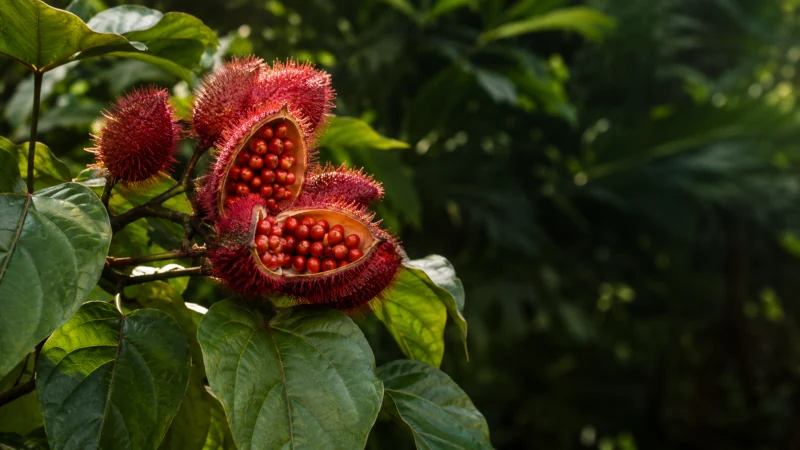
If you’ve met annatto, it was probably as color — the orange-red that makes cheddar orange, tints Latin American rice, and turns a pot of achiote-seasoned chicken a deep rust. That’s the honest headline on annatto tree health benefits: its best-established role is as a safe natural food coloring, and the U.S. Food and Drug Administration lists annatto extract, made from the seeds of Bixa orellana, as a color additive that may be used to color foods generally [FDA color additive regulation, 21 CFR 73.30].
Beyond the kitchen, the seeds and leaves do contain some genuinely interesting compounds, and a few of them have early research behind them. But most of the medicinal claims attached to this tree are traditional, not proven — and a couple that were formally tested didn’t hold up.
Here’s what the evidence actually shows, where it’s thin, and how to use annatto without getting ahead of the science.
What annatto actually is
Annatto comes from a small tropical tree, Bixa orellana, native to Mexico, the Caribbean, and warm parts of South America, where it’s also called achiote (Spanish) or roucou (French). The tree produces spiny reddish pods, and inside each pod is a cluster of small seeds coated in a waxy, vivid pigment. That pigment has been scraped off, ground, and cooked into food across the Americas for thousands of years, and it also had a long life as a body and textile dye.
The parts used are the seeds and, in some traditions, the leaves. When you buy annatto today, you’re usually getting one of three things: whole or ground seeds for cooking, a liquid or oil-based extract used as a colorant, or a concentrated supplement — most often sold as “annatto tocotrienol” or “delta-tocotrienol,” which isolates one specific compound rather than the whole seed.
What’s inside the seeds
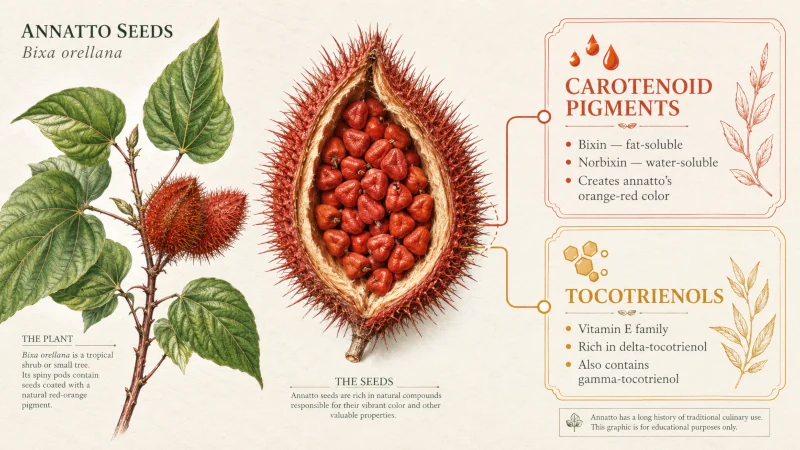
Two families of compounds account for nearly all the interest in annatto.
Bixin and norbixin — the carotenoid pigments
The orange-red color comes from carotenoids, chiefly bixin (fat-soluble) and its cousin norbixin (water-soluble). Carotenoids are the same broad class of plant pigments found in carrots and tomatoes, and many of them have antioxidant activity in the lab. Bixin and norbixin are what the food industry actually extracts and sells as annatto color.
Tocotrienols — the delta-rich form of vitamin E
Annatto seeds are also an unusual source of tocotrienols, part of the vitamin E family. What makes annatto distinctive is its ratio: annatto-derived tocotrienol is roughly 90% delta-tocotrienol and 10% gamma-tocotrienol, with essentially no alpha-tocopherol — the form that dominates most other vitamin E sources [Mohamad et al., Drug Design, Development and Therapy, 2018]. That purity is exactly why supplement makers use annatto to produce “tocopherol-free” tocotrienol products. It’s a real and specific selling point — but a distinctive chemical profile is not the same thing as a proven health effect, and it’s worth keeping those two ideas separate.
Annatto tree health benefits: what the evidence supports
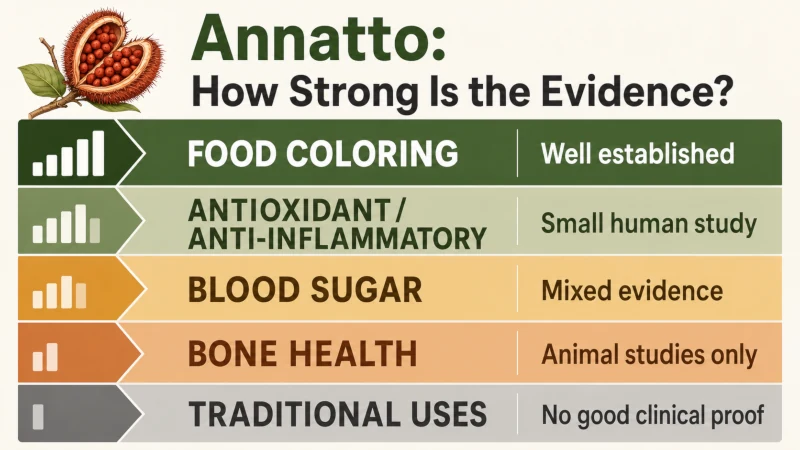
The most useful way to read the claims about annatto is by how strong the evidence behind each one is. Here’s the quick version, expanded below.
| Claimed benefit | What the evidence looks like |
| Natural food coloring | Well established; FDA-listed and widely used |
| Antioxidant / anti-inflammatory | One small human study; promising but preliminary |
| Blood sugar control | Genuinely mixed — may raise or lower it |
| Prostate / urinary symptoms | Tested in a trial and showed no benefit |
| Bone protection (tocotrienol) | Animal studies only; no human trials |
| Skin, burns, coughs (traditional) | Long traditional use, no good clinical proof |
Antioxidant and anti-inflammatory effects
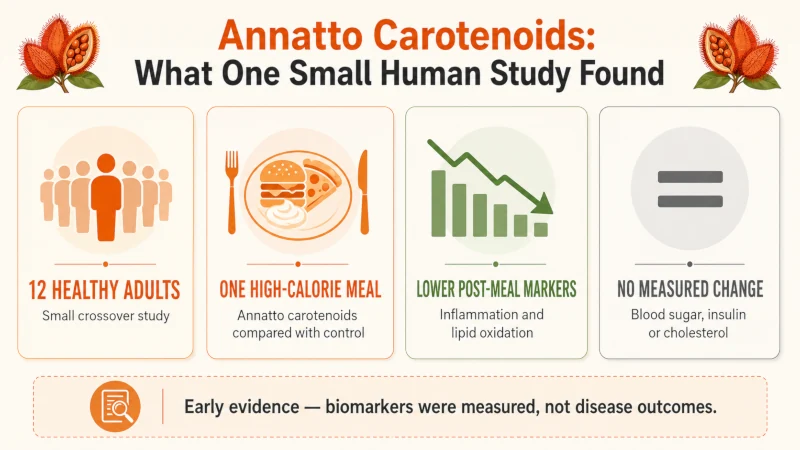
This is the most legitimate health-adjacent finding, and it’s still early. In a small randomized crossover study, 12 healthy adults ate a high-calorie meal with or without annatto carotenoids. A single dose of norbixin reduced the post-meal rise in inflammatory markers (IL-1, IL-6, TNF-α) and lipid oxidation over the following one to two hours [Roehrs et al., Food Research International, 2017]. That’s a real, measurable effect — but read the fine print: it was 12 people, one meal, and the researchers measured blood markers, not health outcomes. Notably, the carotenoids did not change blood glucose, insulin, or cholesterol levels in that study. It’s a reasonable signal that annatto’s pigments have antioxidant activity in the body. It is not evidence that annatto prevents heart disease or any other condition.
Blood sugar — genuinely mixed
You’ll see annatto promoted for diabetes. The honest picture is muddier than that. Annatto may increase or decrease blood sugar, and the direction isn’t settled [WebMD on annatto, 2026]. That uncertainty is precisely why it matters for safety rather than benefit: if you take diabetes medication, an ingredient that can push glucose either way is something to be cautious with, not a treatment to rely on. If blood sugar is your concern, the everyday foods with actual evidence behind them are a better starting point than a colorant — the rundown of diabetic-friendly foods that help control blood sugar is a more useful place to begin.
Prostate and urinary symptoms — tested and came up short
This one is instructive because it was actually studied properly. A 12-month double-blind, randomized, placebo-controlled trial gave 136 men with moderate lower urinary tract symptoms from an enlarged prostate either Bixa orellana (250 mg three times daily) or placebo. The men taking annatto showed no benefit over placebo [Zegarra et al., International Braz J Urol, 2007]. When a plausible-sounding remedy is put to a real test and fails, that result deserves more weight than a dozen enthusiastic testimonials.
Bone health and the tocotrienol research
The delta-tocotrienol angle is where a lot of current marketing lives, usually pointing at bone health. The research is genuinely intriguing and genuinely limited to animals. In a study of male rats with drug-induced osteoporosis, annatto tocotrienol at 60 and 100 mg/kg prevented deterioration of bone structure, calcium content, and strength, with effects comparable to calcium supplementation [Mohamad et al., Drug Design, Development and Therapy, 2018]. That’s a promising preclinical result worth following. But rat bone models don’t automatically translate to people, doses in animal studies don’t map neatly onto human supplements, and no human trial has confirmed a bone benefit from annatto tocotrienol. Treat it as a research lead, not a reason to replace anything your doctor has recommended.
Traditional uses for skin, burns, and coughs
Historically, annatto leaf infusions were gargled for sore throats, applied to skin, rashes, and mild burns, and the seed infusion was taken as an expectorant for coughs. These are long-standing folk uses, and the leaves do contain astringent tannins that could plausibly soothe irritated tissue. What’s missing is the clinical evidence: there is no good scientific proof that annatto treats skin conditions, burns, respiratory problems, or the other conditions it’s traditionally been used for [WebMD on annatto, 2026].
For minor skin and burn care specifically, it’s worth knowing which botanicals have actual data behind them and which don’t — the guide to herbs for skin issues and what the evidence supports sorts that out, and it’s a more reliable footing than tradition alone. If you do try a topical carrier for a folk preparation, a food-grade oil like olive oil is a common base, and for burns generally the field of natural options people reach for is covered separately — with the caveat that a burn worth worrying about is a burn worth showing a professional.
How people use annatto, and what to realistically expect
For cooking, annatto is straightforward and safe: it’s a seasoning and a colorant, and used in food amounts it carries the FDA’s food-additive standing and a long safety record [FDA color additive regulation, 21 CFR 73.30]. Enjoy it in your rice, marinades, and stews without a second thought.
As a supplement, keep expectations grounded. The realistic take is that annatto seed extract is likely safe in the amounts found in food, and annatto leaf powder has been used at up to 750 mg daily for 12 months in study settings without established harm — but there isn’t enough reliable information to know whether the larger concentrated doses sold as medicine are safe, or what they’d actually do [WebMD on annatto, 2026]. No annatto product is a proven treatment for a disease. If a label promises it reverses, cures, or prevents a condition, that promise is running ahead of the evidence.
Safety, side effects, and interactions
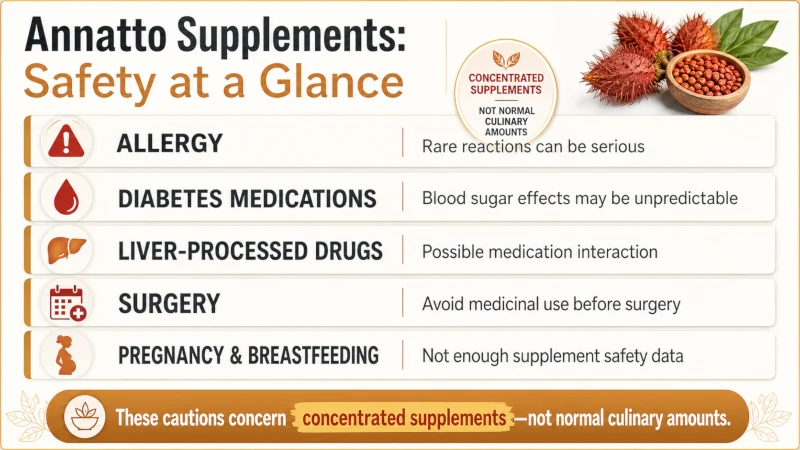
Annatto’s food history makes it easy to assume it’s harmless in any form. Mostly it’s well tolerated — but there are specific, documented exceptions worth knowing before you take it as a supplement.
Allergic reactions
This is the standout safety issue. Annatto can trigger allergic reactions, and the medical literature includes case reports of anaphylaxis — a severe, potentially life-threatening reaction — following exposure to annatto dye, along with IgE-mediated hypersensitivity confirmed by testing [WebMD on annatto, 2026]. Reactions are uncommon, but if you’ve ever reacted to annatto-colored foods, take that seriously and avoid it.
Drug interactions and blood sugar
| Interaction | What to know |
| Diabetes medications | Annatto may raise or lower blood sugar, so combined with glucose-lowering drugs it could make control unpredictable. Monitor closely and talk to your doctor or pharmacist. |
| Drugs processed by the liver (CYP1A1) | Annatto may speed how the liver clears certain drugs, potentially weakening them. Examples include chlorzoxazone, theophylline, and bufuralol. |
| Surgery | Because annatto can affect blood sugar, the standard advice is to stop using it as a medicine at least two weeks before scheduled surgery. |
All three cautions come from the same clinical database [WebMD on annatto, 2026]. None of this applies to normal culinary amounts — it’s about concentrated supplement doses.
Pregnancy, breastfeeding, and who should avoid it
If you’re pregnant or breastfeeding, the safe move is to skip annatto supplements: there isn’t enough reliable information to establish they’re safe in those situations, so the standard guidance is to avoid medicinal use [WebMD on annatto, 2026]. Eating annatto-colored foods is a separate, lower-concern matter. Also be cautious if you have diabetes, are heading into surgery, take medications broken down by the liver, or have a known annatto sensitivity. When in doubt about whether a supplement fits with your medications, a pharmacist can screen for interactions quickly and without an appointment.
When to see a doctor
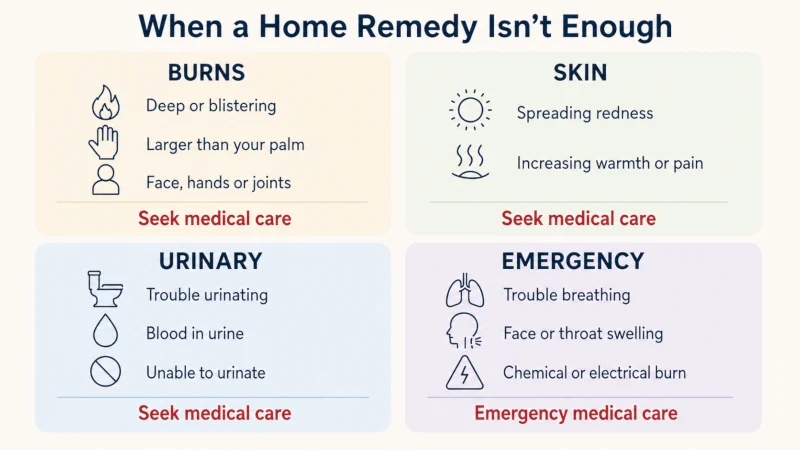
Annatto’s traditional uses cluster around problems that can be more serious than they look, so know the point at which self-care stops being appropriate.
Seek prompt medical care — not a home remedy — if you have a burn that is deep, blistering, larger than your palm, or on the face, hands, genitals, or a joint; a skin infection that’s spreading, warm, and increasingly painful; or urinary symptoms such as difficulty urinating, blood in the urine, or an inability to urinate.
Call 911 for any burn with breathing difficulty, a chemical or electrical burn, or signs of a severe allergic reaction like swelling of the face or throat, widespread hives, or trouble breathing after any exposure. For a suspected poisoning, Poison Help is reachable at 1-800-222-1222. And before adding any annatto supplement to a routine that includes prescription medication, a pregnancy, or a chronic condition, check with your doctor or pharmacist first.
| HEALTH DISCLAIMER This article is for general education and information. It is not medical advice and is not a substitute for diagnosis or treatment from a qualified professional. Annatto is safe as a food coloring and seasoning, but concentrated supplements are a different matter — talk to your doctor, registered dietitian, or pharmacist before using annatto medicinally, especially if you are pregnant or breastfeeding, have diabetes, take prescription medication, have a scheduled surgery, or have a history of allergic reactions. Do not use any natural product to replace treatment your doctor has prescribed. If you have a serious burn, a spreading skin infection, or urinary symptoms that concern you, seek medical care. For a medical emergency, call 911; for a suspected poisoning, call Poison Help at 1-800-222-1222. |
Frequently Asked Questions
Is annatto safe to eat?
For most people, yes. Used as a food coloring and seasoning, annatto has a long safety record and is an FDA-listed color additive [FDA, 21 CFR 73.30]. The main exception is people who are allergic to it, since reactions — rarely including anaphylaxis — have been documented [WebMD on annatto, 2026].
Does annatto have real health benefits or is it just food coloring?
Its proven role is as a colorant. Beyond that, its carotenoids showed antioxidant and anti-inflammatory activity in one small human study [Roehrs et al., 2017], and its delta-tocotrienol has shown bone-protective effects in animals [Mohamad et al., 2018]. Both are early-stage. No annatto product is a proven treatment for any disease.
Is annatto good for diabetes or blood sugar?
It’s not a reliable tool for it. Annatto may raise or lower blood sugar, and that unpredictability is a reason for caution — not a benefit — especially if you take diabetes medication [WebMD on annatto, 2026].
What is annatto tocotrienol, and does it work?
It’s a vitamin E supplement extracted from annatto seeds, valued because it’s naturally high in delta-tocotrienol and free of alpha-tocopherol [Mohamad et al., 2018]. The bone and metabolic research behind it is mostly preclinical, so its distinctive chemistry is better documented than any confirmed human benefit.
Can annatto help an enlarged prostate?
The available trial says no. Over 12 months, men with moderate urinary symptoms from an enlarged prostate got no benefit from annatto compared with placebo [Zegarra et al., 2007].
Is annatto safe during pregnancy?
Annatto-colored food is generally fine, but there isn’t enough information to consider annatto supplements safe in pregnancy or breastfeeding, so avoiding medicinal use is the cautious choice [WebMD on annatto, 2026].
References
- U.S. Food and Drug Administration / Electronic Code of Federal Regulations. “21 CFR 73.30 — Annatto extract.” eCFR (current). View source
- WebMD (content licensed from Therapeutic Research Center / Natural Medicines). “Annatto — Uses, Side Effects, and More.” 2026. View source
- Roehrs M, Conte L, da Silva DT, et al. “Annatto carotenoids attenuate oxidative stress and inflammatory response after high-calorie meal in healthy subjects.” Food Research International. 2017;100(Pt 1):771–779. DOI 10.1016/j.foodres.2017.08.005; PMID 28873749. View source
- Zegarra L, Vaisberg A, Loza C, et al. “Double-blind randomized placebo-controlled study of Bixa orellana in patients with lower urinary tract symptoms associated to benign prostatic hyperplasia.” International Braz J Urol. 2007;33(4):493–500. View source
- Mohamad NV, Ima-Nirwana S, Chin KY. “Effect of tocotrienol from Bixa orellana (annatto) on bone microstructure, calcium content, and biomechanical strength in a model of male osteoporosis induced by buserelin.” Drug Design, Development and Therapy. 2018;12:555–564. DOI 10.2147/DDDT.S158410. View source
