
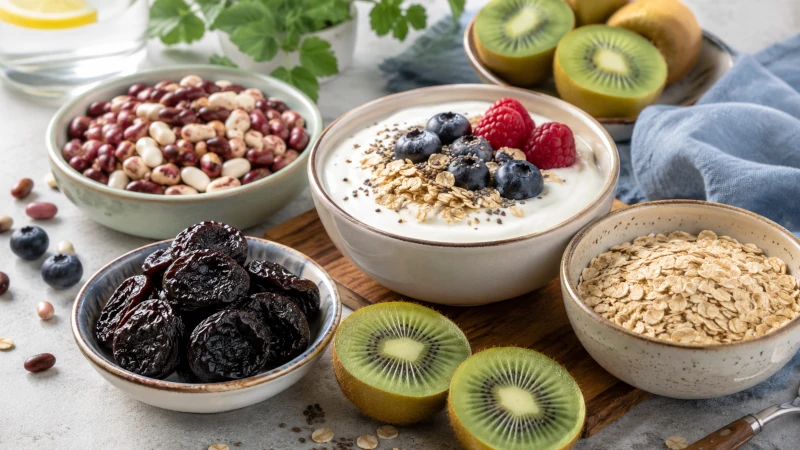
If you want the short answer: the foods for healthy digestion that do the most are the ones that move things along and feed the bacteria in your gut. That means fiber-rich plants — prunes, kiwifruit, whole grains, beans — and fermented foods like yogurt and kefir. A few others, like ginger and papaya, have a smaller but interesting body of evidence behind them.
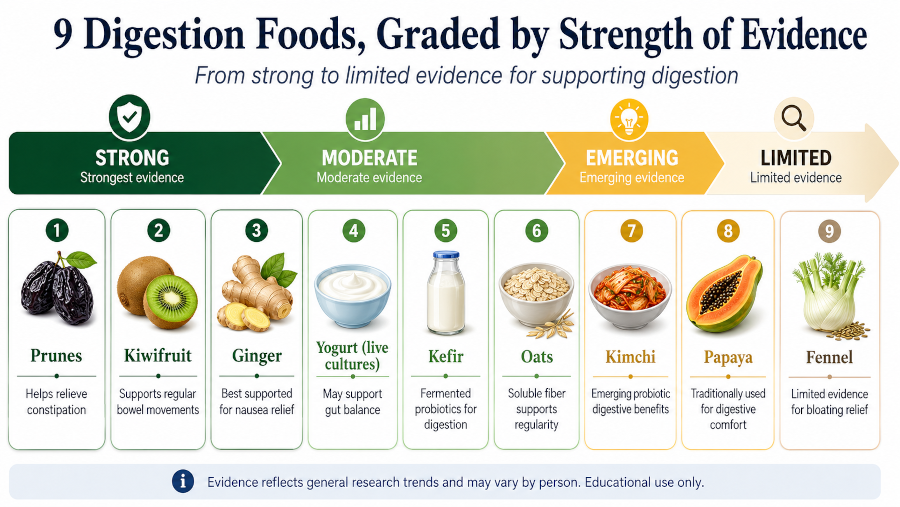
Below are nine foods for healthy digestion, ordered roughly by how strong the research is. Some are backed by human clinical trials. Others rest mostly on tradition or early findings. I’ve flagged which is which, because “people have eaten this for centuries” and “this beat the standard treatment in a randomized trial” are not the same claim, and you deserve to know the difference.
How food actually helps your digestion
Three things are doing most of the work.
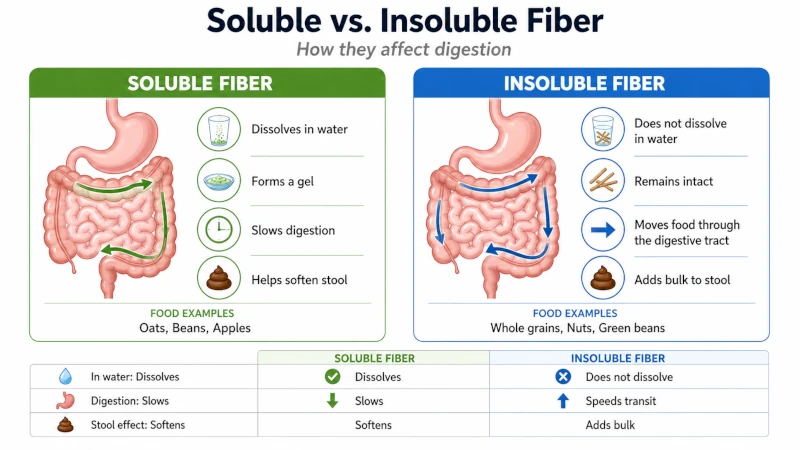
Fiber is the part of plants your body can’t break down, and it comes in two forms. Soluble fiber dissolves into a gel that slows digestion; insoluble fiber adds bulk and helps stool move through and out. Fiber is the single best-established dietary tool for regularity — it increases stool weight and softens it, which makes it easier to pass [Mayo Clinic, 2025]. The catch is that most people fall short of the roughly 25 grams a day suggested for younger women and up to 38 grams for younger men [Mayo Clinic, 2025].
Fermented foods and probiotics are live microbes that mostly act in your digestive tract and may improve how it functions [NIH ODS, 2025]. Yogurt, kefir, kimchi, and sauerkraut all carry them.
Motility — how quickly your stomach empties and your gut contracts — is the third. A few foods, ginger in particular, seem to nudge this along.
If you want a broader tour of gut-supportive eating, our guide to the 10 best foods for gut health covers more ground. Here, the focus is the nine with the most to offer.
The 9 foods for healthy digestion at a glance
| Food | Best for | Evidence strength |
| Prunes (dried plums) | Constipation, regularity | Strong (RCT) |
| Kiwifruit | Constipation, straining, bloating | Strong (RCT) |
| Whole grains & oats | Regularity, stool bulk | Strong (guidelines) |
| Beans & legumes | Fiber, feeding gut bacteria | Strong (guidelines) |
| Yogurt (live cultures) | Lactose digestion | Strong for lactose; mixed otherwise |
| Kefir | Lactose digestion | Moderate (small RCT) |
| Fermented vegetables | Microbiome diversity | Promising but early |
| Ginger | Stomach emptying, nausea | Moderate |
| Papaya | Constipation, bloating | Limited (concentrate study) |
1. Prunes (dried plums) — strong evidence
If one food has earned the top spot, it’s prunes. In a randomized crossover trial, 40 adults with chronic constipation took either prunes (50 grams twice a day, about 6 grams of fiber daily) or psyllium for three weeks each. Prunes came out ahead, producing more complete spontaneous bowel movements and better stool consistency than psyllium — a standard fiber laxative [Attaluri, 2011]. They work through a combination of fiber and sorbitol, a sugar alcohol with a natural laxative effect.
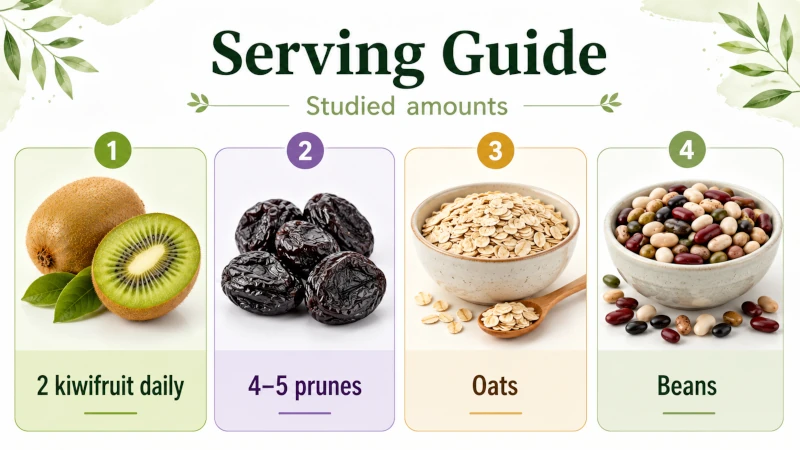
Practical version: start with four to five prunes a day and adjust. The same sorbitol that helps also causes gas if you overdo it. For more options, see our list of foods that help with constipation.
2. Kiwifruit — strong evidence
Kiwifruit has quietly built a solid case. In a US trial of 79 people with chronic constipation, eating two green kiwifruit a day for four weeks significantly improved stool consistency, straining, and bloating — with the fewest side effects of the three foods tested (the others were prunes and psyllium) [Chey, 2021]. Kiwi brings both fiber and an enzyme called actinidin. Two kiwifruit daily is the studied dose, and you can eat the skin for extra fiber.
3. Whole grains and oats — strong evidence
This is fiber doing what fiber does best. Whole grains — oats, barley, brown rice, whole-wheat bread and pasta — keep the bran that refining strips away, and that bran is where much of the fiber lives [Mayo Clinic, 2025]. Oats are especially easy on the stomach thanks to their soluble fiber. Aim for at least half your grains to be whole.
4. Beans, lentils, and other legumes — strong evidence
Legumes are among the richest fiber sources on the plate, delivering both fiber types plus resistant starch that feeds beneficial gut bacteria [Mayo Clinic, 2025]. The honest caveat: beans are famous for gas, especially if you’re not used to them. That settles as your gut adjusts. Add them gradually, rinse canned beans well, and drink water alongside.
5. Yogurt with live cultures — strong for one thing, mixed for the rest
Yogurt is made by fermenting milk with live bacteria, typically Lactobacillus bulgaricus and Streptococcus thermophilus [NIH ODS, 2025]. Those cultures bring its best-documented benefit: people who struggle to digest lactose generally handle yogurt better than milk, because the bacteria help break the lactose down [EFSA, 2010 — see verification note].
Beyond lactose, yogurt’s probiotics may help with symptoms like those of IBS, but here the picture is genuinely mixed — effects depend on the strain, the dose, and the symptom, and not every product has proven benefits [NIH ODS, 2025]. Choose one labeled “live and active cultures” and low in added sugar. For targeted relief, see our overview of the best probiotics for bloating and gas.
6. Kefir — moderate evidence
Kefir is a tart, drinkable fermented milk with a wider range of microbes than yogurt. In a small study of 15 adults who don’t digest lactose well, kefir reduced flatulence by more than half compared with milk and lowered breath-hydrogen levels, a marker of poorly digested lactose [Hertzler & Clancy, 2003]. It’s a reasonable swap if dairy normally bothers you, though the evidence base is thinner than yogurt’s.
7. Sauerkraut, kimchi, and other fermented vegetables — promising but early
In a 10-week Stanford trial, 36 healthy adults who ramped up fermented foods — yogurt, kefir, kimchi, sauerkraut, brined vegetables, and kombucha — showed greater gut-microbe diversity and lower levels of 19 inflammatory proteins in their blood. A high-fiber diet, by contrast, didn’t move microbiome diversity over the same period [Stanford Medicine, 2021].
Keep its limits in view: a small, short proof-of-concept study in healthy people, using markers like diversity and inflammation rather than relief of specific symptoms. Unpasteurized fermented vegetables are the ones that actually contain live microbes — many shelf-stable, vinegar-pickled versions don’t.
8. Ginger — moderate evidence, mainly for motility and nausea
Ginger’s reputation for settling the stomach has some real mechanism behind it. In a double-blind trial, 24 healthy volunteers who took 1,200 mg of ginger emptied their stomachs noticeably faster than on placebo — a half-emptying time of about 13 minutes versus 27 — and had stronger stomach contractions [Wu, 2008]. Worth noting honestly: in that same study, the faster emptying did not translate into a measurable change in how people felt. Ginger’s strongest evidence is actually for nausea. A few slices steeped as tea, or fresh ginger in cooking, is a sensible everyday amount.
9. Papaya — limited evidence
Papaya contains papain, an enzyme that breaks down protein, and it’s a long-standing folk remedy for sluggish digestion. The best clinical support comes from a study of a concentrated papaya preparation (not the raw fruit): taken daily for 40 days, it significantly improved constipation and bloating versus placebo [Muss, 2013]. That’s encouraging, but it tested a specific commercial concentrate, so you can’t assume a slice of fresh papaya delivers the same effect. Our papaya health benefits guide goes deeper.
How to add these foods without making things worse
The most common mistake is doing too much at once. Pile on fiber overnight and you’ll likely get gas, bloating, and cramping — the very things you were trying to fix. Add fiber gradually over a few weeks so your gut bacteria can adjust, and drink plenty of water, because fiber works by absorbing it [Mayo Clinic, 2025].
One more wrinkle: if you have irritable bowel syndrome, some of these foods can backfire. Prunes, certain legumes, and other high-FODMAP foods may trigger gas and bloating in sensitive guts. If that’s you, our comparison of the anti-inflammatory diet versus the low-FODMAP approach is a useful starting point, ideally with a dietitian.
Safety, side effects, and who should be careful
Most of these foods are just food, and for most people they’re safe. A few cautions are worth knowing.
Side effects. Gas and bloating are the usual culprits, especially with beans, prunes, and a sudden fiber jump. Probiotic foods can also cause temporary gas [NIH ODS, 2025].
Who should be careful with high-fiber foods. Your clinician may ask you to limit fiber during a flare of Crohn’s disease or ulcerative colitis, with narrowed intestine (strictures), gastroparesis, after bowel surgery, or before a colonoscopy [Mayo Clinic, 2025].
Who should be careful with probiotic foods. Probiotics can occasionally cause infections in people who are seriously ill or immunocompromised, and the FDA has flagged risks in preterm infants. Talk to a clinician first if that applies [NIH ODS, 2025].
Pregnancy and breastfeeding. These foods are normal parts of a healthy diet. Choose pasteurized dairy and fermented products, and if you’re considering ginger in supplement (not culinary) doses, run it past your provider first.
Medications. No major interactions apply at normal amounts. Very high fiber intake can affect how some medicines are absorbed, so separate daily medication from a big fiber load by a couple of hours and ask your pharmacist if unsure.
When digestive symptoms mean “see a doctor”
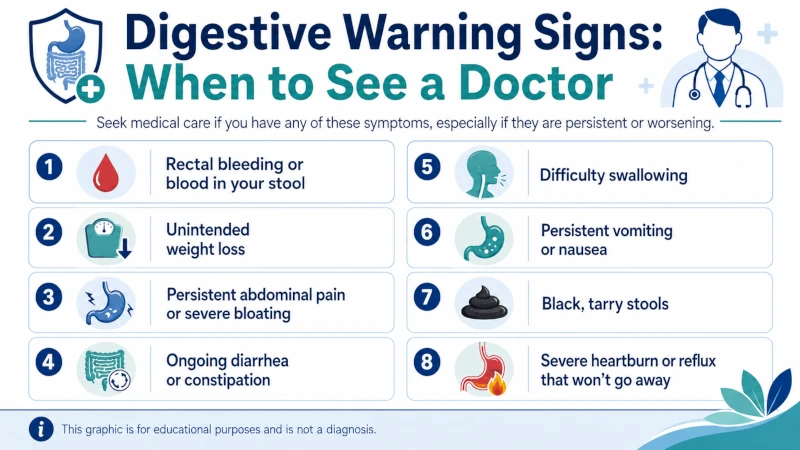
Food helps with everyday sluggishness and mild constipation. It is not the answer for warning signs. See a doctor if symptoms don’t improve with self-care or you have a family history of colon or rectal cancer — and seek care right away if constipation comes with any of these [NIDDK, 2018]:
- bleeding from the rectum or blood in your stool
- constant abdominal pain
- inability to pass gas, vomiting, or fever
- lower back pain
- losing weight without trying
These can signal something that needs proper evaluation. For more on specific conditions, browse our digestive health guides.
| Health Disclaimer This article is for general education and is not a substitute for professional medical advice, diagnosis, or treatment. Foods can support healthy digestion, but they do not cure, prevent, or treat disease. If you are pregnant or breastfeeding, take regular medication, or have a digestive condition such as IBS, IBD, or diabetes, talk with a qualified healthcare provider before making significant changes to your diet. If you have any of the warning signs above, seek medical care promptly. Reliance on any information here is at your own risk. |
Frequently Asked Questions
What is the single best food for digestion?
There’s no one winner, but prunes have the strongest evidence for regularity specifically — they outperformed a standard fiber laxative in a randomized trial [Attaluri, 2011]. For broader gut health, variety matters more than any single food.
How quickly do these foods work?
For constipation, fiber-rich foods like prunes and kiwifruit often help within a few days to a couple of weeks [Chey, 2021]. Fermented foods that shift the microbiome work more slowly — the Stanford study ran for ten weeks [Stanford Medicine, 2021].
Are fermented foods better than fiber for gut health?
They do different jobs. In the Stanford trial, fermented foods increased microbiome diversity while a short high-fiber diet did not — but fiber remains the best-proven tool for regularity [Stanford Medicine, 2021] [Mayo Clinic, 2025]. Eat both.
Can these foods cause bloating?
Yes, especially at first. Beans, prunes, and big fiber increases commonly cause gas, and probiotic foods can too. Adding them slowly and drinking water reduces the effect [Mayo Clinic, 2025] [NIH ODS, 2025].
Is yogurt okay if I’m lactose intolerant?
Often, yes. The live cultures in yogurt help digest lactose, and many people who react to milk tolerate yogurt and kefir well [Hertzler & Clancy, 2003]. Start small and see how you feel.
References
- Attaluri A, et al. Randomised clinical trial: dried plums (prunes) vs. psyllium for constipation. Aliment Pharmacol Ther. 2011;33(7):822–828. PMID 21323688. View source
- Chey SW, et al. Exploratory Comparative Effectiveness Trial of Green Kiwifruit, Psyllium, or Prunes. Am J Gastroenterol. 2021;116(6):1304–1312. PMID 34074830. View source
- Mayo Clinic Staff. Dietary fiber: Essential for a healthy diet. Mayo Clinic; updated Dec 2025. View source
- NIH Office of Dietary Supplements. Probiotics — Fact Sheet for Consumers. Updated Nov 2025. View source
- Wastyk HC, et al. Gut-microbiota-targeted diets modulate human immune status. Cell. 2021 (via Stanford Medicine, Jul 12 2021). View source
- Wu KL, et al. Effects of ginger on gastric emptying and motility in healthy humans. Eur J Gastroenterol Hepatol. 2008;20(5):436–440. PMID 18403946. View source
- Muss C, et al. Papaya preparation (Caricol®) in digestive disorders. Neuro Endocrinol Lett. 2013;34(1):38–46. View source
- Hertzler SR, Clancy SM. Kefir improves lactose digestion and tolerance in adults with lactose maldigestion. J Am Diet Assoc. 2003;103(5):582–587 (via Ohio State University). View source
- NIDDK. Symptoms & Causes of Constipation. Last reviewed 2018. View source
- EFSA Panel. Scientific Opinion on live yoghurt cultures and improved lactose digestion (ID 1143, 2976). EFSA Journal. 2010;8(10):1763. View source
