
Peppermint oil earns most of its reputation in one place: the gut. The clearest benefit of peppermint oil is short-term relief of irritable bowel syndrome (IBS) symptoms from enteric-coated capsules — the kind that dissolve past the stomach [NCCIH, 2025; Ingrosso et al., 2022]. Beyond that, the picture is more mixed than most “10 benefits” lists admit. Some uses have a little supporting research, several rest mainly on menthol’s cooling sensation, and a few common claims have no good evidence at all.
This guide sorts what peppermint oil can plausibly do from what it’s merely said to do, with the sources for each, and it’s honest about safety — because a concentrated essential oil is not automatically gentle just because it comes from a plant. If you want the botany and history of the peppermint plant itself, that’s a separate read.
Peppermint oil benefits at a glance
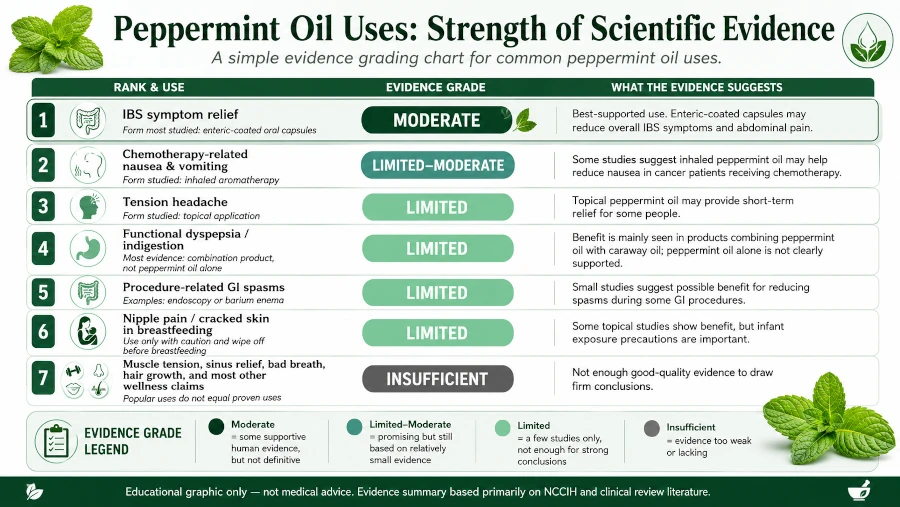
Here’s the short version, graded by how much human evidence stands behind each use. The rest of the article explains each row.
| Use | What the evidence shows | Strength |
| Digestive comfort (IBS) | Enteric-coated capsules ease overall IBS symptoms and abdominal pain over a few weeks; long-term effect unknown. | Best-supported |
| Nausea (chemotherapy) | Small studies suggest inhaled peppermint may reduce nausea and vomiting during chemo. | Promising, limited |
| Tension headache | Topical 10% peppermint-in-alcohol on the forehead eased pain in a controlled trial; overall evidence is still limited. | Promising, limited |
| Indigestion | Helps in fixed peppermint-plus-caraway products; peppermint oil alone can worsen it. | Mixed |
| Muscle aches, alertness, skin, oral care | Mostly menthol’s cooling sensation and lab findings; little direct human trial data. | Traditional / early |
| Hair growth | One 2014 study in mice; no human trials. | Animal only |
| “Detox” or liver cleansing | No credible evidence that peppermint oil removes toxins. | Not supported |
“Best-supported” still means helpful for some people, not a guaranteed fix. “Traditional” means long used but thinly studied.
The strongest use: calming an irritable bowel
Peppermint oil relaxes smooth muscle in the gut wall, which can quiet the cramping and spasm behind IBS pain. A 2022 systematic review of 10 trials in about 1,030 people found enteric-coated peppermint oil beat placebo for overall symptoms and abdominal pain, though it caused more mild side effects such as heartburn and reflux [Ingrosso et al., 2022; NCCIH, 2025]. An earlier meta-analysis reached the same conclusion, and a 2021 American College of Gastroenterology guideline gives peppermint oil a conditional recommendation for IBS [Khanna et al., 2014; NCCIH, 2025].
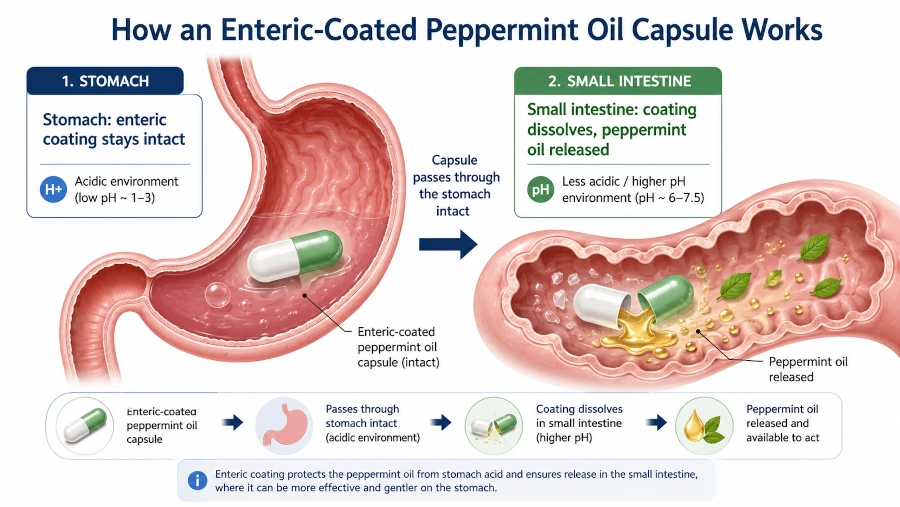
Two honest limits: the benefit is proven only over the short term — a few weeks — and the enteric coating matters, because it carries the oil past the stomach so it doesn’t simply trigger heartburn on the way down [NCCIH IBS fact sheet, 2024]. Loose “peppermint tea for digestion” advice is far weaker than the capsule evidence, and food is often a bigger lever than any supplement. If meals reliably set you off, it’s worth learning which foods most often trigger IBS before reaching for an oil.
Nausea, including during chemotherapy
A 2024 review that pooled several aromatherapy trials found inhaling peppermint oil helped reduce nausea and vomiting in people having chemotherapy [NCCIH, 2025]. It’s promising rather than settled, and it’s a complement to prescribed anti-nausea care, not a replacement. If you’re in cancer treatment, clear any aromatherapy with your oncology team first.
Tension headaches: a real but narrow win
This is the best-studied topical use. In a randomized, placebo-controlled trial, a 10% solution of peppermint oil in alcohol dabbed across the forehead and temples significantly reduced tension-headache intensity within 15 minutes and performed comparably to acetaminophen [Göbel et al., 1996]. Menthol’s cooling effect on the skin appears to dampen the pain signal. Even so, health authorities still classify the overall evidence as limited, so treat it as a reasonable thing to try for ordinary tension headaches, not a proven migraine treatment [NCCIH, 2025].
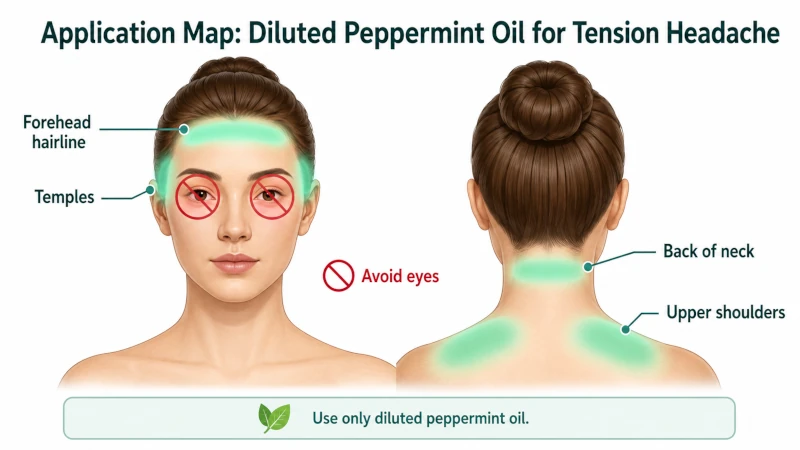
Practical version: dilute a couple of drops in a carrier oil, keep it well away from the eyes, and stop if it stings. A pre-mixed essential-oil roller for headaches is a tidy way to do this. See a clinician for headaches that are new, severe, unusually frequent, or come with vision changes, weakness, fever, or a stiff neck — those are not jobs for a home remedy.
Popular uses with thinner evidence
The claims below aren’t crazy — they mostly ride on menthol’s cooling, mildly analgesic feel or on lab-dish findings — but the human trial support is slim. Keep expectations modest.
- Sore muscles. Diluted and rubbed in, peppermint oil feels cooling and can be pleasant after exertion, but there’s little direct trial evidence it outperforms other topical rubs.
- Focus and energy. Some small studies hint the scent may boost alertness; results are mixed and short-lived. Fine as a pick-me-up, not a treatment for fatigue.
- Stuffy nose and “open airways.” Menthol makes breathing feel clearer by stimulating cold receptors, but that sensation doesn’t reliably mean more air is actually moving. It may feel nice in a steamy shower; it isn’t a decongestant in the medical sense.
- Skin and oral care. Antibacterial activity shows up in the lab, and menthol is a common flavoring, but peppermint oil can also irritate skin and gums. Any homemade mouth rinse should be well diluted, and it shouldn’t replace fluoride toothpaste or dental care.
Indigestion deserves its own caution. Fixed products that combine peppermint and caraway oil can ease it, but peppermint oil taken alone may actually worsen indigestion in some people [NCCIH, 2025] — the opposite of the intended effect.
Hair growth: interesting, but only tested in mice
The hair-growth buzz traces to a single 2014 experiment in which 3% peppermint oil grew more hair on shaved mice than saline, jojoba oil, or minoxidil over four weeks [Oh et al., 2014]. It’s a genuine study, but it was done in animals, with no human trial to confirm it applies to people. If thinning hair is your real concern, the remedies with actual human evidence — like rosemary oil and pumpkin seed oil — are a better place to start; our guide to natural remedies for hair loss lays out what the research supports and what it doesn’t.
The claim to drop: “detox” and liver cleansing
You’ll see peppermint oil sold as a way to “flush toxins” or cleanse the liver, sometimes with advice to drink drops in water. There’s no credible evidence for that, and swallowing undiluted essential oil is a route to heartburn or irritation, not detoxification. Your liver and kidneys already handle that job. Skip internal use of the oil unless a qualified professional specifically directs it.
How to use peppermint oil safely
“Natural” and “concentrated” live in the same bottle here. A few rules keep it on the helpful side.
On the skin
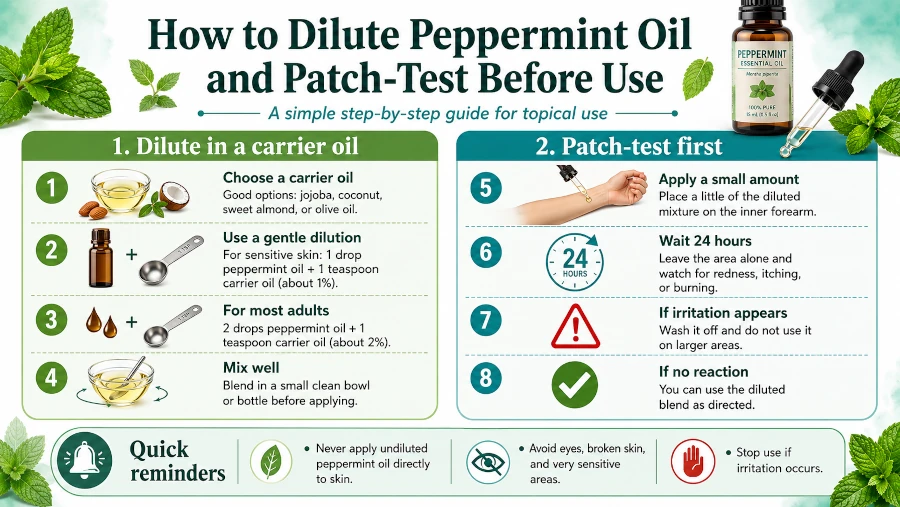
Never apply undiluted peppermint oil — it’s strong enough to burn or irritate. Mix a few drops into a carrier oil such as jojoba, coconut, or almond. Do a patch test on your inner forearm and wait 24 hours first, because allergic contact dermatitis and skin irritation are the most common problems reported [MSKCC; NCCIH, 2025]. Keep it away from the eyes and broken skin.
Side effects to expect
Taken orally, peppermint oil can cause heartburn, belching, nausea, dry mouth, and — with capsules — a burning sensation, usually mild [NCCIH, 2025; AAFP, 2007]. Allergic reactions are uncommon but possible. Enteric-coated capsules are used partly to reduce the heartburn.
Medication interactions
Peppermint oil can slow how the body clears certain drugs by affecting liver enzymes. The most cited caution is cyclosporine (an immune-suppressing transplant drug): peppermint oil may raise its levels, so people taking it should avoid the oil [MSKCC]. It has also been reported to raise levels of some blood-pressure and cholesterol medicines in isolated cases [AAFP, 2007]. Databases disagree on how large these effects really are in humans, which is exactly why it’s worth telling your pharmacist. Separately, acid-reducing drugs can make enteric-coated capsules dissolve too early, so space them a couple of hours apart [AAFP, 2007].
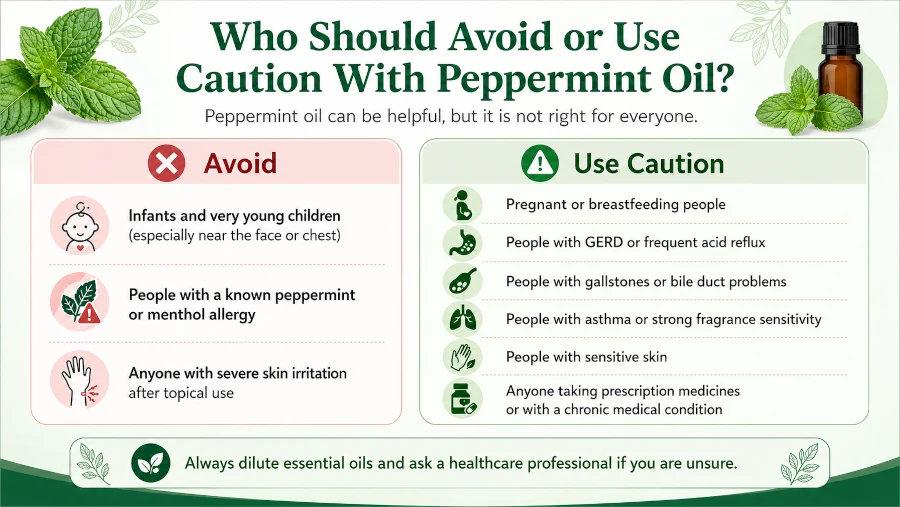
Who should be cautious or avoid it
- Reflux and hiatal hernia. Peppermint relaxes the valve between the stomach and esophagus, which can worsen GERD or hiatal-hernia symptoms. [MSKCC; AAFP, 2007]
- Gallbladder problems. Because it stimulates bile flow, peppermint is generally avoided with gallstones or gallbladder inflammation. [MSKCC]
- Pregnancy and breastfeeding. Peppermint in food amounts is likely fine, but the safety of medicinal doses in pregnancy or breastfeeding isn’t established, and some sources advise avoiding concentrated oil in pregnancy. Check with your clinician. [NCCIH, 2025; AAFP, 2007]
- Babies and young children. Do not apply peppermint oil to or near the face of an infant or small child — inhaled menthol can cause serious breathing problems. [NCCIH, 2025; AAFP, 2007]
Store the bottle out of reach of children and pets, and choose products from brands that publish third-party purity testing.
When to see a professional
Peppermint oil is for minor, familiar complaints. Some symptoms need a clinician instead of a home remedy. Get medical advice promptly for digestive symptoms that include rectal bleeding, black stools, unexplained weight loss, anemia, difficulty swallowing, symptoms that wake you at night, or new IBS-type symptoms starting after age 50 [NCCIH IBS fact sheet, 2024]. For headaches, seek care if they’re sudden and severe, change in pattern, or come with fever, stiff neck, weakness, confusion, or vision changes. And if a “simple” problem isn’t improving with sensible self-care, that itself is a reason to check in.
| Health disclaimer This article is for general education and is not a substitute for personalized medical advice, diagnosis, or treatment. Peppermint oil is a concentrated product that can interact with medications and isn’t right for everyone. Talk with a qualified healthcare professional before using it — especially if you are pregnant or breastfeeding, give it to a child, take prescription medicine, or have reflux, gallbladder disease, or another ongoing condition. Never apply peppermint oil to or near the face of a baby or young child. If you have severe or unusual symptoms, seek medical care rather than relying on a home remedy. |
Frequently Asked Questions
Does peppermint oil really help IBS?
Yes, for many people and over the short term. Enteric-coated capsules reduced overall IBS symptoms and abdominal pain versus placebo across multiple trials, which is why a major gastroenterology guideline lists it as an option [Ingrosso et al., 2022; NCCIH, 2025]. The long-term picture isn’t established, and it can cause mild reflux.
Can I swallow a few drops of peppermint oil in water?
It’s not a good idea on your own. Concentrated oil can irritate and cause heartburn, and the “detox” rationale isn’t supported. Any internal use should be a specific product and dose your healthcare provider recommends.
Is peppermint oil good for hair growth?
The evidence is a single mouse study, with no human trials [Oh et al., 2014]. For hair loss, options like rosemary oil have better human evidence — see our hair-loss remedies guide.
How do I put peppermint oil on my skin without irritation?
Always dilute it in a carrier oil, keep it off the face and eyes, and patch-test on your inner arm 24 hours ahead. Stop if you get redness, itching, or burning.
Who should not use peppermint oil?
Use caution or avoid it if you have GERD or a hiatal hernia, gallbladder disease, take cyclosporine or certain other medications, or are pregnant or breastfeeding — and never use it on a baby’s or young child’s face [MSKCC; NCCIH, 2025].
References
- National Center for Complementary and Integrative Health (NCCIH). Peppermint Oil: Usefulness and Safety. View source
- National Center for Complementary and Integrative Health (NCCIH). Irritable Bowel Syndrome: What You Need To Know. 2024. View source
- Ingrosso MR, Ianiro G, Nee J, et al. Systematic review and meta-analysis: efficacy of peppermint oil in irritable bowel syndrome. Aliment Pharmacol Ther. 2022;56(6):932–941. PMID 35942669. View source
- Khanna R, MacDonald JK, Levesque BG. Peppermint oil for the treatment of irritable bowel syndrome: a systematic review and meta-analysis. J Clin Gastroenterol. 2014;48(6):505–512. PMID 24100754. View source
- Göbel H, Fresenius J, Heinze A, et al. [Effectiveness of Oleum menthae piperitae and paracetamol in therapy of headache of the tension type]. Nervenarzt. 1996;67(8):672–681. PMID 8805113. View source
- Oh JY, Park MA, Kim YC. Peppermint Oil Promotes Hair Growth without Toxic Signs. Toxicol Res. 2014;30(4):297–304. PMC4289931. View source
- Memorial Sloan Kettering Cancer Center. Peppermint (Integrative Medicine, About Herbs). View source
- Kligler B, Chaudhary S. Peppermint Oil. Am Fam Physician. 2007;75(7):1027–1030. View source
