
Lion’s mane is a promising brain supplement with a thin human evidence base. The best trials suggest it may modestly help memory scores in older adults with mild cognitive impairment and may take a little edge off stress. But those studies are small and short, several were run by companies that sell the mushroom, and the memory gains faded once people stopped. In healthy younger adults, results have been mostly flat or mixed.
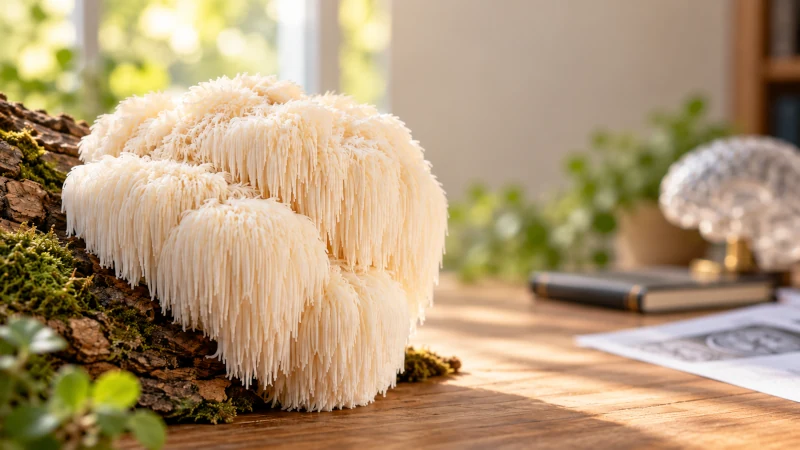
That’s the honest summary of lion’s mane mushroom benefits as of September 2026. Below you’ll find where each claim comes from, how strong it is, how people in studies actually took it, and who should skip it.
| The short version Claim What the evidence shows Strength Better memory in older adults with mild cognitive impairment One 30-person trial found higher cognitive scores after 16 weeks; scores fell after stopping Limited Sharper thinking in healthy adults Several small trials: mostly no overall change; a few single tests better, a few worse Mixed Slowing Alzheimer’s disease One pilot trial in people with mild Alzheimer’s: better daily-function score, no clear difference on memory tests Limited Less stress, anxiety, or low mood Small trials, some without a placebo group; a 2026 industry-funded trial not yet peer reviewed Limited, early Nerve repair and “brain protection” Almost entirely animal and lab studies Preclinical only Safety as a food Generally recognized as safe as a food; long-term supplement data are limited Moderate |
What lion’s mane is — and why brain researchers got interested
Lion’s mane (Hericium erinaceus) is an edible white mushroom covered in long, dangling spines. Cooked, it has a mild, sweet flavor that people often compare to crab or lobster [Cleveland Clinic, 2024]. It has a long history in East Asian cooking and traditional medicine, and today you’ll find it in capsules, powders, liquid extracts, and “mushroom coffee.”
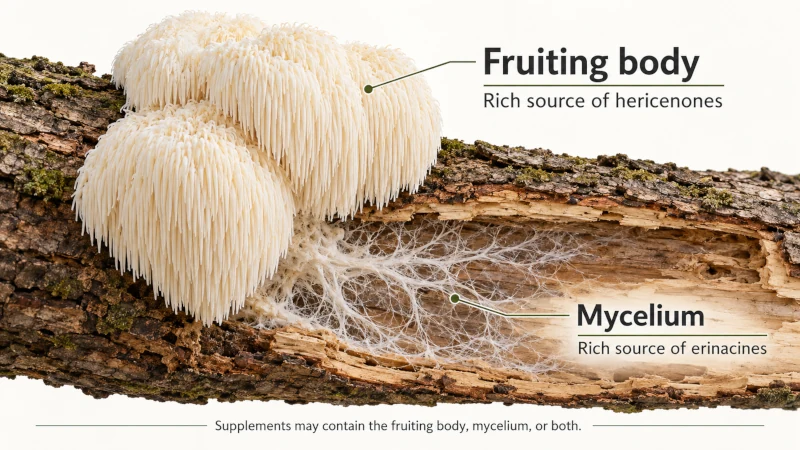
The scientific interest comes from two families of compounds. Hericenones come mainly from the fruiting body — the part you’d cook — and erinacines come mainly from the mycelium, the root-like network the mushroom grows from. In lab studies, both stimulate production of nerve growth factor (NGF), a protein that helps nerve cells grow and survive. In rats, two erinacines have been shown to cross the blood–brain barrier [Alzheimer’s Drug Discovery Foundation report, 2025].
That’s a plausible mechanism, not proof of a benefit. Plenty of compounds look impressive in a dish or a mouse and do nothing measurable in people. The only way to know is human trials, and there aren’t many.
Lion’s mane mushroom benefits for memory: the human trials
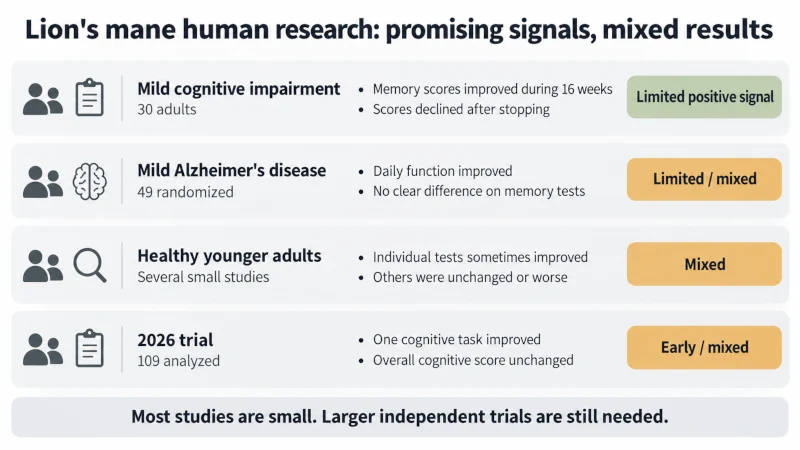
The Alzheimer’s Drug Discovery Foundation (ADDF), whose neuroscientists review supplements for brain health, puts it plainly: cognitive effects have been mixed across a handful of small, short trials, and larger, longer ones are needed [ADDF, 2025]. Here’s what those trials found.
Older adults with mild cognitive impairment
This is the study most “lion’s mane boosts memory” claims trace back to. In a double-blind trial in Japan, 30 adults aged 50 to 80 with mild cognitive impairment took either a placebo or tablets of dried lion’s mane — four 250 mg tablets three times a day, or 3 grams daily — for 16 weeks. The lion’s mane group scored significantly higher on a cognitive function scale at weeks 8, 12, and 16. Four weeks after they stopped, their scores dropped significantly [Mori et al., Phytotherapy Research, 2009].
Read it with two caveats. The trial was tiny, and the lead author worked for a mushroom-growing company. And the fade-out after stopping suggests any effect depends on continued use rather than lasting change.
Healthy older adults
A 12-week trial of 31 healthy adults over 50 who took 3.2 grams of lion’s mane powder daily found improvement on one screening test, the Mini-Mental State Examination, but not on two other memory tests. ADDF’s reviewers point out that healthy people usually score near the top of that test, the lion’s mane group started higher, and the placebo group improved too — so a practice effect can’t be ruled out [ADDF, 2025].
People with early Alzheimer’s disease
In a Taiwanese pilot trial, 49 people with mild Alzheimer’s disease were randomly assigned to erinacine A–enriched lion’s mane mycelium (three 350 mg capsules a day) or a placebo for 49 weeks; 41 finished. At the end, the lion’s mane group scored better than placebo on a measure of everyday independence. On the memory and thinking tests themselves, the two groups weren’t significantly different, although the lion’s mane group’s Mini-Mental score rose from its own starting point [Li et al., Frontiers in Aging Neuroscience, 2020]. Several authors were employed by the company that made the capsules.
That’s not a treatment for Alzheimer’s. It’s a reason to run a bigger trial.
Healthy younger adults
This is where the enthusiasm runs into the data.
- In a UK pilot trial of 41 adults aged 18 to 45, a single 1.8-gram dose made people faster on one attention task, the Stroop test, an hour later. After 28 days there was a borderline trend toward lower self-rated stress (p = 0.051). But the lion’s mane group also did worse on a word-recall test, and most other measures didn’t budge [Docherty et al., Nutrients, 2023].
- In a crossover trial of 18 healthy adults aged 18 to 35, a single 3-gram dose of fruiting-body extract made no difference to overall thinking or mood. People did better on a hand-dexterity task and worse on two tests of executive function [Surendran et al., Frontiers in Nutrition, 2025].
- In 24 college-age adults, 10 grams a day baked into muffins for four weeks didn’t change performance on a stress-and-arithmetic challenge [ADDF, 2025].
When a supplement nudges one test up and another down in a small study, chance is the simplest explanation.
The newest trial (2026)
The largest trial so far was posted in April 2026 as a preprint, which means it hasn’t been peer reviewed yet. Of 150 adults aged 40 to 75 with self-reported memory or focus complaints, 109 were analyzed after eight weeks of either 2 grams a day of a fruiting body–and–mycelium powder or a placebo. The lion’s mane group improved more on one visual attention and working-memory task, but not on the other cognitive tests or the overall score. They also reported faster improvement in sleep quality, morning restedness, and mood. The company that makes the product funded the study [Daoust et al., medRxiv preprint, 2026].
It’s the most encouraging recent signal, and it still points to a modest, narrow effect.
Mood, stress, and sleep
The mood research is even thinner.
- Women in midlife: In a four-week study of 30 women (average age about 41), eating four cookies a day, each with 0.5 gram of lion’s mane powder, lowered depression and general-complaint scores compared with where participants started [Nagano et al., Biomedical Research, 2010]. Summaries of this study disagree. An oncology nursing review describes a significant reduction in depression compared with placebo [Oncology Nursing Society, 2024], while ADDF’s reviewers report the depression scores were not significantly different from placebo [ADDF, 2025]. The paper’s own abstract reports the within-group drop and only two individual items, including palpitations, beating placebo — so the cautious reading holds.
- Adults with overweight or obesity: An 8-week study of 77 people found lower depression, anxiety, and sleep-problem ratings with lion’s mane plus a low-calorie diet, but there was no placebo group to compare against [ADDF, 2025].
- Younger adults: the borderline stress trend in the Docherty trial, no mood change after a single dose in the Surendran trial, and better self-rated sleep and mood in the 2026 preprint.
If stress or low mood is what brought you here, other supplements have more research behind them; our guide to supplements that reduce anxiety and stress compares them. And if symptoms are affecting your work, sleep, or relationships, a doctor is a better first stop than any bottle.
Nerve repair, inflammation, and “brain protection”
The most dramatic claims — that lion’s mane repairs nerves, protects against stroke, or slows Parkinson’s — come from animals and cell cultures. In rodents, erinacine A–enriched extracts reduced stroke damage, protected dopamine-producing cells in Parkinson’s models, and improved recovery after nerve-crush injuries [ADDF, 2025]. Lab studies also show antioxidant and anti-inflammatory activity [Cleveland Clinic, 2024].
None of this has been tested as a treatment in people. It explains why researchers are interested; it isn’t a reason to use lion’s mane for neuropathy, stroke recovery, or any neurological disease.
How to take lion’s mane if you want to try it
Food is the low-risk option. Lion’s mane is generally recognized as safe when eaten as food [ADDF, 2025]. Slice it and sauté it like any other mushroom — just don’t assume a dinner portion matches what was used in trials.
No dose has been established. ADDF notes that no dose has been set for any use [ADDF, 2025], and supplements like lion’s mane aren’t FDA-approved and come with no official intake guidelines [Cleveland Clinic, 2024]. For context, here’s what the human studies used:
| Who was studied | Form | Daily amount | Length |
| Adults 50–80 with mild cognitive impairment | Dried lion’s mane tablets | 3 g | 16 weeks |
| Healthy adults over 50 | Fruiting-body powder | 3.2 g | 12 weeks |
| Adults with mild Alzheimer’s | Erinacine A–enriched mycelium capsules | About 1 g (3 × 350 mg) | 49 weeks |
| Healthy adults 18–45 | Capsules | 1.8 g | 28 days |
| Adults 40–75 with memory complaints | Fruiting body + mycelium powder | 2 g | 8 weeks |
| Women in midlife | Powder baked into cookies | 2 g | 4 weeks |
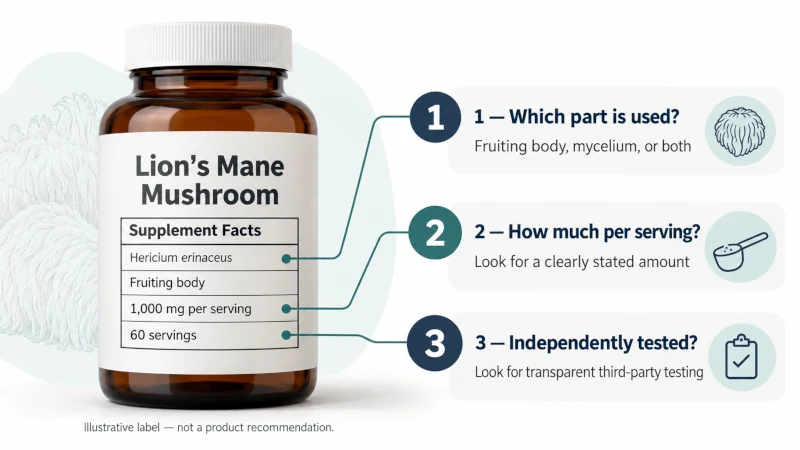
Check what’s actually in the bottle. Products vary a lot. Some use the fruiting body, some the mycelium (often grown on grain), and some a blend, and the extraction method changes which compounds end up in the capsule [Surendran et al., 2025]. The European Union doesn’t allow mycelial extracts in foods and supplements, so European products are fruiting-body based; US products carry no such restriction [ADDF, 2025]. Choose a label that states which part is used, how much is in each serving, and whether an independent lab has tested it.
Give it a fair but limited trial. Most studies ran 4 to 16 weeks, and in the mild cognitive impairment trial the benefit showed up by week 8. If you try lion’s mane, pick one specific thing to track — how often you lose your train of thought, say — give it 8 to 12 weeks, and stop if nothing changes. Taking it with food may help if your stomach is sensitive.
Side effects, drug interactions, and who should skip it
Common side effects are usually mild: stomach discomfort, nausea, and diarrhea. In the 49-week Alzheimer’s trial, a few people dropped out because of abdominal discomfort, nausea, or a skin rash [Li et al., 2020]; Memorial Sloan Kettering lists the same three reactions [Memorial Sloan Kettering Cancer Center, 2024]. In the mild cognitive impairment trial, stomach discomfort and diarrhea showed up about as often on placebo as on lion’s mane [ADDF, 2025]. A 2025 systematic review adds headache and allergic reactions [Menon et al., Frontiers in Nutrition, 2025].
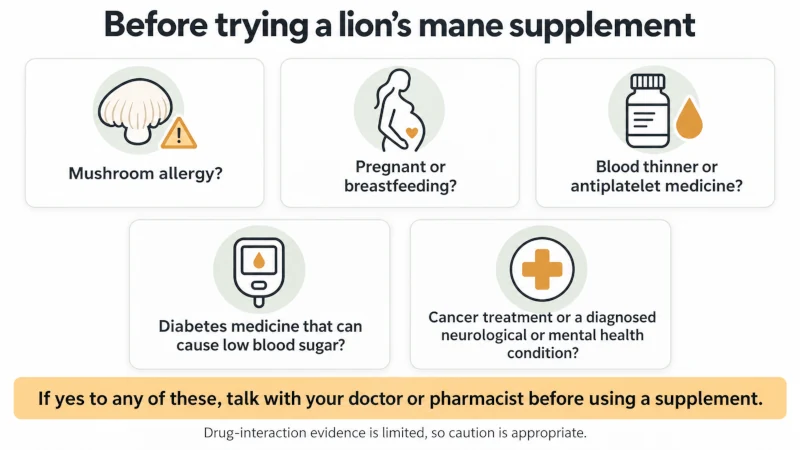
Allergy is the risk to take most seriously. Lion’s mane appears safe unless you’re allergic to mushrooms [Cleveland Clinic, 2024]. One case report from Japan described a 63-year-old man who developed acute respiratory distress syndrome, a serious lung injury, after months of taking lion’s mane supplements. Testing pointed to an immune reaction to the extract, though a later review notes the cause couldn’t be proven [Menon et al., 2025].
Drug interactions are uncertain, and sources disagree. ADDF states that no drug interactions with lion’s mane have been documented [ADDF, 2025]. On the other hand, a compound in lion’s mane called hericenone B blocked one pathway of platelet clumping in rabbit and human platelets in the lab [Mori et al., Phytomedicine, 2010], and lion’s mane extracts lowered blood sugar in diabetic rats [ADDF, 2025]. Neither effect has been shown to cause problems in people, but both are reasonable grounds to ask your doctor or pharmacist first if you take:
- blood thinners or antiplatelet medicines such as warfarin, apixaban, clopidogrel, or daily aspirin — or if you have a bleeding disorder or surgery coming up
- diabetes medicines that can cause low blood sugar, such as insulin or sulfonylureas. If you try lion’s mane anyway, know the signs of low blood sugar and check your levels more often at first.
Skip lion’s mane supplements, or talk to your doctor first, if you:
- have a mushroom allergy
- are pregnant or breastfeeding — there’s no safety data, and trials have excluded pregnant and breastfeeding women [Surendran et al., 2025]
- take blood thinners, antiplatelet drugs, or glucose-lowering medication (see above)
- are being treated for cancer — oncology nurses advise discussing any lion’s mane product with your cancer care team and pharmacist [Oncology Nursing Society, 2024]
- have a diagnosed neurological or mental health condition — lion’s mane isn’t a substitute for treatment, so tell your doctor about it the way you would any other supplement
When to see a doctor — and when to call 911
Lion’s mane can’t tell you whether a memory slip is normal aging or something that needs a checkup. See your doctor if:
- memory problems are starting to get in the way of daily life — getting lost in familiar places, asking the same questions over and over, or struggling with bills and familiar tasks. Our guide to memory health in seniors explains what’s normal and what isn’t.
- low mood, anxiety, or poor sleep lasts more than two weeks or is affecting work or relationships
- you develop a rash, ongoing stomach upset, or any new symptom after starting a supplement
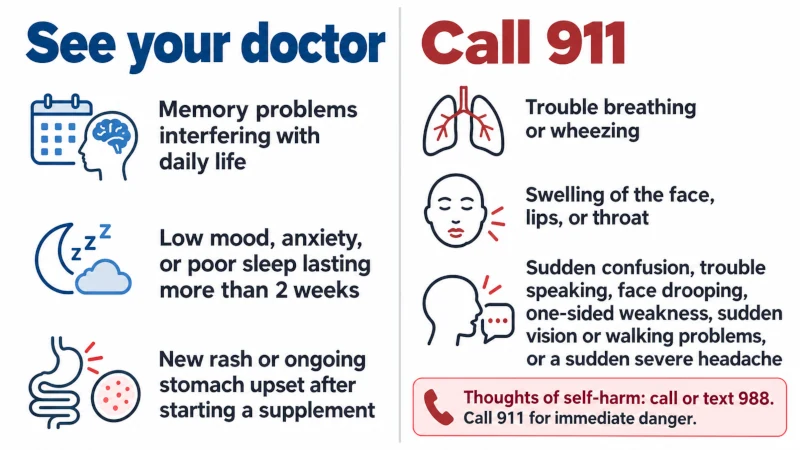
Call 911 right away for:
- trouble breathing, wheezing, or swelling of the face, lips, or throat after taking lion’s mane — these can signal a severe allergic reaction
- sudden confusion, trouble speaking, face drooping, numbness or weakness on one side of the body, sudden trouble seeing or walking, or a sudden severe headache — these are signs of stroke [CDC, 2026]
- thoughts of harming yourself — call or text 988 to reach the Suicide & Crisis Lifeline, or call 911 if you’re in immediate danger
| Health disclaimer: This article is for general education and isn’t medical advice. Lion’s mane supplements are not FDA-approved to treat or prevent any disease, and the human research on them is early. Talk with your doctor or pharmacist before you start lion’s mane — especially if you’re pregnant or breastfeeding, take prescription medicines (particularly blood thinners or diabetes medicines), have a mushroom allergy, or are being treated for a medical or mental health condition. Don’t stop or change a prescribed treatment because of anything you read here. If you have trouble breathing, signs of a stroke, or thoughts of harming yourself, call 911 or 988 right away. |
Frequently Asked Questions
Does lion’s mane really improve memory?
Possibly a little, in specific groups. The best-known trial found higher cognitive scores in older adults with mild cognitive impairment after 16 weeks of 3 grams a day, but it included only 30 people and the effect faded after they stopped. Trials in healthy younger adults have mostly shown no overall improvement.
How long does lion’s mane take to work?
Human trials ran 4 to 16 weeks, and the clearest memory effect appeared around week 8. Single doses have produced only small, inconsistent changes on individual tests.
Is fruiting body or mycelium better?
No study has compared them head to head in people. Fruiting bodies are richer in hericenones and mycelium in erinacines, trials have used both, and results don’t clearly favor either. Whichever you choose, pick a product that says exactly what it contains.
Can lion’s mane help with anxiety or depression?
Small studies suggest modest improvements in mood and stress ratings, but some had no placebo group and none were large. It isn’t a replacement for therapy or medication. If low mood or anxiety lasts more than two weeks, talk to a doctor.
Can lion’s mane prevent dementia?
No study has shown that. A pilot trial in people with mild Alzheimer’s found a difference in daily functioning but not on memory tests. Steps like controlling blood pressure, staying physically active, and treating hearing loss have much stronger support for lowering dementia risk; our memory health guide covers them.
References
- Alzheimer’s Drug Discovery Foundation. Lion’s Mane Mushroom — Cognitive Vitality report for researchers. View source
- Cleveland Clinic Health Essentials. Health Benefits of Lion’s Mane Mushrooms. View source
- Mori K, Inatomi S, Ouchi K, Azumi Y, Tuchida T. Improving effects of the mushroom Yamabushitake (Hericium erinaceus) on mild cognitive impairment: a double-blind placebo-controlled clinical trial. Phytotherapy Research. 2009;23(3):367–372. View source
- Li IC, Chang HH, Lin CH, et al. Prevention of early Alzheimer’s disease by erinacine A-enriched Hericium erinaceus mycelia: pilot double-blind placebo-controlled study. Frontiers in Aging Neuroscience. 2020;12:155. doi:10.3389/fnagi.2020.00155. View source
- Docherty S, Doughty FL, Smith EF. The acute and chronic effects of lion’s mane mushroom supplementation on cognitive function, stress and mood in young adults: a double-blind, parallel groups, pilot study. Nutrients. 2023;15(22):4842. doi:10.3390/nu15224842. View source
- Surendran G, Saye J, Binti Mohd Jalil S, et al. Acute effects of a standardised extract of Hericium erinaceus (Lion’s Mane mushroom) on cognition and mood in healthy younger adults: a double-blind randomised placebo-controlled study. Frontiers in Nutrition. View source
- Daoust J, Farrar S, Grant AD, et al. A randomized, double-blind, placebo-controlled study evaluating the impact of Hericium erinaceus (Lion’s Mane) on cognitive performance and subjective wellbeing. medRxiv preprint (not peer reviewed). View source
- Nagano M, Shimizu K, Kondo R, et al. Reduction of depression and anxiety by 4 weeks Hericium erinaceus intake. Biomedical Research. 2010;31(4):231–237. View source
- Oncology Nursing Society. What the Evidence Says About Lion’s Mane Mushroom for Patients With Cancer. View source
- Memorial Sloan Kettering Cancer Center. Lion’s Mane Mushroom (About Herbs). View source
- Menon A, Jalal A, Arshad Z, Nawaz FA, Kashyap R. Benefits, side effects, and uses of Hericium erinaceus as a supplement: a systematic review. Frontiers in Nutrition. View source
- Mori K, Kikuchi H, Obara Y, et al. Inhibitory effect of hericenone B from Hericium erinaceus on collagen-induced platelet aggregation. View source
- Centers for Disease Control and Prevention. Signs and Symptoms of Stroke. View source


