
Contents
- 1 What most people get wrong
- 2 How to do it step-by-step
- 3 The schedule that works
- 4 Quick checklist
- 5 Common mistakes that wreck your data
- 6 How to average and interpret your log
- 7 When to contact a doctor
- 8 The measurement rhythm that reduces anxiety
- 9 The bottom line
- 10 Frequently Asked Questions
- 10.1 How often should I check my blood pressure at home?
- 10.2 Can I use a wrist blood pressure monitor instead of an upper-arm cuff?
- 10.3 What if my two readings are very different?
- 10.4 Should I measure blood pressure in both arms?
- 10.5 My readings at home are much lower than at the doctor’s office. Which is correct?
- 10.6 Do I need to take my blood pressure at the exact same minute every day?
- 11 References
You’re sitting at your kitchen table, cuff wrapped around your arm, watching the numbers climb. 142/89. You wait a minute, try again. 136/84. Five minutes later, out of curiosity: 128/81. Which one is real? Your doctor wants you to “monitor at home,” but nobody explained that home blood pressure monitoring isn’t just about owning a device—it’s about following a method that actually works.
This guide will show you exactly how to take accurate readings, build a meaningful log, and interpret your numbers without second-guessing every fluctuation. You’ll learn the setup rules that matter, the common mistakes that skew your data, and how to create a simple routine that gives you reliable information instead of more anxiety.
Medical disclaimer: This article is for educational purposes only and is not medical advice. If you have high blood pressure, heart disease, kidney disease, are pregnant, or take prescription medications, talk with a qualified professional before changing treatment, diet, exercise, or supplements. Do not stop or adjust blood pressure medication without your prescriber.


What most people get wrong
The biggest mistake isn’t using the device incorrectly—it’s treating every single reading like a diagnosis.
Blood pressure moves. It spikes when you’re stressed, drops when you’re relaxed, shifts with your posture, responds to what you ate an hour ago. A single reading tells you almost nothing. What matters is the pattern across multiple days, averaged correctly [1].
Here’s what throws people off:
Taking measurements at random times. Your blood pressure follows a circadian rhythm. Morning readings run higher. Evening readings tend to be lower. If you measure at 7 AM on Monday and 9 PM on Tuesday, you’re comparing apples to brake fluid [2].
Checking right after walking upstairs or having coffee. Your reading will be elevated. Not because you have hypertension, but because you just told your cardiovascular system to work harder. Wait 30 minutes after physical activity, caffeine, or smoking [3].
Using the wrong cuff size. Too small, and the reading inflates artificially. Too large, and it deflates. Most people need a standard adult cuff, but if your upper arm circumference is over 13 inches, you need a large cuff. Measure your arm. Check the cuff’s range printed on the fabric [4].
Rounding your back or letting your arm dangle. Unsupported posture adds 5–10 mmHg to your systolic reading. Feet flat on the floor, back against the chair, arm at heart level on a table [5].
One more thing people get wrong: they assume the device is always accurate. Automatic monitors drift over time. Validate yours annually against a manual reading at your doctor’s office, or check it against a calibrated device at a pharmacy [6].
How to do it step-by-step
This is the method that produces reliable data. Not the fastest version. The reliable version.
Before you start:
Sit quietly for 5 minutes. Don’t check your phone. Don’t talk. Just breathe normally. This isn’t meditation—it’s letting your body settle into a resting state.
Use the bathroom first if you need to. A full bladder raises blood pressure readings by several points [7].
During the reading:
- Sit in a chair with back support. Feet flat on the floor, legs uncrossed.
- Rest your arm on a table so the cuff sits at heart level. If the table is too low, use a pillow to prop your arm up.
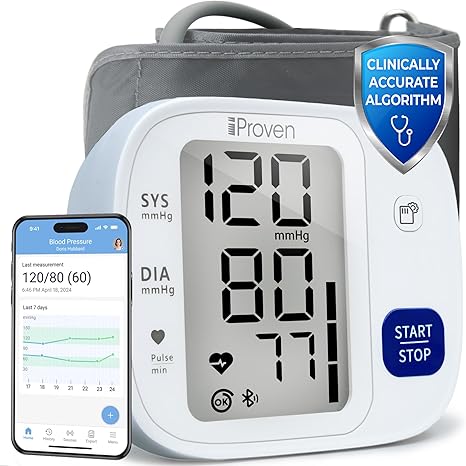
- Wrap the cuff around your bare upper arm, about an inch above your elbow. Snug but not tight—you should fit two fingers under the cuff.
- Press start. Stay still. Don’t talk. Don’t move your arm.
- Record the reading.
- Wait exactly 1 minute.
- Take a second reading using the same position and process.
Why two readings? The first reading is often higher because your arm muscles tense slightly when the cuff inflates. The second reading is usually more accurate. Average the two [8].
Let’s say your first reading is 134/86 and your second is 128/82. Add them: 262/168. Divide by two: 131/84. That’s your reading for this session.
Example: Maria’s doctor told her to start monitoring at home after she hit 138/88 at her annual checkup. She bought a monitor, took a reading after making dinner—146/92. Panicked, she checked again immediately. 151/94. The next morning, she followed the protocol: sat quietly for 5 minutes, took two readings one minute apart (128/81, 126/79), averaged them (127/80). Over seven days, her average came out to 129/81. Still slightly elevated, but not the 150s that had scared her. Context matters.
The schedule that works
You don’t need to check your blood pressure four times a day forever. You need a structured initial phase, then maintenance.
Initial 7-day baseline (when starting or adjusting medication):
Measure twice daily—morning and evening—for seven consecutive days. Take two readings each session, one minute apart. That’s 28 total readings. Average all of them for your baseline [9].
| Phase | When | How many | Duration |
|---|---|---|---|
| Initial baseline | Morning and evening (same times daily) | 2 readings per session, 1 minute apart | 7 days |
| Medication adjustment | Morning and evening | 2 readings per session | 3–7 days before follow-up |
| Maintenance | Morning or evening (same time weekly) | 2 readings, 1 minute apart | 1–2 times per week |
Morning: Within an hour of waking, before breakfast, before medication.
Evening: Before dinner or at least 2 hours after eating.
Pick times you can stick with. If you take your readings at 7 AM on Monday and 11 AM on Wednesday, you’re introducing unnecessary variability.
After the baseline: Drop to 1–2 sessions per week unless your clinician recommends otherwise. You’re looking for trends, not hunting for problems.
It depends on your situation. If you’re newly diagnosed and starting medication, your doctor might want more frequent monitoring for the first month. If you’re stable on treatment, once a week might be plenty. Ask.
Quick checklist
Copy this. Tape it near wherever you keep your monitor.
| Phase | Action | Why |
|---|---|---|
| Before | Empty bladder | Full bladder elevates readings 5–15 mmHg |
| Before | Sit quietly 5 minutes | Allows cardiovascular system to stabilize |
| Before | No caffeine, smoking, or exercise for 30 min | These temporarily elevate BP |
| During | Feet flat, back supported, arm at heart level | Incorrect posture adds 5–10 mmHg |
| During | Bare arm, cuff 1 inch above elbow | Clothing interferes with accuracy |
| During | Two readings, 1 minute apart | First reading often artificially high |
| After | Record both readings and time | Needed to calculate weekly average |
| After | Average the two readings | Reduces measurement error |
Common mistakes that wreck your data
Small errors compound. Here’s what actually happens when you skip the setup rules.
| Mistake | What it causes | Quick fix |
|---|---|---|
| Talking during measurement | +10–15 mmHg systolic | Stay silent until reading completes |
| Arm hanging at side or unsupported | +5–10 mmHg | Rest arm on table at heart level |
| Crossing legs | +2–8 mmHg systolic | Feet flat on floor |
| Back unsupported (perching on stool) | +5–10 mmHg | Use chair with backrest |
| Cuff over clothing | Variable, often +5–50 mmHg | Remove sleeve or take on bare arm |
| Taking one reading only | Higher variability, less reliable | Always take two, average them |
| Measuring right after waking (still in bed) | Often 10–20 mmHg lower | Sit upright for 5 minutes first |
The clothing one surprises people. A thin cotton shirt might add 5 mmHg. A thick sweater can add 50. Just roll up your sleeve or take it off.
How to average and interpret your log
You’re not looking at individual readings. You’re looking at the average across a week.
After seven days of twice-daily measurements (morning and evening, two readings per session), you’ll have 28 individual readings. Add all 28 systolic numbers together. Divide by 28. That’s your average systolic. Do the same for diastolic.
Example log:
- Day 1 AM: 128/81, 126/79 → Session average: 127/80
- Day 1 PM: 124/78, 122/76 → Session average: 123/77
- Day 2 AM: 132/84, 130/82 → Session average: 131/83
- (Continue for 7 days)
Add all 28 readings. Let’s say you get 3,528 for systolic and 2,212 for diastolic. Divide each by 28: 126/79 average.
What the numbers mean (per AHA guidelines) [10]:
- Normal: Less than 120/80
- Elevated: 120–129 systolic, less than 80 diastolic
- Stage 1 hypertension: 130–139 systolic or 80–89 diastolic
- Stage 2 hypertension: 140+ systolic or 90+ diastolic
Home readings run about 5 mmHg lower than office readings on average, so don’t panic if your home average is 132/84 while your doctor’s office hits 138/88. That gap is called white coat hypertension—anxiety in medical settings [11].
It depends whether you’re comparing apples to apples. If your home readings are consistently 15–20 points higher than your doctor’s office readings, something’s off with your technique or device.
When to contact a doctor
Track your numbers, but watch for these red flags:
Call your doctor if:
- Your systolic is consistently above 140 or diastolic above 90 across multiple days
- You see a sudden, sustained jump (e.g., your average goes from 128/80 to 148/94 over a few days)
- Your readings are more erratic than usual without explanation
Seek immediate care if you have:
- Blood pressure above 180/120 with symptoms (severe headache, chest pain, shortness of breath, vision changes, difficulty speaking)
- Blood pressure above 180/120 even without symptoms (call your doctor or nurse line immediately)
One high reading isn’t an emergency. A pattern of very high readings, or any severely elevated reading with symptoms, is.
The measurement rhythm that reduces anxiety
Here’s what actually helps: routine plus detachment.
Take your readings at the same times. Record them. Close the notebook (or app). Don’t analyze every single number. Don’t check “just one more time” because the first reading seemed high.
After your initial 7-day baseline, step back to weekly or twice-weekly monitoring unless your clinician advises otherwise. You’re gathering long-term data, not auditing your cardiovascular system every morning.
Some people find it helps to focus on what they can control. Nitric oxide production from specific foods and regular exercise both influence blood pressure more than obsessive monitoring. The readings are feedback, not a grade.
If you’re wondering when to check during the day, consistency beats timing. Pick a time that works, stick with it. For more detail on the physical technique, see our guide on how to take blood pressure at home.
The bottom line
Home blood pressure monitoring works when you follow a method: same times, correct posture, two readings per session, weekly averages. The device is simple. The discipline is harder.
You’re not hunting for a perfect number. You’re building a dataset that shows whether your treatment is working, whether lifestyle changes are helping, whether you need to have a conversation with your doctor.
Set up the routine. Follow the checklist. Record your numbers. Let the average tell the story.
Frequently Asked Questions
How often should I check my blood pressure at home?
Start with twice daily (morning and evening) for 7 days to establish a baseline. After that, 1–2 times per week is usually sufficient for stable monitoring. If you’re adjusting medication, your doctor may recommend more frequent checks for 3–7 days before follow-up appointments.
Can I use a wrist blood pressure monitor instead of an upper-arm cuff?
Upper-arm monitors are more accurate for most people. Wrist monitors can work if you have a very large upper arm that doesn’t fit standard cuffs, but they require precise positioning at heart level and are more sensitive to user error. If you must use a wrist monitor, follow the manufacturer’s positioning instructions exactly.
What if my two readings are very different?
A difference of 5–10 mmHg between readings is normal. If the difference is larger than 10–15 mmHg, take a third reading after another minute and average all three, or note the issue in your log and mention it to your doctor. Large variations can indicate arrhythmia, improper technique, or device malfunction.
Should I measure blood pressure in both arms?
Check both arms during your first few sessions. If there’s a consistent difference of more than 10 mmHg between arms, tell your clinician—it can indicate vascular issues. Once you’ve established which arm reads higher, use that arm for all future measurements for consistency.
My readings at home are much lower than at the doctor’s office. Which is correct?
Both are correct—they’re measuring different states. Home readings are typically 5–10 mmHg lower because you’re relaxed in a familiar environment. This is why home monitoring is valuable: it shows your blood pressure during normal daily life, not just during medical appointments. Share your home log with your doctor so they can see the complete picture.
Do I need to take my blood pressure at the exact same minute every day?
Within the same hour is fine. If you measure between 7:00–8:00 AM and 6:00–7:00 PM consistently, that’s adequate. The goal is to avoid comparing a 6 AM reading to an 11 PM reading, which would reflect natural circadian variation rather than meaningful changes.
References
- [1] Stergiou GS, et al. 2021 European Society of Hypertension practice guidelines for office and out-of-office blood pressure measurement. Journal of Hypertension. 2021;39(7):1293-1302. https://journals.lww.com/jhypertension/Abstract/2021/07000/2021_European_Society_of_Hypertension_practice.3.aspx
- [2] Kario K. Morning surge in blood pressure and cardiovascular risk: evidence and perspectives. Hypertension. 2010;56(5):765-773. https://www.ahajournals.org/doi/10.1161/HYPERTENSIONAHA.110.157149
- [3] American Heart Association. Monitoring Your Blood Pressure at Home. Updated 2023. https://www.heart.org/en/health-topics/high-blood-pressure/understanding-blood-pressure-readings/monitoring-your-blood-pressure-at-home
- [4] Bonso E, et al. Accuracy of a single rigid conical cuff with standard-size bladder coupled to an automatic oscillometric device over a wide range of arm circumferences. Hypertension Research. 2010;33(11):1186-1191. https://www.nature.com/articles/hr2010109
- [5] Netea RT, et al. Influence of body and arm position on blood pressure readings: an overview. Journal of Hypertension. 2003;21(2):237-241. https://journals.lww.com/jhypertension/Abstract/2003/02000/Influence_of_body_and_arm_position_on_blood.3.aspx
- [6] Ringrose JS, et al. Validation of the A&D UA-651BLE automated upper arm blood pressure monitor. Journal of Clinical Hypertension. 2018;20(4):725-728. https://onlinelibrary.wiley.com/doi/10.1111/jch.13246
- [7] Fagard RH, Cornelissen VA. Effect of a full bladder on blood pressure. Nephrology Dialysis Transplantation. 2007;22(12):3669. https://academic.oup.com/ndt/article/22/12/3669/1866281
- [8] Imai Y, et al. The Japanese Society of Hypertension Guidelines for Self-monitoring of Blood Pressure at Home (Second Edition). Hypertension Research. 2012;35(8):777-795. https://www.nature.com/articles/hr201254
- [9] Parati G, et al. European Society of Hypertension practice guidelines for home blood pressure monitoring. Journal of Human Hypertension. 2010;24(12):779-785. https://www.nature.com/articles/jhh2010101
- [10] Whelton PK, et al. 2017 ACC/AHA/AAPA/ABC/ACPM/AGS/APhA/ASH/ASPC/NMA/PCNA Guideline for the Prevention, Detection, Evaluation, and Management of High Blood Pressure in Adults. Journal of the American College of Cardiology. 2018;71(19):e127-e248. https://www.jacc.org/doi/10.1016/j.jacc.2017.11.006
- [11] Franklin SS, et al. White-coat hypertension: new insights from recent studies. Hypertension. 2013;62(6):982-987. https://www.ahajournals.org/doi/10.1161/HYPERTENSIONAHA.113.01275