
If your blood pressure won’t come down no matter how many medications you add, there’s a common cause your care team may not have checked yet: you might not be breathing properly while you sleep. Obstructive sleep apnea — where the airway repeatedly collapses during sleep — is one of the most common reasons blood pressure resists treatment. And it’s often missed for years, because the person who has it is asleep when it happens.
Here’s the reassuring part, and the reason this is worth your attention: sleep apnea is testable, and treating it can help your numbers. This article about sleep apnea and high blood pressure walks through why the two are linked, the signs worth taking seriously, what the evidence actually shows about treatment, and how to get evaluated.
Why sleep apnea pushes blood pressure up
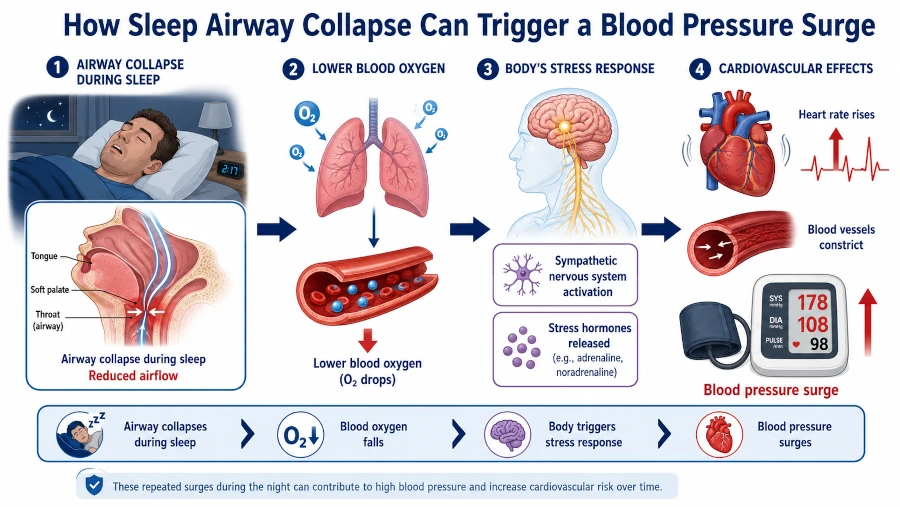
During obstructive sleep apnea, the muscles around your throat relax and the airway narrows or closes. Breathing pauses. Oxygen drops. Your brain briefly rouses you — just enough to reopen the airway, usually too briefly for you to remember it.
Each of those events sets off a jolt of “fight or flight” nervous-system activity: a surge of adrenaline that tightens blood vessels and drives pressure up. Repeated dozens of times an hour in more severe cases, this keeps the nervous system switched on overnight, blunts the normal 10–20% dip in blood pressure that’s supposed to happen while you sleep, and spills over into daytime hypertension that’s hard to medicate [American Heart Association/ACC scientific statement (Somers), 2008]. Standard blood pressure drugs aren’t designed to counter a repetitive adrenaline surge happening while you’re unconscious — part of why apnea-driven hypertension can look “resistant.”
How strong is the link, really?
Stronger than most people expect. In a clinic study of adults whose blood pressure stayed high despite three or more medications, 83% were found to have obstructive sleep apnea [Logan, 2001]. A later randomized trial reported that more than 70% of people with resistant hypertension have OSA [HIPARCO trial (Martínez-García), 2013]. Put simply: if your hypertension won’t respond to treatment, apnea is more likely than not — yet it’s frequently never screened for.
This matters even if you feel fine. Not everyone with sleep apnea is sleepy during the day; some people adapt to fragmented sleep and never connect it to their blood pressure. The cardiovascular strain accumulates regardless.
Signs worth taking seriously
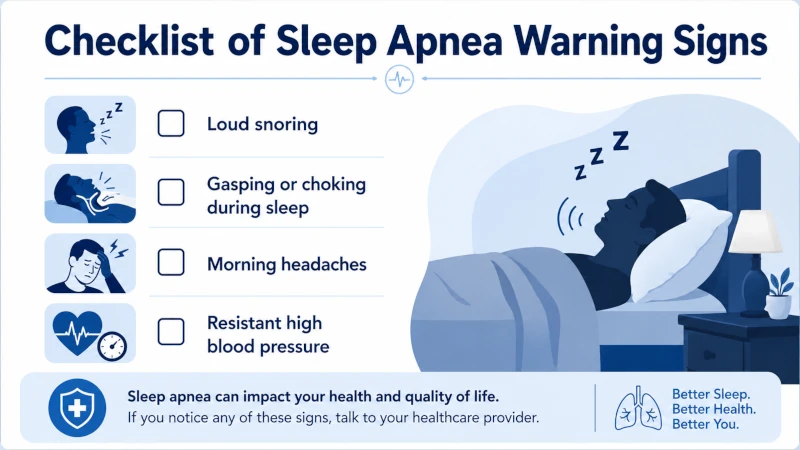
You can’t diagnose sleep apnea from symptoms alone — that takes a sleep test — but certain signs should prompt you to ask for one.
| Sign | Why it matters | What to do next |
| Loud, chronic snoring with gasping, choking, or witnessed pauses | Points to airway obstruction; a bed partner often notices the pauses you can’t | Ask about a sleep study; track morning and evening BP |
| Morning headaches | Can follow overnight oxygen dips and disrupted sleep | Mention it specifically; log morning readings |
| Waking unrefreshed after 7–8 hours in bed | Fragmented sleep prevents restorative stages and the overnight BP dip | Note sleep quality alongside your readings |
| Daytime sleepiness or nodding off during tasks | Signals significant sleep disruption; a safety issue if driving | Avoid drowsy driving; seek prompt evaluation |
| Blood pressure that won’t respond to 2+ medications | Apnea-driven surges can override medication | Request sleep apnea screening in a resistant-hypertension workup |
Who’s most at risk
Excess weight is the biggest single risk factor, especially weight carried around the neck and throat — but plenty of lean people have sleep apnea too, because airway anatomy matters. A recessed or small jaw, a large tongue, a narrow throat, nasal congestion, and a larger neck circumference (often cited around 16–17 inches or more, though thresholds vary) all raise risk. So do older age, being male (though risk in women climbs after menopause), and alcohol, which relaxes the throat muscles and worsens airway collapse. Sleeping on your back tends to make apnea worse than sleeping on your side.
Can treating sleep apnea actually lower your blood pressure?
Yes — modestly on average, and more if you use treatment consistently. It’s worth being precise here, because this is where a lot of health content overstates things.
The strongest test is the HIPARCO trial, which randomly assigned 194 people with resistant hypertension and OSA to use CPAP (continuous positive airway pressure, a machine that keeps the airway open with a steady stream of air) or not, for 12 weeks. On average, the CPAP group’s 24-hour blood pressure fell about 3 mmHg more than the control group’s, and their nighttime blood-pressure pattern improved — more of them regained the normal overnight dip [HIPARCO trial (Martínez-García), 2013].
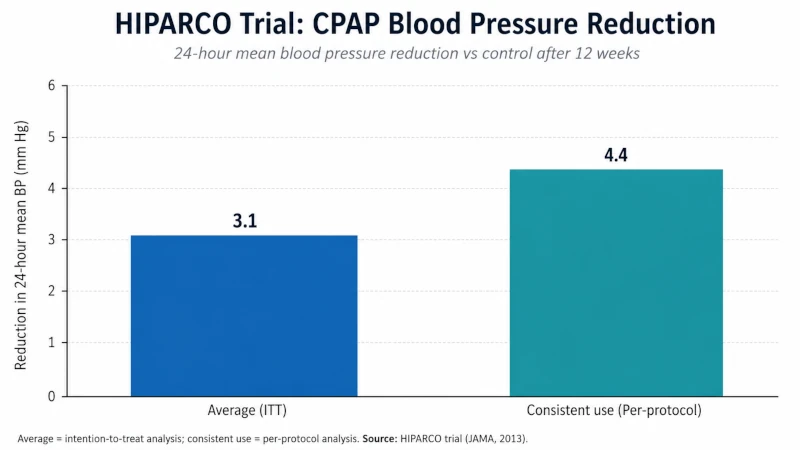
That sounds small, and honestly, across the whole group the systolic number on its own didn’t reach statistical significance. But two things stand out. First, the benefit was larger in people who actually wore the mask: those using it at least four hours a night saw roughly 5 mmHg off their daytime systolic reading and about 7 mmHg off their nighttime systolic reading.
Second, the gains concentrated where they may matter most for heart and stroke risk — overnight and 24-hour pressure, and the restored nighttime dip. The more hours people used CPAP, the more their pressure improved. So CPAP isn’t a substitute for blood pressure medication for most people, but for the right person it treats a genuine underlying driver rather than masking it.
What to do: getting evaluated and treated
Step 1: Track the pattern at home
For about a week, check your blood pressure twice daily — in the evening (30 minutes before bed) and in the morning (within an hour of waking, before medication). Note sleep quality, morning symptoms like headache or dry mouth, and any snoring or breathing pauses your partner observes. If your morning readings run consistently 15–20 mmHg higher than your evening readings, that’s a concrete pattern to bring to your clinician. Our guide to home blood pressure monitoring walks through accurate technique, and the morning blood pressure surge explains why that gap happens.
Step 2: Ask for a sleep evaluation
Many clinicians don’t screen for sleep apnea routinely, even in resistant hypertension, so it helps to raise it directly. You might say: “My morning readings run higher than my evening ones, and I [snore loudly / wake with headaches / have a partner who’s seen me stop breathing]. Could sleep apnea be contributing to my blood pressure, and can we arrange a sleep study?”
Step 3: Home test vs. in-lab study
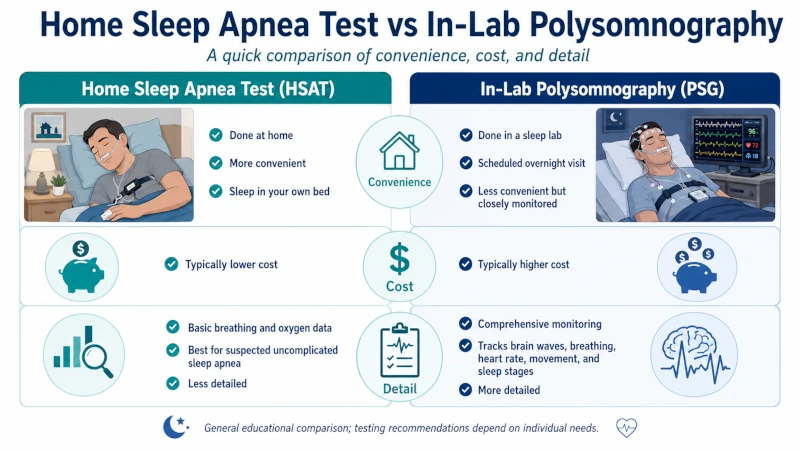
A home sleep apnea test is a small device you wear overnight that measures breathing, oxygen, and heart rate — convenient, and often covered by insurance when moderate-to-severe OSA is suspected. An in-lab study (polysomnography) is more comprehensive and used for complex cases or when a home test is inconclusive. Either way, you need objective testing; snoring and headaches are clues, not a diagnosis.
Step 4: Treatment options
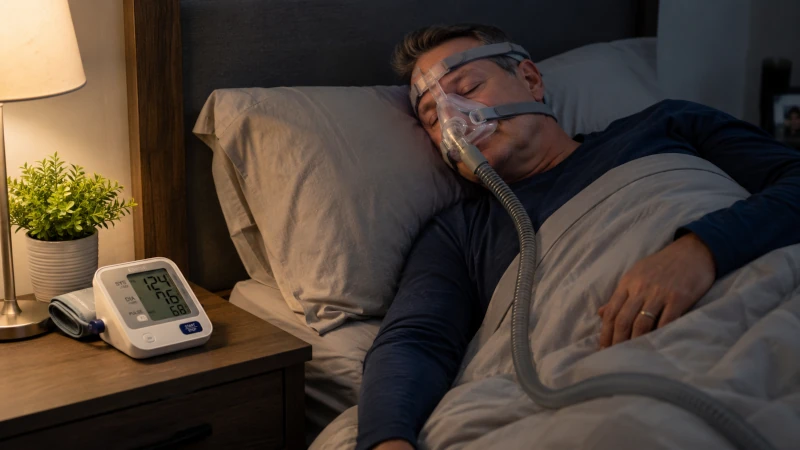
CPAP is the first-line treatment for moderate-to-severe OSA and the most effective at keeping the airway open [AASM/AADSM clinical practice guideline, 2015]. Early discomfort is common and usually fades within a few weeks; trying different mask styles (nasal, full-face, nasal pillows) and adding a humidifier helps most people adapt. It isn’t the only option:
- Oral appliances — custom mouthpieces that reposition the jaw — are a recommended alternative for people who can’t tolerate CPAP or prefer something else, and adherence is often better, though CPAP tends to control moderate-to-severe disease more completely [AASM/AADSM clinical practice guideline, 2015].
- Positional therapy (staying off your back) can help milder, position-dependent apnea.
- Weight loss, for those carrying excess weight, reduces apnea severity roughly in proportion to how much is lost — in one meta-analysis, about a 20% reduction in BMI corresponded to a roughly 57% drop in apnea events [weight-loss meta-analysis, 2024]. It’s worth pursuing alongside treatment, not instead of it, since untreated apnea keeps straining your cardiovascular system in the meantime. Our exercise for blood pressure guide can support both goals.
- Surgery is generally reserved for severe cases or specific anatomical problems.
Step 5: Recheck and adjust (with your prescriber)
Keep tracking morning and evening blood pressure once you start treatment. Improvements in the HIPARCO trial were measured over 12 weeks, so give consistent use a few months before judging the effect. If your numbers improve, your clinician may be able to reduce a medication — but never change doses on your own. If your pressure hasn’t budged after a couple of months of consistent CPAP use, follow up; you may need a pressure adjustment, added lifestyle changes, or further cardiovascular evaluation.
Red flags: when to get help sooner
Some situations shouldn’t wait for a routine appointment.
- Seek urgent care for a blood pressure reading at or above 180/120 mmHg — call your doctor or nurse line right away if there are no symptoms, and treat it as an emergency (call 911 in the US) if it comes with severe headache, chest pain, shortness of breath, vision changes, or trouble speaking.
- Don’t drive if you’re battling heavy daytime sleepiness or nodding off; get evaluated promptly.
- Witnessed breathing pauses, gasping, or choking during sleep, or apnea alongside heart or lung disease, warrant a prompt evaluation rather than a wait-and-see approach.
Special situations and medication safety
Don’t stop or adjust blood pressure medication on your own. Treating apnea sometimes allows a supervised reduction, but tapering is your prescriber’s call.
Alcohol and sedatives relax the throat and worsen apnea. If you drink in the evenings, trialing a few alcohol-free weeks — and tracking your readings — is a reasonable experiment, and some people notice a real difference.
Pregnancy: new or worsening loud snoring together with rising blood pressure deserves prompt attention, because sleep-disordered breathing in pregnancy is associated with blood-pressure complications. Tell your obstetric clinician rather than waiting.
Persistent nasal congestion — from allergies, a deviated septum, or chronic sinusitis — can worsen apnea by forcing mouth breathing. An ENT evaluation may help if congestion is ongoing.
| Medical disclaimer This article about sleep apnea and high blood pressure is for educational purposes only and is not medical advice. If you have high blood pressure, heart disease, kidney disease, are pregnant, or take prescription medications, talk with a qualified clinician before changing treatment, diet, exercise, or supplements. Do not stop or adjust blood pressure medication without your prescriber. Sleep apnea requires objective testing to diagnose; this page cannot diagnose it. |
Frequently Asked Questions
Can I diagnose sleep apnea on my own without a sleep study?
No. Snoring, morning headaches, and a high morning-to-evening blood-pressure gap are useful clues, but confirming apnea and its severity requires objective testing. A home sleep apnea test is accurate and convenient for most people with suspected OSA.
How much will treating sleep apnea lower my blood pressure?
On average, modestly. In the strongest trial, consistent CPAP use lowered 24-hour and nighttime blood pressure by a few mmHg and improved the overnight pattern, with larger effects in people who used the machine at least four hours a night [HIPARCO trial (Martínez-García), 2013]. Some people see bigger drops than others. Either way, you’re addressing an underlying driver and reducing cardiovascular strain.
What if I can’t tolerate CPAP?
Don’t give up after one rough night. Try different mask styles, use a humidifier for dryness, and work with your equipment provider on settings; most people adapt within a few weeks. If you truly can’t tolerate it after a genuine effort, ask about an oral appliance, which is a recommended alternative [AASM/AADSM clinical practice guideline, 2015].
Will treating apnea let me stop my blood pressure medication?
Sometimes it allows a lower dose or fewer drugs; often it doesn’t eliminate the need entirely. Any change should be made with your prescriber — don’t taper on your own.
Does sleep apnea come back if I stop treatment?
CPAP controls apnea but doesn’t cure it. If you stop using it, the apnea and its blood-pressure effects return. Weight loss can reduce severity long-term, but most people need ongoing treatment to keep the benefit.
Is it worth treating mild sleep apnea?
It depends. If your blood pressure is resistant or you have symptoms affecting your quality of life or driving safety, yes. If your pressure is well controlled and you feel fine, the decision is more individual — weigh it with your clinician based on your overall cardiovascular risk.
References
- American Heart Association / American College of Cardiology Foundation (Somers VK, et al.). Sleep Apnea and Cardiovascular Disease: A Scientific Statement. Circulation. 2008;118(10):1080–1111. PMID 18725495. View source
- Logan AG, et al. High prevalence of unrecognized sleep apnoea in drug-resistant hypertension. Journal of Hypertension. 2001;19(12):2271–2277. PMID 11725173. View source
- Martínez-García MA, et al. (Spanish Sleep Network). Effect of CPAP on Blood Pressure in Patients With Obstructive Sleep Apnea and Resistant Hypertension: The HIPARCO Randomized Clinical Trial. JAMA. 2013;310(22):2407–2415. PMID 24327037. View source
- Ramar K, et al. Clinical Practice Guideline for the Treatment of Obstructive Sleep Apnea and Snoring With Oral Appliance Therapy: An Update for 2015 (AASM/AADSM). Journal of Clinical Sleep Medicine. 2015;11(7):773–827. PMID 26094920. View source
- Weight reduction and the impact on apnea-hypopnea index: A systematic meta-analysis. Sleep Medicine. 2024. PMC11330732. View source
