
Yohimbe has one reasonably well-studied use, one that works better on a whiteboard than in a person, and a safety record serious enough that several countries have pulled it from shelves. The best-supported use is erectile dysfunction, where a set of older randomized trials did beat placebo.
The fat-burning claims that dominate the supplement aisle rest on four small human trials that contradict each other. Sorting the real yohimbe benefits from the marketing means keeping those two stories apart — and knowing that in the United States, what the label says is often not what the capsule contains.
What Yohimbe Actually Is — and Why “Yohimbe” and “Yohimbine” Are Not the Same Word
Yohimbe is the bark of Pausinystalia yohimbe, an evergreen tree native to central and western Africa. The bark has a long traditional use in Africa as an aphrodisiac and sexual performance enhancer, and as a mild hallucinogen [NCCIH, 2025]. Researchers have identified about 55 alkaloids in it. Yohimbine is just one of them [US Department of Defense OPSS, 2025].
That distinction runs through everything else on this page. Nearly all the human research used purified yohimbine, usually as yohimbine hydrochloride — and the synthetic version is what most US products now contain. Whole-bark extract carries other active compounds, and is generally regarded as more potent and more side-effect-prone than the isolated alkaloid [NIH LiverTox, 2020]. So a trial result for yohimbine HCl does not automatically transfer to a bark capsule.
The US regulatory position surprises people. Yohimbine, yohimbine hydrochloride, and yohimbinum are named by the FDA in its rule on over-the-counter aphrodisiac products, which concludes that no ingredient offered OTC for that purpose can be generally recognized as safe and effective — a rule finalized in 1989 [21 CFR 310.528; FDA rulemaking history, 1989].
It remains illegal in the US to market an over-the-counter yohimbine product as an erectile dysfunction treatment without FDA approval [NCCIH, 2025]. Yohimbine HCl was once available here as an FDA-approved prescription drug for certain kinds of ED; it is rarely used now because better-tolerated drugs exist [OPSS, 2025]. Meanwhile it is sold freely as a dietary supplement, and it is banned outright in Canada, Australia, the Netherlands, and the United Kingdom [OPSS, 2025].
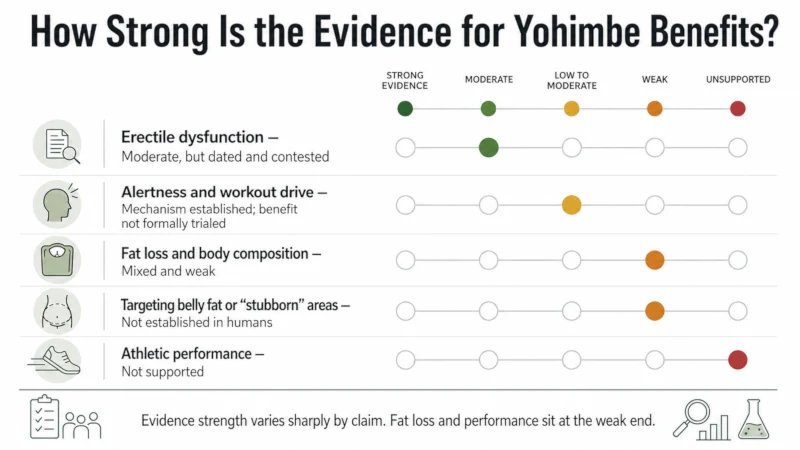
How the Claimed Yohimbe Benefits Grade Out
| Claimed benefit | What the evidence actually looks like | Grade |
| Erectile dysfunction | A 1998 meta-analysis of seven randomized placebo-controlled trials in 419 men favored yohimbine. Independent appraisers later questioned whether those trials should have been pooled at all. | Moderate but dated and contested |
| Fat loss / body composition | Four small human trials. Two positive, two null. The lipolysis mechanism is confirmed only in short lab studies, not in body-composition outcomes. | Mixed and weak |
| Alertness and workout drive | Yohimbine reliably raises noradrenaline. This is the most consistent thing it does — and it is the same effect that produces the side effects. | Mechanistically reliable; benefit not formally trialed |
| Athletic performance | The one training trial that measured it found no change in strength, sprint, jump, or agility. Federal reviewers call the performance research limited, small, and inconsistent. | Not supported |
| Targeting belly fat or “stubborn” areas specifically | The one trial that directly measured fat distribution — by CT scan and waist-to-hip ratio — found no change. | Not established in humans |
Erectile Dysfunction: The Best-Studied Use, With Real Caveats
This is where yohimbe has its strongest case, and it is still not a strong case. Ernst and Pittler pooled seven randomized, double-blind, placebo-controlled trials covering 419 men aged 18 to 70 and reported an odds ratio of 3.85 in favor of yohimbine (95% CI 2.22 to 6.67). The trial doses were 5 to 10 mg three times daily, or yohimbine HCl at 5, 5.4, or 6 mg taken three, four, or eight times a day, over two to ten weeks. Their conclusion was that yohimbine beats placebo and is relatively safe [Ernst & Pittler, 1998].
Here is the part supplement pages leave out. When the UK Centre for Reviews and Dissemination appraised that same meta-analysis for its evidence database, it noted that response rates across the seven trials ranged from 34% to 73% — and concluded that because of that variability, statistical pooling was not appropriate [CRD critical appraisal of Ernst & Pittler, 1998]. The headline odds ratio, in other words, is contested by the reviewers who catalogued it. The likely explanation for the spread is that the trials mixed men with organic, non-organic, and psychogenic ED, which respond very differently.
NIH’s LiverTox database describes the clinical picture more soberly: in trials, synthetic yohimbine has had a consistent but limited effect on erectile function, and its effect on sexual desire is less well defined [NIH LiverTox, 2020]. Side effects were not trivial either — in one placebo-controlled trial of 86 men, 30% of the yohimbine group reported side effects versus 10% on placebo [Vogt et al. 1997, via NIH LiverTox].
In current US practice, yohimbine is not part of the standard pathway. The American Urological Association’s erectile dysfunction guideline sets out treatment options that include PDE5 inhibitors, vacuum erection devices, intraurethral and intracavernosal alprostadil, and penile prosthesis; yohimbine appears in none of its treatment recommendations [American Urological Association ED Guideline, 2018].
One thing genuinely worth acting on: the same guideline advises that men with ED be counseled that it is a risk marker for underlying cardiovascular disease [American Urological Association ED Guideline, 2018]. If erections have changed, that is a reason to book a primary care appointment and get blood pressure, glucose, and lipids checked — not a reason to order a bark extract. Treating the symptom with a supplement while ignoring what it may be signaling is the expensive mistake here.
Fat Loss: A Mechanism That Performs Better in Theory Than in People
How the alpha-2 mechanism is supposed to work
Fat cells carry alpha-2 adrenergic receptors that act as a brake on lipolysis, the release of stored fatty acids. Yohimbine blocks those receptors, which in principle releases the brake. Short lab studies do show something real happening: oral yohimbine at 0.2 mg/kg raised plasma glycerol and non-esterified fatty acids in fasting healthy men and lifted noradrenaline by 40 to 50%, without significantly moving heart rate or blood pressure over the test period. The effect was reinforced by exercise, completely suppressed after a meal, and partly blocked by propranolol [Galitzky et al., 1988].
The same research group then complicated their own story. In women, they found the lipid-mobilizing effect was mainly attributable to the rise in synaptic noradrenaline acting on beta-receptors, with blockade of the fat cell’s own alpha-2 receptors amounting to only a minor component under standard 12-hour fasting. They also found the effect was not enhanced in women with obesity compared with those without [Berlan et al., 1991]. That second finding cuts directly against the marketing logic, which assumes people carrying more fat have more to gain.
The trials that found an effect
The study every seller quotes: 20 top-level male soccer players received either 20 mg of yohimbine daily in two doses or a cellulose placebo for 21 days alongside their normal training. Body fat fell from 9.3% (±1.1) to 7.1% (±2.2) in the yohimbine group. Body mass and muscle mass did not change, and no participant reported side effects [Ostojic, 2006]. It is a genuine positive result. It is also 20 elite athletes at 9% body fat for three weeks, which is about as far from the average reader as a study can get.
The second positive trial ran 20 women with obesity through a three-week 1,000 kcal/day diet, then randomized them to 5 mg of yohimbine four times daily or placebo for three more weeks on the same diet. The yohimbine group lost 3.55 kg versus 2.21 kg. Notably, the researchers found no significant effect on their lipolysis marker — so the extra weight came off without the mechanism the supplement is sold on showing up in the blood work [Kucio et al., 1991].
The trials that found nothing
The longest and largest trial gave 47 men, average age 42, an escalating dose peaking at 43 mg/day or placebo for six months. Thirty-three finished. Yohimbine had no effect on body weight, BMI, total cholesterol, HDL, body fat, or fat distribution measured by both waist-to-hip ratio and CT scan [Sax, 1991]. This is the trial that most directly tests the “targets stubborn fat” claim, and it is the trial that found nothing.
A French trial put 19 volunteers with obesity on 1,000 kcal/day for eight weeks, with 10 receiving 18 mg of yohimbine daily and 9 receiving placebo. No difference in body weight, blood pressure lying or standing, heart rate, or any lipid measure [Berlin et al., 1986].
Why the results disagree
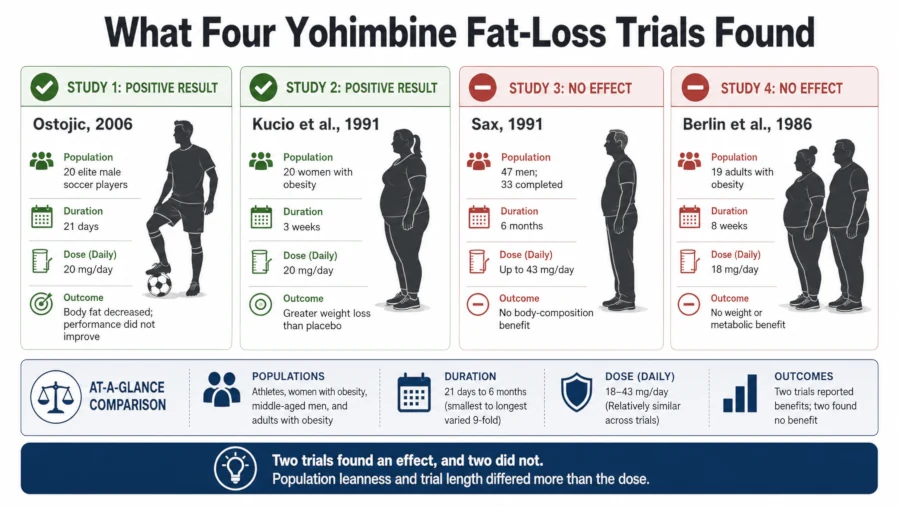
Four variables plausibly separate the positive trials from the null ones, and none of them has been tested head to head:
- Leanness. The positive body-composition trial used athletes at 9% body fat. The two null trials used people with obesity — and the mechanistic work found no enhanced effect in that group either.
- Fed versus fasted. The lipolytic effect was completely suppressed after a meal. Trials that did not control meal timing may have dosed straight into that suppression.
- Exercise. The acute effect was reinforced during physical exercise, and the one clearly positive body-composition trial ran in athletes training daily.
- Statistical power. Sample sizes were 19, 20, 20, and 47. Trials that small cannot reliably detect a modest effect, which means the null results are weak evidence of absence, just as the positive ones are weak evidence of presence.
A 2024 review of yohimbine’s therapeutic potential reached the same place: promising in parts, with real toxicological concerns at higher doses, and short of the evidence needed for firm conclusions [Nowacka et al., 2024]. Federal reviewers put it more bluntly — there is not enough evidence to support yohimbe or yohimbine supplements for weight loss or athletic performance [OPSS, 2025].
Energy and Workout Drive
The most dependable thing yohimbine does is raise noradrenaline — measured at 40 to 50% above baseline after an oral dose [Galitzky et al., 1988]. That is a real pharmacological effect, and it explains the alertness and drive people report.
It also explains the problems. The typical side effects of alpha-2 blockade are insomnia, anxiety, palpitations, chest pain, sweating, blurred vision, and raised blood pressure [NIH LiverTox, 2020]. The stimulation and the side effects are one phenomenon, not two, so you cannot dose up the first without the second. Tolerance can also develop with continued use [NIH LiverTox, 2020], which tends to push people toward higher doses — the wrong direction with this compound. If steady energy is the actual goal, the supplements with real evidence behind them for fatigue are a better starting point, and most of them work by correcting a measurable deficiency rather than by revving your sympathetic nervous system.
Stacking is where this gets dangerous. Combining yohimbine with caffeine, rauwolscine, ephedrine, or synephrine raises heart rate and cardiovascular risk [OPSS, 2025]. Many pre-workout and fat-burner formulas contain several of these at once.
What Is Actually in the Bottle
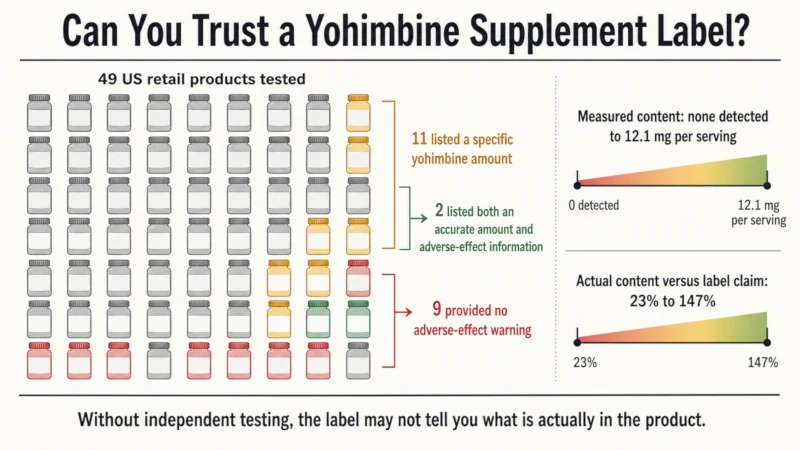
A 2016 analysis bought 49 yohimbe or yohimbine supplement brands from seven major US retailers and measured what was in them. Yohimbine per recommended serving ranged from none detected to 12.1 mg. Only 11 of the 49 brands stated a specific yohimbine quantity on the label — and among those, actual content ran from 23% to 147% of what was claimed. Nine labels carried no adverse-effect information at all. Just two of the 49 gave both an accurate quantity and adverse-effect information [Cohen et al., 2016].
Nineteen of the products contained no rauwolscine or corynanthine — the other alkaloids you would expect alongside yohimbine in real bark — which suggests the yohimbine was synthetic or came from a heavily processed extract [Cohen et al., 2016]. Without lab testing, there is no way to know what is in a given product [OPSS, 2025]. If you are going to buy anyway, a third-party certification seal — NSF Certified for Sport, Informed Sport, BSCG Certified Drug Free, or USP — is the only practical check available to a consumer [OPSS, 2025].
Yohimbe Bark vs. Yohimbine HCl
| Yohimbe bark extract | Yohimbine HCl | |
| Yohimbine content | Frequently unstated; measured content across US retail products has ranged from none detected to 12.1 mg per serving | Stated in milligrams, though label accuracy still varied in testing |
| Other alkaloids | Around 55 alkaloids identified in the bark; most are poorly studied | Isolated compound; many US products test as synthetic in origin |
| Dose control | Difficult to titrate | Easier to titrate |
| Research base | Very few trials used whole-bark extract | Almost all human trials used purified yohimbine |
| US status | Sold as a dietary supplement; cannot legally be marketed OTC as an ED treatment without FDA approval | Sold as a dietary supplement; was formerly an FDA-approved prescription drug, now rarely used |
Safety: Side Effects, Serious Risks, and Overdose
Yohimbine has been associated with cardiac arrhythmia, blood pressure problems, heart attacks, and seizures, and yohimbe supplements have been restricted or banned in many countries because of inaccurate labeling and the potential for serious side effects [NCCIH, 2025]. This is the section to read slowly.
Common side effects
Usually mild and transient, and typical of alpha-2 blockade: insomnia, anxiety, palpitations, chest pain, sweating, blurred vision, and raised blood pressure [NIH LiverTox, 2020]. Federal reviewers add tachycardia, flushing, nausea, headache, and restlessness [OPSS, 2025].
Serious risks and overdose
Overdose can cause low blood pressure, rapid heart rate, seizures, paralysis, and coma, and deaths from overdose have been described [NIH LiverTox, 2020]. Two published cases give a sense of the range: a 37-year-old bodybuilder developed fatigue, vomiting, seizures, and coma within two hours of taking 5 grams, and recovered; a 42-year-old man developed a rash, fever, eosinophilia, and progressive kidney failure a day after taking three tablets, and needed long-term corticosteroids [case reports catalogued in NIH LiverTox, 2020].
Poison-center data show this is not purely theoretical. A review of California Poison Control System cases from 2000 to 2006 identified 238 symptomatic adult exposures, with reported cases rising from 1.8 to 8.0 per 10,000 adult exposures over that period; 98.7% involved non-prescription herbal products [Kearney et al., 2010]. People calling about yohimbe were generally more likely to need medical care than other callers [NCCIH, 2025].
One reassurance, since supplement pages often lump every organ together: the liver does not appear to be the problem. NIH’s drug-induced liver injury database assigns yohimbine a likelihood score of E — unlikely to cause clinically apparent liver injury — and notes it has not been linked to liver enzyme elevations even though it turns up in weight-loss and muscle-building blends [NIH LiverTox, 2020]. The organs to worry about are the heart and the brain.
Who should not take yohimbe
Skip it entirely if any of these apply to you:
- You have anxiety, depression, high blood pressure, low blood pressure, or PTSD [OPSS, 2025).
- You have heart disease, an arrhythmia, or any history of cardiac events — given the documented association with arrhythmia, blood pressure problems, and heart attacks [NCCIH, 2025).
- You have a history of seizures [NCCIH, 2025; NIH LiverTox, 2020).
- You are pregnant or breastfeeding. Oral yohimbe might be unsafe in both [NCCIH, 2025).
- You are under 18. There is no safety data in children or teenagers, which is reason enough.
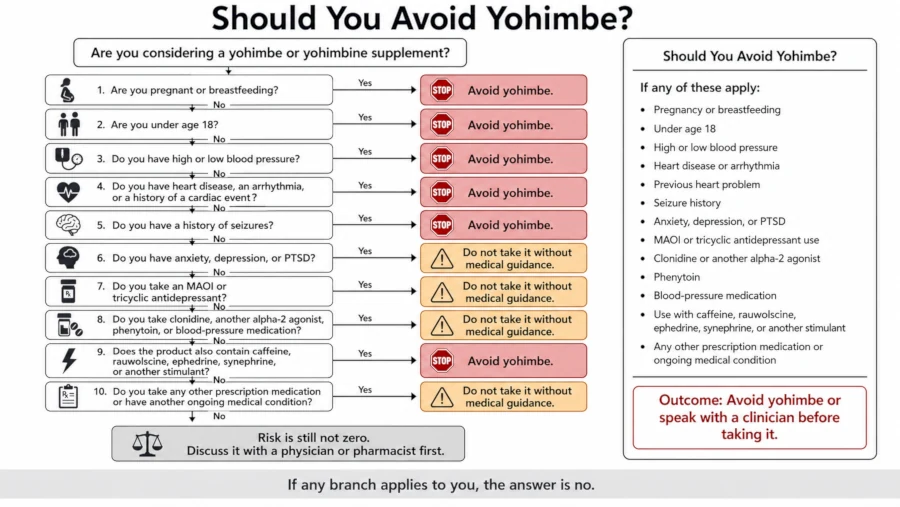
If you have any other ongoing medical condition, or take any prescription medicine at all, talk to your clinician before using yohimbe or any herbal product [NCCIH, 2025]. That is not boilerplate here — the interaction list below is short but severe.
Drug interactions
- MAOI and tricyclic antidepressants. Do not combine — yohimbe interacts with both classes [NCCIH, 2025).
- Clonidine and other alpha-2 agonists. Yohimbine is the pharmacological opposite of these drugs. A published case describes intracranial hemorrhage after a single yohimbine dose in a long-term clonidine user [case report catalogued by OPSS, 2025).
- Phenytoin. Loss of the anti-epileptic effect of phenytoin was among the adverse events recorded in the pooled ED trials [Ernst & Pittler, 1998).
- Blood pressure medication. Yohimbine pushes blood pressure up, working against antihypertensives. If you are managing blood pressure, review anything you take with your prescriber — including the supplements marketed for blood pressure support.
- Other stimulants. Caffeine, rauwolscine, ephedrine, and synephrine all stack cardiovascular risk with yohimbine [OPSS, 2025).
Overdose, or use alongside other medications, can cause brain damage, panic attacks, or death [OPSS, 2025]. Tell your prescriber and your pharmacist about every supplement you take — pharmacists will run an interaction check for free.
When to get medical help right away
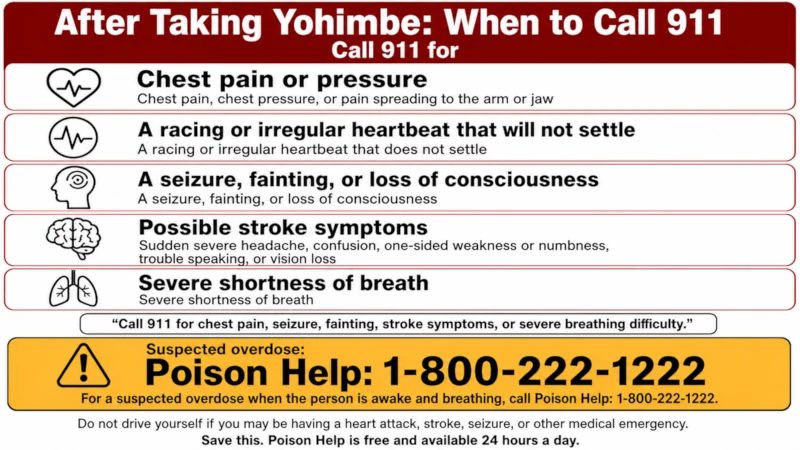
Call 911 or go to the nearest emergency room if you develop any of these after taking yohimbe:
- Chest pain, chest pressure, or pain spreading to the arm or jaw
- A racing or irregular heartbeat that will not settle
- A seizure, fainting, or loss of consciousness
- Sudden severe headache, confusion, one-sided weakness or numbness, trouble speaking, or vision loss
- Severe shortness of breath
For a suspected overdose in someone who is awake and breathing, call Poison Help at 1-800-222-1222 — it is free, staffed 24 hours, and they will tell you whether you need the ER.
Stop taking it and contact your primary care clinician within a few days for persistent palpitations, new or worsening anxiety or panic, insomnia, tremor, or dizziness. And see a clinician rather than self-treating if the reason you are here is erectile dysfunction, unexplained fatigue, or weight you cannot shift — each of those can have a treatable cause that a supplement will only mask.
Doses Used in the Research
There is no established safe or effective dose for yohimbe bark. The figures below are what researchers used, reported so you can see the context — not a recommendation to dose yourself.
| Study | Population | Dose | Duration | Outcome |
| Ostojic, 2006 | 20 elite male soccer players | 20 mg/day, 2 divided doses | 21 days | Body fat 9.3% → 7.1%; no change in body mass, muscle mass, or any performance measure |
| Kucio et al., 1991 | 20 women with obesity, on 1,000 kcal/day | 5 mg × 4/day (20 mg/day) | 3 weeks | 3.55 kg lost vs 2.21 kg on placebo; no significant change in the lipolysis marker |
| Berlin et al., 1986 | 19 volunteers with obesity, on 1,000 kcal/day | 18 mg/day | 8 weeks | No difference in weight, blood pressure, heart rate, or lipids |
| Sax, 1991 | 47 men, mean age 42 (33 completed) | Escalating to 43 mg/day | 6 months | No change in any body-composition or lipid measure |
| 7 ED trials pooled by Ernst & Pittler, 1998 | 419 men aged 18–70 | 5–10 mg 3×/day, or HCl 5–6 mg 3–8×/day | 2–10 weeks | Pooled OR 3.85 favoring yohimbine; the appropriateness of pooling was later disputed |
For context, NIH lists the usual dose of purified yohimbine as 5 to 10 mg three times a day [NIH LiverTox, 2020]. Given that measured product content has ranged from zero to 12.1 mg per serving, a “standard dose” of a bark capsule is not a meaningful concept.
On timing: the case for taking it fasted rests on a single acute study in which the lipid-mobilizing effect was suppressed by a meal and reinforced by exercise [Galitzky et al., 1988]. That is a plausible reason to dose before rather than after breakfast, but it was a blood-marker finding over a few hours, not a demonstration of better body-composition results. If you already practice short-term fasting, the schedules happen to line up — that convenience is not itself evidence. Because of the insomnia risk, later-in-the-day dosing is the clearer thing to avoid.
Realistic Expectations
Set against what the research actually shows, a fair summary is narrow. Yohimbine reliably makes you feel more stimulated. It may add a modest amount to fat loss in lean, already-training people who take it fasted, and it may help some men with erectile dysfunction — with a caveat that the reviewers who catalogued that evidence questioned how it was pooled. It will not reshape where you carry fat, it did nothing measurable over six months in ordinary middle-aged men, and it does not substitute for a calorie deficit, consistent training, and sleep.
If you are carrying significant excess weight, sedentary, on any prescription medicine, or living with anxiety, blood pressure problems, or heart disease, the risk sits clearly on the wrong side of the ledger. If none of that applies and you still want to try it, a third-party certified product, the lowest available dose, morning-only timing, and a conversation with your clinician first are the minimum sensible precautions.
| HEALTH DISCLAIMER: This article is for general education and is not medical advice, diagnosis, or treatment. Yohimbe is a stimulant with documented cardiovascular and neurological risks, and supplement labels for it are frequently inaccurate. Talk with a qualified healthcare provider — a physician, nurse practitioner, physician assistant, or pharmacist — before taking yohimbe or any supplement, particularly if you take prescription medication, have any diagnosed condition, or are pregnant or breastfeeding. Natural Health Message does not diagnose, treat, cure, or prevent any disease. If you think you or someone else has taken too much, call Poison Help at 1-800-222-1222. For chest pain, a seizure, fainting, or stroke symptoms, call 911. |
Frequently Asked Questions
Does yohimbe actually burn belly fat?
There is no human evidence that it targets a specific area. The one trial that measured fat distribution directly — using CT scans and waist-to-hip ratio in 47 men over six months — found no change at all [Sax, 1991]. The alpha-2 receptor theory behind the claim is real physiology, but the mechanistic research also found that fat-cell receptor blockade was only a minor part of the effect, and that the effect was not stronger in people with obesity [Berlan et al., 1991].
Is yohimbe safe to take every day?
Long-term daily use has not been well studied, and the risks accumulate rather than fade — tolerance to the stimulant effect can develop even as cardiovascular exposure continues [NIH LiverTox, 2020]. The longest trial ran six months at high doses and found no benefit [Sax, 1991]. Daily use is not something to start without a clinician who knows your full medication list.
Can I take yohimbe with caffeine?
Combining yohimbine with caffeine — or with rauwolscine, ephedrine, or synephrine — raises heart rate and cardiovascular risk [OPSS, 2025]. Many pre-workouts already contain more than one of these, so check the full label rather than assuming your coffee is the only stimulant in play. If you have any cardiac history, high blood pressure, or anxiety, do not stack them.
Does yohimbe work for erectile dysfunction?
It has the strongest evidence of any yohimbe use, and that evidence is still limited. A meta-analysis of seven randomized trials in 419 men favored yohimbine over placebo [Ernst & Pittler, 1998], though independent appraisers concluded the trials were too varied to pool [CRD critical appraisal, 1998]. Effects on erectile function were consistent but limited; effects on desire are less clear [NIH LiverTox, 2020]. It is not part of current US urology treatment recommendations, and ED can be an early sign of cardiovascular disease — so it is worth a doctor’s visit rather than a supplement order.
What is the difference between yohimbe and yohimbine?
Yohimbe is the tree bark, which contains roughly 55 alkaloids. Yohimbine is one of them, and the one nearly all research has studied [OPSS, 2025]. Most US products now use synthetic yohimbine rather than bark-derived material, and whole-bark extract is regarded as more potent and more side-effect-prone than the isolated compound [NIH LiverTox, 2020]. Trial results for purified yohimbine do not automatically apply to a bark capsule.
How do I know how much yohimbine is in my supplement?
Often you cannot. Testing of 49 US retail brands found only 11 stated a specific yohimbine amount, and among those the real content ranged from 23% to 147% of the label; overall content ranged from none detected to 12.1 mg per serving [Cohen et al., 2016]. A third-party certification seal — NSF Certified for Sport, Informed Sport, BSCG Certified Drug Free, or USP — is the only practical consumer check [OPSS, 2025].
References
- National Center for Complementary and Integrative Health. Yohimbe: Usefulness and Safety. National Institutes of Health, US Department of Health and Human Services; last updated May 2025. → View source
- Operation Supplement Safety (OPSS). Yohimbe and Yohimbine in Dietary Supplement Products. Consortium for Health and Military Performance, Uniformed Services University, US Department of Defense; updated March 25, 2025. → View source
- LiverTox: Clinical and Research Information on Drug-Induced Liver Injury. Yohimbine. National Institute of Diabetes and Digestive and Kidney Diseases, National Institutes of Health; updated April 5, 2020. → View source
- Ernst E, Pittler MH. Yohimbine for erectile dysfunction: a systematic review and meta-analysis of randomized clinical trials. Journal of Urology. 1998;159(2):433-436. PMID 9649257. Critical abstract and appraisal in the Database of Abstracts of Reviews of Effects (DARE), Centre for Reviews and Dissemination, University of York. → View source
- US Food and Drug Administration. 21 CFR 310.528 — Drug products containing active ingredients offered over-the-counter (OTC) for use as an aphrodisiac. Code of Federal Regulations; final monograph 1989. → View source
- US Food and Drug Administration. Rulemaking History for OTC Aphrodisiac Drug Products. Final Monograph published July 7, 1989 (54 FR 28786). → View source
- Galitzky J, Taouis M, Berlan M, Rivière D, Garrigues M, Lafontan M. Alpha 2-antagonist compounds and lipid mobilization: evidence for a lipid mobilizing effect of oral yohimbine in healthy male volunteers. European Journal of Clinical Investigation. 1988;18(6):587-594. PMID 2906290. → View source
- Berlan M, Galitzky J, Rivière D, Foureau M, Tran MA, Flores R, Louvet JP, Houin G, Lafontan M. Plasma catecholamine levels and lipid mobilization induced by yohimbine in obese and non-obese women. International Journal of Obesity. 1991;15(5):305-315. PMID 1885256. → View source
- Ostojic SM. Yohimbine: the effects on body composition and exercise performance in soccer players. Research in Sports Medicine. 2006;14(4):289-299. doi:10.1080/15438620600987106. PMID 17214405. → View source
- Kucio C, Jonderko K, Piskorska D. Does yohimbine act as a slimming drug? Israel Journal of Medical Sciences. 1991;27(10):550-556. PMID 1955308. → View source
- Sax L. Yohimbine does not affect fat distribution in men. International Journal of Obesity. 1991;15(9):561-565. PMID 1960007. → View source
- Berlin I, Stalla-Bourdillon A, Thuillier Y, Turpin G, Puech AJ. Absence d’efficacité de la yohimbine dans le traitement de l’obésité [Lack of efficacy of yohimbine in the treatment of obesity]. Journal de Pharmacologie. 1986;17(3):343-347. French. PMID 3795978. → View source
- Nowacka A, Śniegocka M, Śniegocki M, Ziółkowska E, Bożiłow D, Smuczyński W. Multifaced Nature of Yohimbine — A Promising Therapeutic Potential or a Risk? International Journal of Molecular Sciences. 2024;25(23):12856. doi:10.3390/ijms252312856. PMID 39684567. PMC11641166. → View source
- Cohen PA, Wang Y-H, Maller G, DeSouza R, Khan IA. Pharmaceutical quantities of yohimbine found in dietary supplements in the USA. Drug Testing and Analysis. 2016;8(3-4):357-369. doi:10.1002/dta.1849. PMID 26391406. → View source
- Kearney T, Tu N, Haller C. Adverse drug events associated with yohimbine-containing products: a retrospective review of the California Poison Control System reported cases. Annals of Pharmacotherapy. 2010;44(6):1022-1029. doi:10.1345/aph.1P060. PMID 20442348. → View source
- Burnett AL, Nehra A, Breau RH, et al. Erectile Dysfunction: AUA Guideline. American Urological Association; 2018. Journal of Urology. 2018;200:633. → View source
