
A good massage usually leaves you feeling better, and the research mostly agrees — up to a point. Massage therapy can ease many kinds of pain, take the edge off post-workout soreness and calm anxiety, but the benefits tend to be modest and short-lived, and many of the studies behind them are small [NCCIH, 2019] [Furlan, 2015]. Some of the most repeated claims, like massage flushing lactic acid out of your muscles or protecting your heart, don’t hold up.
So is regular massage therapy worth it? Often yes, for comfort and stress relief. Rarely as a fix on its own.
What counts as massage therapy
Massage therapy means manipulating the soft tissues of the body — skin, muscle and connective tissue — with the hands or, sometimes, a device. Swedish massage is the most common style in Western countries; others include sports massage and Eastern styles such as shiatsu and tuina [NCCIH, 2019]. Swedish work uses long gliding strokes, kneading and tapping [Michigan Medicine, n.d.], while deeper techniques press firmly into specific spots. A typical session runs about 50 minutes [Cleveland Clinic, n.d.].
Massage therapy for pain: real relief, usually temporary
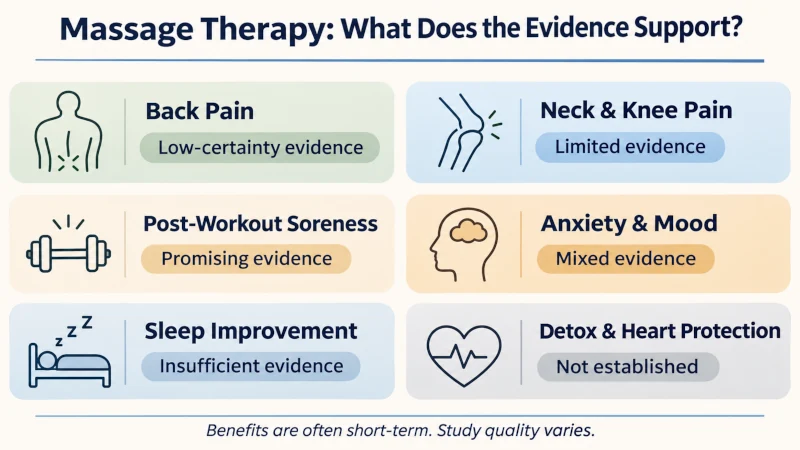
Pain is the most studied reason people book a massage, and the picture is fairly consistent: it helps, it’s low-risk for most people, and the effect fades. A 2016 meta-analysis of 67 randomized trials found that massage reduced pain compared with no treatment, and by smaller margins compared with sham treatment or other active therapies [Crawford, 2016]. A Veterans Affairs evidence map of 49 systematic reviews was more guarded: most conclusions rested on low-strength evidence, because few large, rigorous trials have been done [Miake-Lye, 2019].
Low back pain
A Cochrane review of 25 trials and 3,096 people found short-term pain improvements with massage. But most trials were small with design flaws, and the authors said they had very little confidence that massage is an effective treatment for low back pain. Compared with other active treatments, massage eased pain but didn’t improve day-to-day function at any follow-up. Side effects were minor [Furlan, 2015].
Guidelines reflect that uncertainty. The American College of Physicians’ 2017 guideline listed massage as an option for acute or subacute low back pain, but not for chronic low back pain [NCCIH, 2018].
In practice, massage is a reasonable way to get through a flare-up. For back pain that keeps coming back, treat it as a comfort measure alongside the care your clinician recommends rather than the main plan. Our overview of natural approaches for musculoskeletal disorders covers other options for back pain and sciatica, plus the warning signs that need a doctor.
Neck, shoulders, knees and fibromyalgia
Massage may help neck and shoulder pain, but the benefit may last only a short time. Limited research on knee osteoarthritis points the same way: some short-term relief. In fibromyalgia, a review of nine studies found that massage continued for at least five weeks improved pain, anxiety and depression [NCCIH, 2019]. That five-week figure is a useful hint that, for chronic conditions, one session is rarely enough to judge.
Sore muscles after exercise
This is where massage looks strongest. A 2018 meta-analysis of 99 studies compared post-exercise recovery methods and found massage was the most effective for reducing delayed onset muscle soreness (DOMS) and perceived fatigue [Dupuy, 2018].
Two caveats. Participants can’t be blinded to getting a massage, so placebo effects couldn’t be ruled out, and the review looked at single recovery sessions without measuring performance [Dupuy, 2018]. Put simply, massage will probably make your legs feel less sore after a hard session. Whether it makes you faster or stronger next time is unproven.
If you’d rather work on sore muscles at home, our guide to essential oils for muscle soreness covers safe dilution for self-massage blends.
The “flushing out lactic acid” idea
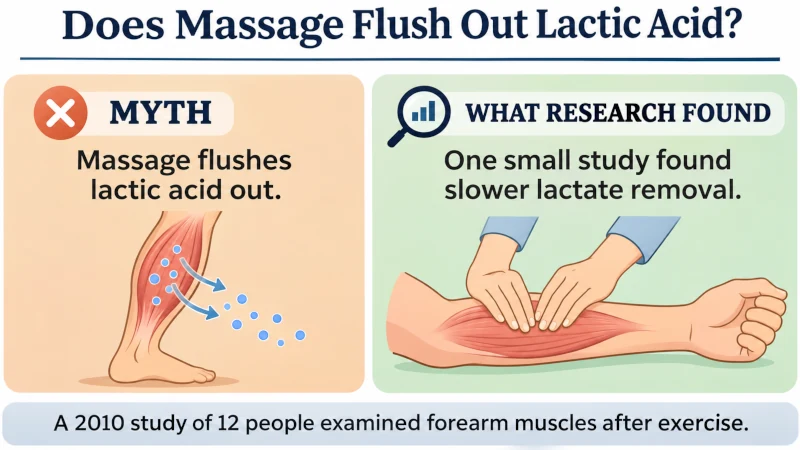
You’ll often hear that massage boosts blood flow and clears lactic acid. When researchers tested this in 12 people after a strenuous hand-grip exercise, massage actually reduced blood flow to the working muscle and slowed lactate removal compared with resting [Wiltshire, 2010]. It’s one small study of forearm muscles, so it doesn’t settle every question about circulation. It is a good reason to be skeptical of “flushing” and “detox” language.
Stress, anxiety and mood
Most people walk out of a massage calmer, and studies capture some of that. A meta-analysis of 37 randomized studies found that a course of massage reduced ongoing (trait) anxiety and depression by amounts similar in size to those typically reported for psychotherapy — though no included study compared the two head to head. Single sessions produced small, short-term drops in blood pressure and heart rate. The effect on in-the-moment anxiety lost statistical significance once the authors adjusted for publication bias, and cortisol, the stress hormone often mentioned in spa marketing, didn’t change significantly [Moyer, 2004].
Trials in people diagnosed with generalized anxiety disorder (GAD) are mixed. In one, 68 people had 10 sessions over 12 weeks of massage, heat therapy or rest in a relaxing room. Everyone improved, and massage did no better than the other two, which points to a general relaxation response [Sherman, 2010]. A smaller trial found that 12 sessions of Swedish massage over six weeks lowered anxiety scores more than light touch, though only 47 people were randomized [Rapaport, 2016].
So massage is a sensible way to unwind and may ease symptoms for some people. It isn’t a substitute for treatment when anxiety or low mood is affecting your daily life. Our guide to anxiety and depression explains the treatments with the strongest evidence and when to get help. If you’re having thoughts of harming yourself, call or text 988 (in the US) or call 911 now.
What about sleep?
Plenty of people say they sleep better after a massage, but the research is thin. In the fibromyalgia studies where massage improved pain and mood, it did not improve sleep disturbance [NCCIH, 2019]. If you sleep better because you hurt less or feel calmer, that’s a real benefit. Just don’t count on massage to treat insomnia.
Claims that outrun the evidence
Massage is often promoted for heart health, immunity, “detoxing” and sharper thinking. We didn’t find strong human evidence for any of these. The brief dips in blood pressure and heart rate seen after a single session [Moyer, 2004] are not the same as protecting your heart over time, and the one controlled test of the circulation claim we found pointed the other way [Wiltshire, 2010].
The evidence at a glance
| Use | What studies show | Strength of evidence |
| Low back pain | Short-term pain relief; no better than other treatments for function | Low to very low certainty [Furlan, 2015] |
| Neck and shoulder pain | May help; benefit often short-lived | Limited [NCCIH, 2019] |
| Knee osteoarthritis | Short-term relief in a few studies | Limited [NCCIH, 2019] |
| Fibromyalgia | Pain, anxiety and depression improved with 5+ weeks of sessions; sleep did not | Limited [NCCIH, 2019] |
| Post-exercise soreness (DOMS) | Most effective recovery method studied for soreness and perceived fatigue | Promising; unblinded, single-session studies [Dupuy, 2018] |
| Anxiety and low mood | Courses of massage lowered anxiety and depression scores; GAD trials mixed | Mixed [Moyer, 2004] [Sherman, 2010] |
| Sleep | No improvement in fibromyalgia studies | Insufficient [NCCIH, 2019] |
| “Flushing” lactic acid / circulation | One small trial found reduced muscle blood flow after exercise | Not supported [Wiltshire, 2010] |
| Heart health, immunity, detox | No strong human evidence found | Insufficient |
Is massage therapy safe?
For most healthy adults, yes. Serious harm appears to be uncommon. The rare serious events reported include blood clots, nerve injury and bone fractures, and many involved vigorous techniques such as deep tissue massage, or people already at higher risk of injury, such as older adults [NCCIH, 2019]. A review of case reports published between 2003 and 2013 found 40 reports describing 138 adverse events and judged the overall incidence to be low, while noting that spinal manipulation was repeatedly linked to the more serious problems [Yin, 2014].
The more common downside is discomfort. Firmer techniques can feel uncomfortable [Michigan Medicine, n.d.], and some people describe deeper work as “hurts so good.” Tell your therapist right away if the pressure hurts in a way you don’t like [Cleveland Clinic, n.d.].
Check with your doctor first if you…
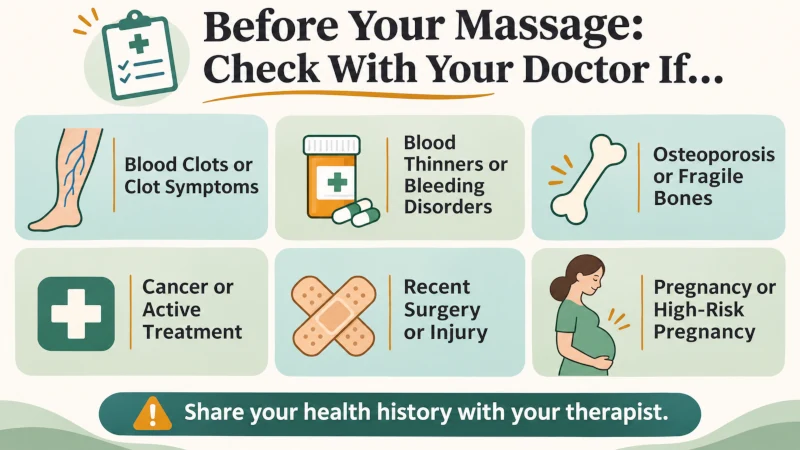
- have, or might have, a blood clot in a leg vein (deep vein thrombosis) [Cleveland Clinic, n.d.] [Michigan Medicine, n.d.]
- take a blood thinner, have a bleeding disorder or have a low platelet count — bruising is the main concern [Michigan Medicine, n.d.] [Cleveland Clinic, n.d.]
- have osteoporosis or a spine disorder that raises your risk of fractures [Cleveland Clinic, n.d.]
- have a tumor or are being treated for cancer [Cleveland Clinic, n.d.] [NCCIH, 2019]
- had surgery recently, or an acute injury or surgery within the past 48 hours [Michigan Medicine, n.d.] [Cleveland Clinic, n.d.]
- have a fever or contagious illness, or bruises or broken skin where you’d be massaged [Michigan Medicine, n.d.]
- have a medical device implanted in or attached to your body [Cleveland Clinic, n.d.]
- are pregnant, especially if it’s a high-risk pregnancy [Cleveland Clinic, n.d.]
Massage doesn’t interact with medicines the way a supplement can, but blood thinners raise the risk of bruising, so mention every medication on your intake form.
Pregnancy and breastfeeding
Prenatal massage typically uses very light to medium pressure. Check with your obstetric provider first, especially if you have blood clots, a bleeding disorder, high blood pressure, diabetes, preeclampsia, heart disease, pitting swelling, abdominal pain, unexplained symptoms, or a history of preterm labor or miscarriage [Cleveland Clinic, n.d.]. None of the sources we reviewed raised concerns specific to breastfeeding; positioning and comfort are the practical issues to discuss with your therapist.
Cancer and older adults
For people with cancer, massage can be part of supportive care with precautions such as lighter pressure near sensitive areas, though the evidence that it relieves pain and anxiety is not strong [NCCIH, 2019]. Older adults may be more prone to injury from vigorous techniques [NCCIH, 2019], so gentler styles make sense. Our article on chronic pain management for seniors covers massage alongside other non-drug options.
See a doctor before you book if you have these symptoms
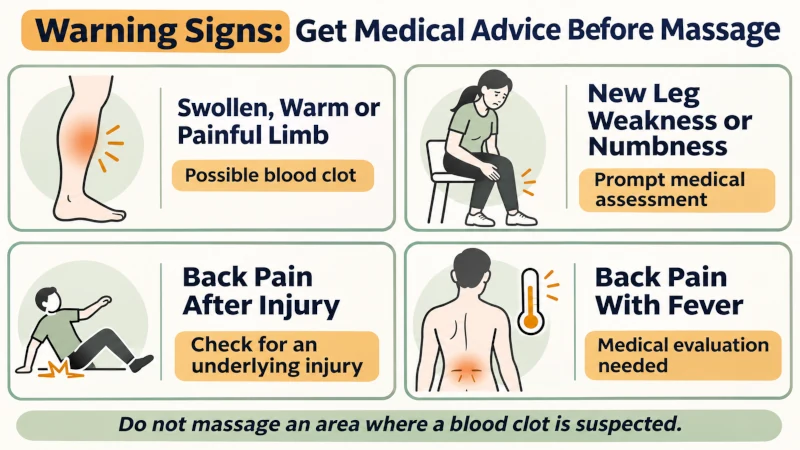
Massage shouldn’t be a reason to put off seeing a clinician about a new or unexplained problem [NCCIH, 2019]. Get medical advice first if you notice:
- a leg or arm that is swollen, painful or tender, warm to the touch or red — possible signs of a blood clot, which should not be massaged [MedlinePlus, 2025] [Michigan Medicine, n.d.]
- back pain with weakness or numbness in one or both legs, or pain running down a leg below the knee (see a doctor the same day) [UW Medicine, n.d.]
- back pain after a fall or injury, or back pain with fever (unless you also have flu-like aches) (same day) [UW Medicine, n.d.]
- back pain that keeps waking you after three nights, or that hasn’t improved after six weeks of home care [UW Medicine, n.d.]
- anxiety or low mood that lasts more than two weeks or disrupts work, relationships or daily life — and call or text 988, or call 911, for thoughts of self-harm
How to make regular massage therapy worth it
Choose a licensed therapist. Licensing rules vary by state. The Federation of State Massage Therapy Boards links to state license lookups so you can check a practitioner’s status [FSMTB, n.d.].
Share your health history. Mention medications (especially blood thinners), recent surgery or injury, pregnancy and any condition on the list above.
Speak up about pressure. More pressure isn’t automatically better, and vigorous deep work carries most of the rare serious risks [NCCIH, 2019].
Set a trial period. There’s no evidence-based schedule. The fibromyalgia benefits appeared with at least five weeks of sessions [NCCIH, 2019], and the anxiety trials used 10–12 sessions over six to 12 weeks [Sherman, 2010] [Rapaport, 2016]. A practical approach is to commit to a few weeks, note whether your pain, sleep or stress actually changes, and then decide how often it’s worth paying for.
Keep it in context. Massage works best as an add-on to the care your clinician recommends, not a replacement for it.
| HEALTH DISCLAIMER: This article is for general education and isn’t a substitute for advice from your doctor or another qualified health professional. Massage therapy isn’t right for everyone: check with a clinician before starting if you have any of the conditions listed above, are pregnant, or are being treated for a medical condition. Don’t use massage to delay getting a new or worsening symptom checked. |
Frequently Asked Questions
How often should you get a massage?
No schedule has been proven best. Studies that found benefits used at least five weeks of sessions in fibromyalgia [NCCIH, 2019] and 10–12 sessions over six to 12 weeks for anxiety [Sherman, 2010] [Rapaport, 2016]. Try a few weeks, track whether anything changes, and adjust to your budget.
Does massage therapy help back pain?
It can ease pain in the short term, but the evidence is low quality and it doesn’t clearly improve function compared with other treatments [Furlan, 2015]. It’s a reasonable add-on for a flare-up, not a stand-alone fix for chronic back pain [NCCIH, 2018].
Is deep tissue massage better than Swedish massage?
We didn’t find good evidence that deeper is more effective. Vigorous techniques like deep tissue work account for many of the rare serious injuries [NCCIH, 2019], and the positive anxiety trial used Swedish massage [Rapaport, 2016].
Do you need to drink water after a massage to flush out toxins?
Drink if you’re thirsty, but massage doesn’t flush lactic acid or toxins out of muscles — one controlled study found it slowed lactate removal after exercise [Wiltshire, 2010].
Is it normal to feel sore after a massage?
Some tenderness after firm pressure can happen, and side effects in trials are usually minor [Furlan, 2015]. A swollen, warm, painful leg, or new numbness or weakness, isn’t normal soreness — get it checked [MedlinePlus, 2025] [UW Medicine, n.d.].
Can massage replace therapy or medication for anxiety?
No. It may lower anxiety for a while, but in a trial of people with generalized anxiety disorder it did no better than other relaxing treatments [Sherman, 2010]. Use it alongside, not instead of, care from a professional.
References
- National Center for Complementary and Integrative Health (NCCIH). Massage Therapy: What You Need To Know. View source
- NCCIH Clinical Digest. Massage Therapy for Health. View source
- Furlan AD, Giraldo M, Baskwill A, Irvin E, Imamura M. Massage for low-back pain. View source
- Crawford C, Boyd C, Paat CF, et al.; Evidence for Massage Therapy (EMT) Working Group. View source
- Miake-Lye IM, Mak S, Lee J, et al. Massage for pain: an evidence map. J Altern Complement Med. View source
- Dupuy O, Douzi W, Theurot D, Bosquet L, Dugué B. An evidence-based approach for choosing post-exercise recovery techniques to reduce markers of muscle damage, soreness, fatigue, and inflammation: a systematic review with meta-analysis. View source
- Wiltshire V, et al. (senior author Tschakovsky ME). Massage impairs postexercise muscle blood flow and “lactic acid” removal. View source
- Moyer CA, Rounds J, Hannum JW. A meta-analysis of massage therapy research. View source
- Sherman KJ, et al. Effectiveness of therapeutic massage for generalized anxiety disorder: a randomized controlled trial. View source
- Rapaport MH, Schettler P, Larson ER, Edwards SA, Dunlop BW, Rakofsky JJ, Kinkead B. Acute Swedish massage monotherapy successfully remediates symptoms of generalized anxiety disorder: a proof-of-concept, randomized controlled study. View source
- Yin P, Gao N, Wu J, Litscher G, Xu S. Adverse events of massage therapy in pain-related conditions: a systematic review. View source
- Cleveland Clinic Wellness & Preventive Medicine. Massage Therapy. View source
- Michigan Medicine Health Library (Healthwise). Massage Therapy. View source
- MedlinePlus Medical Encyclopedia. Deep venous thrombosis. View source
- UW Medicine Department of Orthopaedics and Sports Medicine. Back Pain. View source
- Federation of State Massage Therapy Boards. View source


