
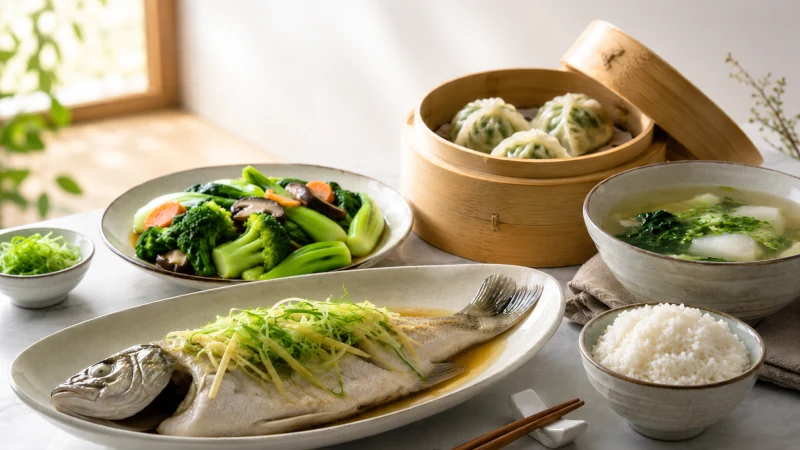
Short answer: for most people, yes. If you’ve been asking can I eat Chinese food with gallstones, the reassuring part is that the problem was never “Chinese food.” It’s fat — how much a dish has and how it’s cooked. A plate of deep-fried General Tso’s is a different proposition from steamed fish with ginger and scallions, and your gallbladder can tell the difference even when your taste buds are having a great time.
So this isn’t a page that tells you to give up your favorite takeout. It’s a page that tells you which items are worth ordering, which ones are worth going easy on, and the handful of warning signs that mean stop eating and get medical help.
Can I eat Chinese food with gallstones? The short answer
Yes — with a few sensible choices. Steamed, poached, and lightly stir-fried dishes built around lean protein and vegetables are usually gentle. Deep-fried dishes, fatty cuts of meat, and anything swimming in oil or rich sauce are the ones most likely to set off pain. You don’t need a special “gallstone menu.” You need to know where the fat is hiding.
Why fat — not “Chinese food” — sets off a gallbladder attack
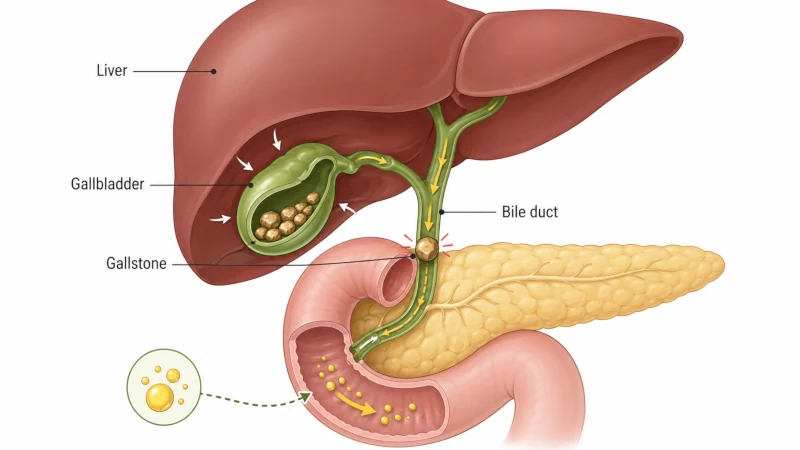
Your gallbladder is a small pouch under your liver that stores bile and squeezes it into your small intestine when fat shows up to be digested. When a gallstone is blocking a bile duct, that squeeze is what you feel: a sudden, intensifying pain in the upper-right part of your abdomen that can last from minutes to a few hours. Attacks tend to follow heavy meals and often show up in the evening or overnight [NIDDK on gallstone symptoms and causes, 2017].
That mechanism is the whole story. Fat is the trigger that tells the gallbladder to contract, which is exactly why a greasy, deep-fried meal is a plausible problem and a bowl of steamed vegetables is not [Mayo Clinic on gallstones, 2025].
Here’s the part that surprises people, though: cutting fat to zero is not the goal. Fat is also what keeps the gallbladder emptying on a regular basis, and a gallbladder that never empties is where bile sits, thickens, and forms more stones. Federal guidance is to eat healthy fats — like olive oil and the fat in oily fish — so the gallbladder keeps contracting, and to cut back on the fats found in fried food and desserts [NIDDK on eating and gallstones, 2017]. UK dietitians make the same point more bluntly: a blanket low-fat diet doesn’t suit everyone with gallstones, there’s little evidence behind it, and stripping fat out can cause its own problems [Cambridge University Hospitals NHS (UK), 2025]. The target is moderation and smarter choices, not deprivation.
Dishes to skip or go easy on
The trouble spots on a Chinese menu cluster around a few cooking methods and ingredients:
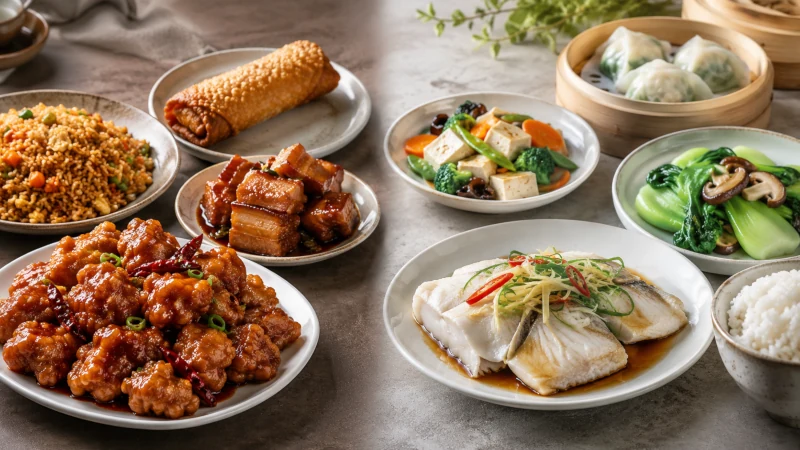
- Deep-fried items. Egg rolls, crispy spring rolls, fried wontons, sesame or General Tso’s chicken, sweet-and-sour battered pork, crispy “shredded” beef. The batter-and-fry method loads a dish with fat fast.
- Fatty meats. Pork belly, duck, and spare ribs are rich by nature.
- Heavy oil and rich sauces. Dishes finished with a lot of oil, or thick, glossy sauces, add up quickly — and fried rice can carry far more oil than plain steamed rice.
None of these are “forbidden.” They’re the items to order occasionally, split with someone, or ask to have prepared with less oil. If fatty meals reliably set off your pain, going lighter is a reasonable personal experiment rather than a permanent ban [Cambridge University Hospitals NHS (UK), 2025].
A quick swap guide
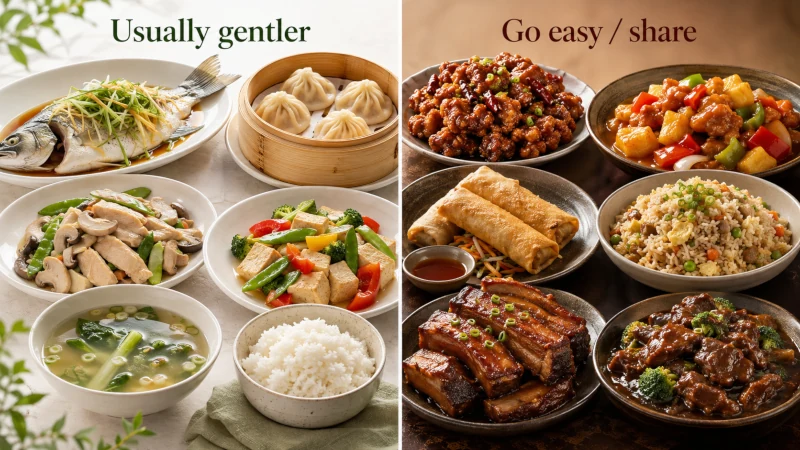
| If you love… | Why it can be a trigger | A gentler swap |
| Sweet-and-sour or General Tso’s chicken | Battered and deep-fried | Steamed or lightly stir-fried chicken, sauce on the side |
| Crispy spring / egg rolls | Deep-fried | Steamed dumplings or fresh (summer) rolls |
| Fried rice | Cooked with a lot of oil | Plain steamed rice (or brown rice for fiber) |
| Pork belly, spare ribs, duck | Naturally high-fat cuts | Skinless chicken, shrimp, scallops, white fish, or tofu |
| Creamy or heavy-sauce dishes | Concentrated fat | Clear-broth soups; sauce served on the side |
What’s usually gentle on your gallbladder
Plenty of the menu works in your favor.
Cooking methods that help
Steaming, poaching, and stir-frying with a light touch of oil all keep the fat load down. Think steamed fish with ginger and scallions, steamed vegetable dumplings, tofu in a light sauce, Moo Goo Gai Pan (chicken and mushrooms), or a vegetable stir-fry. Clear-broth soups like wonton or hot-and-sour are easier on the gallbladder than creamy ones. Choosing steamed, poached, or grilled preparations over fried is exactly the swap dietitians recommend for keeping fat down [Cambridge University Hospitals NHS (UK), 2025].
Lower-fat proteins and vegetables
Lean proteins give you what you need without a heavy fat hit: skinless chicken breast, shrimp, scallops, white fish, and plant proteins like tofu and tempeh. Load up on vegetables — bok choy, Chinese broccoli, snow peas, mushrooms, bamboo shoots — which are naturally low in fat and bring fiber to the plate. That pattern (more fiber, healthy fats in moderation, less fried food) is precisely what health agencies recommend for lowering gallstone risk in the first place [NIDDK on eating and gallstones, 2017]. For the wider picture, our guide to foods that suit a gallstone-friendly plate is a useful companion.
Does MSG bother the gallbladder?
This is worth clearing up, because it gets repeated a lot. Monosodium glutamate (MSG) is a flavor enhancer common in many cuisines, and the U.S. Food and Drug Administration classifies it as safe to eat in typical amounts. An independent scientific review it commissioned concluded MSG is safe, while noting that some sensitive people may get short-term, mild symptoms — headache, flushing, numbness, palpitations — usually only after consuming 3 grams or more of MSG without food [U.S. FDA on MSG]. Those reactions, sometimes called “MSG symptom complex,” are not an allergy, and they affect a small share of people, on the order of 1% or less [Mayo Clinic on MSG, 2025] [Harvard Health on MSG, 2024].
What matters here: there’s no good evidence that MSG causes or worsens gallstones or gallbladder attacks. Fat is the gallbladder trigger, not MSG. If you personally notice you feel off after MSG-heavy meals, you can ask for dishes made without it — most restaurants will accommodate that — but treat it as a personal-sensitivity question, not a gallbladder one.
How to order (a short script that works)
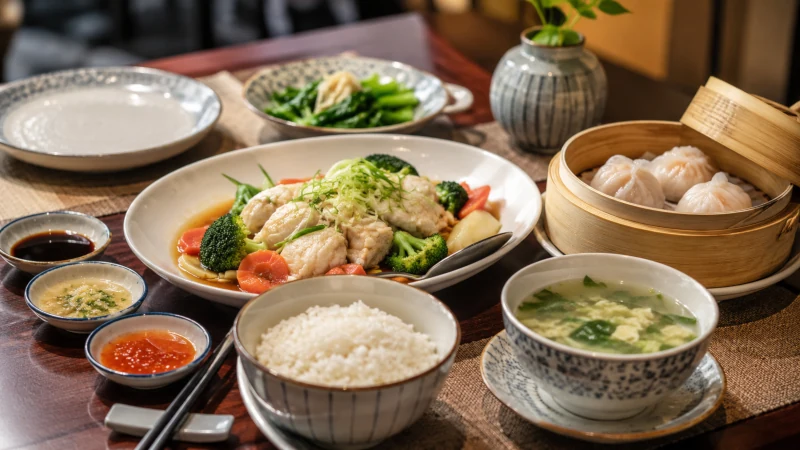
You don’t have to interrogate the kitchen. A few small requests cover most of it:
- Ask how it’s cooked, and request steamed or “light on the oil” where you can.
- Get rich sauces on the side so you control how much you use.
- Choose clear-broth soups over creamy ones.
- Share dishes to keep portions reasonable and sample more without overloading one meal.
- Don’t arrive starving. Skipping meals and long fasting gaps actually reduce gallbladder emptying, which raises the risk of stones forming — so eating regularly, including breakfast, is part of the plan, not the enemy of it [Cambridge University Hospitals NHS (UK), 2025] [NIDDK on dieting and gallstones, 2017].
Then pay attention to your own body. If a particular dish reliably leaves you bloated or in pain, note it and skip it next time. Triggers vary from person to person, and your list is usually shorter than you feared.
Beyond the takeout box: lowering your risk of future stones
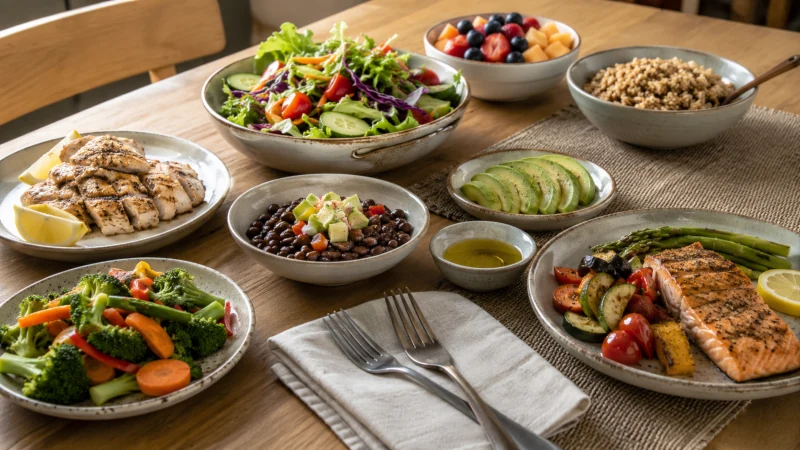
The choices that move the needle most aren’t glamorous, and they’re the same ones that make any meal — Chinese or not — easier on your gallbladder:
- Build meals around fiber (vegetables, fruit, beans, whole grains) and keep refined carbs and sugar down [NIDDK on eating and gallstones, 2017].
- Keep some healthy fat in the diet so the gallbladder empties regularly [NIDDK on eating and gallstones, 2017].
- Eat regular meals, including breakfast [Cambridge University Hospitals NHS (UK), 2025].
- If you need to lose weight, do it slowly. Rapid weight loss and crash diets are among the clearest gallstone triggers there are, because fast loss and long fasts push extra cholesterol into bile and stop the gallbladder emptying properly. UK guidance caps a safe pace at about 1 kg (2 lb) a week [NIDDK on dieting and gallstones, 2017] [Cambridge University Hospitals NHS (UK), 2025].
- Move regularly — aim for at least 150 minutes a week of moderate activity [NIDDK on dieting and gallstones, 2017].
If you want a full plan, see our broader gallbladder-friendly diet, and if you’re wondering about specific foods, we cover things like whether fruit such as bananas is fine with gallstones separately. It’s also worth knowing that risk isn’t only about diet: being over 40, being female, pregnancy, a family history, diabetes, and certain ethnic backgrounds all raise the odds [Mayo Clinic on gallstones, 2025]. And if you’ve been told your stones’ measurements, our gallstones size chart explains what those numbers do and don’t predict.
A word on herbal “gallbladder” remedies and supplements
It’s tempting to reach for a “gallbladder cleanse,” a bitter herbal tonic, or a supplement promising to melt stones. Be realistic about what these can do: no food, herb, tea, or “flush” has been shown to dissolve a gallstone or clear a blocked duct. Diet and supplements work on comfort and future risk, not on stones you already have.
There’s also a specific hazard. Herbs that stimulate the gallbladder to empty (cholagogues) are exactly the wrong thing if a duct is blocked — pushing more bile against a blockage can make matters worse. Concentrated herbal extracts can also cause side effects like bloating and gas, may interact with prescription medicines (including blood thinners and diabetes drugs), and often lack safety data in pregnancy and breastfeeding. If you have known gallstones, are pregnant or breastfeeding, take regular medications, or have liver disease, talk to a doctor or pharmacist before starting any supplement. Our evidence-based guide to herbs for the gallbladder and liver goes through the individual options and their cautions.
Red flags: when it isn’t just indigestion
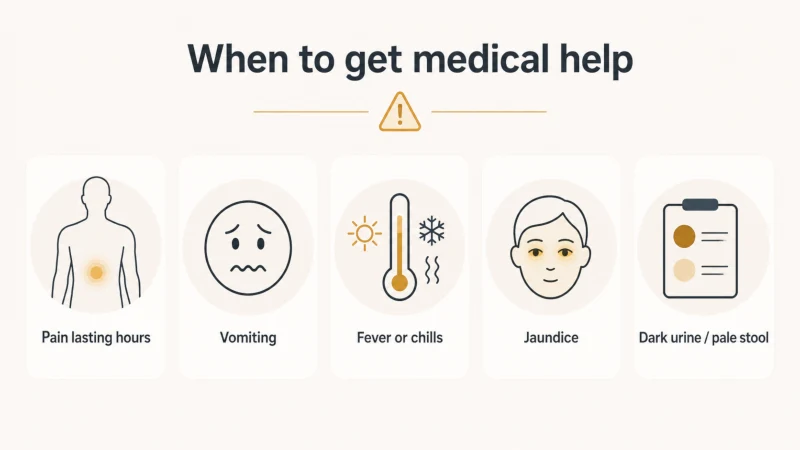
Most gallstones cause no symptoms at all, and silent stones usually need no treatment. But a gallbladder attack that doesn’t settle can turn into an emergency quickly. Get medical care right away if, during or after an attack, you have any of the following:
- Abdominal pain lasting several hours
- Nausea and vomiting
- Fever — even a low-grade one — or chills
- Yellowing of the skin or the whites of your eyes (jaundice)
- Tea-colored urine and light-colored stools
These can signal a serious infection or inflammation of the gallbladder, liver, or pancreas [NIDDK on gallstone symptoms and causes, 2017]. A blocked duct that isn’t treated can lead to complications such as pancreatitis or a bile-duct infection, and left untreated it can become life-threatening [Cleveland Clinic on gallstones, 2023]. For severe or sudden abdominal pain, high fever, or jaundice, don’t wait it out — go to urgent care or the emergency room, or call 911. This is not a situation to manage with a change of order at the takeout counter.
| Health Disclaimer: This article is for general education and is not medical advice, a diagnosis, or a treatment plan. Gallstones can cause complications that need urgent care, and no food, drink, herb, or supplement prevents, dissolves, or treats them. Before changing your diet, starting a weight-loss plan, or taking any supplement — especially if you are pregnant or breastfeeding, take prescription medication, or have another health condition — talk with a doctor, pharmacist, or registered dietitian who knows your history. If you have severe abdominal pain, fever, persistent vomiting, or yellowing of the skin or eyes, seek medical care now rather than adjusting what you eat. |
Frequently Asked Questions
Can I eat fried rice or General Tso’s chicken with gallstones?
You can, but these are the higher-risk items — fried rice is often cooked with a lot of oil, and General Tso’s is battered and deep-fried, so both carry a heavy fat load that can trigger an attack. If you’re craving that flavor, order plain steamed rice on the side and a steamed or lightly stir-fried version of the chicken with sauce on the side. Save the deep-fried version for an occasional treat and consider sharing it.
Is MSG or soy sauce a problem for gallstones?
There’s no good evidence that MSG affects gallstones or the gallbladder; the FDA considers MSG safe in typical amounts, and only a small share of people get short-term, mild reactions unrelated to bile [U.S. FDA on MSG] [Mayo Clinic on MSG, 2025]. Soy sauce is mainly a salt concern, not a fat or gallbladder one. The thing to watch on a Chinese menu is fat, not seasoning.
Are dumplings okay to eat with gallstones?
Steamed dumplings are usually a good choice — the steaming keeps the fat down. Pan-fried or deep-fried dumplings (potstickers cooked in lots of oil, fried wontons) are heavier and more likely to cause trouble. When in doubt, ask for the steamed version.
Can Chinese food cause a gallbladder attack?
A high-fat meal of any kind can, because dietary fat is what makes the gallbladder contract — and when a stone blocks a duct, that contraction is the pain [NIDDK on gallstone symptoms and causes, 2017]. So it’s the fatty, fried dishes that pose the risk, not Chinese cuisine as a category. Lighter, steamed, vegetable-and-lean-protein dishes are far less likely to be a problem.
What should I order if I’ve had a gallbladder attack before?
Lean toward steamed fish or chicken, tofu and vegetable dishes, clear-broth soups, and steamed rice, and ask for everything light on the oil with sauces on the side. Don’t go to the meal overly hungry, keep the portion moderate, and stop if you feel discomfort. If attacks are recurring, that’s a conversation with your doctor, since symptomatic gallstones are usually treated with surgery rather than diet alone.
References
- National Institute of Diabetes and Digestive and Kidney Diseases (NIDDK). “Symptoms & Causes of Gallstones.” NIH, last reviewed November 2017. View source
- NIDDK. “Eating, Diet, & Nutrition for Gallstones.” NIH, last reviewed November 2017. View source
- NIDDK. “Dieting & Gallstones.” NIH, last reviewed November 2017. View source
- NIDDK. “Definition & Facts for Gallstones.” NIH, last reviewed November 2017. View source
- Mayo Clinic. “Gallstones — Symptoms & Causes.” Reviewed 2025. View source
- Cleveland Clinic. “Gallstones (Cholelithiasis): Symptoms, Causes & Treatment.” 2023. View source
- U.S. Food and Drug Administration. “Questions and Answers on Monosodium Glutamate (MSG).” No publication date printed on page; accessed 2026. View source
- Mayo Clinic. “Monosodium glutamate (MSG): Is it harmful?” 2025. View source
- Harvard Health Publishing. “Monosodium glutamate (MSG): What it is.” 2024. View source
- Cambridge University Hospitals NHS Foundation Trust (UK), Nutrition and Dietetics. “Dietary advice for patients with gallstones or inflammation of the gallbladder.” v6, approved 4 September 2025. Cited as UK dietetic evidence, not US care instructions. View source
