
Type “foods that cause acne” into a search bar and you’ll get confident lists blaming chocolate, grease, and salt. The real science is narrower, and more useful. No single food gives you a pimple overnight, and for most people diet is a minor character in the acne story, not the villain.
What the research does support is that a couple of eating patterns can worsen breakouts in people already prone to them — mostly by nudging the hormones and inflammation that drive acne. The strongest links aren’t the usual suspects. They’re fast-digesting carbohydrates and, more weakly, milk. Below are the six foods most often tied to acne, ranked by how good the evidence actually is, plus what to eat instead and when a breakout is worth a doctor’s visit.
How food affects your skin
Acne begins inside a pore. Oil glands push out sebum to lubricate the skin; when that sebum mixes with dead skin cells and plugs the follicle, a skin bacterium called Cutibacterium acnes can multiply and set off inflammation. The red, sore part of a pimple is that immune response.
Hormones set the pace of oil production, and that is where food gets a foot in the door. Eating fast-digesting carbohydrates spikes blood sugar, which raises insulin and a related hormone called insulin-like growth factor 1 (IGF-1). Higher insulin and IGF-1 make androgens more active, and androgens crank up sebum and skin-cell turnover (Harvard Health, 2020). That one pathway explains most of the credible diet–acne links.
It also explains what doesn’t happen: the oil in fried food doesn’t travel to your face. Dietary fat is broken down for energy, not piped to your pores. The American Academy of Dermatology is blunt about it — greasy food hasn’t been shown to directly cause acne (AAD).
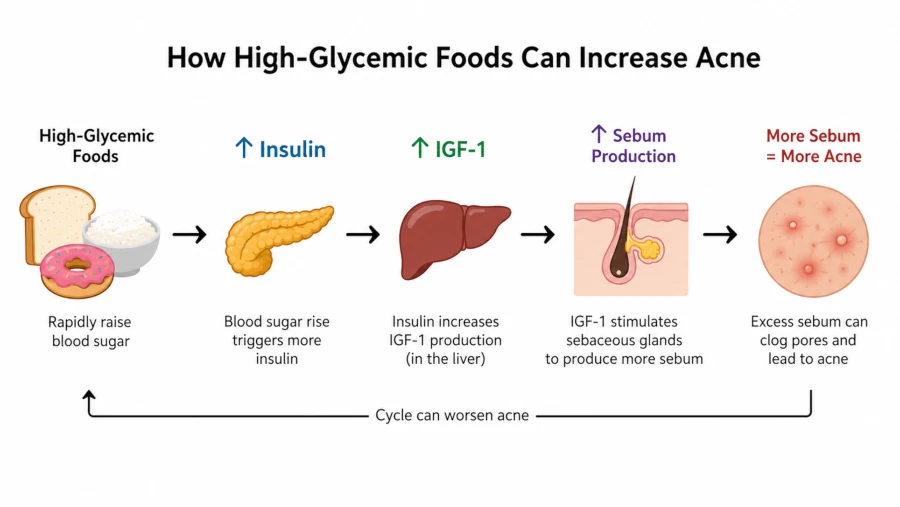
6 foods that may cause or worsen acne
Here’s the honest ranking. “Moderate” evidence means several human studies point the same way; “limited” means mostly observational data that can show a link but can’t prove cause.
1. Sugary foods and drinks
Evidence: moderate
Candy, soda, sweetened coffee, and desserts are the clearest dietary trigger because they hit blood sugar hardest. In a French study of 24,452 adults, people who ate a lot of fatty, sugary foods had about 54% higher odds of current acne, and sugary drinks carried their own smaller bump (JAMA Dermatology, 2020). These are associations, not proof, but the insulin mechanism behind them is well understood. If you change one thing, cutting back on added sugar is a reasonable place to start.
2. White bread and refined-flour baked goods
Evidence: moderate — the single biggest lever
White bread, pastries, many breakfast cereals, white rice, and other low-fiber starches behave like sugar once digested: fast glucose, fast insulin. This is the most directly tested part of the diet–acne link. In a 12-week randomized trial, 43 young men who switched to a low-glycemic-load diet saw their total acne lesions fall by roughly 22, compared with about 14 in the comparison group (Smith, 2007). The American Academy of Dermatology now tells patients a low-glycemic diet may reduce how much acne they have (AAD). Swapping refined grains for whole ones is the most evidence-backed diet move you can make for your skin.
3. Milk — especially skim milk
Evidence: limited and observational
Milk is the dairy product repeatedly tied to acne. A 2018 meta-analysis pooling 14 studies and 78,529 people found that any dairy was linked to modestly higher odds of acne, with skim and low-fat milk showing the strongest signal — not yogurt or cheese (Juhl, 2018). The likely reason isn’t an allergy, as some older articles claimed; it’s that milk influences insulin and IGF-1. Keep the limits in mind: this evidence is observational and carries real bias, so it can’t prove milk causes breakouts. A short, time-limited trial makes more sense than quitting dairy for good — see the safety section first.
4. Whey protein supplements
Evidence: limited, mostly case reports
This one matters mainly if you lift. Case reports and small series — typically in teenage boys and young men — describe acne that flared with whey protein powder and settled after stopping (JAAD International, 2022). Whey is a concentrated dairy protein that strongly stimulates IGF-1, the same lever as milk. It’s far from proven, but if you use whey and your chest or back breaks out, a few weeks off it is a cheap experiment.
5. Fast food and the “Western” diet pattern
Evidence: moderate — for the pattern, not the grease
Burgers, fries, nuggets, and shakes turn up in study after study alongside more acne. But it’s the package — refined buns, sugary drinks, and dairy — doing the work, not the oil itself (JAAD International, 2022). The takeaway isn’t “never eat fries.” It’s that a daily diet built on refined carbs and sweet drinks is the real dietary risk, while the occasional fast-food meal isn’t what’s keeping your skin broken out.
6. Chocolate
Evidence: mixed and weak
Chocolate has the worst reputation and some of the thinnest evidence. A handful of small studies hint at a link, but blinded tests point at the sugar and milk in a chocolate bar rather than the cocoa: when researchers gave volunteers chocolate with far more cocoa than usual, breakouts didn’t rise to match (AAD). If you want the treat with the least baggage, dark chocolate carries less sugar and milk than milk chocolate.
Evidence at a glance
| Food | What the research shows | Evidence | Practical move |
| Sugar & sugary drinks | Higher acne odds in large cohort data; clear insulin/IGF-1 mechanism | Moderate | Cut added sugar and sweet drinks first |
| Refined-carb baked goods | Low-glycemic diet reduced lesions in a randomized trial | Moderate | Swap white flour/rice for whole grains |
| Milk (esp. skim) | Meta-analysis of 78,529 people; modest link, milk > cheese/yogurt | Limited | Try a time-limited dairy break |
| Whey protein | Case reports of flares that ease after stopping | Limited | If you use it, test a few weeks off |
| Fast food / Western diet | Pattern (refined carbs + dairy) linked to acne, not the grease | Moderate | Make it occasional, not daily |
| Chocolate | Small studies mixed; sugar/milk, not cocoa, seems responsible | Weak | Prefer dark chocolate |
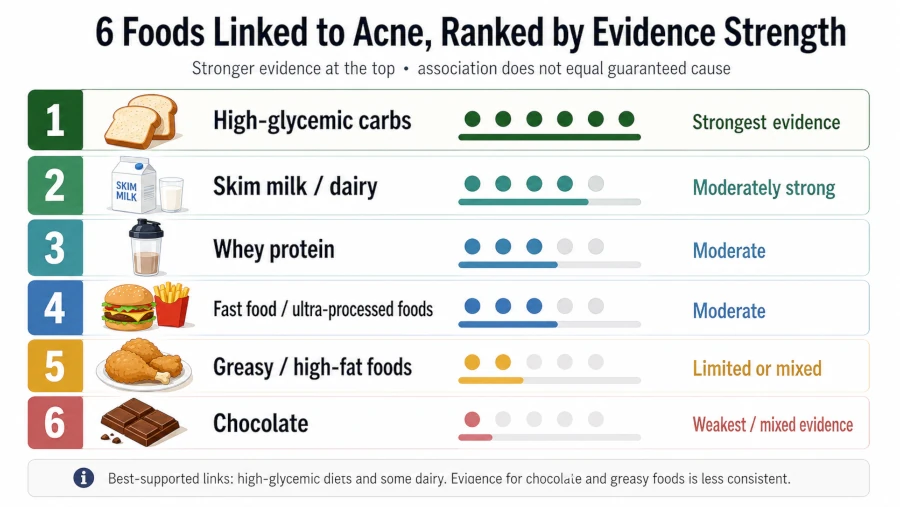
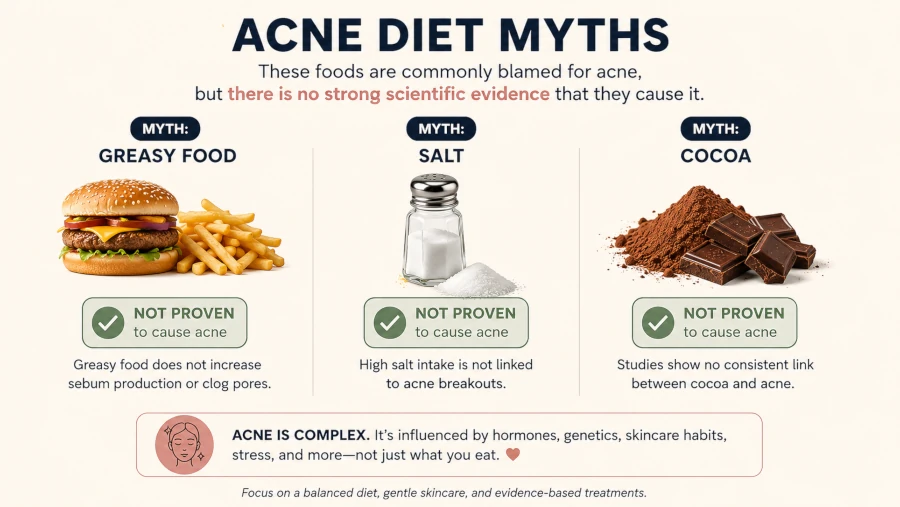
What probably won’t fix your acne
A few popular culprits don’t hold up, and they’re worth clearing out:
- Grease reaching your skin from the inside. The fat you eat is digested for energy, not deposited in pores.
- Salt. Despite older lists (this article used to include it), there’s no solid evidence that dietary salt causes acne — which is why it’s gone.
- Cocoa itself. The chocolate signal tracks with sugar and milk, not the cocoa solids.
And the bigger myth: that the right diet alone will clear moderate or severe acne. For most people it won’t. Diet is a modifier you stack on top of good skincare and, when needed, prescription treatment.
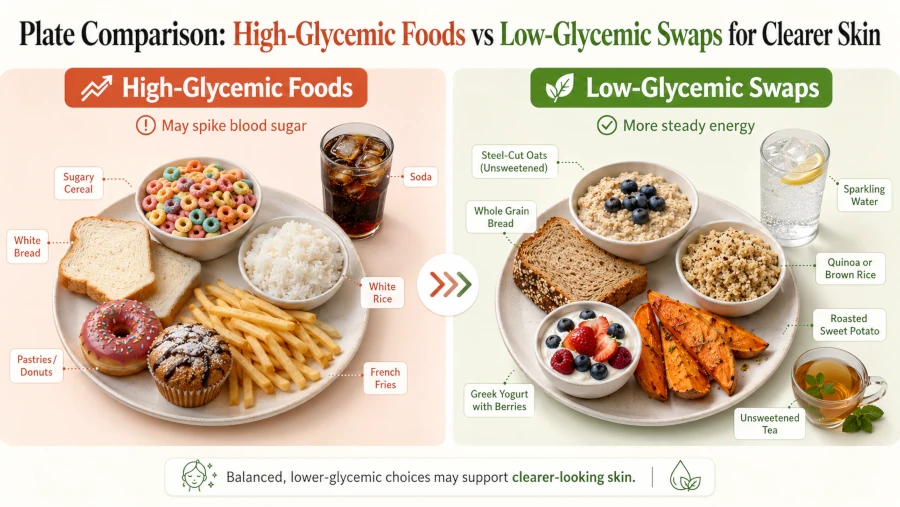
What to put on your plate instead
The flip side of the glycemic story is encouraging. A plate that keeps blood sugar steady is the same one dermatologists recommend for general health: whole grains, beans and lentils, vegetables, whole fruit, and unsweetened drinks. Leafy greens like spinach and other vegetables add fiber that blunts glucose spikes.
Some evidence suggests omega-3 fats (from oily fish, walnuts, and seeds) may calm inflammation, and antioxidant-rich produce supports the skin barrier — though these effects are smaller and less certain than the glycemic one. For a deeper list, see our guide to foods that are good for your skin and to vitamin E–rich foods. You can also browse more skin health guides. Treat all of this as support, not a cure.
How long before you’d notice a difference
Skin renews itself over roughly four to six weeks, so a diet change needs at least one or two full cycles — think 8 to 12 weeks — before you can judge it. Change one thing at a time (added sugar, or milk, not both at once) and keep a simple photo log, or you won’t know what helped.
Set expectations honestly. Where diet helps, it usually means fewer or milder breakouts, not flawless skin. Plenty of people who eat well still get acne, because hormones and genetics matter more than any single meal.
Safety, cautions, and when to see a doctor
Be careful about cutting whole food groups to chase clear skin. Milk and dairy supply calcium, vitamin D, and protein that growing teenagers — and people who are pregnant or breastfeeding — genuinely need. If you trial a dairy-free stretch, replace those nutrients (fortified plant milks work) and keep it time-limited unless a clinician advises otherwise.
Rigid “acne diets” can also slide into disordered eating, especially in teens, who get the most acne and the most pressure about appearance. If food rules start feeling anxious or all-consuming, that’s a reason to step back and talk to a doctor or dietitian, not to tighten the rules.
Don’t start high-dose supplements — zinc, vitamin A derivatives, and the like — for acne on your own, and never during pregnancy without medical advice. Several acne medications are unsafe in pregnancy, so coordinate your care.
When to see a dermatologist
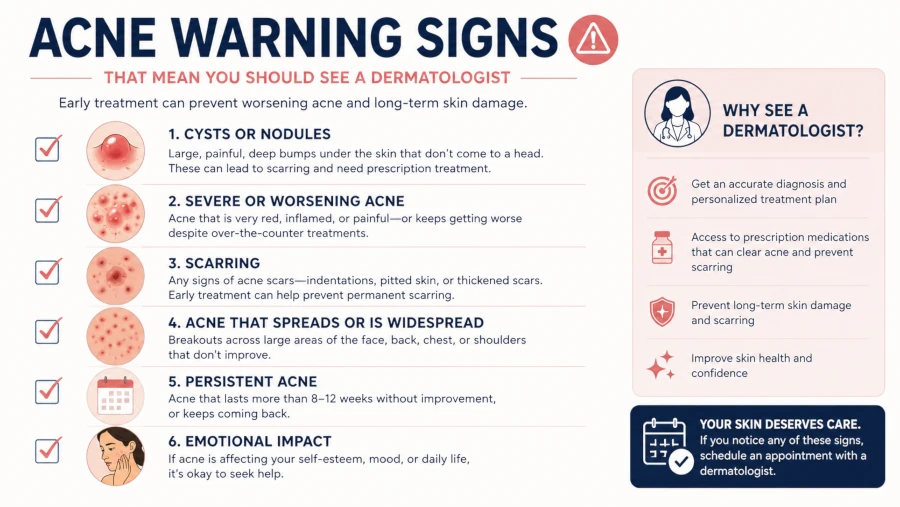
- Deep, painful cysts or nodules, or any acne that’s leaving scars or dark marks — see a dermatologist early, before scarring sets in.
- Acne that hasn’t budged after about three months of consistent over-the-counter care.
- Sudden, severe acne in adulthood — especially in women with irregular periods, excess facial or body hair, or hair thinning, which can point to a hormonal condition such as PCOS.
- A new breakout pattern after starting a medication or supplement.
- Acne that’s affecting your mood, sleep, or confidence. That counts as a reason to get help.
None of these are problems you can eat your way out of. They’re signals to bring in a professional.
| Health Disclaimer This article is for general education and is not medical advice. It is not a substitute for diagnosis or treatment from a qualified clinician. Acne has many causes, and the right plan depends on your skin, history, and overall health. If you are pregnant, breastfeeding, managing a medical condition, or taking medication, talk to your doctor or a dermatologist before making significant diet changes or starting any supplement. |
Frequently Asked Questions
Does sugar cause acne?
No food single-handedly causes acne, but diets high in sugar and other fast-digesting carbs are linked to more breakouts, probably through insulin and IGF-1. Cutting back on added sugar and refined carbs is the most evidence-backed dietary change — though it helps some people more than others.
Will quitting dairy clear my skin?
Maybe, maybe not. The link is real but modest and strongest for milk, especially skim. A time-limited trial of 8 to 12 weeks is reasonable; replace the calcium, vitamin D, and protein you’d miss, and don’t cut dairy permanently without guidance — especially for teens or during pregnancy.
Is chocolate bad for acne?
The evidence is mixed and weak, and what link exists seems driven by the sugar and milk in chocolate rather than the cocoa. If you’re cutting back, dark chocolate is the lower-sugar choice.
Does greasy or fried food cause pimples?
Not the way people think. The grease doesn’t add oil to your skin. Fried fast food is often loaded with refined carbs and sometimes dairy, and that’s the more likely connection.
Can I clear acne with diet alone?
Usually not, especially for moderate to severe acne. Think of diet as a helper that works alongside good skincare and, when needed, treatment from a dermatologist.
References
- American Academy of Dermatology. Can the right diet get rid of acne? → View source
- Penso L, et al. Association Between Adult Acne and Dietary Behaviors: Findings From the NutriNet-Santé Prospective Cohort Study. JAMA Dermatology. 2020. → View source
- Juhl CR, et al. Dairy Intake and Acne Vulgaris: A Systematic Review and Meta-Analysis of 78,529 Children, Adolescents, and Young Adults. Nutrients. 2018. → View source
- Smith RN, et al. A low-glycemic-load diet improves symptoms in acne vulgaris patients: a randomized controlled trial. American Journal of Clinical Nutrition. 2007. → View source
- Meixiong J, et al. Diet and acne: A systematic review. JAAD International. 2022. → View source
- Harvard Health Publishing. Does diet really matter when it comes to adult acne? 2020. → View source
