
Yes, most people lose some weight after a hiatal hernia repair, and in the first few weeks that’s expected. Surgeons commonly tell patients to expect around 10 to 15 pounds over the first four to six weeks [Kastenmeier, 2021], and one NHS hospital tells its patients that most people lose up to a stone (14 pounds) [Cambridge University Hospitals, 2026]. Weight loss after hiatal hernia surgery mostly comes from the liquid and soft-food diet, a tight feeling when you swallow, and early fullness. For many people a few pounds stay off for good. That’s a side effect, though, not what the operation is for. In the early weeks your job is to heal and eat enough.

If you’re still deciding on surgery, our guide to how hiatal hernia surgery and recovery work covers the operation itself. This article picks up afterward.
How much weight loss after hiatal hernia surgery is normal?
The early drop is well documented. What happens over the following year depends a lot on where you started.
| Source | Who was studied | What they found |
| Kastenmeier, 2021 (surgical review) | Patient guidance after hiatal hernia repair | Expect about 10–15 lb lost in the first 4–6 weeks before weight levels off. |
| Cambridge University Hospitals, 2026 (NHS leaflet) | Patients after anti-reflux surgery | Most people can lose up to a stone (about 14 lb). |
| Neumayer et al., 2005 | 213 adults after laparoscopic Nissen fundoplication, followed for 12 months | Average BMI fell from 27.6 to 26.0; average loss 3.9 kg (about 8.6 lb). Weight didn’t rebound or keep dropping between 3 and 12 months. Women and people with obesity lost more. |
| Patel et al., 2016 (conference abstract) | 228 adults after laparoscopic fundoplication, 2-year follow-up | BMI under 25: no meaningful change (+0.4 lb). BMI 25–30: −2.8 lb. BMI 30–35: −5.3 lb. BMI over 35: −16.9 lb. |
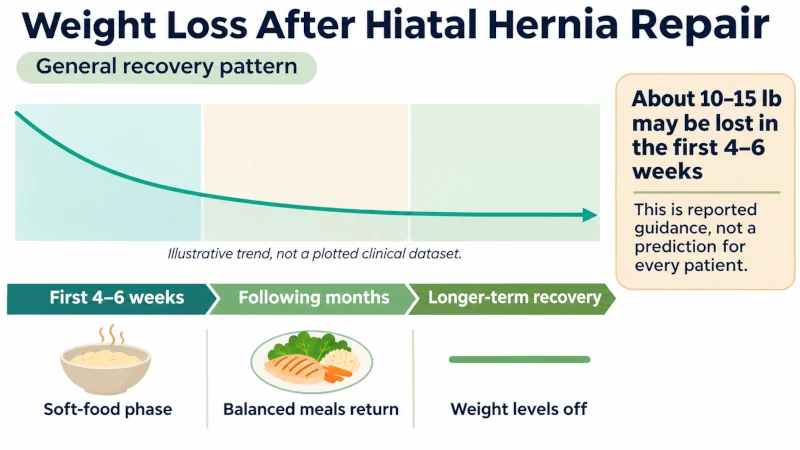
Read these numbers as rough guides. Both studies are from single centers, the ranges around each average were wide, and the 2016 figures come from a meeting abstract rather than a full published paper. Still, the pattern is consistent: people at a healthy weight tend to drift back to where they started, while people carrying more weight are more likely to keep some of the loss.
Why the scale drops
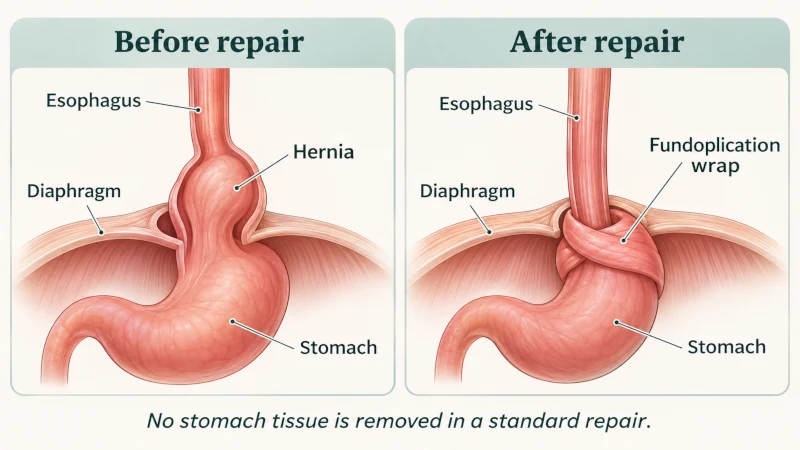
A common belief is that the surgery shrinks your stomach. A standard repair doesn’t remove any stomach. The surgeon pulls the stomach back below the diaphragm, tightens the opening it slipped through, and usually wraps the top of the stomach around the lower esophagus to stop reflux [MedlinePlus, 2025]. That’s different from a sleeve gastrectomy, which is a weight-loss operation. The weight comes off for more ordinary reasons.
The recovery diet
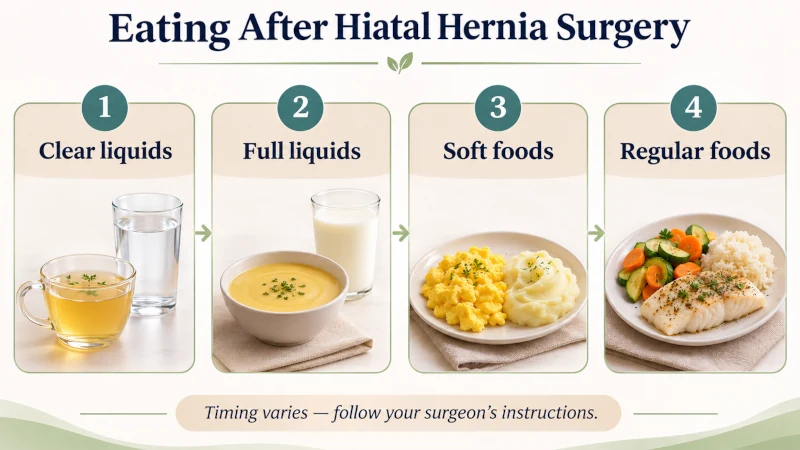
You’ll move from liquids to soft foods to solids over several weeks [MedlinePlus, 2025]. The details vary by hospital. MedlinePlus describes two weeks of clear liquids, about two weeks of full liquids, then soft food [MedlinePlus, 2024]. Other surgeons send patients home on a soft or puréed diet for two weeks, extended up to six weeks if swallowing is still difficult [Kastenmeier, 2021]. Either way, it’s hard to eat your usual calories when your food is thin, soft and slow to get down. Follow the plan your own surgeon gave you.
Tight swallowing
Food can feel as if it sticks or moves slowly for the first several weeks. That’s mostly swelling where the repair was done [Nikolic et al., 2019], and MedlinePlus says to expect tightness for six to eight weeks [MedlinePlus, 2024]. It usually settles within three months [MedlinePlus, 2025]. People eat less when every bite takes effort.
Gas, bloating and early fullness
The wrap that stops reflux also makes it harder to burp, so swallowed air and gas can collect and leave you feeling full fast. MedlinePlus calls this “gas bloat” and notes it usually improves [MedlinePlus, 2025].
How often this lingers is genuinely unclear, because studies define it differently. A 2024 systematic review of randomized trials found that a year after Nissen fundoplication, about 30% of patients reported gas bloating, 22% some difficulty swallowing, and 16% trouble belching or vomiting [Zehetner et al., 2024]. A large Vienna cohort that counted only daily, bothersome symptoms found gas-bloat syndrome in about 13% and persistent swallowing problems in just 2% after a median of four years [Nikolic et al., 2019]. Mild symptoms are common; ones that disrupt eating are much less so.
Why some people keep it off
Researchers haven’t pinned this down. In the 213-patient study, lasting weight loss wasn’t linked to swallowing problems [Neumayer et al., 2005], so it isn’t simply that people can’t eat. Changed eating habits, smaller meals and feeling full sooner are plausible explanations, but none has been proven.
How to keep eating enough while you heal
These habits make each meal easier and help you get enough food down:
- Eat little and often. Around six small meals a day works better than three big ones [Cambridge University Hospitals, 2026].
- Slow down and chew well. Sit upright while you eat and for 30 to 60 minutes afterward [Kastenmeier, 2021].
- Sip, don’t gulp. Skip fizzy drinks and straws, which add air to your stomach, and avoid very cold drinks early on [MedlinePlus, 2024].
- Watch foods that clump or catch. Bread and rice tend to form a lump [MedlinePlus, 2024]. Tough or large pieces of meat, raw vegetables, nuts, crisps and gas-forming vegetables such as broccoli, cauliflower and beans can also cause trouble early on [Cambridge University Hospitals, 2026].
| Usually easier in the first weeks | Often worth holding off on |
| Porridge or soaked cereal; scrambled or poached eggs | Bread, toast, pastries, dry crackers |
| Minced or very tender meat in gravy; soft, boneless fish | Steak, tough or fried meat, sausages |
| Mashed potato, soft pasta in sauce, mashed beans or lentils | Rice that clumps, chips, crisps, popcorn, nuts |
| Yogurt, cottage cheese, custard, puréed soup | Raw salad, fruit skins and seeds, stringy vegetables |
| Stewed or mashed fruit, smoothies | Fizzy drinks, including beer and sparkling water |

Table based on MedlinePlus (2024) and Cambridge University Hospitals (2026). Your surgeon’s list takes priority.
If you’re losing too much
When the scale keeps falling, make each mouthful count. The Cambridge NHS team suggests full-fat versions instead of “light” products, adding butter, oil, cream or cheese to soft foods, and having milky drinks, smoothies or soups between meals [Cambridge University Hospitals, 2026]. Protein helps you heal, and soft sources like eggs, fish, yogurt, cottage cheese and mashed lentils are easy to swallow. Tell your surgical team if your weight keeps dropping; they may suggest fortified nutrition drinks [Cambridge University Hospitals, 2026]. That same team asks patients to call if they can’t manage at least 1.5 liters of fluid in 24 hours [Cambridge University Hospitals, 2026].

Pills and medicines
Large tablets can catch at the repair site. Surgeons often have patients crush or split them for the first two weeks [Kastenmeier, 2021], and MedlinePlus says to crush pills and take them with liquid for the first month [MedlinePlus, 2024]. Some medicines must not be crushed, especially extended-release forms, which may need switching to another form [Kastenmeier, 2021]. Ask your pharmacist before you crush anything. If you think a medicine is affecting your appetite or weight, raise it with your doctor rather than stopping it yourself.
Moving again
Walking is encouraged from the start, several times a day [MedlinePlus, 2024]. It also helps ease gas pain. Lifting is limited for a while. MedlinePlus advises nothing heavier than 10 pounds [MedlinePlus, 2024], while some surgeons set the limit at 15 pounds for six weeks [Kastenmeier, 2021]. Use whichever limit your surgeon gave you. Straining, heavy or awkward lifting and strenuous exercise put pressure on the repair, so build back up gradually once you’re cleared [Kastenmeier, 2021].
The same goes for retching and vomiting. Each heave raises the pressure inside your abdomen sharply and can damage a fresh repair [Kastenmeier, 2021]. If you feel sick, tell your team early so they can treat it.
If you want to lose weight after hiatal hernia surgery
For many people this is a reasonable goal. Obesity is common in people with hiatal hernias and is known to raise the risk that the hernia comes back after repair [Daly et al., 2024]. Surgeons haven’t yet settled the BMI at which losing weight before or after repair makes a real difference. The 2024 SAGES guideline calls that an open question, made more pressing by newer weight-loss medicines [Daly et al., 2024].
Timing matters. Don’t diet during the liquid and soft-food weeks. Wait until you’re back on ordinary food and your surgeon has lifted your restrictions. After that, the basics apply: steady, modest calorie reduction, enough protein, and activity you build up to. A registered dietitian can plan this around foods you now tolerate. If you’re considering a weight-loss medicine, ask your surgeon or doctor first, especially if it can cause nausea or vomiting.
If your weight is high enough that weight-loss surgery is on the table, ask whether a combined operation makes sense. Our article on hiatal hernias and gastric sleeve surgery explains the trade-offs, including why a sleeve can worsen reflux. For everyday eating once you’ve recovered, these reflux-friendly foods for a hiatal hernia are a good place to start.
The mental side of eating again
A weeks-long soft diet is tedious, and a few episodes of food sticking can make anyone wary of eating. Some people start avoiding meals without quite noticing. Others feel relieved enough after surgery to want a fresh start with food. Both are understandable.
Weigh yourself once a week rather than daily, so you see the trend instead of the noise. If you’re skipping meals out of fear of discomfort, or low mood, anxiety or loss of interest in food lingers, tell your doctor. These are common after surgery and worth treating.
When weight loss is a warning sign
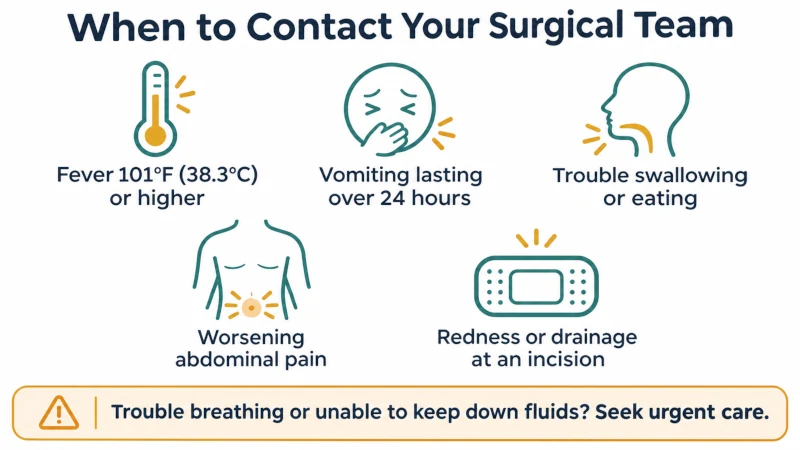
Steady loss during the soft-food weeks is expected. Weight loss alongside any of the following is not. Call your surgeon or care team if you have [MedlinePlus, 2024]:
- a temperature of 101°F (38.3°C) or higher
- nausea or vomiting that lasts more than 24 hours
- swallowing problems that stop you eating, or that haven’t improved after 2 to 3 weeks
- you can’t eat or drink
- swelling or pain in your belly, or pain your medicine doesn’t control
- incisions that bleed, are red or warm, or drain thick yellow, green or milky fluid
- a cough that won’t go away
- yellowing of your skin or the whites of your eyes
| Get urgent care now if you have trouble breathing, or if you can’t keep down any fluids at all. Call 911 or your local emergency number for severe breathing difficulty. |
Later on, severe or persistent heartburn, trouble swallowing, regurgitation, nausea or retching should be checked even if you feel otherwise well. They can point to a hernia that has come back or a wrap that has slipped. Doctors usually start with a barium swallow and may follow with an endoscopy or other tests [Kastenmeier, 2021]. Here’s what an upper endoscopy involves if you’re referred for one.
| HEALTH DISCLAIMER: This article is for general information and does not replace advice from your surgeon or doctor. Recovery plans differ between hospitals and between patients, so your own surgical team’s instructions on diet, medicines, lifting and follow-up come first. If you have symptoms that worry you, contact your care team, and for emergencies call 911 or your local emergency number. |
Frequently Asked Questions
Is it normal to lose weight after hiatal hernia surgery?
Yes. Losing roughly 10 to 15 pounds in the first four to six weeks is commonly reported [Kastenmeier, 2021]. It comes mainly from the liquid and soft-food diet and temporary swallowing tightness. Weight loss that continues after you’re back on normal food, or that comes with vomiting or an inability to eat, should be checked.
How long does weight loss last after hiatal hernia surgery?
Most of the drop happens in the first month or two. In one study of 213 patients, weight stayed stable between 3 and 12 months after surgery, with an average loss of 3.9 kg [Neumayer et al., 2005].
Will I gain the weight back?
It depends on where you started. In a two-year follow-up, people with a BMI under 25 ended up roughly where they began, while people with a BMI over 35 kept off an average of about 17 pounds [Patel et al., 2016]. That finding comes from a conference abstract, so treat it as a rough guide.
Can hiatal hernia surgery be used as a weight-loss surgery?
No. A standard repair doesn’t remove any stomach [MedlinePlus, 2025]. If you need substantial weight loss, ask about dedicated weight-loss treatment, which can sometimes be combined with hernia repair.
When can I start trying to lose weight?
Wait until you’re back on normal food and your surgeon has lifted your lifting and activity limits. Restricting calories during the soft-food phase makes healing harder and raises the risk of losing too much.
References
- Kastenmeier AS. Hiatal hernia repair: postoperative diet, activity, and optimal long-term follow-up. View source
- Neumayer C, Ciovica R, Gadenstätter M, Erd G, Leidl S, Lehr S, Schwab G. View source
- Patel LY, Bonamici NJ, Stringer TJ, Brown C, Morrison JD, Gitelis ME, Vigneswaran Y, Lapin B, Linn JG, Ujiki MB. View source
- MedlinePlus (U.S. National Library of Medicine). Anti-reflux surgery – discharge. View source
- MedlinePlus (U.S. National Library of Medicine). Anti-reflux surgery. View source
- Cambridge University Hospitals NHS Foundation Trust. Dietary advice following anti-reflux surgery. View source
- Daly S, Kumar SS, Collings AT, et al. SAGES guidelines for the surgical treatment of hiatal hernias. View source
- Nikolic M, Schwameis K, Semmler G, Asari R, Semmler L, Steindl A, Mosleh BO, Schoppmann SF. View source
- Zehetner J, Hoffsten J, Das S, et al. Looking back on a gold standard: a systematic literature review of laparoscopic Nissen fundoplication as an anti-reflux treatment option. European Surgery. View source


