
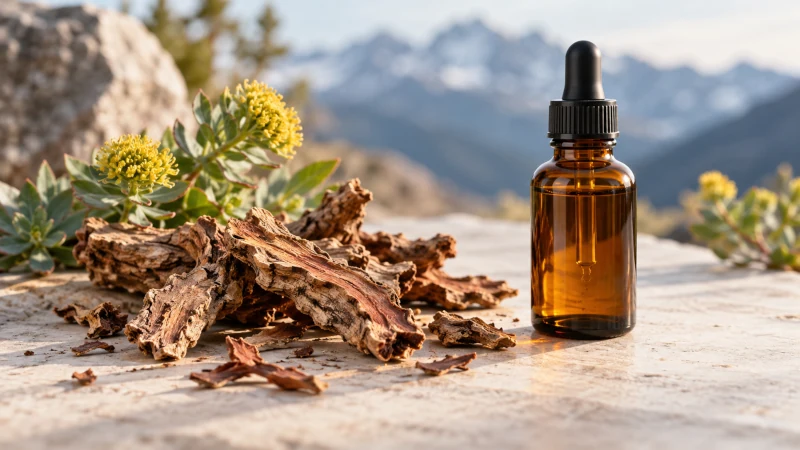
Rhodiola tincture is a liquid extract of the root of Rhodiola rosea, a hardy plant also known as golden root or arctic root. Most people reach for it hoping for steadier energy, less stress, or a clearer head. Here is the straight answer: a handful of small studies suggest rhodiola may ease stress-related fatigue, but the National Center for Complementary and Integrative Health says there still isn’t enough reliable evidence to show it helps with any health condition [NCCIH, 2025]. Very little of that research tested a tincture.
That isn’t a reason to write it off. It is a reason to keep your expectations modest, choose a product carefully, and check whether you’re someone who should skip it.
What rhodiola tincture is
Rhodiola rosea grows in cold regions and at high altitudes in Europe, Asia, and North America. It has a long history of use in Russia, Scandinavia, and other parts of Europe for endurance, fatigue, low mood, and altitude sickness [NCCIH, 2025]. Today it is sold mainly for energy, mood, focus, athletic performance, and stress.
A tincture is made by soaking the dried root in alcohol, often mixed with water, so the plant’s compounds dissolve into a liquid you take by the dropper. Two of those compounds matter when you shop. Rosavins are characteristic of R. rosea and help tell it apart from related species; salidroside is the other common marker [Booker et al., 2016]. You’ll also see rhodiola called an adaptogen, a loose term for herbs believed to help the body cope with stress.
Rhodiola tincture vs. capsules vs. tea
Form matters more than most labels let on. The human studies discussed below used dry extracts measured in milligrams, not tinctures measured in drops.
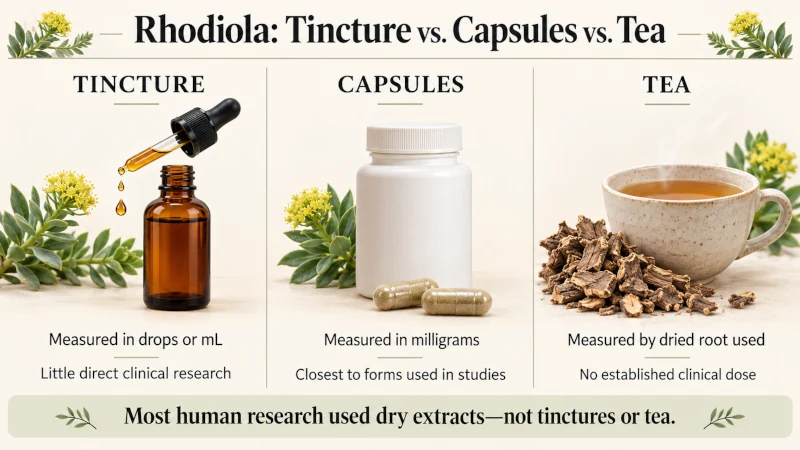
| Form | How the dose is measured | Research behind it | Watch for |
| Standardized capsule or tablet | Milligrams, often with a stated percentage of rosavins or salidroside | The form used in the trials discussed here [Mao et al., 2015; Kasper & Dienel, 2017] and in the EU traditional-use monograph [EMA, 2024] | Contents don’t always match the label [Porwollik & Jafari, 2026] |
| Tincture | Drops or milliliters; strength depends on the herb-to-solvent ratio | Little direct clinical research | Contains alcohol; in one small lab analysis, the tinctures had lower marker levels than most capsules [Porwollik & Jafari, 2026] |
| Tea | Grams of dried root per cup, rarely standardized | We found no clinical trials of rhodiola tea | Hard to know how much you’re getting |
Tinctures do have real advantages. They’re easy to adjust a few drops at a time, they suit people who struggle with pills, and in that same 2026 analysis none of the three tinctures tested had detectable heavy metals, while all seven capsules contained trace amounts [Porwollik & Jafari, 2026]. The trade-off is that you can’t easily compare a dropperful with the doses used in research.
A note on rhodiola tea
Brewing the dried root is a traditional way to take it, but there is no research telling you what a cup actually delivers. If the calming ritual of a warm cup is what you’re after, our guide to blending and brewing nervine tea covers herbs that are traditionally taken that way.
Rhodiola tincture benefits: what the research shows
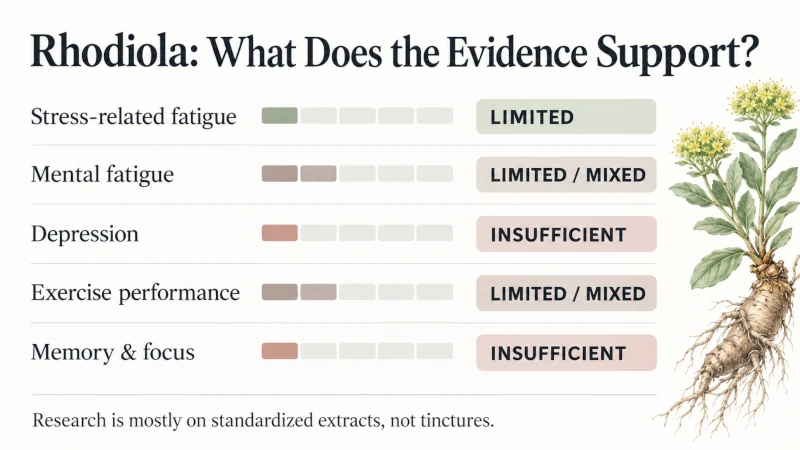
| Claimed benefit | Evidence | What that means |
| Stress-related fatigue and burnout | Limited | Accepted in the EU as traditional use only [EMA, 2024]; small trials with design weaknesses [Ishaque et al., 2012; Kasper & Dienel, 2017] |
| Mental fatigue | Limited, mixed | Several positive trials, but none free of plausible bias [Ishaque et al., 2012] |
| Depression | Insufficient | Did not beat placebo in a small 12-week trial [Mao et al., 2015]; not recommended by major psychiatric organizations [MSD Manual, 2025] |
| Exercise performance | Limited, mixed | The most promising area, but doses and results vary too much for firm conclusions [MSD Manual, 2025] |
| Memory and focus | Insufficient | No high-quality evidence [MSD Manual, 2025] |
Stress and fatigue
This is where rhodiola has the most support, and even here it is thin. The European Medicines Agency’s herbal committee lists rhodiola as a traditional herbal medicine for relieving symptoms of stress such as fatigue and exhaustion [EMA, 2024]. Read the fine print, though. The monograph states that this indication is based exclusively on long-standing use, not on proof from clinical trials.
The trials themselves paint a cautious picture. A 2012 systematic review examined 11 controlled studies of rhodiola for physical and mental fatigue and found that none were free of plausible bias. Results for physical fatigue were inconsistent; results for mental fatigue were mixed, with several studies favoring rhodiola [Ishaque et al., 2012].
A frequently cited newer study gave 118 adults with burnout symptoms 400 mg a day of a specific rhodiola extract for 12 weeks. Most reported at least some improvement. But everyone knew they were taking rhodiola and there was no placebo group, so the authors called their results preliminary [Kasper & Dienel, 2017].
Fatigue that lingers deserves a look before it gets treated. That goes double for exhaustion that hangs on after COVID, which needs a proper medical workup. If anxiety is part of what you’re feeling, our guide to adaptogenic herbs for social anxiety compares rhodiola with other options, and if you’re weighing it against the other best-known adaptogen, see what the evidence on ashwagandha supports.
Mood and depression
The best-designed trial here is small. Researchers randomly assigned 57 adults with mild to moderate major depression to a rhodiola extract, the antidepressant sertraline, or a placebo for 12 weeks. Overall, neither rhodiola nor sertraline did better than placebo. Rhodiola did cause fewer side effects: 30% of people taking it reported adverse reactions, compared with 63% on sertraline and 17% on placebo [Mao et al., 2015].
Major psychiatric organizations do not recommend rhodiola for major depression, either alone or added to other treatment [MSD Manual, 2025]. Depression is a serious and treatable illness. If you’re struggling, talk with a health care professional, and don’t stop or cut back an antidepressant to try rhodiola.
Focus and memory
Supplement marketing leans hard on focus and memory, yet there is no high-quality evidence that rhodiola improves either [MSD Manual, 2025]. If you’ve noticed memory changes, what’s normal and what isn’t as we age is a better starting point than any supplement.
Exercise and endurance
The MSD Manual identifies exercise as the most promising area. Some studies suggest a single dose may help endurance, and longer use may help short, intense efforts. The same source notes that doses and study lengths vary too much to settle the question [MSD Manual, 2025], and NCCIH’s overall verdict still stands: there isn’t enough reliable evidence to call rhodiola useful for any health purpose [NCCIH, 2025].
How to take rhodiola tincture
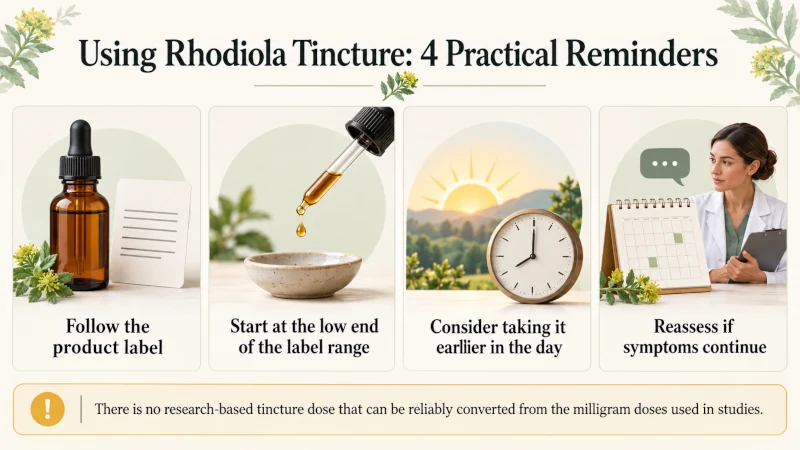
There is no research-based dose for rhodiola tincture. The dosing you’ll find in official sources is for dry extracts. The EU monograph, for example, covers a dry extract made with 67–70% ethanol, taken as 144–200 mg once or twice a day, up to 400 mg daily [EMA, 2024]. The trials above used roughly 340 to 400 mg a day of standardized extract [Mao et al., 2015; Kasper & Dienel, 2017]. Because tinctures vary so much in strength, you can’t reliably convert those milligrams into drops.
What you can do:
- Follow the label, and start low. Use the low end of the product’s suggested range for the first week or so and see how you react.
- Take it earlier in the day. Insomnia is one of the reported side effects [NCCIH, 2025], so an evening dose may not suit you.
- Keep courses short. Rhodiola is considered possibly safe for up to 12 weeks [NCCIH, 2025]. Less is known about longer use.
- Check in at two weeks. If your symptoms haven’t improved, the EU monograph advises seeing a doctor or qualified practitioner [EMA, 2024].
- Mind the alcohol. Tinctures are usually alcohol-based. If you avoid alcohol for any reason, look for an alcohol-free (glycerin-based) extract or use capsules instead.
Side effects
Most reported side effects are mild. NCCIH lists dizziness, headache, trouble sleeping, and either dry mouth or extra saliva [NCCIH, 2025]. The EU monograph adds nausea, stomach pain, diarrhea, rash, and itching, with frequency unknown [EMA, 2024]. Across the 11 studies in the fatigue review, only five adverse events were reported among 446 participants, all mild [Ishaque et al., 2012].
One rare but serious exception: a case report describes a manic episode in a person taking rhodiola as an exercise supplement [MSD Manual, 2025].
Drug interactions: the sources disagree
Respected sources reach different conclusions here, which is a reason for caution rather than reassurance. The EU monograph states that no clinically relevant interactions have been observed [EMA, 2024]. NCCIH, however, notes reported interactions with losartan, a blood pressure drug [NCCIH, 2025]. The MSD Manual goes further and flags possible interactions with [MSD Manual, 2025]:
- Antidepressants, especially serotonergic ones such as SSRIs (faster heart rate; risk of serotonin syndrome)
- Diabetes medicines (low blood sugar)
- Blood pressure medicines (added lowering effect)
- Warfarin (levels may rise)
- Anti-inflammatory drugs (added effect)
- Immunosuppressants (may work less well)
The practical advice is the same whichever source you trust most. If you take any prescription medicine, ask your pharmacist or doctor before adding rhodiola. NCCIH gives that advice for herbs in general, because some herbs and medicines interact in harmful ways [NCCIH, 2025].
Who should avoid rhodiola tincture
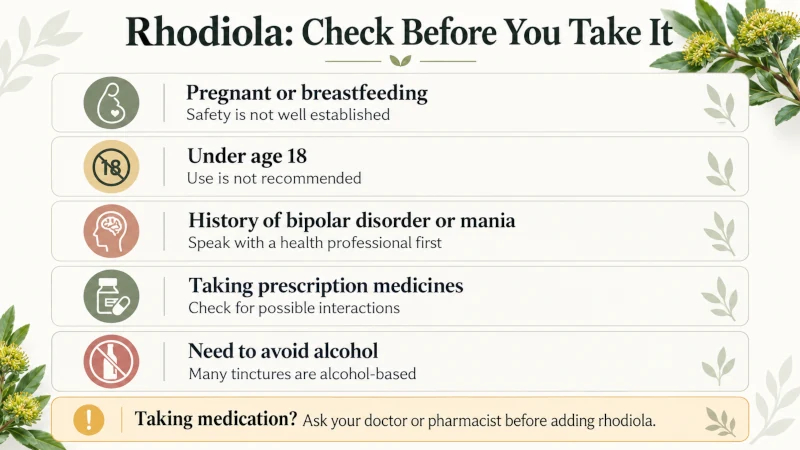
- Pregnant or breastfeeding people. Little is known about safety [NCCIH, 2025], and the EU monograph does not recommend use [EMA, 2024].
- Anyone under 18. There isn’t enough data, so use is not recommended [EMA, 2024].
- People with bipolar disorder or a history of mania, given the reported manic episode [MSD Manual, 2025].
- People on antidepressants, diabetes or blood pressure medicines (including losartan), warfarin, or immunosuppressants, unless a clinician has approved it [MSD Manual, 2025; NCCIH, 2025].
- People who need to avoid alcohol, who should choose an alcohol-free form.
When to see a doctor
Tiredness and stress have many causes, and some are treatable medical problems. Contact a health care provider right away if fatigue comes with confusion or dizziness, blurred vision, little or no urine, or new swelling and weight gain [MedlinePlus, 2025]. Make an appointment if you have unexplained weakness or fatigue along with fever, unintentional weight loss, or regular sweats, or if you feel sad or depressed or have insomnia [MedlinePlus, 2025].
If you’re having thoughts of harming yourself, call or text 988 in the U.S. to reach the 988 Suicide & Crisis Lifeline, which is free, confidential, and available 24/7 [988 Lifeline].
How to choose a rhodiola tincture
Quality is a genuine problem with rhodiola. A 2016 analysis of about 40 commercial products found that roughly one in five contained no rosavins, the marker that identifies R. rosea, and most of the rest appeared to be mixed with other Rhodiola species [Booker et al., 2016]. A 2026 study of 10 products bought on Amazon found several whose contents differed substantially from their labels, including one that likely contained added synthetic salidroside [Porwollik & Jafari, 2026].
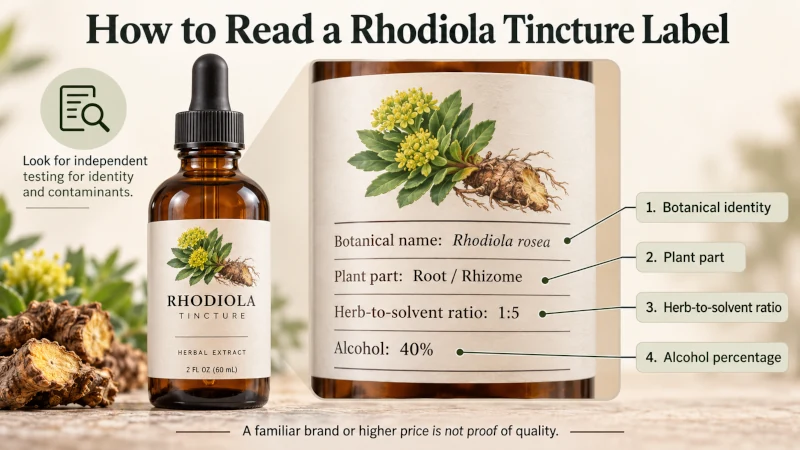
Before you buy, look for:
- The botanical name Rhodiola rosea and the plant part (root or rhizome)
- The herb-to-solvent ratio and alcohol percentage, so you know how concentrated it is
- Independent third-party testing for identity and contaminants
- Restrained marketing: skip any product that promises to cure depression, anxiety, or fatigue
A familiar brand or a higher price isn’t proof of quality. If the label doesn’t answer these questions, ask the manufacturer.
| HEALTH DISCLAIMER: This article is for general education and is not a substitute for advice from your doctor, pharmacist, or another qualified health professional. In the U.S., rhodiola is typically sold as a dietary supplement, and supplements are not approved by the FDA before they are sold [NCCIH, 2025]. Talk with a professional before using rhodiola if you are pregnant or breastfeeding, take prescription medicines, or have a mental health or other medical condition. |
Frequently Asked Questions
How long does rhodiola tincture take to work?
No study has answered that for tinctures. The trials discussed above measured results over several weeks, up to 12 [Mao et al., 2015; Kasper & Dienel, 2017]. If your symptoms haven’t improved after two weeks of use, the EU monograph advises seeing a doctor [EMA, 2024].
Can I take rhodiola tincture every day?
Studies gave it daily, and NCCIH considers rhodiola possibly safe for up to 12 weeks [NCCIH, 2025]. Less is known about longer use, so check with a clinician if you plan to take it beyond that.
Is rhodiola tincture better than capsules?
Not necessarily. Standardized capsules are closer to what was studied and easier to dose. Tinctures are easier to adjust, and in one small lab analysis they had no detectable heavy metals, but they also had lower levels of rhodiola’s marker compounds than most capsules [Porwollik & Jafari, 2026].
Can I take rhodiola with an antidepressant?
Not without talking to your prescriber first. The MSD Manual warns of possible faster heart rate and serotonin syndrome when rhodiola is combined with serotonergic antidepressants [MSD Manual, 2025].
Is rhodiola tincture safe during pregnancy?
Little is known about rhodiola during pregnancy or breastfeeding [NCCIH, 2025], and the EU monograph does not recommend it [EMA, 2024]. Most tinctures also contain alcohol.
References
- National Center for Complementary and Integrative Health. Rhodiola: Usefulness and Safety. View source
- European Medicines Agency, Committee on Herbal Medicinal Products. European Union herbal monograph on Rhodiola rosea L., rhizoma et radix, Revision 1. View source
- Ishaque S, Shamseer L, Bukutu C, Vohra S. Rhodiola rosea for physical and mental fatigue: a systematic review. BMC Complementary and Alternative Medicine. View source
- Kasper S, Dienel A. Multicenter, open-label, exploratory clinical trial with Rhodiola rosea extract in patients suffering from burnout symptoms. Neuropsychiatric Disease and Treatment. View source
- Mao JJ, Xie SX, Zee J, et al. Rhodiola rosea versus sertraline for major depressive disorder: a randomized placebo-controlled trial. Phytomedicine. View source
- Shane-McWhorter L. Rhodiola. MSD Manual Professional Edition. View source
- Booker A, Jalil B, Frommenwiler D, et al. The authenticity and quality of Rhodiola rosea products. Phytomedicine. View source
- Porwollik S, Jafari M. The quality and safety of Rhodiola rosea supplements on the U.S. market: an analysis of biomarkers, heavy metals, and pesticide residues. View source
- MedlinePlus Medical Encyclopedia. Fatigue. U.S. National Library of Medicine. View source
- 988 Suicide & Crisis Lifeline. 988lifeline.org. View source


