
If you are still exhausted months after COVID, the most useful thing you can do is not a supplement. It is learning to stay inside your energy limit so you stop triggering crashes — and getting bloodwork to rule out the treatable causes of fatigue that have nothing to do with the virus. Natural remedies for post-COVID fatigue can support that work. None of them replace it, and one commonly recommended herb carries a real cardiac risk that rarely gets mentioned.
What post-COVID fatigue actually is
Fatigue, brain fog, and post-exertional malaise are among the most commonly reported symptoms of Long COVID, which has been linked to more than 200 distinct symptoms across multiple body systems [CDC, 2026a]. Symptoms can last months or years, and they can fade, return, and change over time. Most people improve significantly after about three months; some take far longer [CDC, 2026a].
The tiredness itself is not ordinary tiredness. It does not reliably lift after a good night’s sleep, and it is often out of proportion to what you actually did that day.
No blood test diagnoses Long COVID, and routine results — blood work, chest X-rays, ECGs — often come back normal [CDC, 2026b]. Normal results do not mean nothing is wrong. Diagnosis rests on your history and symptoms, and testing is mainly there to rule other things out.
Natural remedies for post-covid fatigue: Start with pacing, not with supplements
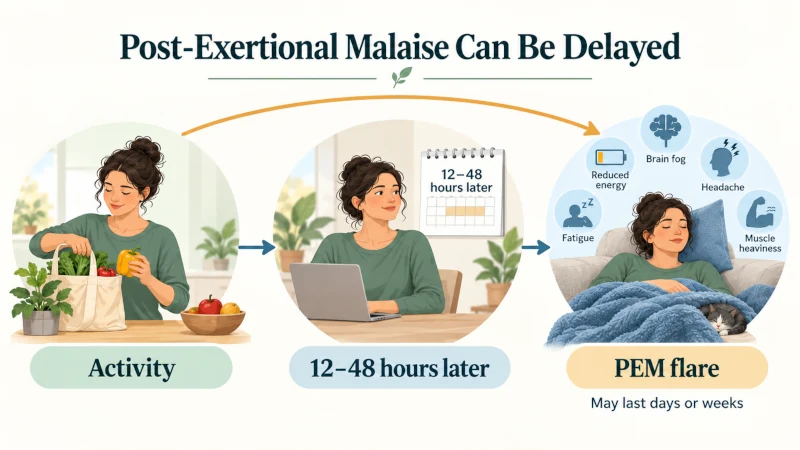
Post-exertional malaise (PEM) is the worsening of symptoms after even minor physical or mental effort that you would have handled easily before you got sick. Symptoms typically get worse 12 to 48 hours after the activity, and a flare can last days or weeks [CDC, 2026b].
That delay is what makes PEM so easy to miss. You feel roughly okay while you are doing the thing. The bill arrives two days later, by which point it is hard to connect the two.
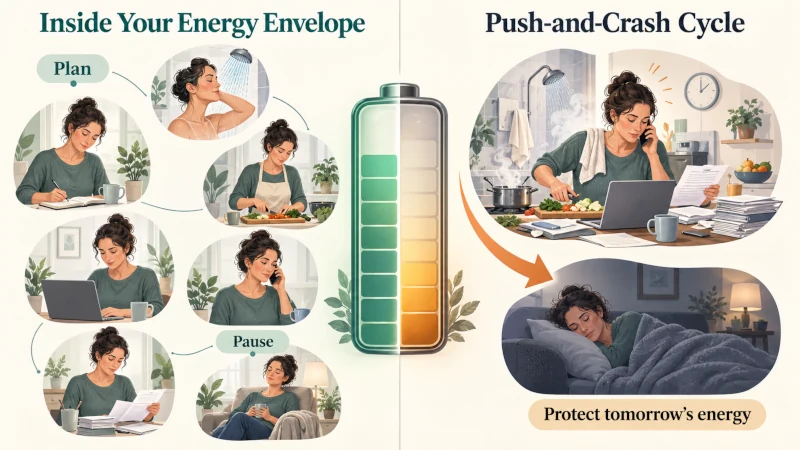
PEM can be reduced through activity management, usually called pacing. The goal is to work out your own limits for physical and mental activity, then plan your days to stay inside them — what clinicians often call staying within your “energy envelope” [CDC, 2024].
Finding your baseline
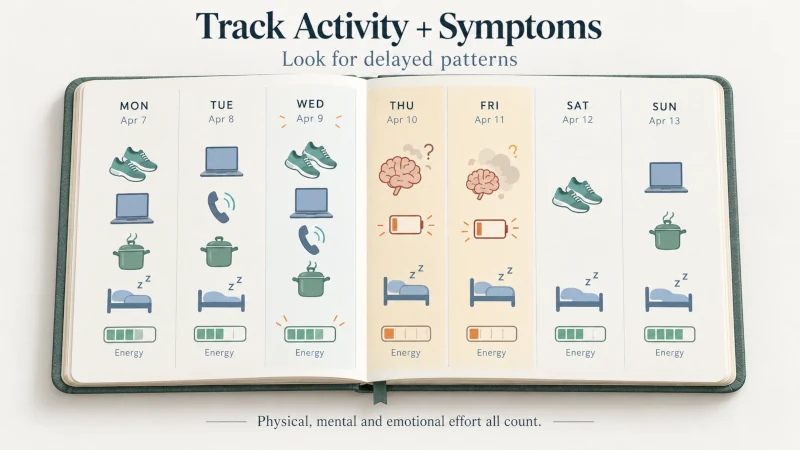
A symptom and activity diary is the practical starting point, particularly early on [CDC, 2024]. Log what you did and how you felt, then look back across one to two weeks for the pattern. You are looking for the level of activity that does not produce a crash a day or two later, including mental and emotional effort — a long phone call, a difficult meeting, or a stressful conversation all draw on the same account.
Once you have that baseline, the hard part is holding it on good days. The CDC describes the “push and crash” cycle directly: people try to do too much on a good day to make up for lost time, and the pushing sets off a relapse [CDC, 2024]. Protecting a good day by not spending all of it is genuinely counterintuitive, and it is the single most valuable habit in this whole article.
Breaking tasks into smaller pieces helps. Showering, cooking, and cleaning can each be split into shorter segments with rest between [CDC, 2024].
Why “gradually build up your exercise” is the wrong default
Plenty of post-COVID advice, including the earlier version of this article, tells you to start with gentle movement and steadily increase the intensity. For some people that is fine. For people with PEM, it can cause real harm.
The CDC is unambiguous on this point for ME/CFS, the post-infectious illness that overlaps heavily with Long COVID: patients cannot tolerate vigorous aerobic exercise, and standard exercise recommendations written for healthy people can substantially harm them. If exercise plans are not designed and carried out carefully, patients may experience serious deterioration in function and health [CDC, 2024].
The NHS puts the same caution more plainly for Long COVID: do not start exercising again before talking to a GP or specialist, and if you do move, be careful and stop if symptoms appear [NHS, 2025].
Deconditioning is also harmful, so the answer is not total rest indefinitely [CDC, 2024]. Keep the activity you can tolerate. Increase it cautiously, only once you are stable, and ideally with a clinician or exercise physiologist who understands PEM. If standing upright is itself a problem — dizziness, palpitations, feeling faint after a minute or two on your feet — that orthostatic intolerance usually needs addressing before any activity plan makes sense [CDC, 2024].
There is trial evidence on exercise in Long COVID, and it is narrower than it first appears. A living systematic review of 24 randomized trials covering 3,695 patients found moderate-certainty evidence that intermittent aerobic exercise three to five times weekly for four to six weeks probably improves physical function compared with continuous exercise [Zeraatkar et al., 2024]. That is a comparison between two ways of exercising, not proof that exercise beats rest, and the trials in this area have generally not screened participants for PEM. Treat it as a reason to favor short bouts with recovery over sustained effort, not as permission to push.
Rule out the causes of fatigue that have real treatments
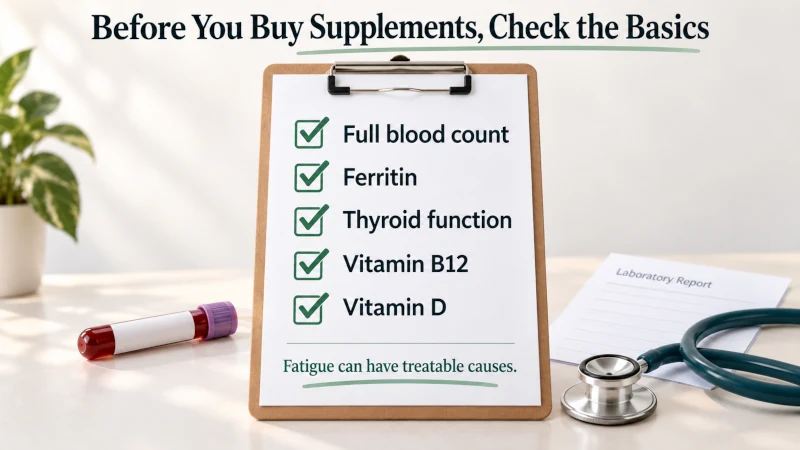
Before you spend money on supplements, find out whether something fixable is contributing. Iron-deficiency anemia, low B12, an underactive thyroid, low vitamin D, sleep apnea, depression, and medication side effects all produce fatigue, and all of them are more treatable than Long COVID itself. A GP assessing suspected Long COVID will typically check blood pressure and heart rate, run blood tests, and measure blood oxygen [NHS, 2025].
Ask for the basics: a full blood count, ferritin, thyroid function, vitamin D, and B12. If one of those comes back low, correcting it is a far better use of your effort than any herb — and if they are all normal, you have saved yourself from guessing.
If iron does come back low, food helps alongside whatever your doctor recommends. Our guide to iron-rich foods covers both animal and plant sources, and pairing plant-based iron with vitamin C-rich foods improves how much of it you absorb.
Sleep that does not refresh you
Unrefreshing sleep is one of the defining features of this kind of illness — you sleep the hours and wake up as though you did not [CDC, 2024]. Frequent waking, vivid dreaming, restless legs, and either insomnia or excessive sleepiness are all common [CDC, 2024].
Standard sleep hygiene is still worth doing, because it costs nothing and occasionally helps: consistent bed and wake times, a dark cool room, screens out of the last hour, caffeine confined to the morning. The NHS specifically suggests going to sleep and waking at the same time each day to help with fatigue [NHS, 2025].
Be realistic about the ceiling. If you are still waking unrefreshed after weeks of good sleep habits, that is information to bring to your doctor, not a sign you need to try harder. Sleep medication is sometimes appropriate, and an undiagnosed primary sleep disorder such as sleep apnea is worth ruling out [CDC, 2024].
Chamomile, lemon balm, and similar teas are a reasonable part of a wind-down routine if you enjoy them. The evidence that they meaningfully change post-COVID fatigue is not there, so treat them as comfort rather than treatment.
Food, hydration, and what they can and cannot do
Nutrition advice for post-COVID fatigue tends to get oversold. No food resets your energy metabolism, and nothing you eat “removes toxins” — that claim appeared in the earlier version of this article and it is not supported by anything credible.
What eating well does do is stop you adding preventable problems on top of an illness that is already draining. The NHS includes eating a balanced diet among the practical steps for Long COVID [NHS, 2025]. A reasonable pattern looks like this:
- Protein at every meal. Eggs, fish, poultry, beans, lentils, Greek yogurt. Helps steady blood sugar through the day.
- Slow carbohydrates rather than fast ones. Oats, brown rice, whole-grain bread. Sugary snacks produce a lift and then a slump that is easy to mistake for a symptom flare.
- Vegetables, fruit, nuts, and seeds. Leafy greens, beans, nuts, and whole grains are also the best food sources of magnesium, which is involved in energy metabolism and which many adults fall short on.
- Fluids through the day. Dehydration worsens dizziness and headaches, especially if you have orthostatic symptoms.
- Less alcohol. It fragments sleep even in modest amounts, which feeds directly back into daytime fatigue.
Practical constraint: cooking is itself an activity that can trigger PEM [CDC, 2024]. On low-energy days, simple assembly food, batch cooking from a better day, or help from someone else beats an ambitious recipe you will pay for later.
Supplements and herbs: what the evidence actually supports
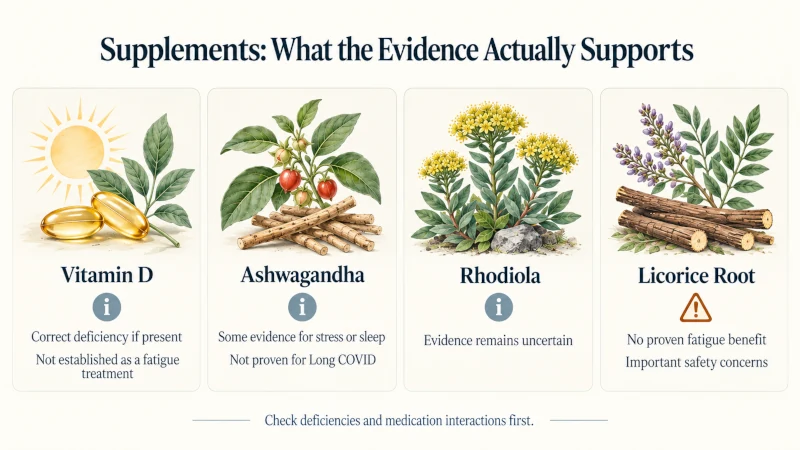
Start with the honest headline. NICE, which produces the UK’s Long COVID guidance, instructs clinicians to explain to patients that it is not known whether over-the-counter vitamins and supplements are helpful, harmful, or have no effect in treating ongoing symptomatic COVID-19 or post-COVID-19 syndrome [NICE, 2021].
What follows is not a ranking of what works. It is a realistic account of each option.
Vitamin D
Worth testing for, worth correcting if low, not established as a treatment for existing fatigue.
The largest relevant trial randomized 1,747 adults with recently diagnosed COVID-19, plus 277 household contacts, to high-dose vitamin D3 (9,600 IU daily for two days, then 3,200 IU daily) or placebo for four weeks. Vitamin D did not reduce the severity of the acute infection. A per-protocol analysis showed a non-significant trend toward less Long COVID at eight weeks, which the authors described as promising enough to warrant further study [Ganmaa et al., 2026].
Two things to hold onto. The trend was not statistically significant, so it is a signal rather than a finding. And the trial tested supplementation starting during acute infection — it does not tell you that taking vitamin D now will improve fatigue you have already had for months. If your level is low, correcting it is sensible on its own merits.
Ashwagandha
Some ashwagandha preparations may be effective for insomnia and stress, according to NCCIH, though the evidence for anxiety is unclear and there is not enough evidence to judge it for most other conditions. There is specifically not enough high-quality evidence to support its use for COVID-19 [NCCIH, 2023].
If stress and poor sleep are feeding your fatigue, that is the plausible route by which it might help. It is not a treatment for Long COVID.
Safety matters more here than the benefit does. Ashwagandha may be safe short term, up to about three months, with no good long-term safety data. It can cause drowsiness, stomach upset, diarrhea, and vomiting. Rare cases of liver injury have been linked to ashwagandha supplements. It should be avoided in pregnancy and while breastfeeding, and it is not recommended for people about to have surgery or those with autoimmune or thyroid disorders. It may interact with medicines for diabetes and high blood pressure, immunosuppressants, sedatives, anticonvulsants, and thyroid hormone medication. Because it may raise testosterone, people with hormone-sensitive prostate cancer should avoid it [NCCIH, 2023].
Given how many people with Long COVID have thyroid or autoimmune conditions, or are on several medications, ashwagandha deserves a conversation with your doctor rather than a click. Our broader guide to adaptogenic herbs covers this category in more detail.
Rhodiola
NCCIH’s assessment is blunt: there is not enough reliable evidence to determine whether rhodiola or its components are useful for any health-related purpose, and most human research is low to moderate quality [NCCIH, 2025a].
It is possibly safe for up to 12 weeks. Side effects can include dizziness, headache, insomnia, and either dry mouth or excess saliva, and interactions with losartan have been reported [NCCIH, 2025a]. Insomnia and dizziness are both symptoms you are presumably trying to reduce, which is worth weighing before you start.
Licorice root — the one to be careful with
The older version of this page recommended licorice root on the basis that it “strengthens the adrenal glands.” That rationale is not supported, and the safety profile makes this the most important correction in this rewrite.
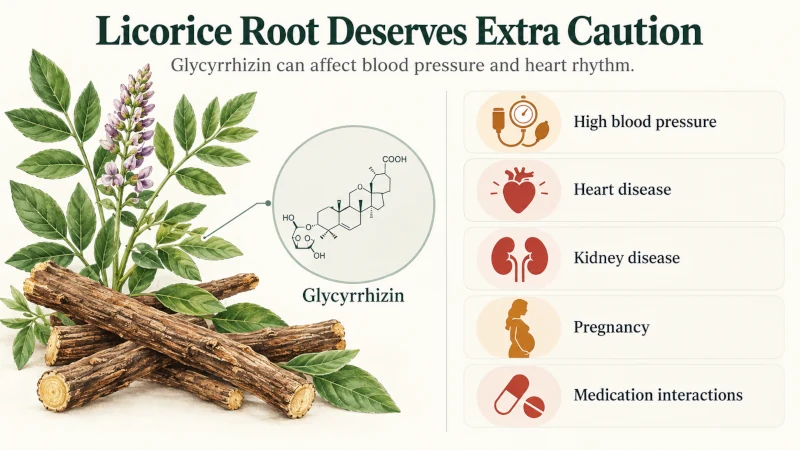
Licorice contains glycyrrhizin, which can cause serious adverse effects including irregular heartbeat and cardiac arrest, particularly in large amounts or with long-term use. Even small amounts have been linked to severe effects in people who consume a lot of salt, people with high blood pressure, and people with heart or kidney conditions. Licorice can also interact with corticosteroids, and consuming large amounts during pregnancy is unsafe and raises the risk of delivery before 38 weeks [NCCIH, 2025b].
There is also no good evidence supporting licorice for COVID-19, and not enough high-quality evidence to clearly support its use for any health condition [NCCIH, 2025b].
Deglycyrrhizinated licorice (DGL), which has the glycyrrhizin removed, might be safe for up to four months [NCCIH, 2025b] — but it has no demonstrated benefit for fatigue either. If you have high blood pressure, heart disease, or kidney disease, ordinary licorice root is one to leave alone.
The rest of the list
Several supplements frequently suggested for post-COVID fatigue were tested in randomized trials and reviewed in the 2024 BMJ living systematic review, which found no compelling evidence of effectiveness for combined probiotics and prebiotics, coenzyme Q10, or combined L-arginine and vitamin C, among other interventions [Zeraatkar et al., 2024].
Absence of proven benefit is not proof that they do nothing — it means the trials run so far have not shown an effect you can rely on. Omega-3s, green tea, turmeric, and probiotics are all reasonable things to eat; none has been shown to resolve post-COVID fatigue. Our guide to anti-inflammatory supplements covers what that evidence does and does not show, and our overview of energy-boosting supplements goes deeper on dosing and testing.
Green tea deserves one specific caution: it contains caffeine. Stimulants can mask your true energy limit and make it easier to overshoot into a crash, which is the opposite of what pacing requires.
Essential oils, Epsom salt baths, massage, and acupuncture were in the earlier version of this page. A warm bath or a gentle massage can be genuinely pleasant and may ease muscle aches, and there is no reason to stop if you find them comforting. There is no good evidence that any of them changes the course of post-COVID fatigue, and they should not displace pacing or a medical assessment.
What has the strongest evidence so far
The 2024 living systematic review in The BMJ pooled 24 randomized trials covering 3,695 patients with Long COVID. Two approaches came out ahead, both with moderate-certainty evidence [Zeraatkar et al., 2024]:
| Intervention | Finding | Certainty |
| Online cognitive behavioral therapy (CBT) | Probably reduces fatigue (mean difference −8.4; 95% CI −13.11 to −3.69 on the Checklist for Individual Strength fatigue subscale, range 8–56) and probably improves concentration | Moderate |
| Online supervised combined physical and mental health rehabilitation | Probably improves overall health — an estimated 161 more patients per 1,000 (95% CI 61 to 292 more) reported meaningful improvement or recovery — and probably reduces depression symptoms and improves quality of life | Moderate |
| Intermittent vs. continuous aerobic exercise, 3–5×/week for 4–6 weeks | Probably improves physical function compared with continuous exercise | Moderate |
CBT needs one clarification, because the term carries baggage in this community. It does not imply the illness is psychological. It is a structured way to manage symptoms, activity, and the distress that comes with chronic illness — and in these trials it produced the clearest reduction in fatigue scores of anything tested.
Neither approach is a cure, and both were delivered as structured programs rather than as self-help. Ask your doctor what post-COVID rehabilitation services exist near you. In the UK, the NHS supports people through post-COVID syndrome services covering fatigue management, physiotherapy, CBT, and cognitive rehabilitation [NHS, 2025].
Safety, interactions, and who should be cautious
Talk to a doctor or pharmacist before starting any supplement in this article if you:
- are pregnant, trying to conceive, or breastfeeding — ashwagandha should be avoided in pregnancy and breastfeeding [NCCIH, 2023], and large amounts of licorice in pregnancy are unsafe [NCCIH, 2025b];
- take prescription medication, especially for blood pressure, diabetes, thyroid conditions, seizures, or immune suppression, or take sedatives or corticosteroids [NCCIH, 2023; NCCIH, 2025b];
- have high blood pressure, heart disease, or kidney disease — this is the group most at risk from licorice [NCCIH, 2025b];
- have an autoimmune or thyroid disorder, or surgery scheduled [NCCIH, 2023];
- are already taking several supplements at once, since interactions multiply and nobody is tracking the total but you.
Supplements are not reviewed by the FDA for safety or effectiveness before they are sold, and manufacturers are responsible for their own safety evaluation and labeling [NCCIH, 2023]. Products vary in what they actually contain. Third-party testing marks are a partial safeguard, not a guarantee.
One more caution specific to this illness: anything that makes you feel temporarily more capable — caffeine, high-dose stimulant blends, “energy” formulas — can push you past your limit without you noticing until the crash lands two days later.
Red flags: when to stop reading and get care
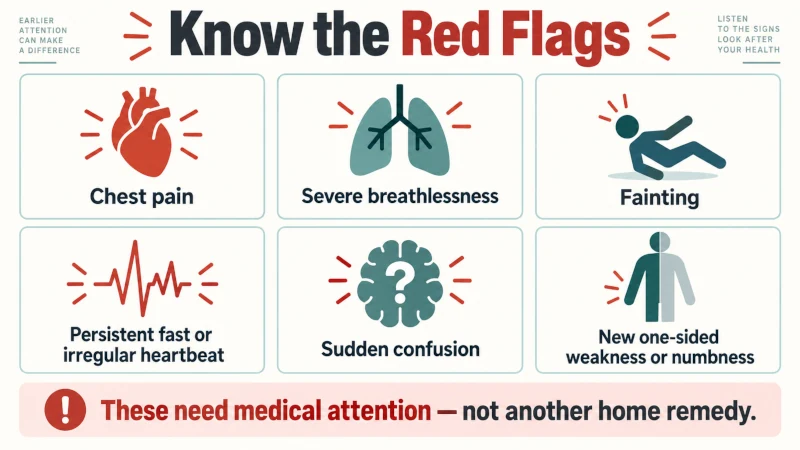
Some symptoms need medical attention rather than a remedy. People who have had COVID-19, particularly severe cases, may be more likely to develop new or worsening health conditions including heart problems and blood clots [CDC, 2026a].
Seek emergency care for chest pain, severe or sudden shortness of breath, fainting, a fast or irregular heartbeat that does not settle, sudden confusion, or new weakness or numbness on one side of the body.
Make a non-urgent appointment if you have symptoms that persist or are hard to explain, or if you think you might have Long COVID [NHS, 2025] — and also for unexplained weight loss, a persistent fever, night sweats, new breathlessness on light activity, loud snoring with daytime sleepiness, or low mood and loss of interest that lasts more than two weeks. Fatigue is a feature of many conditions that are more treatable than Long COVID, which is exactly why it is worth having someone check.
If your fatigue is getting steadily worse rather than fluctuating, that also deserves a review rather than another supplement.
| Health Disclaimer: This article is for general educational and informational purposes only. It is not medical advice and is not a substitute for diagnosis or treatment by a qualified healthcare professional. Long COVID varies enormously from person to person, and supplements and herbs can interact with prescription medication. Talk to your doctor or pharmacist before starting any supplement described here — especially if you are pregnant or breastfeeding, have a heart, kidney, thyroid, or autoimmune condition, or take regular medication. Do not begin or increase an exercise programme without speaking to a clinician first. Seek urgent medical care for chest pain, severe breathlessness, fainting, an irregular heartbeat, sudden confusion, or new weakness or numbness, and call 911 (or 999 in the UK) in an emergency. |
Frequently Asked Questions
How long does post-COVID fatigue last?
It varies widely. Most people with Long COVID symptoms improve significantly after about three months, while others see no improvement for months or even years after symptoms first appear [CDC, 2026a]. Symptoms can also fade and return rather than resolving in a straight line.
What is the best supplement for post-COVID fatigue?
There is no supplement with established effectiveness for it. NICE guidance tells clinicians to explain that it is not known whether over-the-counter vitamins and supplements are helpful, harmful, or have no effect in Long COVID [NICE, 2021]. The better use of your energy is bloodwork to find a correctable deficiency, and pacing to avoid crashes.
Should I exercise through post-COVID fatigue?
How do I know if I have post-exertional malaise?
The signature is delayed and disproportionate. Symptoms typically worsen 12 to 48 hours after physical or mental exertion that would previously have been easy, and the flare can last days or weeks [CDC, 2026b]. Keeping an activity and symptom diary for a week or two usually makes the pattern visible [CDC, 2024].
Is brain fog part of the same problem?
Often, yes. Cognitive effort draws on the same limited capacity as physical effort, and mental overexertion can trigger PEM. Planning rest after any demanding mental activity is part of the same strategy [CDC, 2024].
Can a blood test confirm Long COVID?
No. No laboratory test can definitively diagnose or rule out Long COVID, and routine results are often normal [CDC, 2026b]. Testing is used to exclude other explanations, which is still worth doing.
References
- Centers for Disease Control and Prevention. Long COVID Signs and Symptoms. Page updated 9 March 2026. View source
- Centers for Disease Control and Prevention. Long COVID Clinical Guidance. Accessed 19 September 2026. View source
- Centers for Disease Control and Prevention. Strategies to Prevent Worsening of Symptoms (ME/CFS). Last reviewed 10 May 2024. View source
- National Health Service (UK). Long COVID. Page last reviewed 19 August 2025. View source
- National Institute for Health and Care Excellence. COVID-19 rapid guideline: managing the long-term effects of COVID-19 (NG188), section 5: Management. Recommendations in this section marked [2020, amended 2021]. View source
- Zeraatkar D, Ling M, Kirsh S, et al. Interventions for the management of long covid (post-covid condition): living systematic review. BMJ. 2024;387:e081318. doi:10.1136/bmj-2024-081318. PMID 39603702. View source
- Ganmaa D, Cook KA, Khudyakov P, et al. A Randomized Trial of Vitamin D Supplementation and COVID-19 Clinical Outcomes and Long COVID: The Vitamin D for COVID-19 Trial. J Nutr. 2026;156(4):101398. doi:10.1016/j.tjnut.2026.101398. PMID 41826107. View source
- National Center for Complementary and Integrative Health. Ashwagandha: Usefulness and Safety. Last updated March 2023. View source
- National Center for Complementary and Integrative Health. Rhodiola: Usefulness and Safety. Last updated April 2025. View source
- National Center for Complementary and Integrative Health. Licorice Root: Usefulness and Safety. Last updated April 2025. View source


