
This Mexican-style salad is a big, crunchy plate of sweet corn, peas, red and green peppers, carrots, tomato, cucumber, and olives on crisp lettuce, finished with a simple lemon and olive oil dressing. It takes about 20 minutes, almost all of it chopping. You get a lot of vegetables, a solid dose of fiber, and enough olive oil to help your body absorb what the produce has to offer.
A quick word on the name: this Mexican salad is inspired by the corn-and-pepper salads found across Mexican and Tex-Mex cooking rather than a single traditional dish. If you want it to lean more Mexican, the swaps further down (lime, cilantro, black beans, a little chile) get you there in two minutes.
And a word on expectations. No salad cures or prevents disease on its own. What a bowl like this does well is make the eating pattern linked to a healthier heart and steadier appetite easy to repeat. That is worth more than any single “superfood” claim.
Mexican Salad Ingredients (Serves 4)
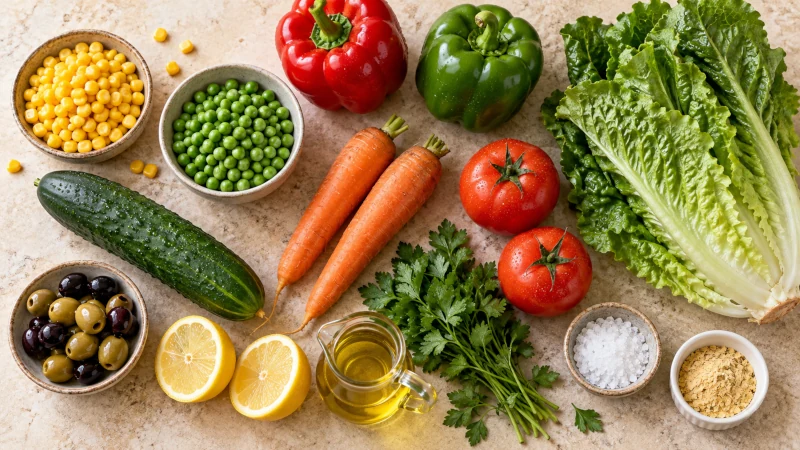
For the salad
- 7 oz (200 g) sweet corn kernels — frozen and briefly cooked, fresh, or canned and drained (choose no-salt-added if you can)
- 1 red bell pepper
- 1 green bell pepper
- 2 carrots
- 2 tomatoes
- 1 cucumber
- 1 head of lettuce (romaine or leaf lettuce both work)
- 3.5 oz (100 g) peas, fresh or frozen
- 3.5 oz (100 g) green and black olives
- 1 tablespoon brewer’s yeast (optional — see the safety notes below)
For the dressing
- A small handful of fresh parsley, finely chopped
- Juice of ½ lemon
- 4 tablespoons extra-virgin olive oil (2–3 tablespoons if you want a lighter salad)
- Sea salt, to taste — go easy, because the olives are already salty
How to Make It
- Wash the produce. Rinse everything under running water, scrub the carrots and cucumber with a clean brush, and pat dry. Skip soap or produce washes; plain running water is the recommended method [FDA, 2024].
- Prep the crunchy vegetables. Peel and slice the carrots and cucumber. Seed the peppers and cut them into strips. Chop the tomatoes.
- Cook the peas. Drop them into boiling water for 3–5 minutes (a little less if frozen) until just tender, then drain and let them cool. Cook frozen or fresh corn the same way; canned corn only needs draining.
- Build the plates. Separate the lettuce into whole leaves and line four plates or a platter. Arrange the vegetables, peas, corn, and olives on top. Sprinkle with the brewer’s yeast, if using, and a light pinch of salt.
- Make the dressing. Whisk the olive oil, lemon juice, and chopped parsley together with a fork.
- Dress just before serving so the lettuce stays crisp.
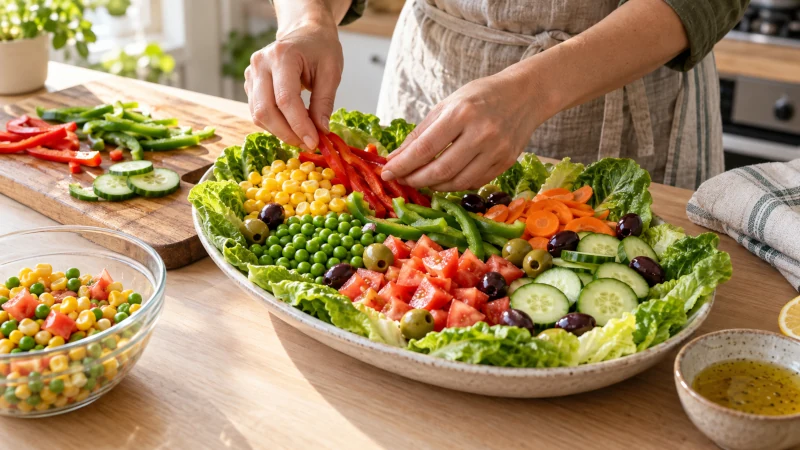
If you are making it ahead, keep the dressing separate and refrigerate the cut vegetables at 40°F or below [FDA, 2024]. They hold well for a day.
Make It Taste More Mexican
The base recipe leans Mediterranean in its dressing. These swaps push it toward the flavors most people expect from a Mexican salad, and a couple of them make it more filling:
- Lime for lemon, cilantro for parsley. The single biggest flavor shift.
- A pinch of ground cumin and chili powder in the dressing, or a finely minced jalapeño for real heat.
- A can of black beans, rinsed and drained. Beans are one of the best everyday fiber sources [Harvard Nutrition Source, 2022] and turn a side salad into a meal.
- Half an avocado, diced. Avocado is rich in monounsaturated fat, the same family of fat as olive oil [Harvard Nutrition Source, 2025b], so you can trim a tablespoon of oil if you add it.
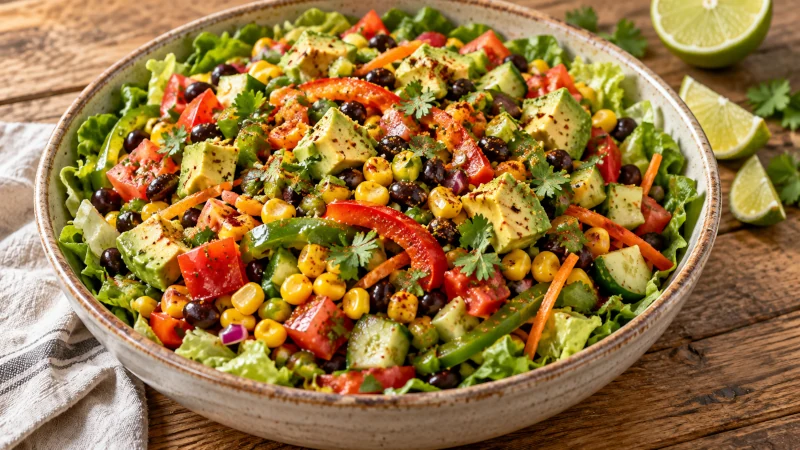
For another simple, vegetable-forward recipe built the same way, try our spring salad with green beans, peas, and potatoes.
What a Serving Actually Gives You
Two ingredients drive most of the numbers, and both are easy to adjust.
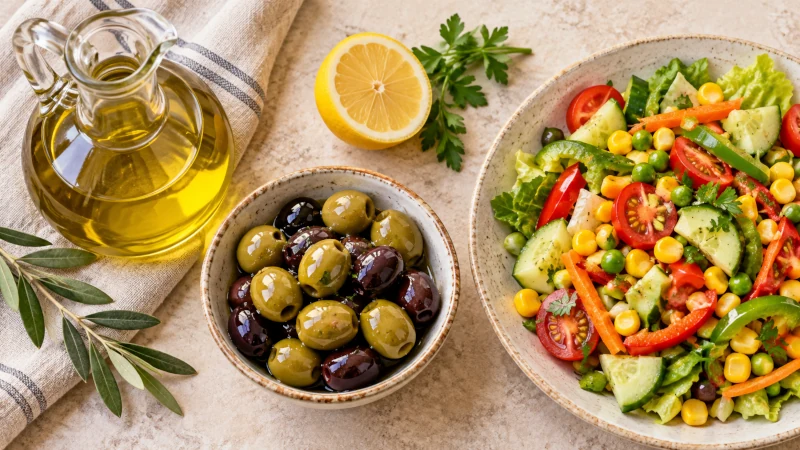
Olive oil carries most of the calories. Four tablespoons split four ways is about one tablespoon per plate, which is roughly 120 calories [UNVERIFIED — confirm figure on USDA FoodData Central before publishing] and nearly all of the fat in the dish. Using two tablespoons instead halves that without losing the benefit of having some fat on the plate (more on why below).
Olives carry most of the sodium. Brine-cured olives are salty: 100 grams of ripe canned black olives contain about 735 mg of sodium [Healthline, 2026]. Spread across four plates, that is roughly 185 mg each before you add any salt, and brands vary.
| Ingredient | What it adds | How to adjust |
| Olive oil (4 tbsp total) | Most of the calories and fat; mostly monounsaturated fat | Use 2–3 tbsp for a lighter plate |
| Olives (3.5 oz total) | Most of the sodium; some fat | Use half the olives, or choose a lower-sodium brand |
| Corn and peas | The starchier part of the salad; fiber and some plant protein | Keep portions as written if watching carbohydrates |
| Lettuce, peppers, carrots, tomato, cucumber | Volume, water, fiber, vitamin C and carotenoids; very few calories | Add more freely |
Exact calories, fiber, and sodium per serving depend on the brands and portions you use, so treat any single number for a home recipe as an estimate.
Mexican Salad Health Benefits, Graded Honestly
Heart health: the strongest case, at the level of the whole diet
The best evidence here isn’t about corn or peppers specifically. It’s about eating lots of vegetables, day after day. A meta-analysis of cohort studies covering 469,551 people linked each extra daily serving of fruits and vegetables with about a 4% lower risk of dying from cardiovascular disease. In two large Harvard cohorts, people averaging eight or more servings a day were 30% less likely to have had a heart attack or stroke than those eating under 1.5, and green leafy vegetables such as lettuce showed some of the strongest associations [Harvard Nutrition Source, 2025a]. These are observational findings, so they show a link rather than proof that vegetables alone caused the difference.
The dressing helps too, as long as it replaces something worse. Olive oil is about 72% monounsaturated fat, and eating unsaturated fats in place of saturated fat lowers LDL (“bad”) cholesterol and improves the ratio of total to HDL cholesterol [Harvard Nutrition Source, 2025b]. Soluble fiber adds a modest cholesterol-lowering effect of its own [Harvard Nutrition Source, 2022]. One salad won’t move your lab numbers. A heart-healthy eating pattern you keep up for months can, and our guide to what food can and can’t do for your arteries lays out realistic expectations.
Fiber and digestion: well established
Between the vegetables, corn, and peas, this salad is a meaningful fiber contributor. Adults need roughly 25 to 35 grams of fiber a day, while most Americans get about 15. Insoluble fiber, the kind in vegetable skins and leafy greens, adds bulk and helps prevent constipation [Harvard Nutrition Source, 2022].
If you don’t usually eat many vegetables, build up gradually and drink more fluids, because a sudden jump in fiber can cause bloating and cramping [Harvard Nutrition Source, 2022]. Our guide to adding fiber without the bloating walks through it step by step.
Feeling full on fewer calories: promising, but short-term
Salads can help you eat less at a meal — if the dressing is kept in check. In a randomized crossover study of 42 women, eating a low-calorie-density salad as a first course cut total lunch calories by 7% for a small portion and 12% for a large one. When the salad was made richer with more dressing and cheese, total lunch calories rose instead, by 8% and 17% [Rolls et al., 2004].
That was a short-term lab study, not a weight-loss trial, and starchier vegetables like corn and peas have been linked with weight gain rather than loss in long-term cohorts. Produce helps with weight mainly when it replaces other foods rather than being added on top [Harvard Nutrition Source, 2025a]. Practical takeaway: start the meal with the salad, and measure the oil.
Carotenoids and the case against fat-free dressing
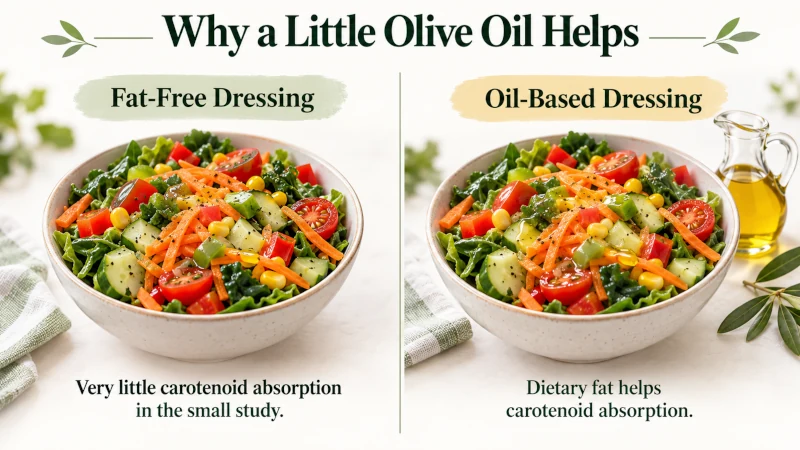
Carrots, tomatoes, peppers, and greens supply carotenoids, plant pigments that may help protect against cardiovascular disease [Harvard Health Publishing, 2019]. Your body needs some fat to absorb them. In a small study of seven people eating the same salad with different dressings, almost no carotenoids were absorbed with fat-free dressing, and absorption rose with reduced-fat and again with full-fat dressing [Brown et al., 2004]. The study was tiny and used canola oil, but the takeaway is sensible: a moderate amount of olive oil makes the vegetables more useful, not less.
Cancer: weaker than the old claims suggest
Early research suggested a strong link between eating fruits and vegetables and protection against cancer. Larger cohort studies have not consistently confirmed it. The World Cancer Research Fund and American Institute for Cancer Research conclude that non-starchy vegetables and fruit “probably” protect against cancers of the mouth, throat, voice box, esophagus, and stomach. The link between tomato products and prostate cancer remains mixed [Harvard Nutrition Source, 2025a]. So this salad fits a cancer-preventing diet, but it isn’t a prevention strategy by itself.
The evidence at a glance
| Claim | What the evidence shows | Strength |
| Supports heart health | Vegetable-rich diets are linked to lower cardiovascular risk; olive oil in place of saturated fat improves cholesterol | Strong for the overall pattern; observational |
| Helps regularity | Fiber adds bulk and helps prevent constipation | Well established |
| Helps you eat less at a meal | A light first-course salad reduced lunch calories in a lab study; heavy dressing reversed it | Promising, short-term |
| Oil improves carotenoid absorption | Small crossover study; consistent with how fat-soluble nutrients work | Limited but plausible |
| Lowers cholesterol on its own | Soluble fiber has a modest effect; a single dish won’t change lab results | Modest |
| Prevents cancer | Overall fruit-and-vegetable link is inconsistent; probable protection for some specific cancers | Mixed / limited |
Who Should Adjust This Recipe
Most people can enjoy this salad as written. A few situations call for small changes:
- High blood pressure, heart failure, or kidney disease. If you have been told to limit sodium, use fewer olives and little or no added salt; people in these groups are generally advised to limit olives [Healthline, 2026]. Our list of foods that push blood pressure up shows where else sodium hides.
- Taking an MAOI. Brewer’s yeast contains tyramine, which can interact with monoamine oxidase inhibitors (used for depression and Parkinson’s disease). Leave the yeast out unless your prescriber says otherwise [WebMD, 2026].
- Other medications or conditions. Brewer’s yeast may also interact with diabetes medicines, immune-suppressing drugs, and several antifungals, and it isn’t recommended if you are allergic to yeast. Check with your doctor or pharmacist first if you have a weakened immune system or Crohn’s disease [WebMD, 2026].
- Pregnancy and breastfeeding. The vegetables are a great fit. Brewer’s yeast hasn’t been well studied in pregnancy or breastfeeding [WebMD, 2026], so it is reasonable to skip it. Wash produce carefully, because pregnant people are more vulnerable to foodborne illness [FDA, 2024].
- Diverticulosis. Corn and the seeds in tomatoes and cucumbers don’t need to be avoided; the advice to avoid them is not supported by research, and a high-fiber diet is linked to lower risk of diverticulitis [Harvard Nutrition Source, 2022].
- Managing diabetes or weight. Count the corn and peas as the starchy part of the meal and measure the olive oil.
When to Talk to a Professional
A recipe can support your health goals, but it can’t replace individual advice. Talk with your doctor, pharmacist, or a registered dietitian if you are on a sodium-restricted diet, managing diabetes or kidney disease, or taking any of the medications listed above and want to use brewer’s yeast.
Get emergency help (call 911 in the U.S.) for signs of a severe allergic reaction after eating, such as trouble breathing or wheezing, or swelling of the face, lips, tongue, or throat [WebMD, 2026]. If you develop vomiting, diarrhea, or fever after a meal and think it may be foodborne illness, contact your healthcare provider, especially if you are pregnant, older, or have a weakened immune system [FDA, 2024].
| HEALTH DISCLAIMER: This article is for general information and education only. It is not medical or dietary advice and is not a substitute for guidance from a qualified healthcare professional. Foods and supplements such as brewer’s yeast can interact with medications and existing conditions. If you are pregnant or breastfeeding, have high blood pressure, diabetes, kidney disease, or a food allergy, or take prescription medication, talk with your doctor, pharmacist, or a registered dietitian before making significant changes to how you eat. Never delay seeking medical care because of something you have read here. |
Frequently Asked Questions
Is Mexican salad healthy?
This version is. It is mostly vegetables, dressed with olive oil instead of a creamy dressing, and it provides fiber with relatively few calories. The two things to watch are the amount of oil and the sodium from the olives and salt.
Is this a traditional Mexican salad?
Not exactly. It is a Mexican-inspired corn and pepper salad. For more authentic flavor, use lime and cilantro, add black beans and avocado, and season the dressing with cumin and chile.
Can I make it ahead?
Yes. Prep the vegetables up to a day ahead, refrigerate them at 40°F or below, and keep the dressing separate until just before serving [FDA, 2024].
Is this salad good for weight loss?
It can help as part of an overall calorie-aware diet. Eating a light salad before the main course reduced total meal calories in a lab study, but a heavily dressed salad had the opposite effect [Rolls et al., 2004]. Measure the oil and treat the corn and peas as the starchy portion of the meal.
Can I leave out the brewer’s yeast?
Yes. It adds a mild, nutty flavor but isn’t essential. Leave it out if you take an MAOI, are allergic to yeast, are pregnant or breastfeeding, or simply don’t like it [WebMD, 2026].
How do I make it lower in sodium?
Use half the olives or a lower-sodium brand, choose frozen or no-salt-added canned corn, and skip the added salt. A squeeze of extra lemon or lime brightens the flavor without any sodium.
References
- Harvard T.H. Chan School of Public Health, The Nutrition Source. Vegetables and Fruits. View source
- Harvard T.H. Chan School of Public Health, The Nutrition Source. Fiber. View source
- Harvard T.H. Chan School of Public Health, The Nutrition Source. Types of Fat. View source
- Harvard Health Publishing. Fill up on phytochemicals. February 1, 2019. View source
- Brown MJ, Ferruzzi MG, Nguyen ML, Cooper DA, Eldridge AL, Schwartz SJ, White WS. Carotenoid bioavailability is higher from salads ingested with full-fat than with fat-reduced salad dressings as measured with electrochemical detection. View source
- Rolls BJ, Roe LS, Meengs JS. Salad and satiety: Energy density and portion size of a first-course salad affect energy intake at lunch. View source
- U.S. Food and Drug Administration. Selecting and Serving Produce Safely. View source
- Denton C (writer); Johnston B, PharmD (medical reviewer). Brewer’s Yeast — Uses, Side Effects, and More. WebMD. View source
- Bjarnadottir A, MS, RDN; reviewed by Richter A, MS, RD. Olives 101: Nutrition Facts and Health Benefits. Healthline. View source


