
Few drinks pack as much vitamin C into a single ounce as acerola cherry juice. Pressed from the small red fruit of Malpighia emarginata, it can carry more ascorbic acid in one shot-glass serving than many people get from fruit and vegetables in a week [Prakash & Baskaran, 2018].
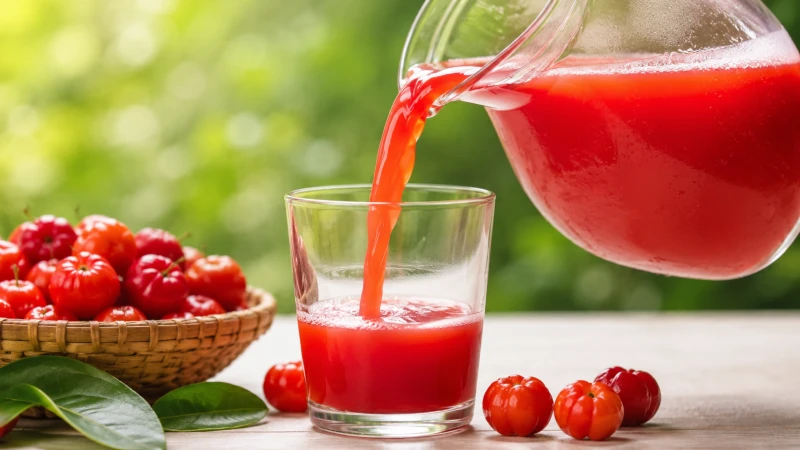
But acerola is not orange juice. It is intensely sour, fades fast once pressed, and is hard to find pure outside tropical growing regions. Knowing how to make it, what to look for when buying it, and how to store it is the difference between a vitamin C powerhouse and a glass of tartness that has already lost much of its punch.
This guide covers the practical essentials: nutrition per serving, how processing affects vitamin C, three tested recipes, store-bought versus homemade options, sensible amounts, and storage. For a broader look at the fruit itself, see the complete acerola cherry guide.
What is acerola cherry juice?
Acerola cherry juice is the liquid pressed from the ripe or near-ripe fruit of the acerola (also called Barbados cherry or West Indian cherry). It runs deep red to orange, tastes sharply tart, and concentrates the fruit’s vitamin C and plant compounds. Because the fruit is roughly four-fifths juicy pulp by weight, it releases liquid readily when blended or crushed [Delva & Schneider, 2013].
Pure acerola juice is uncommon on store shelves. Most bottled products blend it with sweeter juices such as apple, grape, mango, or pineapple to soften the sourness, because drinking it straight is an acquired taste. Homemade versions are usually diluted with water and lightly sweetened.
Acerola cherry juice nutrition
Acerola juice inherits the fruit’s unusual vitamin C density. The U.S. Department of Agriculture lists raw acerola at about 1,678 mg of vitamin C per 100 g of fruit [USDA, FoodData Central] — and published reviews put the fruit’s range at roughly 1,500 to 4,500 mg per 100 g depending on cultivar and ripeness [Prakash & Baskaran, 2018]. Pressed into juice, the numbers shift with dilution and processing, so treat the table below as an approximate guide rather than a fixed label value.
| Component | Per 100 ml pure juice (approximate) |
| Vitamin C | ~800–1,600 mg (varies with ripeness and processing) |
| Calories | ~30 kcal |
| Potassium | ~140 mg |
| Vitamin A (as carotenoids) | Present in small amounts |
| B vitamins (B1, B2, B3, B5) | Small amounts |
| Main organic acid | Malic acid (the source of the tartness) |
| Flavonoids | Quercetin, rutin, and related compounds |
| Anthocyanins | Red-purple pigments with antioxidant activity |
Sources and ranges: USDA FoodData Central; Delva & Schneider, 2013; Prakash & Baskaran, 2018; Mezadri et al., 2008. Values depend heavily on ripeness, cultivar, and how the juice is processed.
Here is the practical takeaway: a small 30 ml (1 oz) pour of pure juice can deliver roughly 240–480 mg of vitamin C — several times the adult recommended intake of 75–90 mg per day [NIH ODS]. That is why acerola juice is sipped in small amounts or diluted rather than poured by the glass like orange juice.
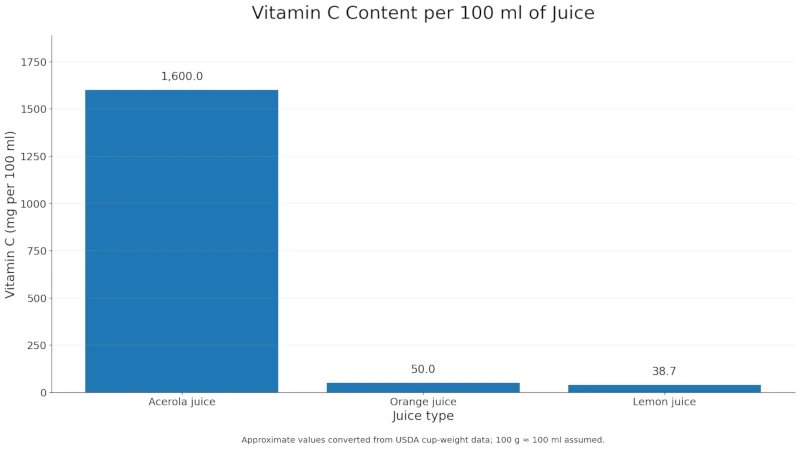
For the full fruit breakdown, see the acerola cherry nutrition profile.
How juicing and processing affect vitamin C
Vitamin C is fragile. It breaks down with heat, light, oxygen, and time. Understanding these four factors helps you hold onto more of it in any acerola juice you make or buy.
Heat
Ascorbic acid degrades faster as temperature rises, and the heat used in commercial pasteurization speeds that loss. Processing studies on acerola and other fruit juices report meaningful vitamin C losses during thermal treatment — commonly cited in the range of about 20–50%, depending on temperature, time, and oxygen exposure [Santos et al., 2018]; [Delva & Schneider, 2013]. One reason shelf-stable juice tends to carry less vitamin C than a fresh-pressed glass is simply the heat it went through to become shelf-stable.
Light and oxygen
Once juice is extracted, vitamin C reacts with oxygen on contact with air, and light speeds the reaction. That is why quality acerola products are bottled in dark or opaque containers, and why a fresh glass left on the counter loses potency as it sits.
Time
Fresh acerola juice begins losing vitamin C within hours. Refrigeration slows the decline but does not stop it. In a study of Barbados cherry pulp stored different ways, freezing at –18°C preserved a greater share of vitamin C than refrigeration or room-temperature storage [Visentainer et al., 1998].
Practical takeaways
- Drink homemade juice soon after you make it.
- Making a batch? Freeze it in small portions — ice cube trays work well.
- Store in dark or opaque containers, filled near the top to limit air.
- Skip heating or cooking the juice.
- With commercial juice, gentler processing (flash pasteurization or high-pressure processing) tends to retain more vitamin C than long, hot processing.
Store-bought vs homemade acerola juice
Both have a place. Here is an honest comparison:
| Factor | Store-bought | Homemade |
| Convenience | High — ready to drink | Lower — needs fruit or pulp and prep |
| Vitamin C | Lower (heat-processed) | Higher (raw) |
| Availability | Moderate (health and Latin grocers, online) | Hard outside tropical regions |
| Cost per serving | Higher | Lower with fruit access |
| Purity | Usually blended with other juices | Fully customizable |
| Freshness | Weeks to months old | Minutes old |
| Additives | May include added sugar or preservatives | None unless you add them |
| Shelf life | Months unopened | Hours to a couple of days refrigerated |
What to look for on a commercial label
Pure acerola vs blend. True 100% acerola juice is rare. In many products labeled “acerola juice,” acerola is the second or third ingredient. Check the ingredient order.
Stated vitamin C per serving. A quality product tells you how much vitamin C each serving provides. If that number is missing, consider another option.
Added synthetic ascorbic acid. Some juices are fortified with synthetic vitamin C to raise the number. If the label lists “ascorbic acid” as a separate ingredient, it has been added.
Added sugars. Because pure acerola is so tart, many products add sugar or fruit concentrate. Unsweetened or low-sugar versions are preferable.
Processing method. Flash-pasteurized or high-pressure-processed (HPP) juices generally keep more vitamin C than juices held at high heat for longer.
Frozen acerola pulp: a practical middle ground
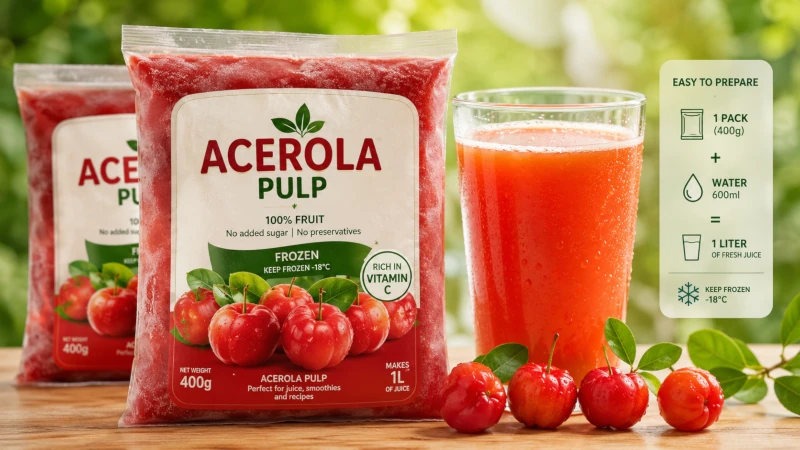
Frozen acerola pulp — sold in small packets at Brazilian and Latin American markets, some specialty grocers, and online — is a strong compromise. It is minimally processed, frozen soon after harvest, and easy to blend into fresh juice at home. If you cannot get fresh fruit, frozen pulp is the best starting material.
How to make acerola cherry juice at home
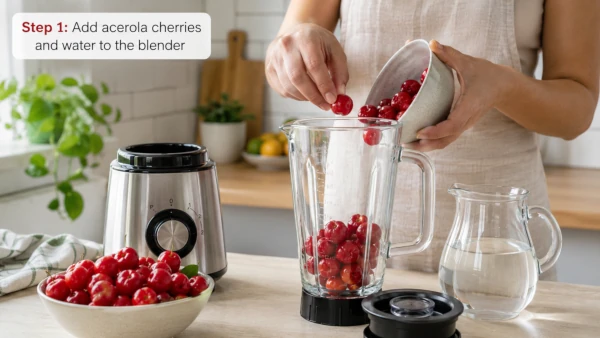
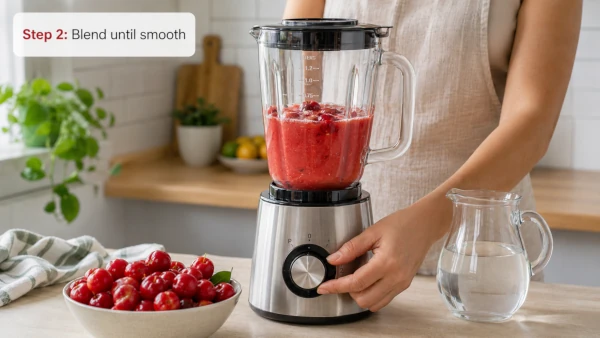
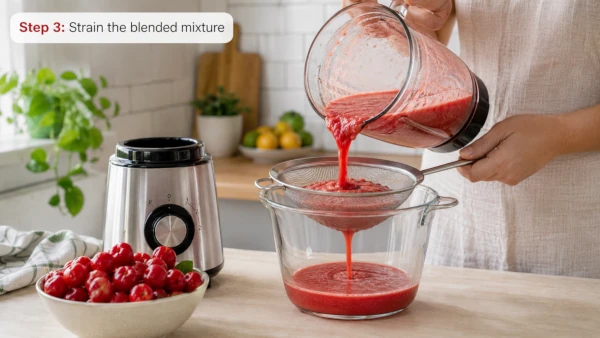
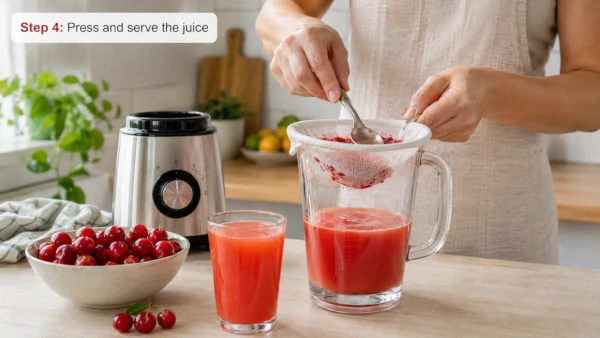
Homemade juice needs either fresh acerola fruit (found in tropical regions and occasionally at farmers markets in southern Florida, Texas, and Hawaii) or frozen acerola pulp. The method is simple.
Equipment
- Blender or food processor
- Fine-mesh strainer or nut-milk bag
- Glass pitcher or jar
- Ice cube trays for freezing leftovers
Method
- Rinse fresh acerola cherries well and remove stems or damaged fruit. If using frozen pulp, thaw it slightly.
- Add about 1 cup (150 g) of cherries to a blender with 1–2 cups of cold water.
- Blend on medium for 15–30 seconds — just enough to break up the fruit. Over-blending whips in air and can speed vitamin C loss.
- Strain through a fine-mesh strainer or nut-milk bag to catch seeds and pulp.
- Sweeten to taste with honey, maple syrup, or stevia, or skip it if you are blending with sweeter fruit.
- Drink it soon for the most vitamin C. Refrigerate leftovers in a sealed container for up to 24 hours, or freeze in ice cube trays.
Three acerola cherry juice recipes
Classic acerola juice
Yield: about 3 cups (4–6 small glasses)
Ingredients
- 1.5 cups fresh or frozen acerola cherries (~225 g)
- 2 cups cold filtered water
- 1–2 tablespoons honey or maple syrup, to taste
- 1 tablespoon fresh lime juice (optional, for brightness)
Method. Blend the cherries and water for about 20 seconds on medium. Strain, pressing gently with the back of a spoon. Stir in sweetener and lime juice, and serve over ice. Drink within 24 hours for the most vitamin C.
Tropical acerola-mango smoothie
Yield: 2 servings
Ingredients
- 1/2 cup fresh or frozen acerola cherries (~75 g)
- 1 ripe mango, peeled and diced
- 1 frozen banana
- 1 cup coconut water or orange juice
- 1/2 cup plain Greek yogurt (optional)
- Ice cubes
Method. Blend everything on high for 45–60 seconds until smooth. No straining needed — drink it as a smoothie with the fiber intact. The mango and banana balance acerola’s tartness, and coconut water adds electrolytes. Serve right away.
Acerola-pineapple refresher
Yield: 4 servings
Ingredients
- 1 cup fresh or frozen acerola cherries (~150 g)
- 1 cup fresh pineapple, chopped
- 2 cups cold water or coconut water
- Fresh mint leaves (optional)
- Ice cubes
Method. Blend the acerola, pineapple, and water for about 30 seconds. Strain, pour over ice, and garnish with mint. The natural sugar in pineapple usually means you can skip added sweetener.
How much acerola juice should you drink?
Because the juice is so concentrated, portion size matters more here than with most juices. A 30–50 ml (1–2 oz) pour of pure juice supplies several hundred milligrams of vitamin C — well above the daily requirement but still below the adult tolerable upper limit of 2,000 mg per day from all sources [NIH ODS].
For most adults, one small glass (150–200 ml) of diluted juice a day is a reasonable amount. If you are drinking a blend with other fruit juices, larger pours are fine because the acerola is more diluted. For form-by-form guidance, see the acerola dosage guide. Count vitamin C from every source — supplements, other juices, and multivitamins — to stay under the upper limit.
Storing acerola juice
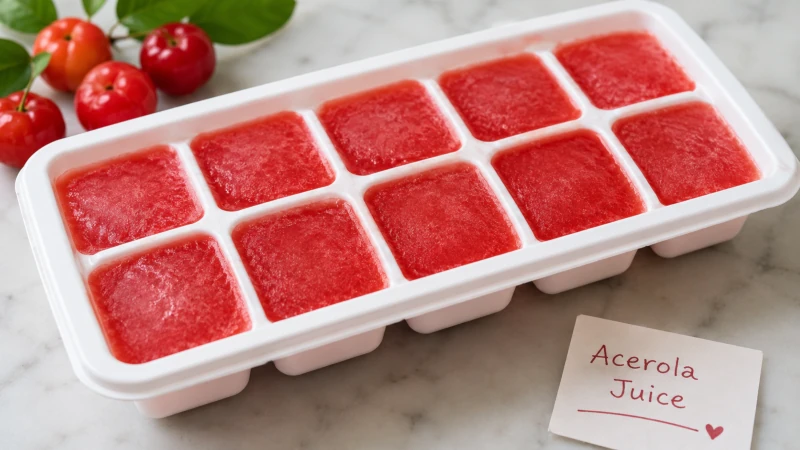
Because fresh juice loses vitamin C quickly, how you store it makes a real difference.
Refrigeration (1–2 days)
Keep fresh juice in a glass bottle or jar with an airtight lid, filled near the top to limit air. Store it in the coldest part of the fridge and use it within 24–48 hours for the best nutrition and flavor.
Freezing (up to about 6 months)
Freezing is the best long-term option. Two easy approaches:
Ice cube trays. Pour juice into standard trays (each cube is about 30 ml), freeze solid, then move the cubes to a freezer bag. Each cube is a ready single serving — drop one or two into water, a smoothie, or sparkling water.
Glass jars. Freeze in small jars with at least half an inch of headspace to allow for expansion. Thaw overnight in the fridge before drinking.
Frozen juice holds most of its vitamin C for several months at –18°C (0°F) or below [Visentainer et al., 1998]. Label containers with the date you made them.
What to avoid
- Do not can or boil the juice at home — heat destroys vitamin C.
- Do not store it in clear plastic on the counter — light speeds degradation.
- Do not leave it at room temperature for more than about 2 hours.
- Do not stir it into hot drinks — the vitamin C will break down.
Acerola juice vs acerola powder
If you cannot get fresh or frozen fruit regularly, acerola powder is a practical alternative. Here is how they compare:
| Factor | Acerola juice | Acerola powder |
| Vitamin C per serving | High but variable | Very high and standardized |
| Shelf stability | Poor fresh; weeks for commercial | Excellent (often 12–18 months) |
| Dosing | Variable | Precise |
| Availability | Regional | Widely available online |
| Cost per serving | Higher | Lower |
| Best for | Drinking and recipes | Daily supplementation and mix-ins |
For everyday convenience and consistent dosing, powder usually wins. For flavor and the closest experience to fresh fruit, juice wins. Many people use both — powder for daily intake and juice as a treat or recipe ingredient. For choosing a product, see the guide to choosing an acerola cherry supplement.
Safety, side effects, and who should be cautious
For most healthy people, acerola juice in food amounts is safe and a useful source of vitamin C. The cautions below mostly apply to large amounts or to specific health conditions, and they come from the vitamin C itself rather than the fruit [NIH ODS].
Too much vitamin C. Intakes above about 2,000 mg of vitamin C per day (from all sources combined) can cause diarrhea, nausea, stomach cramps, and heartburn. A small pour of juice will not reach that, but stacking concentrated juice with high-dose supplements can.
Kidney stones. High doses of vitamin C can raise urinary oxalate. If you have a history of kidney stones or kidney disease, keep concentrated vitamin C modest and check with your clinician.
Iron overload. Vitamin C increases absorption of iron from food. People with hemochromatosis or other iron-overload conditions should be cautious with large or frequent doses of concentrated vitamin C.
Cancer treatment and certain medicines. High-dose vitamin C may interact with chemotherapy and radiation, and antioxidant combinations can blunt the cholesterol benefit of a statin taken with niacin. If you are in cancer treatment or on these medicines, talk with your care team before adding concentrated vitamin C.
Pregnancy and breastfeeding. Vitamin C from food and juice is both safe and needed during pregnancy and breastfeeding. High-dose supplements are a different matter — discuss those with your prenatal provider, who can keep your total intake within recommended limits.
Blood sugar and teeth. Blended recipes with mango, banana, or added sweetener raise the sugar content, which matters if you are managing blood sugar. Acerola is also quite acidic, so frequent sipping of sour juice can be hard on tooth enamel — rinse with water afterward.
When to talk to a healthcare professional. Acerola juice is a food, not a treatment, and it is not a substitute for medical care. Check with a clinician before using concentrated juice or supplements if you are pregnant, take prescription medicines (especially chemotherapy or a statin-plus-niacin regimen), or have kidney disease, a history of kidney stones, or an iron-overload condition. Symptoms such as ongoing fatigue, bleeding gums, or slow-healing wounds should be evaluated by a professional rather than self-treated with juice.
| Health Disclaimer This content is for educational purposes only and is not intended to diagnose, treat, cure, or prevent any disease. It is not a substitute for advice from a qualified healthcare professional. Always consult your doctor, pharmacist, or a registered dietitian before changing your diet, supplements, medications, or treatment plan — especially if you are pregnant or breastfeeding, take prescription medicines, or have a chronic health condition. |
Frequently Asked Questions
How much vitamin C is in acerola cherry juice?
Pure juice from ripe fruit carries roughly 800–1,600 mg of vitamin C per 100 ml, varying with ripeness, cultivar, and processing. A small 30 ml (1 oz) pour can supply around 240–480 mg — several times the adult daily requirement. Commercial pasteurized juice usually has less because heat degrades vitamin C.
Where can I buy acerola cherry juice?
Pure juice is uncommon outside tropical regions. Look in Brazilian or Latin American grocery stores, health-food shops, and online. Many products are blends in which acerola is mixed with apple, grape, or mango juice. Frozen acerola pulp is often easier to find than bottled juice and lets you make a fresh batch at home.
Does acerola juice taste good?
Pure acerola juice is intensely tart — closer to unsweetened lemon juice than to sweet cherry juice. Most people find it too sour to drink straight. Blending it with mango, pineapple, or banana, or diluting it with water and a little sweetener, makes it much more pleasant.
How long does fresh acerola juice last?
Fresh homemade juice loses vitamin C fast. Drink it within 24 hours for the most nutrition, or freeze it right away in small portions. Refrigerated juice is fine to drink for 1–2 days but loses potency quickly. Frozen juice holds most of its vitamin C for several months.
Can I drink acerola juice every day?
For most healthy adults, a small daily serving (about 30–100 ml of pure or blended juice) is considered safe and provides plenty of vitamin C. Add up vitamin C from all sources and stay under 2,000 mg per day. Check with your healthcare provider if you take medications or have kidney problems or iron overload.
Key takeaways
Acerola cherry juice is among the most vitamin C–dense drinks available, supplying several hundred milligrams in a single small serving.
Homemade juice keeps more vitamin C than shelf-stable commercial versions, because pasteurization heat degrades ascorbic acid. With fresh fruit or frozen pulp, making your own is the most nutritionally effective route.
The flavor is sharply tart, so most people blend it with sweeter fruit or dilute and sweeten it, and pour small servings.
Storage matters: drink it within 24 hours or freeze it in small portions, with ice cube trays giving handy single servings.
Powder wins on convenience and precise dosing; juice wins on flavor and the experience of fresh fruit. Both fit into a whole-food vitamin C routine.
References
- U.S. Department of Agriculture, Agricultural Research Service. FoodData Central: Acerola (West Indian cherry), raw. FDC ID 171686. View source
- Prakash A, Baskaran R. Acerola, an untapped functional superfruit: a review on latest frontiers. Journal of Food Science and Technology. 2018;55(9):3373–3384. View source
- Delva L, Goodrich Schneider R. Acerola (Malpighia emarginata DC): production, postharvest handling, nutrition, and biological activity. Food Reviews International. 2013;29(2):107–126. View source
- Visentainer JV, Vieira OA, Matsushita M, de Souza NE. Vitamin C in Barbados cherry (Malpighia glabra L.) pulp submitted to processing and to different forms of storage. Archivos Latinoamericanos de Nutrición. 1998;48(3):256–259. View source
- Mezadri T, Villaño D, Fernández-Pachón MS, García-Parrilla MC, Troncoso AM. Antioxidant compounds and antioxidant activity in acerola (Malpighia emarginata DC.) fruits and derivatives. Journal of Food Composition and Analysis. 2008;21(4):282–290. View source
- Santos VO, Rodrigues S, Fernandes FAN. Improvements on the stability and vitamin content of acerola juice obtained by ultrasonic processing. Foods. 2018;7(5):68. View source
- National Institutes of Health, Office of Dietary Supplements. Vitamin C: Fact Sheet for Health Professionals. View source
