If you searched for foods that clear arteries, here’s the honest headline first: no food scrubs plaque out of your arteries like a drain cleaner. That image is appealing, and a lot of “artery-cleansing” pages lean on it, but it isn’t how the body works. What is true matters more. The way you eat over months and years is one of the strongest levers you have over whether arterial plaque keeps building, holds steady, or — in the right circumstances — slowly shrinks. So while no single food clears arteries on its own, a consistent pattern of the right foods can meaningfully change the course of arteriosclerosis. That’s the version worth your attention.
What “clearing” arteries really means
Arteriosclerosis (often called atherosclerosis when cholesterol-laden plaque is involved) is a slow process. Cholesterol, inflammatory cells, and other debris build up in the inner lining of artery walls, thickening them and narrowing the channel blood flows through. Left to progress, it’s the engine behind most heart attacks and many strokes — which is why the same eating pattern that protects your heart also overlaps with foods that help prevent stroke.
Here’s where the evidence has landed. Diet and lifestyle can slow that buildup, help stabilize existing plaque so it’s less likely to rupture, and in some studies produce modest regression — a small reduction in plaque burden over time (American Heart Association, 2021). But “modest” and “some studies” are doing real work in that sentence. The trials that showed measurable reversal generally combined an intensive, mostly plant-based diet with exercise, not smoking, and often medication, sustained over years. Even then, researchers describe it as partial regression, not a return to a clean, plaque-free artery (review in IJMS, 2024).
So a more accurate way to read your search is this: you can’t eat your way to brand-new arteries, but you can change the trajectory. For most people that’s the realistic, valuable goal — and it’s worth far more than any “cleanse.”
The pattern beats any single food
The biggest mistake “miracle food” articles make is fixating on one ingredient. Decades of nutrition research point the other way: it’s the overall pattern of eating that protects your heart, not a hero food you add on top of an otherwise poor diet (American Heart Association, 2021).
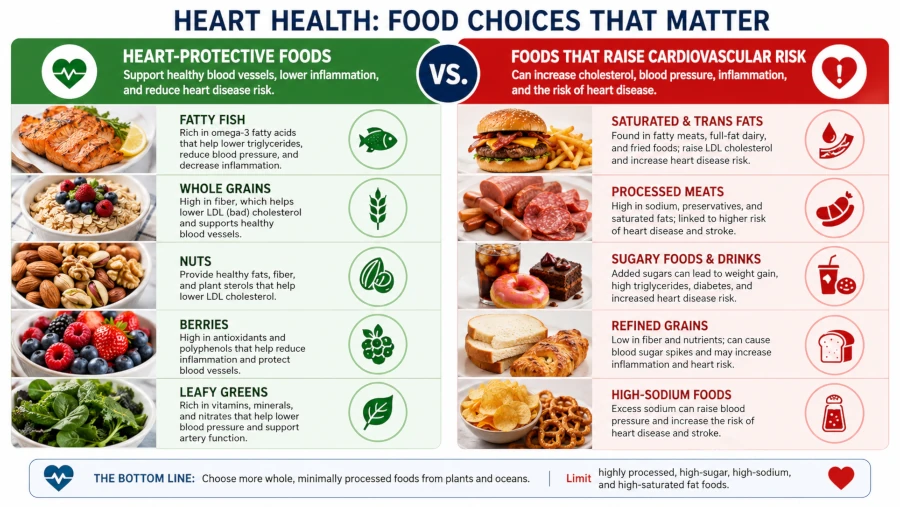
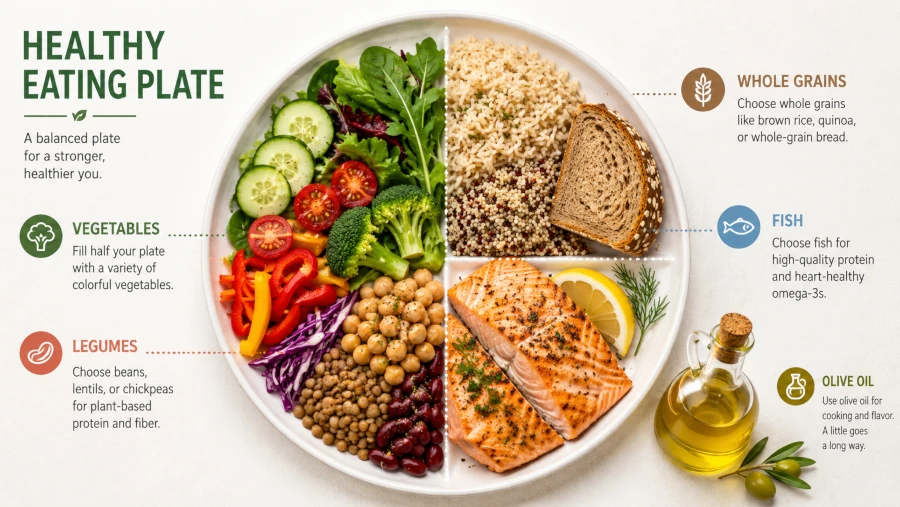
The American Heart Association’s dietary guidance, updated in 2021 and again in 2026, reads less like a list of superfoods and more like a way of eating: plenty of fruits and vegetables; whole grains rather than refined; protein mostly from plants, with regular fish and seafood; liquid plant oils instead of tropical or partially hydrogenated fats; minimally processed foods over ultra-processed ones; and as little added sugar and salt as you can manage (American Heart Association, 2026). Notably, the same guidance found insufficient evidence to recommend fad approaches like very strict keto or intermittent fasting for heart health.
The Mediterranean dietary pattern is the best-studied version of this idea. In the PREDIMED trial — more than 7,400 adults at high cardiovascular risk — a Mediterranean diet rich in extra-virgin olive oil or nuts lowered the risk of major cardiovascular events (heart attack, stroke, or cardiovascular death) by roughly 30% compared with a lower-fat control diet, over about five years (Estruch et al., 2018). That’s the kind of result a single food never delivers. The foods below earn their place mainly as parts of that bigger pattern.
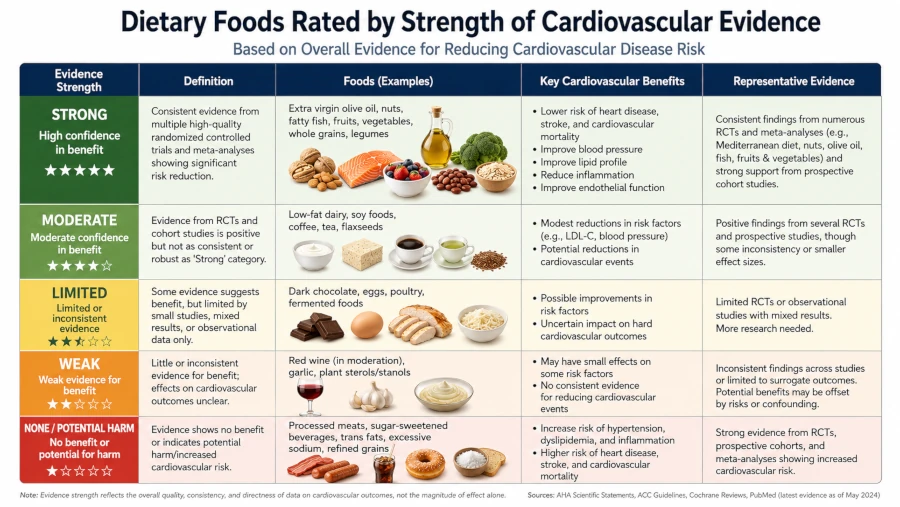
The foods with the strongest case
| Food | What the evidence shows | Strength of evidence |
| Vegetables & fruit | Lower blood pressure, fiber, potassium, polyphenols; the backbone of protective patterns | Strong (as pattern) |
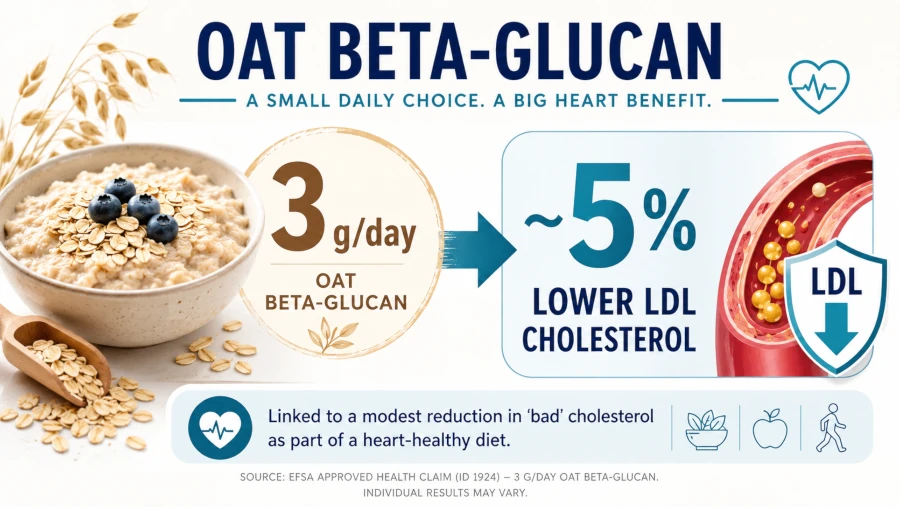
| Oats & soluble fiber | ~3 g/day of oat beta-glucan lowers LDL cholesterol by about 5% | Strong |
| Legumes | Fiber and plant protein; biggest win as a swap for fatty or processed meat | Strong (as pattern) |
| Nuts | ~30 g/day within the Mediterranean diet; part of a ~30% event reduction | Strong |
| Extra-virgin olive oil | ~10 g/day linked to ~10% lower CVD risk when it replaces animal fat | Strong |
| Fatty fish | Omega-3 fats; regular intake built into heart-protective patterns | Moderate-strong |
| Garlic | Modest blood-pressure drop, slight cholesterol change; no hard-outcome data | Limited / promising |
Evidence at a glance: what each food does, and how strong the evidence is.
Vegetables and fruit. These are the backbone. They’re low in sodium and saturated fat, high in potassium and fiber, and carry a wide range of polyphenols and other plant compounds. Leafy greens, in particular, show up repeatedly in heart-healthy patterns. You don’t need an exotic variety — the win comes from eating a lot, and a variety, most days.
Whole grains and soluble fiber. This is one of the few “single food” effects with solid trial backing. The soluble fiber in oats and barley, called beta-glucan, modestly lowers LDL (“bad”) cholesterol. Pooled randomized trials show that about 3 grams of oat beta-glucan a day — the amount in roughly one and a half cups of cooked oatmeal — lowers LDL cholesterol by around 5% (Whitehead et al., 2014). The effect is real enough that food regulators in the US and Europe permit a heart-health claim for oats. Swapping refined grains (white bread, pastries, sugary cereal) for whole ones is one of the more reliable dietary moves you can make.
Legumes. Beans, lentils, and chickpeas are rich in fiber and plant protein and low in saturated fat. Their biggest value is often as a swap: when a lentil stew replaces a fatty cut of meat or processed meat, you lower the saturated fat and sodium load while adding fiber. They’re a staple of nearly every heart-healthy foods pattern linked to lower heart risk.
Nuts. In PREDIMED, a daily serving of mixed nuts (about 30 grams — a small handful of walnuts, almonds, and hazelnuts) was part of the Mediterranean arm that cut cardiovascular events by roughly 30% (Estruch et al., 2018). Nuts replace less healthy snacks and supply unsaturated fats and vitamin E. They’re calorie-dense, so portion matters, but the evidence for a modest daily handful is strong.
Extra-virgin olive oil. Within the Mediterranean pattern, olive oil is a standout. In PREDIMED, each additional roughly 10 grams a day of extra-virgin olive oil was associated with about 10% lower cardiovascular disease risk (Guasch-Ferré et al., 2014). The benefit shows up most clearly when it replaces butter and other animal fats — not when it’s simply poured on top of everything. If you want the longer view on olive oil and heart health, extra-virgin (less refined) appears to carry more of the protective plant compounds.
Fatty fish. Salmon, sardines, and mackerel supply omega-3 fats, and regular fish intake is built into heart-protective patterns. Whole fish has better evidence than fish-oil capsules for most people.
Garlic — promising, but keep expectations realistic. Garlic is the food most oversold by “unclog your arteries” pages, so it’s worth being precise. Meta-analyses of randomized trials suggest garlic supplements can modestly lower blood pressure — by roughly 8 mmHg systolic in people who already have hypertension — and may slightly improve cholesterol (Ried, 2016). Those are genuine, useful effects. What garlic has not been shown to do is “stop the arteriosclerosis process” or reduce heart attacks and deaths; the trials measuring hard outcomes simply haven’t been done. Enjoy garlic for flavor and a possible small blood-pressure nudge, not as a treatment.
Where the old advice oversells
A few claims travel from article to article and deserve a closer look.
“Artery cleanses,” detoxes, and juices. There’s no credible evidence that any supplement, juice, or cleanse removes plaque from arteries. Some supplements can interfere with prescribed medications. If a product promises to flush your arteries, that’s a reason for skepticism, not hope.
Antioxidant supplements. It’s true that fruits and vegetables rich in vitamins C, E, and beta-carotene are linked to better heart health. But that benefit hasn’t carried over to isolated antioxidant supplements in trials — and some, like high-dose beta-carotene in smokers, have shown harm. The takeaway is consistent: get these nutrients from whole foods, not pills.
The folate and homocysteine story. Older articles confidently link folate and vitamin B6 to lower arteriosclerosis risk because they lower homocysteine, an amino acid associated with heart disease. Homocysteine is a real risk marker — but lowering it with B-vitamin supplements has repeatedly failed to reduce heart attacks or strokes. A meta-analysis pooling more than 37,000 participants found that folic acid cut homocysteine levels by about a quarter yet produced no reduction in cardiovascular events (Clarke et al., 2010). So eat folate-rich foods like leafy greens and legumes as part of a good overall diet, but don’t count on folate supplements to protect your arteries.
Olive oil isn’t a magic bullet. It’s beneficial, but mostly as a replacement for worse fats within a whole pattern — not because adding more oil to your day does something special.
What to cut matters as much as what to add
You can’t out-eat a diet full of the foods that clog arteries. Much of diet’s benefit comes from replacement — better foods crowding out worse ones:
- Saturated and trans fats: trim fatty and processed meats, butter, and partially hydrogenated oils; lean on plant oils, fish, nuts, and legumes instead.
- Sodium: most of it hides in ultra-processed and restaurant food. The 2026 AHA guidance puts extra emphasis on choosing low-sodium foods and cooking with little or no added salt, alongside potassium-rich foods that help with blood pressure.
- Added sugars and refined grains: sugary drinks, sweets, and white-flour products.
- Ultra-processed foods: these tend to bundle the problems above into convenient packages.
And the single most important non-food step: don’t smoke. Tobacco accelerates arteriosclerosis and undercuts everything a good diet is trying to do.
Realistic expectations, cautions, and interactions
Food works slowly and alongside the rest of your care — not instead of it. For many people, especially anyone with established heart disease, diet is one part of a plan that may also include medication. Statins and blood-pressure drugs are backed by strong evidence; choosing food over prescribed treatment, rather than alongside it, can be dangerous. Diet makes those tools work better, not redundant. (If you don’t know your numbers, a simple cholesterol test is a sensible starting point.)
A few specific cautions worth knowing:
- If you take warfarin (a blood thinner), the vitamin K in leafy greens affects how the medication works. The goal isn’t to avoid greens but to keep your intake consistent and coordinate with your clinician, who may adjust your dose.
- Garlic supplements and fish-oil capsules can increase bleeding risk, especially if you take anticoagulant or antiplatelet medication or are heading into surgery. Culinary amounts of garlic are generally fine; concentrated supplements are where caution applies.
- Grapefruit interacts with some statins and blood-pressure medications. Check your specific drug.
- Pregnancy and breastfeeding: these foods in normal culinary amounts are part of a healthy diet, but concentrated herbal or garlic supplements aren’t well studied in pregnancy — talk to your provider before using them.
Talk to a healthcare professional before making big changes if you have established heart or kidney disease, diabetes, you take any of the medications above, or you’re considering supplements rather than food. A clinician or registered dietitian can tailor this to your numbers and your medications.
When food isn’t the issue — warning signs to act on
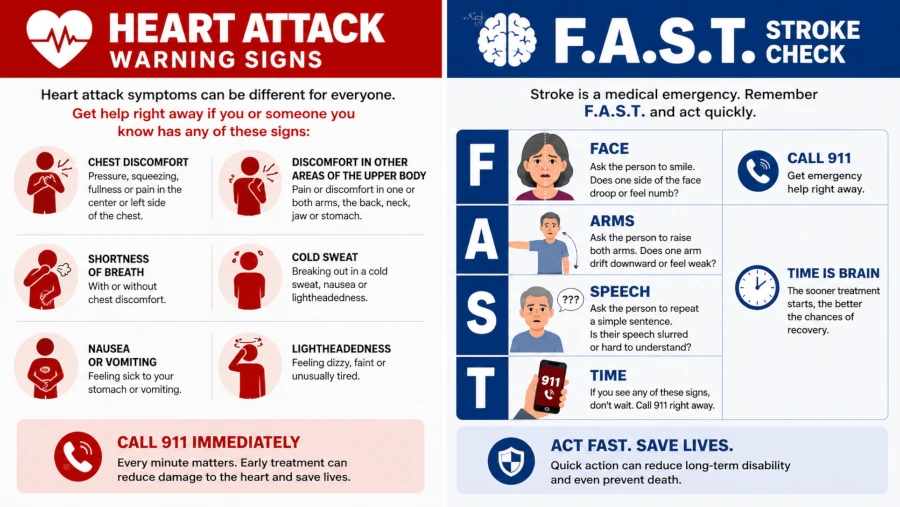
Diet is for the long game. Some symptoms need emergency care now, not a change to your grocery list.
| Call 911 for a possible heart attack: chest discomfort — pressure, squeezing, or fullness in the center of the chest — that lasts more than a few minutes or comes and goes; pain spreading to the arm, jaw, neck, or back; shortness of breath; or a cold sweat, nausea, or lightheadedness. Women more often have symptoms other than classic chest pain. Don’t drive yourself; an ambulance can begin treatment on the way. Spot a stroke with F.A.S.T.: Face drooping, Arm weakness, Speech difficulty, Time to call 911. Call even if the symptoms go away — that can be a warning stroke (American Heart Association). |
These can’t be managed at home, and minutes matter.
| HEALTH DISCLAIMER: This article is for general education and information only. It is not medical advice and is not a substitute for diagnosis or treatment from a qualified healthcare professional. Do not start, stop, or change any medication, supplement, or treatment based on this page. If you are pregnant or breastfeeding, take prescription medication, or have a heart, kidney, or other medical condition, talk with your doctor before making significant dietary changes or using any herbal or natural product. If you think you may be having a heart attack or stroke, call your local emergency number immediately. |
Frequently Asked Questions
Can any food actually unclog or clear arteries?
No single food removes existing plaque. The realistic, evidence-based goal is to slow buildup, help stabilize plaque, and in some cases achieve modest regression over time — which generally takes a sustained heart-healthy pattern, often combined with exercise and, when needed, medication.
What’s the single best change I can make to my diet for my arteries?
Replacement, not addition. Swapping saturated fats (fatty and processed meats, butter) and refined grains for plant oils, whole grains, legumes, nuts, vegetables, and fish captures most of the benefit. No one food does it alone.
Do oats really lower cholesterol?
Yes, modestly. About 3 grams of oat beta-glucan daily — roughly a generous bowl of oatmeal — lowers LDL cholesterol by around 5% in randomized trials, enough that oats carry an approved heart-health claim.
Is garlic good for my heart?
Garlic supplements can modestly lower blood pressure (more so if you already have hypertension) and may slightly improve cholesterol, but they haven’t been shown to prevent heart attacks or clear arteries. Treat it as a helpful flavor and a small blood-pressure nudge, not a cure.
Should I take folic acid or B vitamins to protect my heart?
Probably not for heart protection. Although these lower homocysteine, large trials show no reduction in heart attacks or strokes from the supplements. Get folate from leafy greens and legumes as part of your overall diet instead.
Can diet replace my cholesterol or blood-pressure medication?
Diet works alongside medication, not instead of it. Statins and blood-pressure drugs have strong evidence; don’t stop or change them without your doctor.
References
- Lichtenstein AH, Appel LJ, Vadiveloo M, et al. “2021 Dietary Guidance to Improve Cardiovascular Health: A Scientific Statement From the American Heart Association.” Circulation. 2021;144(23):e472–e487. View source
- American Heart Association. “2026 Dietary Guidance to Improve Cardiovascular Health (Scientific Statement) — news summary.” 2026. View source
- Estruch R, Ros E, Salas-Salvadó J, et al. “Primary Prevention of Cardiovascular Disease with a Mediterranean Diet Supplemented with Extra-Virgin Olive Oil or Nuts.” N Engl J Med. 2018;378(25):e34. View source
- Guasch-Ferré M, Hu FB, Martínez-González MA, et al. “Olive oil intake and risk of cardiovascular disease and mortality in the PREDIMED Study.” BMC Medicine. 2014;12:78. View source
- Whitehead A, Beck EJ, Tosh S, Wolever TM. “Cholesterol-lowering effects of oat β-glucan: a meta-analysis of randomized controlled trials.” Am J Clin Nutr. 2014;100(6):1413–1421. View source
- Ried K. “Garlic Lowers Blood Pressure in Hypertensive Individuals, Regulates Serum Cholesterol, and Stimulates Immunity: An Updated Meta-analysis and Review.” J Nutr. 2016;146(2):389S–396S. View source
- Clarke R, Halsey J, Lewington S, et al. (B-Vitamin Treatment Trialists’ Collaboration). “Effects of lowering homocysteine levels with B vitamins on cardiovascular disease, cancer, and cause-specific mortality.” Arch Intern Med. 2010;170(18):1622–1631. View source
- Wang Y, et al. “Mechanistic insights into the regression of atherosclerotic plaques.” Review. 2024. View source
- American Heart Association. “Heart Attack and Stroke Symptoms (Warning Signs; F.A.S.T.).” View source
