
Pomegranate fruit extract is a concentrated supplement made from pomegranate polyphenols, mainly punicalagins and ellagic acid. The short version before you spend money on it: it may lower blood pressure a little, the cholesterol and prostate cancer claims haven’t held up in controlled trials, and what’s actually in the bottle varies more than most labels admit [NCCIH, 2025].
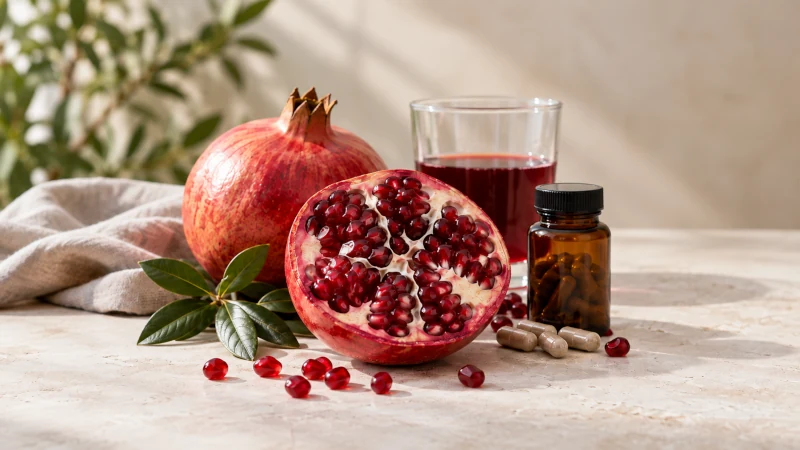
It’s generally well tolerated. The real risks are quieter ones: a possible interaction with the blood thinner warfarin, a caution for people on statins, and products that contain little real pomegranate. If you take regular medication, read the safety section before you buy.
What is pomegranate fruit extract?
Pomegranates (Punica granatum) are rich in a family of polyphenols called ellagitannins. The main one, punicalagin, accounts for more than half of the antioxidant activity measured in pomegranate juice [MSKCC, 2022]. Extracts concentrate these compounds into capsules or powders, and most are standardized to their ellagic acid content [Zhang, 2009].
You’ll often read that the extract is the “essence of the seeds.” That undersells the rind. When researchers compared juices, those pressed from the whole fruit carried more punicalagins than juice made from the seed sacs (arils) alone [Mathon, 2019].
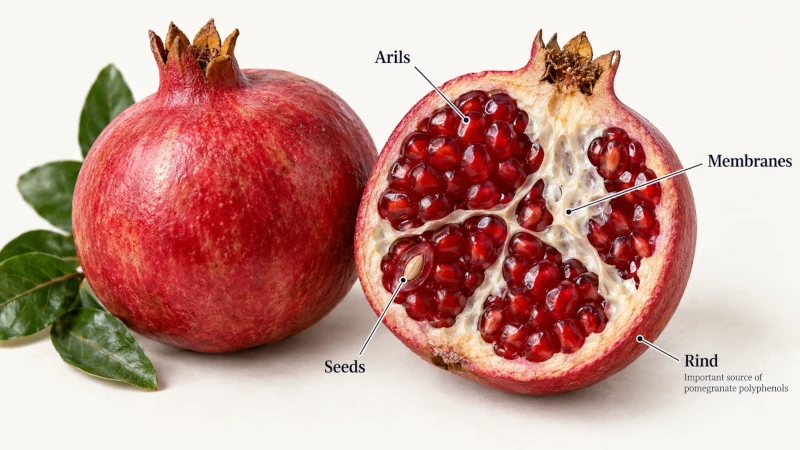
One more detail shapes everything below. Your body barely absorbs punicalagins intact. Gut bacteria break them down into compounds called urolithins, and people differ widely in how well they do this [González-Sarrías, 2017]. In one trial, about one in six people taking pomegranate extract made no urolithin A at all [Henning, 2019]. That variability is one reason study results bounce around.
Pomegranate fruit extract benefits: what the research supports
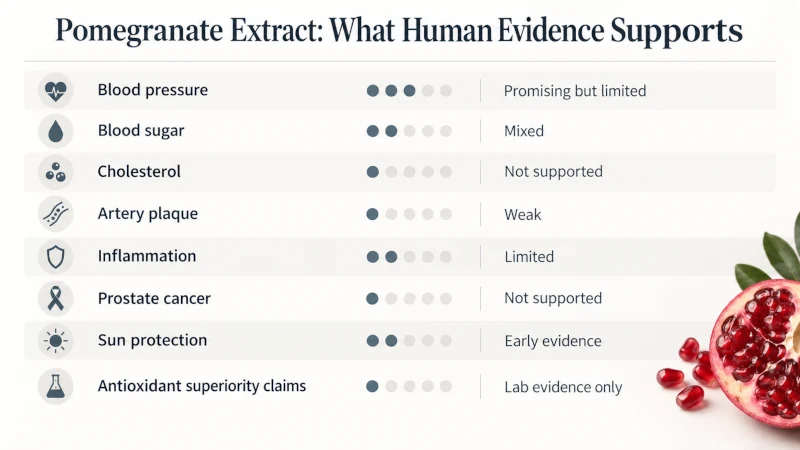
Most human trials used pomegranate juice rather than capsules, so the evidence for the extract itself is thinner than the headlines suggest [NCCIH, 2025]. Here’s how the main claims hold up.
| Claim | What human studies found | Evidence |
| Lowers blood pressure | Pooled trials show a small drop in systolic pressure, mostly with juice; not every review agrees | Promising but limited |
| Lowers blood sugar | Reviews disagree: one summary reports a small reduction, a meta-analysis found none | Mixed |
| Improves cholesterol | No clear effect on cholesterol or other blood fats | Not supported |
| Reduces artery plaque | An 18-month trial found no overall effect on artery-wall thickening | Weak |
| Fights inflammation | Some inflammation markers may improve; oxidative-stress markers did not | Limited |
| Prostate cancer | A placebo-controlled trial found extract no better than placebo | Not supported |
| Protects skin from sun | One small, open-label 12-week trial | Early |
| “More antioxidants than green tea” | Test-tube comparisons of bottled drinks, not health outcomes | Lab only |
Blood pressure: the strongest case, and still modest
This is where pomegranate looks best. A 2023 meta-analysis pooled 14 trials with 573 people and found pomegranate juice lowered systolic blood pressure (the top number) by about 5 mmHg on average [Ghaemi, 2023]. Oddly, the benefit showed up at 300 mL a day or less, but not at higher intakes.
Not every review lands in the same place. An Oxford review of 8 trials with 619 participants concluded the evidence failed to convincingly show a benefit, pointing to small studies and uneven reporting [Gbinigie, 2017]. The NIH’s complementary-health center splits the difference: juice or extract may help, but more research is needed [NCCIH, 2025].
So it’s a real but small effect, and it came mostly from juice. If your numbers are high, the bigger wins still come from foods that lower blood pressure, less sodium, and the treatment your clinician recommends.
Cholesterol, artery plaque, and heart health
The evidence here is weaker than the marketing. Studies of pomegranate juice, extract, and other products haven’t shown clear effects on cholesterol or other blood fats [NCCIH, 2025].
The “clears your arteries” claim rests largely on small early studies. The biggest test was an 18-month randomized trial in 289 adults at moderate heart risk. People drinking 240 mL of pomegranate juice a day showed no overall difference in carotid artery-wall thickening compared with a control drink [Davidson, 2009]. The authors saw a possible effect in people with higher oxidative stress, which is a lead for future research rather than a result. The trial was industry-funded.
Antioxidant and anti-inflammatory claims
You’ve probably seen pomegranate billed as having more antioxidants than green tea or blueberries. That traces back to test-tube comparisons of bottled drinks. In one widely cited analysis, pomegranate juice outscored red wine, grape juice, blueberry juice, and iced tea beverages on several lab measures [Seeram, 2008]. The authors noted that lab antioxidant potency doesn’t prove an effect in the body, and one author was affiliated with a pomegranate juice company.
That comparison says nothing about eating whole blueberries or brewing a cup of green tea. In people, pooled trials haven’t found that pomegranate improves markers of oxidative stress, though some markers of inflammation and blood-vessel function may improve [MSKCC, 2022]. Treat “fights inflammation” as plausible but unproven, not as a reason to expect less joint pain or a lower disease risk.
Cancer: a promising start, a disappointing follow-up
Prostate cancer is where pomegranate drew the most attention. A small 2006 study gave men with rising PSA after prostate cancer treatment 8 ounces of pomegranate juice a day and reported a slower PSA rise, but it had no comparison group [Pantuck, 2006]. A later trial of extract capsules saw the same pattern, and its authors cautioned that the slowing couldn’t be interpreted without a placebo-controlled study [Paller, 2013].
That study arrived in 2015. Among 183 men, PSA doubling time lengthened in the placebo group too, and pomegranate extract did no better than placebo [Pantuck, 2015]. Men with one gene variant seemed to respond, but the researchers framed that as a hypothesis to test, not a finding. The study was funded by a pomegranate juice company.
Breast and other cancer claims rest on cell and animal research [MSKCC, 2022]. Pomegranate extract is not a cancer treatment. If you have cancer, tell your oncology team about any supplement you take.
Pomegranate fruit extract for skin
The best human evidence is about sun, not wrinkles. In a 12-week trial, 74 women took 1,000 mg of pomegranate extract, 8 ounces of juice, or a placebo each day. Both pomegranate groups needed a somewhat higher UVB dose before their skin reddened [Henning, 2019]. The trial was small and open-label, skin hydration didn’t change, and in the extract group the benefit appeared only in people whose gut bacteria made urolithin A.
None of that makes a capsule a substitute for sunscreen. For creams, serums, and DIY masks, human evidence is thin; the acne and eczema claims come mainly from lab studies of pomegranate’s antibacterial activity [Henning, 2019] [NCCIH, 2025].
If you try a topical product, patch-test it on your inner forearm first. For approaches with better support, see our guides to vitamins for age spots and herbs for skin issues.
How to take pomegranate fruit extract
How much to take
There’s no established dose. You’ll see figures like 250–500 mg a day online, but we couldn’t find trials that tested those amounts. Studies have mostly used about 1,000 mg of extract daily, which one research team estimated delivers polyphenols similar to 8 ounces of juice [Henning, 2019]. A prostate cancer trial compared 1 g and 3 g a day: diarrhea affected about 2% of men at the lower dose and about 14% at the higher one [Paller, 2013].
Don’t expect to notice anything in days. The skin trial ran 12 weeks. If you’re trying it for blood pressure, log home readings for a few weeks before and after, and stop if nothing changes.
Fruit, juice, or capsule?
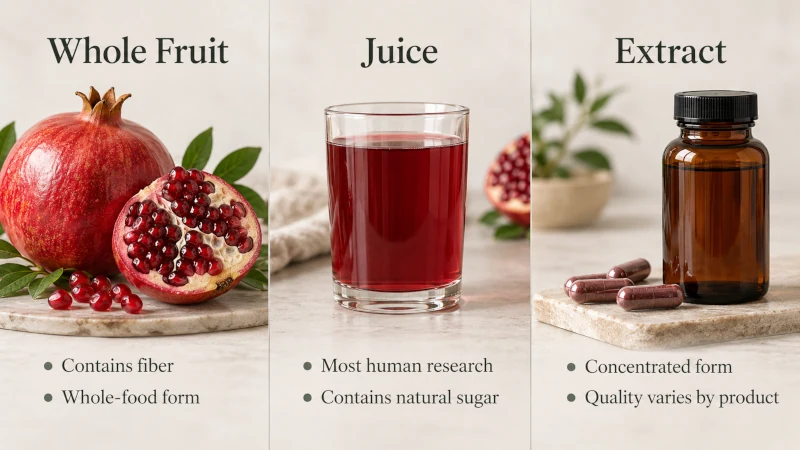
Whole fruit gives you fiber along with the same polyphenol family. Juice has the most research behind it but brings a lot of natural sugar, which matters if you have diabetes [MSKCC, 2022]. Capsules skip the sugar, but you have to trust the label.
Choosing a product you can trust
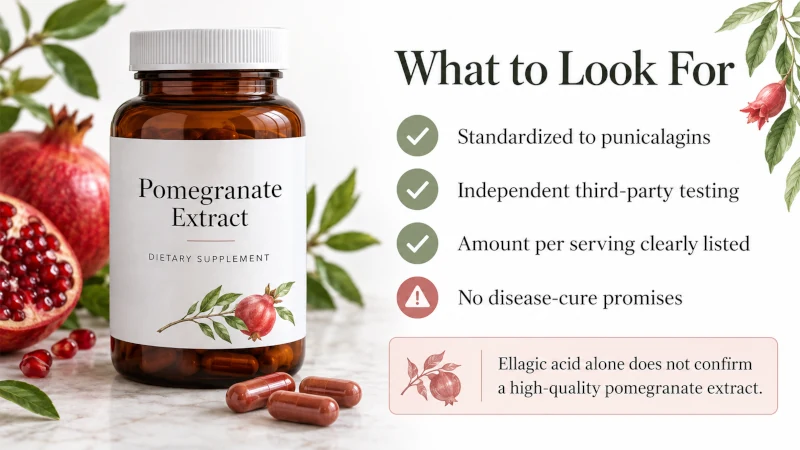
That trust is a real issue. When UCLA researchers tested 27 pomegranate extract supplements, only 5 had the tannin profile you’d expect from pomegranate; 17 were mostly ellagic acid, which can come from cheaper plants, and 5 had no detectable tannins or ellagic acid at all [Zhang, 2009]. That testing is from 2009 and the market may have changed, but the lesson holds.
- Look for standardization to punicalagins, not ellagic acid alone.
- Prefer brands that carry an independent third-party testing seal.
- Skip proprietary blends that hide how much pomegranate is inside.
- Walk away from any product that promises to cure, prevent, or reverse disease.
Side effects, drug interactions, and who should avoid it
Pomegranate juice is considered safe for most people, and the extract may be as well. Side effects are usually digestive, such as diarrhea or an upset stomach, and allergic reactions have been reported [NCCIH, 2025]. The root, stem, and peel may not be safe in large amounts; our guide to the pomegranate tree explains why bark and root remedies are a different, riskier story.
Medication interactions: what’s known and what isn’t
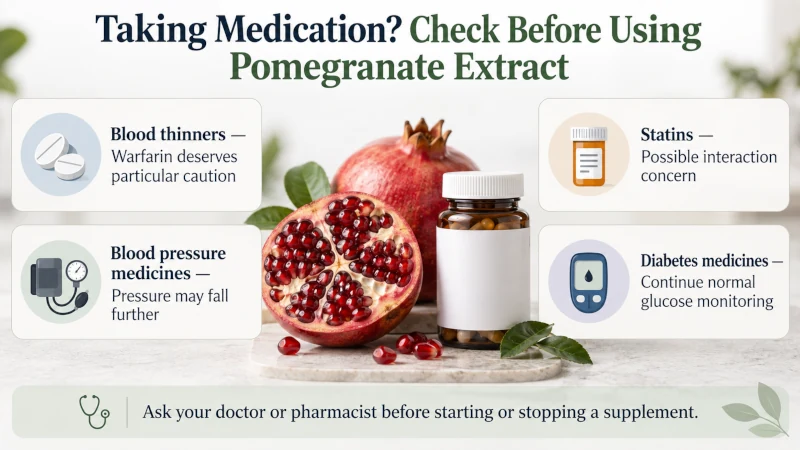
Precision matters here, because the interaction story often gets exaggerated. Rat studies suggested pomegranate might slow two liver enzymes (CYP3A and CYP2C9) that clear many drugs, the way grapefruit does. Human studies haven’t borne that out. Pomegranate juice didn’t change how people cleared midazolam [Farkas, 2007], and neither juice nor a 1-gram extract capsule changed flurbiprofen levels [Hanley, 2012]. The specific concerns that remain:
- Warfarin. At least two case reports describe possible interactions with pomegranate juice [Komperda, 2009] [Jarvis, 2010]. Case reports can’t prove cause, but if you take warfarin, don’t start or stop pomegranate products without telling your anticoagulation clinic so your INR can be checked.
- Statins. Memorial Sloan Kettering lists a possible increased risk of rhabdomyolysis (serious muscle breakdown) in people on statins, based on a case report [MSKCC, 2022].
- Blood pressure medicine. If pomegranate lowers your pressure slightly, the effect could add to your medication. Ask your prescriber, and check your blood pressure at home for the first few weeks.
- Diabetes medicine. Studies disagree on blood sugar. The NIH summary reports a small reduction [NCCIH, 2025], while a meta-analysis found no meaningful effect [Huang, 2017]. Juice also adds sugar, so keep monitoring as usual.
Pregnancy and breastfeeding
Drinking pomegranate juice may be safe during pregnancy or while breastfeeding, but little is known about extracts or other parts of the plant [NCCIH, 2025]. Unless your obstetric provider says otherwise, stick with the fruit or juice.
Who should skip it or check with a clinician first
- Anyone allergic to pomegranate.
- People taking warfarin or another blood thinner, statins, blood pressure medicine, or diabetes medicine.
- Anyone in cancer treatment.
- People who are pregnant or breastfeeding (extract form).
- Children, unless a pediatrician recommends it.
When to get medical help
Stop taking it and call your doctor if you notice:
- Unusual bruising, nosebleeds, bleeding gums, pink or brown urine, or black stools, especially if you take a blood thinner.
- Unexplained muscle pain or weakness, or dark urine, especially if you take a statin.
- Dizziness or lightheadedness if you take blood pressure medicine.
Call 911 or your local emergency number for swelling of the lips, tongue, or throat, trouble breathing, or hives spreading across your body after taking it.
| Health disclaimer: This article is for general education and isn’t medical advice. Pomegranate fruit extract is a dietary supplement. Supplements aren’t approved by the FDA before they’re sold [NCCIH, 2025], and this one should not replace prescribed treatment for high blood pressure, heart disease, diabetes, or cancer. Talk with your doctor or pharmacist before using it if you take prescription medication (especially warfarin, statins, blood pressure drugs, or diabetes drugs), are pregnant or breastfeeding, or have an ongoing medical condition. If you think you’re having an allergic reaction or another emergency, call 911 or your local emergency number. |
Frequently Asked Questions
Is pomegranate extract better than pomegranate juice?
Not that anyone has shown. Most research used juice. In the one trial that tested both side by side, 1,000 mg of extract and 8 ounces of juice produced similar results for sunburn resistance [Henning, 2019]. The extract avoids the sugar; the juice avoids the label-quality problem.
How long does pomegranate fruit extract take to work?
There’s no reliable timeline. The skin trial ran 12 weeks. For blood pressure, compare a few weeks of home readings before and after starting; if nothing moves, it probably isn’t worth the money.
Can pomegranate extract replace blood pressure medication?
No. The average drop in trials was about 5 mmHg, mostly with juice [Ghaemi, 2023]. Don’t stop or reduce prescribed medication without your prescriber.
Does pomegranate extract prevent or treat prostate cancer?
There’s no good evidence that it does. In the placebo-controlled trial, extract didn’t slow PSA rise any better than placebo [Pantuck, 2015].
Is it safe to take pomegranate extract every day?
For most healthy adults it appears to be. Men in one trial took 1–3 g daily for up to 18 months without clinically significant toxicity, though diarrhea was more common at the higher dose [Paller, 2013]. Check first if you take medication or are pregnant.
Does pomegranate extract interact with medications?
Human studies are reassuring for the common drug-clearing enzymes [Hanley, 2012]. The open questions are warfarin, based on case reports, and statins, based on a single case [MSKCC, 2022]. Ask your pharmacist before combining them.
References
- National Center for Complementary and Integrative Health. Pomegranate: Usefulness and Safety. NIH; last updated April 2025. View source
- Memorial Sloan Kettering Cancer Center. About Herbs: Pomegranate. Last updated November 11, 2022. View source
- Ghaemi F, Emadzadeh M, Atkin SL, Jamialahmadi T, Zengin G, Sahebkar A. Impact of pomegranate juice on blood pressure: a systematic review and meta-analysis. Phytother Res. 2023;37(10):4429–4441. DOI 10.1002/ptr.7952. View source
- Gbinigie OA, Onakpoya IJ, Spencer EA. Evidence for the effectiveness of pomegranate supplementation for blood pressure management is weak: a systematic review of randomized clinical trials. Nutr Res. 2017;46:38–48. DOI 10.1016/j.nutres.2017.07.007; PMID 29173650. View source
- Huang H, Liao D, Chen G, Chen H, Zhu Y. Lack of efficacy of pomegranate supplementation for glucose management, insulin levels and sensitivity: evidence from a systematic review and meta-analysis. Nutr J. 2017. DOI 10.1186/s12937-017-0290-1; PMC5629805. View source
- Davidson MH, Maki KC, Dicklin MR, et al. Effects of consumption of pomegranate juice on carotid intima–media thickness in men and women at moderate risk for coronary heart disease. Am J Cardiol. 2009;104(7):936–942. DOI 10.1016/j.amjcard.2009.05.037; PMID 19766760. View source
- Seeram NP, Aviram M, Zhang Y, et al. Comparison of antioxidant potency of commonly consumed polyphenol-rich beverages in the United States. J Agric Food Chem. 2008;56(4):1415–1422. DOI 10.1021/jf073035s; PMID 18220345. View source
- Pantuck AJ, Leppert JT, Zomorodian N, et al. Phase II study of pomegranate juice for men with rising prostate-specific antigen following surgery or radiation for prostate cancer. Clin Cancer Res. 2006;12:4018–4026. DOI 10.1158/1078-0432.CCR-05-2290; PMID 16818701. View source
- Paller CJ, Ye X, Wozniak PJ, et al. A randomized phase II study of pomegranate extract for men with rising PSA following initial therapy for localized prostate cancer. Prostate Cancer Prostatic Dis. 2013;16(1):50–55. DOI 10.1038/pcan.2012.20; PMID 22689129. View source
- Pantuck AJ, Pettaway CA, Dreicer R, et al. A randomized, double-blind, placebo-controlled study of the effects of pomegranate extract on rising PSA levels in men following primary therapy for prostate cancer. Prostate Cancer Prostatic Dis. 2015;18(3):242–248. DOI 10.1038/pcan.2015.32; PMID 26169045. View source
- Henning SM, Yang J, Lee RP, et al. Pomegranate juice and extract consumption increases the resistance to UVB-induced erythema and changes the skin microbiome in healthy women: a randomized controlled trial. Sci Rep. 2019;9:14528. DOI 10.1038/s41598-019-50926-2. View source
- Zhang Y, Wang D, Lee RP, Henning SM, Heber D. Absence of pomegranate ellagitannins in the majority of commercial pomegranate extracts: implications for standardization and quality control. J Agric Food Chem. 2009;57(16):7395–7400. DOI 10.1021/jf9010017; PMID 20349921. View source
- Mathon C, Chater JM, Green A, et al. Quantification of punicalagins in commercial preparations and pomegranate cultivars, by liquid chromatography–mass spectrometry. J Sci Food Agric. 2019;99(8):4036–4042. DOI 10.1002/jsfa.9631; PMID 30729530. View source
- González-Sarrías A, García-Villalba R, Romo-Vaquero M, et al. Clustering according to urolithin metabotype explains the interindividual variability in the improvement of cardiovascular risk biomarkers in overweight-obese individuals consuming pomegranate: a randomized clinical trial. Mol Nutr Food Res. 2017. DOI 10.1002/mnfr.201600830; PMID 27879044. View source
- Farkas D, Oleson LE, Zhao Y, et al. Pomegranate juice does not impair clearance of oral or intravenous midazolam, a probe for cytochrome P450-3A activity: comparison with grapefruit juice. J Clin Pharmacol. 2007;47(3):286–294. DOI 10.1177/0091270006298359; PMID 17322140. View source
- Hanley MJ, Masse G, Harmatz JS, Court MH, Greenblatt DJ. Pomegranate juice and pomegranate extract do not impair oral clearance of flurbiprofen in human volunteers: divergence from in vitro results. Clin Pharmacol Ther. 2012;92(5):651–657. DOI 10.1038/clpt.2012.170; PMID 23047652. View source
- Komperda KE. Potential interaction between pomegranate juice and warfarin. Pharmacotherapy. 2009;29(8):1002–1006. DOI 10.1592/phco.29.8.1002; PMID 19637955. View source
- Jarvis S, Li C, Bogle RG. Possible interaction between pomegranate juice and warfarin. Emerg Med J. 2010;27:74–75. PMID 20029019. View source


