
Blueberries are a smart everyday fruit: low in calories, easy to eat, rich in fiber for their size, and packed with blue-purple plant pigments called anthocyanins. The health benefits of blueberries are best understood as food benefits, not medicine benefits. They can support a healthier diet pattern, but they should not be described as a treatment for urinary infections, kidney stones, diarrhea, parasites, vision loss, or circulation disorders.
That distinction matters. The old version of this article leaned heavily on cranberry-style claims and several medicinal claims that need stronger evidence than a food article can provide. This rewrite keeps the useful nutrition story and removes or softens the claims that could mislead readers.
Health benefits of blueberries: the evidence-backed list
They add fiber, vitamin K, manganese, and protective plant compounds
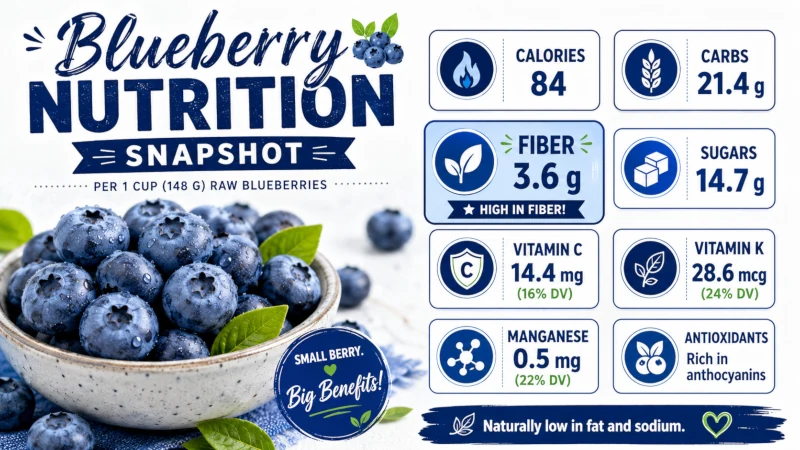
One cup of raw blueberries is a modest portion with meaningful nutrition. Cleveland Clinic lists one cup as about 96 calories, with roughly 21.9 grams of carbohydrate, 3.6 grams of fiber, 14 grams of sugar, 1 gram of protein, vitamin K, manganese, and vitamin C [Cleveland Clinic, 2026]. That makes blueberries useful as a sweet food that still brings fiber and micronutrients along with the sugar.
The blue color is not decoration. Red, blue, and purple berries are common food sources of anthocyanins, a type of flavonoid pigment [Linus Pauling Institute, 2026]. These compounds are part of why blueberries are studied so often, but they do not turn blueberries into a cure-all. The strongest everyday takeaway is simpler: eating more whole fruit and fewer highly processed sweets is usually a good trade.
They support heart and blood-vessel health as part of a healthy pattern
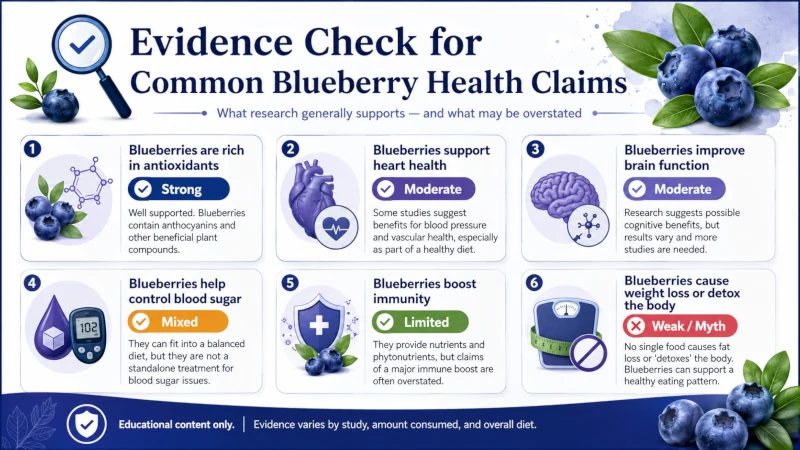
Blueberries fit naturally into a heart-health eating pattern because they are a whole fruit with fiber and polyphenols. Evidence from randomized trials suggests that flavonoid-rich foods and beverages containing anthocyanins or flavan-3-ols may improve short-term vascular endothelial function, but researchers still cannot say that these acute changes directly lower long-term cardiovascular disease risk [Linus Pauling Institute, 2026].
So the careful claim is this: blueberries may support blood-vessel health when they are part of a broader pattern that includes vegetables, legumes, whole grains, nuts, seeds, and less sodium-heavy processed food. Readers looking at diet and blood pressure can also review your guide to potassium-rich foods, but blueberries themselves should not be promoted as a blood-pressure treatment.
They can fit a blood-sugar-friendly diet
Blueberries taste sweet, yet the whole fruit contains fiber and water, which makes it different from candy, sweetened drinks, or desserts. Cleveland Clinic’s review notes that blueberries may fit into blood-sugar-friendly eating, while also making clear that more research is needed before making strong claims about blood sugar control [Cleveland Clinic, 2026].
For most people, the practical move is to eat blueberries as whole fruit: stirred into plain yogurt, oatmeal, chia pudding, cottage cheese, salads, or a smoothie that includes protein. Blueberry muffins, sweetened dried blueberries, and blueberry juice are different foods. They often bring more added sugar and less fiber per serving.
They may support brain health, but the evidence is still limited
Blueberries are often promoted for memory and brain health. That may be promising, but it should be written carefully. The Linus Pauling Institute notes that evidence suggesting some flavonoids or flavonoid-rich foods may enhance cognitive function is limited, and it is not yet known whether these foods lower the risk of cognitive impairment or dementia in humans [Linus Pauling Institute, 2026].
A safer reader takeaway: blueberries are a reasonable part of a brain-supportive diet pattern, especially when they replace highly processed snacks. They should not be framed as preventing dementia, reversing cognitive decline, or treating neurological disease.
They support digestion through fiber, not by “killing germs”
Blueberries contain fiber, and fiber supports normal digestion. That is different from saying blueberries treat infectious diarrhea, kill intestinal germs, or rebalance the gut after antibiotics. Those are medical claims and need direct clinical evidence.
If a reader has mild digestive sluggishness, adding whole fruits gradually may help as part of an overall high-fiber diet. If they have severe diarrhea, bloody stool, fever, dehydration, or symptoms after travel or antibiotics, that is not a blueberry problem — it is a reason to seek medical advice.
Blueberries vs. cranberries: useful relatives, different claims
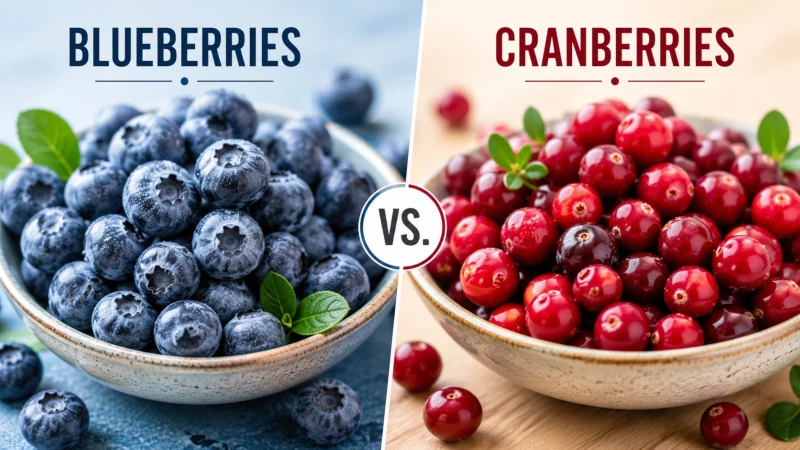
Blueberries and cranberries both belong to the Vaccinium family, but they are not interchangeable in health writing. Blueberries are best framed around whole-fruit nutrition, fiber, and anthocyanin-rich food patterns. Cranberries have a more specific research history around recurrent urinary tract infections.
NCCIH states that cranberry products may reduce the overall risk of symptomatic, recurrent UTIs in some women, but the evidence is inconsistent. NCCIH also says cranberry is not recommended as a treatment for an existing UTI in any population [NCCIH, 2024]. That means a blueberry article should not tell readers to use blueberry or cranberry juice instead of diagnosis and care.
People who think they have a UTI should contact a healthcare professional. NIDDK lists symptoms such as burning urination, frequent or intense urges to urinate, lower abdominal pain, cloudy or bloody urine, and warns that fever, chills, nausea, vomiting, or back, side, or groin pain may point to a kidney infection that needs quick treatment [NIDDK, 2024].
Blueberry claims that need careful wording
| Claim area | Evidence grade | Safer takeaway |
| UTIs/cystitis | Cranberry products may help reduce recurrent UTIs in some women, but evidence is inconsistent; blueberries are not established for UTI prevention. | Do not use blueberries or cranberries as UTI treatment. Seek care for UTI symptoms. |
| Kidney stones | The old claim that cranberry/blueberry juice can dissolve calcium phosphate stones is not verified. | For stone-specific diet advice, visit the kidney stone diet page. |
| Infectious diarrhea | Fiber may support digestion, but “antibiotic” or germ-killing claims are too strong for blueberries. | Use blueberries as food, not as treatment for infection or severe diarrhea. |
| Varicose veins/circulation | Anthocyanins may support vascular function in limited research, but that does not prove blueberries treat varicose veins, phlebitis, ulcers, or hemorrhoids. | Utilize as general heart/vascular dietary support only. |
| Vision/retina | Blueberry/bilberry eye claims are common, but there are very little to no verified clinical basis for treating retinal deterioration or improving visual acuity. | Eye symptoms need professional evaluation. |
| Parasites | The cranberry/blueberry “treatment” for oxyurids has very little to no verified evidence and could distract from proper care. | Consult a physician for proper care. |
How to eat blueberries for the most benefit
The best form is usually the simplest one: fresh or frozen whole blueberries. Frozen berries are useful because they are affordable, available year-round, and easy to add to breakfast or snacks. Cleveland Clinic notes that fresh and frozen blueberries can both be good options, while washing fresh berries before eating is important.
- Add 1/2 to 1 cup to plain Greek yogurt, oatmeal, or cottage cheese.
- Use frozen blueberries in smoothies, but include protein or fat so the smoothie is more filling.
- Add blueberries to salads with greens, nuts, seeds, or beans.
- Choose unsweetened frozen berries rather than sweetened dried berries for daily use.
- Keep blueberry juice and blueberry desserts as occasional foods, not the main “health” form.
Blueberries work best as one part of a varied plant-forward diet. Rotate them with other fiber-rich foods such as cabbage, beans, oats, nuts, and sunflower seeds instead of treating one berry as the whole strategy.

Safety, side effects, interactions, and when to get medical care
Whole blueberries are generally a safe food for most people. The most common issue is digestive discomfort if someone suddenly eats a large amount of fruit or fiber. Start with a modest portion if your digestion is sensitive.
People with known berry allergies should avoid blueberries. Anyone who takes warfarin or another anticoagulant should not make sudden major diet changes without asking their healthcare team; this is not because blueberries are “dangerous,” but because consistent eating patterns matter when medication dosing is carefully managed.
Cranberry products and cranberry supplements need their own cautions. NCCIH reports that cranberry taken by mouth is generally thought to be safe, but very large amounts can cause stomach upset and diarrhea; NCCIH also notes conflicting evidence about cranberry and warfarin and advises people taking warfarin or other medicines to talk with a healthcare professional before using cranberry or herbal products [NCCIH, 2024].
Pregnancy and breastfeeding deserve extra caution with supplements and concentrated products. Normal food portions of blueberries are usually just food, but large supplemental doses of cranberry or blueberry extracts should be discussed with a clinician, especially if the person has medical conditions or takes medication.
Seek medical care rather than relying on fruit or juice if you have symptoms of a UTI, kidney stone, severe diarrhea, blood in the stool or urine, fever, chills, vomiting, dehydration, severe abdominal pain, new vision changes, or worsening leg swelling. NIDDK specifically advises contacting a healthcare professional for bladder infection symptoms and quick treatment if kidney infection symptoms appear [NIDDK, 2024].
Health disclaimer
| Health disclaimer: This article is for educational purposes only and is not a substitute for medical advice, diagnosis, or treatment. Blueberries can be part of a healthy diet, but they should not be used to treat UTIs, kidney stones, diarrhea, parasites, eye disease, circulation disorders, diabetes, high blood pressure, or any other medical condition. Talk with a qualified healthcare professional if you have symptoms, take medication, are pregnant or breastfeeding, or are considering concentrated extracts or supplements. |
Frequently Asked Questions
Are blueberries good for you every day?
Yes, for most people. A daily serving of whole blueberries can fit well into a healthy diet. The value comes from regular use as a whole fruit, not from treating blueberries like a medical therapy.
Are frozen blueberries as healthy as fresh?
Frozen blueberries are a good option. They are convenient, often less expensive, and can be used in oatmeal, yogurt, smoothies, and sauces. Choose unsweetened frozen berries when possible.
Do blueberries help UTIs?
Blueberries are not established as a UTI treatment or prevention strategy. Cranberry products have some evidence for reducing recurrent symptomatic UTIs in certain women, but the evidence is inconsistent and cranberry is not recommended as treatment for an existing UTI.
Are blueberries good for blood sugar?
Whole blueberries can fit a blood-sugar-friendly eating pattern because they contain fiber and are usually eaten in moderate portions. They should not be described as lowering blood sugar like a medicine.
How many blueberries should I eat?
A practical serving is about 1/2 to 1 cup. More is not automatically better, especially if it replaces protein, vegetables, or other important foods.
Are blueberry supplements better than whole blueberries?
Not usually. Whole blueberries bring fiber, water, flavor, and a normal food matrix. Supplements are more concentrated, less food-like, and may carry more interaction or quality-control concerns.
References
- Cleveland Clinic. 5 Major Health Benefits of Blueberries. 2026. View source
- U.S. Department of Agriculture. FoodData Central. 2026 database access. View source
- Linus Pauling Institute, Oregon State University. Flavonoids. Accessed 2026. View source
- National Center for Complementary and Integrative Health. Cranberry: Usefulness and Safety. 2024. View source
- National Institute of Diabetes and Digestive and Kidney Diseases. Symptoms & Causes of Bladder Infection in Adults. 2024. View source
- MedlinePlus Medical Encyclopedia. Urinary tract infection – adults. 2024; editorial update 2025. View source
