
Saffron has the best human evidence of any kitchen spice for one thing: lifting low mood. Several dozen small trials suggest a standardized saffron extract can ease mild to moderate depression symptoms, though the research has real weak spots [Marx et al., 2019]. Almost everything else you’ll read about the saffron plant — that it heals menstrual pain, settles digestion, or soothes teething babies — rests on tradition rather than testing. And at high doses, saffron is genuinely toxic [TRC Natural Medicines via WebMD].
This guide sorts out which is which, so you can enjoy saffron in your cooking, decide whether a supplement makes sense for you, and stay well clear of the risks.
What the saffron plant is
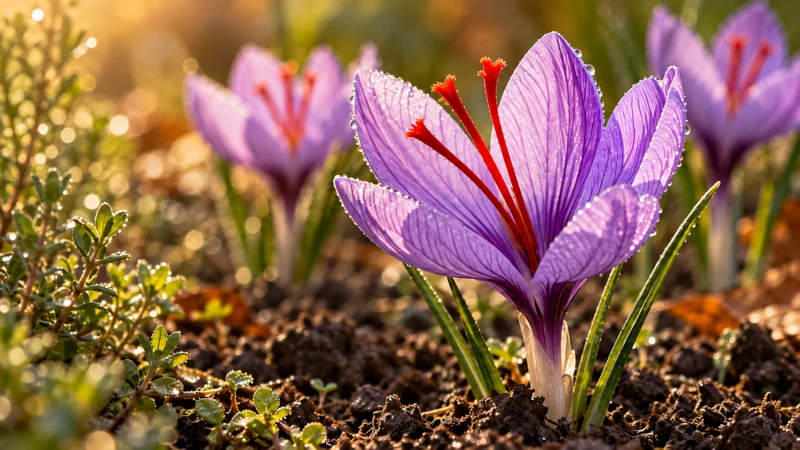
Saffron comes from Crocus sativus, a small autumn-flowering crocus grown from corms. Each lavender flower holds three bright red stigmas — the thread-like tips of the female flower parts — and those threads, dried, are the spice [UVM Extension, 2024].
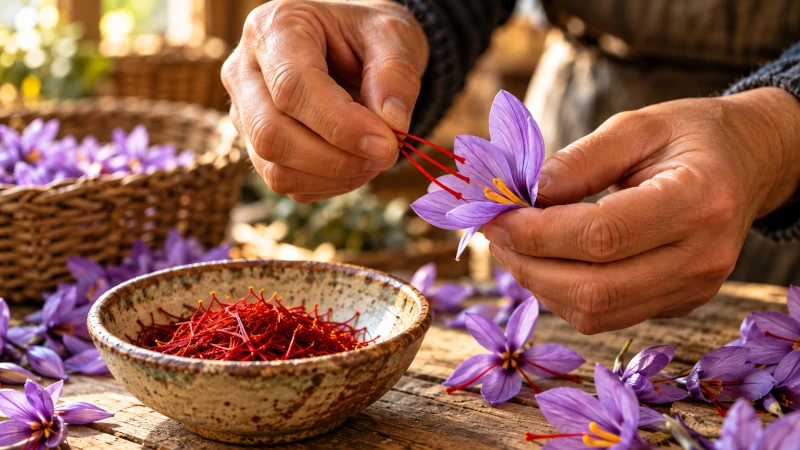
The price makes sense once you see the harvest. Every flower is picked by hand and its three stigmas are pulled out by hand, and it takes roughly 150 to 170 flowers to make a single gram of saffron [UVM Extension, 2024].
Three compounds give saffron its personality: crocin supplies the golden color, picrocrocin the slightly bitter taste, and safranal the hay-like aroma [Hosseinzadeh, 2014]. Crocin and safranal are also the compounds researchers point to when they study saffron’s effects on mood.
Don’t confuse it with “autumn crocus”
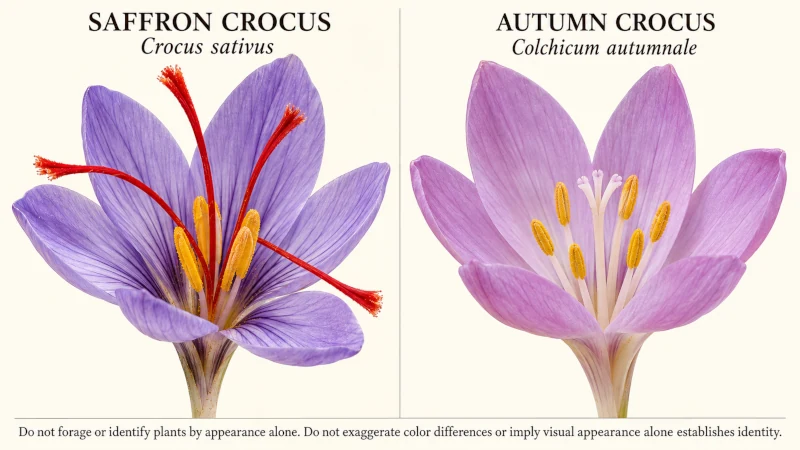
| Look-alike warning You may see saffron called “autumn crocus.” Avoid that name. In common and poison-control usage, autumn crocus (also called meadow saffron) is Colchicum autumnale — a different plant in which every part is poisonous. In France, people who mistook it for wild garlic have been seriously poisoned, and one died in 2020 [ANSES, 2020]. Never forage “saffron” flowers or bulbs. Buy saffron threads or powder from a reputable spice seller. |
Saffron plant benefits, graded by the evidence
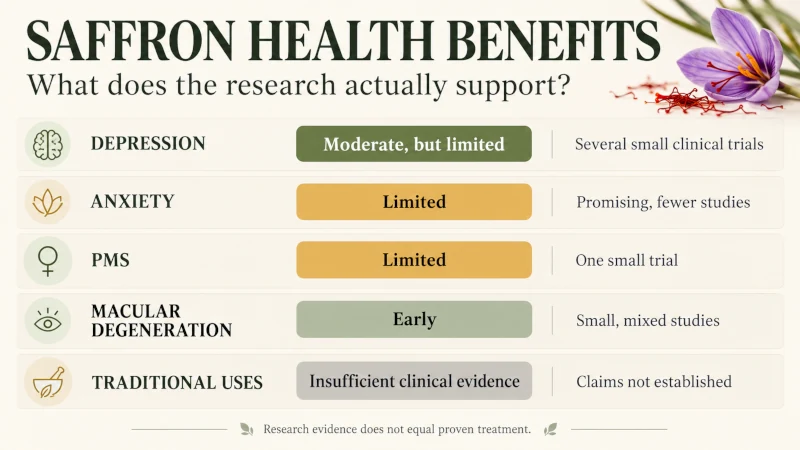
Low mood and depression: the strongest case
This is where saffron has earned real attention. A 2019 meta-analysis pooled 23 randomized controlled trials and found that saffron reduced depressive symptoms compared with placebo, with a large statistical effect, and also helped when added to standard antidepressants [Marx et al., 2019]. A 2020 meta-analysis of 12 studies reached a similar conclusion for mild to moderate depression, finding saffron better than placebo, roughly comparable to the synthetic antidepressants it was tested against, and no more likely to cause side effects [J Nerv Ment Dis meta-analysis, 2020].
Before you treat that as settled, weigh the caveats. The 2019 authors found signs of publication bias — positive trials may be overrepresented — and noted a lack of regional diversity in where the research was done [Marx et al., 2019]. Trials generally ran for weeks to a few months, so long-term effects are unknown [TRC Natural Medicines via WebMD]. A licensed natural-medicines monograph rates saffron “possibly effective” for depression, which is a fair summary: encouraging, not proven [TRC Natural Medicines via WebMD].
What that means for you: saffron extract may be a reasonable thing to discuss with your doctor for mild low mood. It is not a replacement for treatment of moderate or severe depression, and you shouldn’t stop or swap a prescribed antidepressant on your own. Food matters too — our guide to foods that help with depression covers the eating patterns with the best support.
Anxiety: promising, less tested
The same 2019 meta-analysis also found a reduction in anxiety symptoms versus placebo [Marx et al., 2019]. Far fewer trials looked at anxiety directly, so the signal is thinner and more likely to shift as new studies arrive. If anxiety is your main concern, compare saffron with the options in our evidence review of supplements to reduce anxiety and stress, or with lavender, which has its own trial evidence for anxiety.
Premenstrual syndrome: one small trial
A double-blind, placebo-controlled trial in women aged 20 to 45 with long-standing PMS gave 30 mg of saffron a day over two menstrual cycles and reported meaningful drops in PMS symptom scores and depression ratings compared with placebo [Agha-Hosseini et al., 2008]. That’s a genuine result, but it’s essentially one study. Treat PMS relief as promising and unconfirmed.
Eye health and macular degeneration: early
A 2026 systematic review found four studies of saffron in age-related macular degeneration (AMD). The best of them, a 100-person placebo-controlled crossover trial, used 20 mg a day for three months and found small improvements in visual acuity and retinal function. A smaller Iranian trial at 50 mg a day reported similar gains. The other two studies were open-label, and in a 12-month follow-up visual acuity actually dipped slightly, possibly from cataracts [Ferrara & Schloss, 2026]. The reviewers couldn’t pool the results because the studies were too different, and they called for longer trials [Ferrara & Schloss, 2026].
If you have AMD, saffron is something to ask your eye doctor about — not a substitute for the monitoring and treatment you already have.
Digestion, appetite, menstrual cramps, and teething: tradition only
Older herbals, including the source behind the earlier version of this page, describe saffron as a digestive and appetite stimulant, a remedy for menstrual pain, and a gum rub for teething children. We could not find controlled human trials supporting any of these. For digestive complaints, herbs with real evidence for stomach issues such as peppermint and ginger are a better place to start.
Please don’t rub saffron preparations on a baby’s gums. Children’s hospital guidance favors simple measures instead — gently massaging the gums with a clean finger, offering a chilled (not frozen) wet washcloth or a solid teething ring, and asking your pediatrician before giving any pain reliever [CHOP, 2016].
Evidence at a glance
| Use | Strength of evidence | What it means for you |
| Mild to moderate depression | Moderate but limited — many small, short trials; signs of publication bias | Worth discussing with a doctor; not a replacement for treatment |
| Anxiety symptoms | Limited — fewer trials | Possible small help; less certain |
| PMS | Limited — essentially one trial | Promising, unconfirmed |
| Macular degeneration | Early — four small studies, mixed designs | Ask your eye doctor; keep standard care |
| Digestion, appetite, menstrual cramps | Traditional only | No trial support found |
| Teething (rubbed on gums) | None — and not advised | Use safer, standard measures |
How to use saffron
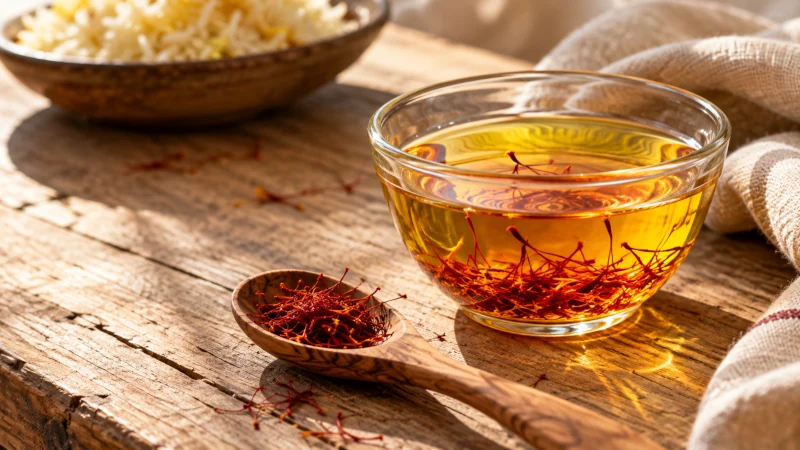
In cooking. A pinch of threads in rice, stews, or baked goods is the way most people use saffron, and food amounts are generally considered safe. Steep the threads in a few tablespoons of warm water or broth for 10 to 20 minutes first so the color and flavor spread evenly. Saffron tea works the same way: a few threads in a cup of hot water, sweetened if you like.
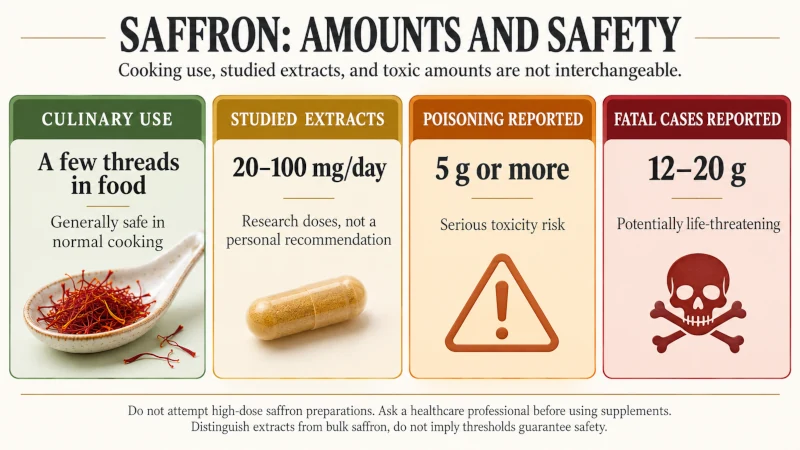
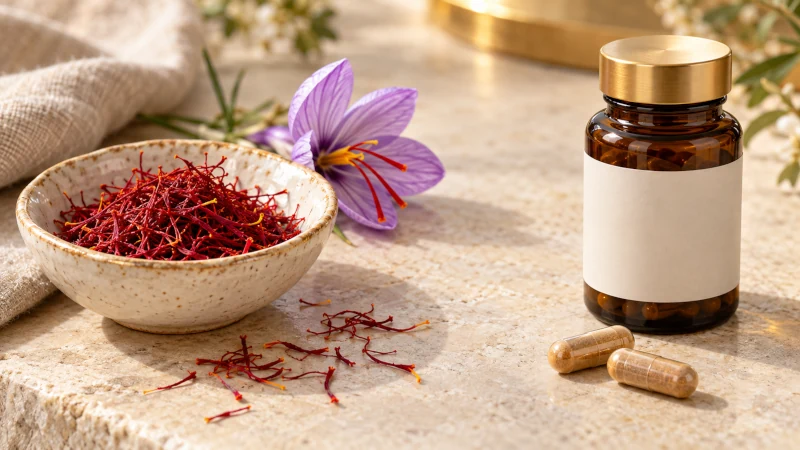
As a supplement. Supplements use standardized extracts, which kitchen saffron isn’t, so cooking amounts and capsule doses don’t translate directly. Adults in studies have most often taken 20 to 100 mg of saffron extract a day for up to three months, and up to 100 mg daily for as long as 26 weeks is rated possibly safe [TRC Natural Medicines via WebMD]. The PMS trial used 30 mg a day [Agha-Hosseini et al., 2008]; the main eye-health trial used 20 mg [Ferrara & Schloss, 2026].
More is not better. Poisoning has been reported at 5 g or more, and doses of 12 to 20 g have caused death [TRC Natural Medicines via WebMD]. Those amounts are hundreds of times the studied supplement doses, but they are why you should never improvise a “strong” home preparation.
Side effects, interactions, and who should avoid saffron
At studied doses, saffron is generally well tolerated. A 2026 review of 102 clinical trials estimated that about 17.5% of people had some adverse effect, most often minor stomach upset that resolved on its own, and advised clinical monitoring at higher doses or with long-term use [Hasheminasab et al., 2026]. Reported side effects include drowsiness, stomach problems, nausea or vomiting, and occasional allergic reactions [TRC Natural Medicines via WebMD].
Medication interactions. Saffron may add to the effect of blood-pressure drugs, diabetes medicines, and sedatives, and it may slow how quickly your body clears caffeine [TRC Natural Medicines via WebMD]. If you take any of these, ask your doctor or pharmacist before starting a supplement.
Avoid saffron supplements or talk to a clinician first if you:
- are pregnant — more than food amounts is considered likely unsafe, and larger amounts might cause miscarriage [TRC Natural Medicines via WebMD]
- are breastfeeding — there isn’t enough reliable information, so stick to food amounts [TRC Natural Medicines via WebMD]
- have bipolar disorder — saffron might trigger excitability and impulsive behavior [TRC Natural Medicines via WebMD]
- have surgery scheduled — stop at least two weeks before [TRC Natural Medicines via WebMD]
- are allergic to olive pollen, ryegrass (Lolium), or Salsola plants — cross-allergy to saffron is possible [TRC Natural Medicines via WebMD]
- take blood-pressure, diabetes, or sedating medication [TRC Natural Medicines via WebMD]
Also be cautious with children: supplement safety in children wasn’t addressed in the sources we reviewed.
When to talk to a doctor
See a healthcare professional if low mood lasts more than two weeks, gets in the way of work or relationships, or doesn’t improve. Get prompt care for any new or sudden change in your vision. And seek help right away if:
- you have thoughts of harming yourself — in the U.S., call or text 988 to reach the Suicide and Crisis Lifeline
- someone has swallowed a large amount of saffron, or a plant you suspect may be autumn crocus — call Poison Control at 1-800-222-1222, or 911 if they are very unwell
- you develop vomiting, severe diarrhea, or swelling of the lips or face after taking saffron
| Health Disclaimer: This article is for general education and information only. It is not medical advice and doesn’t replace diagnosis or treatment from a qualified healthcare professional. Saffron extract has promising but limited evidence and does not cure or prevent any disease. Large amounts are toxic. If you are pregnant or breastfeeding, have bipolar disorder or another ongoing condition, take prescription medicine, or have surgery planned, talk with your doctor or pharmacist before taking saffron supplements. If you are in crisis, call or text 988 in the U.S. |
Frequently Asked Questions
Is the saffron plant the same as autumn crocus?
No. Saffron comes from Crocus sativus. The plant commonly called autumn crocus or meadow saffron is Colchicum autumnale, which is poisonous in every part [ANSES, 2020]. Don’t pick or eat either from the wild.
How much saffron is safe to take?
Food amounts are generally safe. As a supplement, research has mostly used 20 to 100 mg of extract a day for up to three months, and up to 100 mg daily for 26 weeks is rated possibly safe. Poisoning has been reported at 5 g or more [TRC Natural Medicines via WebMD].
Can saffron replace an antidepressant?
No. Trials suggest saffron can ease mild to moderate depression symptoms, but publication bias means the benefit may be overstated [Marx et al., 2019]. Never stop or swap a prescribed medicine without your doctor.
How long does saffron take to work for mood?
Most trials ran for weeks rather than days, generally up to about three months [TRC Natural Medicines via WebMD]. If you and your doctor decide to try it, give it several weeks and track how you feel.
Is saffron safe during pregnancy?
Cooking amounts are fine for most people, but more than food amounts is considered likely unsafe in pregnancy and larger amounts might cause miscarriage [TRC Natural Medicines via WebMD]. Skip saffron supplements while pregnant.
References
- Marx W, Lane M, Rocks T, Ruusunen A, Loughman A, Lopresti A, Marshall S, Berk M, Jacka F, Dean OM. Effect of saffron supplementation on symptoms of depression and anxiety: a systematic review and meta-analysis. View source
- [Authors not confirmed]. Safety and efficacy of saffron (Crocus sativus L.) for treating mild to moderate depression: a systematic review and meta-analysis. View source
- Agha-Hosseini M, Kashani L, Aleyaseen A, et al. Crocus sativus L. (saffron) in the treatment of premenstrual syndrome: a double-blind, randomised and placebo-controlled trial. View source
- Ferrara S, Schloss J. Does Crocus sativus (saffron) have an influence or effect on ocular health: a systematic literature review. View source
- Therapeutic Research Center (Natural Medicines). Saffron: uses, side effects, precautions, interactions, dosing. Licensed monograph published on WebMD. View source
- Hasheminasab FS, Hajimonfarednejad M, Najibi SM, et al. Adverse events of saffron (Crocus sativus L.): systematic review of current evidence. Health Science Reports. View source
- Hosseinzadeh H. Saffron: a herbal medicine of third millennium. View source
- Benoit DJ. Saffron: world’s most expensive spice. University of Vermont Extension. View source
- ANSES and French poison control centres. Confusion between autumn crocus and wild garlic: a fatal case of poisoning. View source
- Children’s Hospital of Philadelphia. Teething pain: risky remedies to avoid. View source


