
The COVID-19 Cicada variant is BA.3.2, a heavily mutated member of the Omicron family that health agencies have tracked since late 2024. Its many changes help it slip past some antibodies in lab tests. Even so, the World Health Organization rates the extra public health risk it poses as low and has found no evidence that it causes more severe illness than other circulating strains [WHO risk evaluation, 2025].
For you, that means the familiar playbook still applies. The symptoms, tests, treatments, and warning signs are the same as for any COVID-19 infection.
What Is the Cicada Variant?
BA.3.2 is a lineage of SARS-CoV-2, the virus that causes COVID-19. It descends from BA.3, an early Omicron branch that briefly circulated alongside BA.1 and BA.2 in late 2021 and 2022. The first known sample was collected in South Africa on November 22, 2024 [CDC MMWR, 2026].
“Cicada” is an informal nickname, not a scientific classification [UKHSA, 2026]. Scientists use the lineage name BA.3.2, which has since split into two branches, BA.3.2.1 and BA.3.2.2.
What sets BA.3.2 apart is how different it is from other recent strains. Its spike protein—the part of the virus that antibodies mainly recognize—carries roughly 70 to 75 changes compared with the JN.1 and LP.8.1 strains used in the 2025–26 vaccines [CDC MMWR, 2026].
WHO named BA.3.2 a “variant under monitoring” on December 5, 2025, and it remained on that list as of July 27, 2026 [WHO variant tracking, 2026]. The label means scientists are watching it closely. It does not mean the variant is more dangerous, and it does not mean it has become the main strain.
COVID-19 Cicada Variant Symptoms
Based on current evidence, BA.3.2 causes the same range of symptoms as other COVID-19 strains. The CDC and WHO reports on BA.3.2 do not describe any symptom unique to it, and no reliable study has established a distinct “Cicada” symptom profile.
The CDC lists these possible COVID-19 symptoms [CDC, symptoms of COVID-19]:
- Fever or chills
- Cough
- Shortness of breath or difficulty breathing
- Sore throat
- Congestion or runny nose
- New loss of taste or smell
- Fatigue
- Muscle or body aches
- Headache
- Nausea or vomiting
- Diarrhea
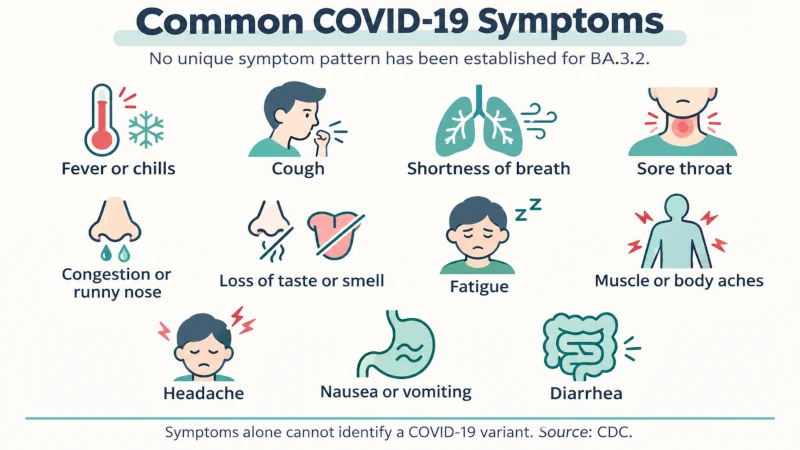
Symptoms may appear 2 to 14 days after exposure. They can start mild and become more severe, and they can differ by variant and vaccination status. The list isn’t complete.
You also can’t tell COVID-19 from the flu by symptoms alone, because the two overlap. A test is the only way to know you have COVID-19—and even a test won’t tell you which variant caused it.
Is the Cicada Variant More Dangerous or Contagious?
There is no evidence that BA.3.2 causes more severe illness, and so far it has not outcompeted other variants. Lab studies, surveillance data, and clinical outcomes each tell part of the story.
What lab studies show
In laboratory experiments, BA.3.2 bound less strongly to ACE2—the receptor the virus uses to enter cells—and entered lung cells less efficiently than the XFG and NB.1.8.1 variants [CDC MMWR, 2026]. WHO likewise describes lower infectivity and modest replication compared with co-circulating strains [WHO risk evaluation, 2025]. These results may help explain why it hasn’t taken over, but lab findings don’t measure how sick people get.
What real-world tracking shows
From November 2025 through January 2026, BA.3.2 reached about 30% of sequenced samples in Denmark, Germany, and the Netherlands. Overall COVID-19 levels in those countries were not substantially higher than in earlier years, and BA.3.2 circulated alongside other strains rather than replacing them [CDC MMWR, 2026].
In WHO’s most recent global variant summary, covering September 6 to October 4, 2026, XFG accounted for 52% of submitted sequences. Other tracked variants, including BA.3.2, were stable or declining, and WHO concluded BA.3.2 poses no additional public health risk compared with other circulating variants [WHO COVID-19 dashboard, 2026].
What we know about severity
WHO found no clinical or epidemiological data linking BA.3.2 to more severe disease, hospitalizations, or deaths [WHO risk evaluation, 2025]. Some early U.S. detections came from hospitalized older adults with other health problems. CDC researchers cautioned that this doesn’t show the variant is more severe, because hospital patients are simply more likely to be tested and sequenced [CDC MMWR, 2026].
One honest caveat: WHO rated its confidence on severity as low, partly because fewer countries now report hospital and death data. “No sign of greater harm” is reassuring, but it isn’t proof that the variant is mild. COVID-19 of any strain can still be serious, especially for older adults and people with certain health conditions.
Immune Escape, Explained
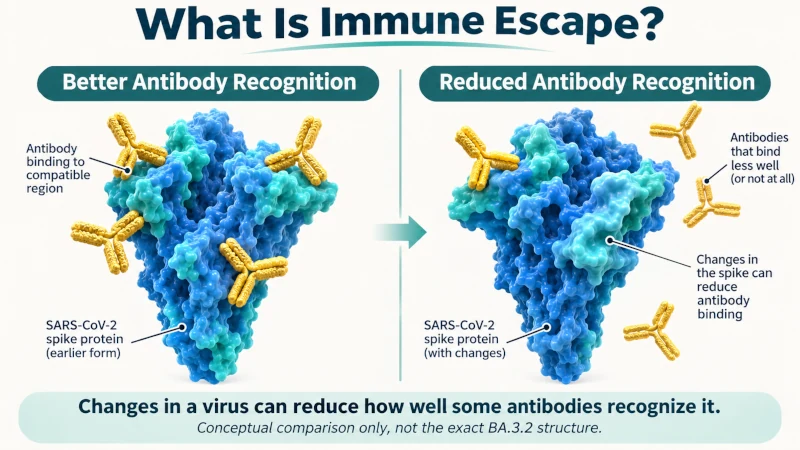
Immune escape means a virus has changed enough that antibodies from past infections or vaccines don’t recognize it as well. Picture antibodies as keys cut to fit a lock. When the lock changes shape, some keys stop fitting snugly.
BA.3.2 shows marked immune escape in the lab. In one study of seven variants, blood from people who received the 2025–26 LP.8.1-based mRNA vaccine neutralized BA.3.2 the least [CDC MMWR, 2026]. That could make it easier for BA.3.2 to infect people who already have some immunity.
It helps to separate two kinds of protection:
- Protection against infection relies heavily on antibodies, fades over time, and is the kind immune-escape variants are most likely to reduce.
- Protection against severe disease is the main goal of vaccination. WHO expects currently approved COVID-19 vaccines to keep protecting against severe disease from BA.3.2, despite the lower lab results [WHO risk evaluation, 2025].
Lab neutralization tests are an early signal, not a measure of real-world protection. CDC has said observational studies are still needed to show how vaccines perform against BA.3.2 in people.
Do Vaccines Still Protect Against BA.3.2?
Vaccines are expected to keep reducing the risk of severe illness, though no data yet show how well this season’s shots protect against BA.3.2 infection. The 2026–2027 COVID-19 vaccines target XFG, a JN.1-lineage strain, under FDA guidance issued May 29, 2026 [FDA, 2026–2027 vaccine formula]. XFG is the most common variant worldwide, while BA.3.2 is genetically distant from it.
For the 2026–2027 season, CDC recommends [CDC vaccine guidance, 2026]:
- Adults 18 and older: a 2026–2027 COVID-19 vaccine.
- Children 6 months to 17 years with moderate or severe immunocompromise: a 2026–2027 vaccine.
- All other children: vaccination based on shared decision-making between parents and a healthcare provider.
CDC notes that some of these recommendations go beyond the FDA-approved labeling for specific products, and it encourages everyone to talk through benefits and risks with a provider. A pharmacist or clinician can tell you which vaccine fits your age and health.
Testing: What a Home Test Can and Can’t Tell You
Home COVID-19 tests are rapid antigen tests that give results in 15 to 30 minutes. A positive result is reliable. A negative result doesn’t rule out infection, so FDA recommends repeat testing: two negative tests 48 hours apart if you have symptoms, or three if you don’t [CDC, testing for COVID-19]. Lab-based PCR tests are more likely to detect the virus.
No home test, and no routine test at a doctor’s office, can tell you which variant you have. Variants are identified through genomic sequencing, which public health labs run on a sample of specimens and on wastewater to track trends [CDC MMWR, 2026]. WHO has found no evidence that BA.3.2 causes PCR or antigen tests to miss infections [WHO risk evaluation, 2025].
The good news: you don’t need to know the variant. Testing, treatment, and precautions are the same.
If You Test Positive
Supportive care at home
Most people with COVID-19 have mild illness and recover at home. Over-the-counter medicines such as acetaminophen or ibuprofen can ease fever and aches [CDC, COVID-19 treatment]; follow the package directions. Rest, regular fluids, and simple meals help you get through the worst days. If your appetite is low, our guide to foods for cold and flu recovery covers gentle options.
Keep expectations realistic. No food, vitamin, herb, or supplement is an approved treatment for COVID-19, and CDC warns that people have been seriously harmed by taking unapproved products to treat or prevent it. Home care eases symptoms; it doesn’t replace antiviral treatment when you qualify for it.
If you’re more likely to get very sick, antiviral medicines can lower your risk of hospitalization and death. Timing is critical: treatment must start within 5 to 7 days of your first symptoms [CDC, COVID-19 treatment].
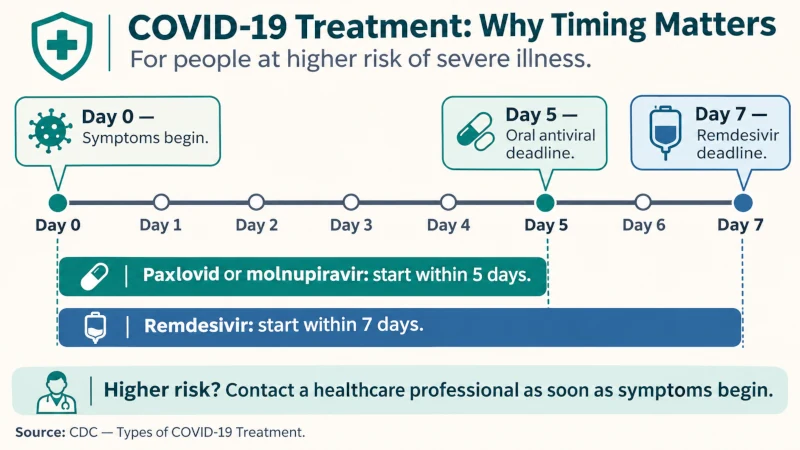
| Antiviral | For people at high risk who are | Start within | How it’s given |
| Nirmatrelvir with ritonavir (Paxlovid) | Adults and children 12 and older | 5 days of symptom onset | Pills taken at home |
| Remdesivir (Veklury) | Adults and children | 7 days of symptom onset | IV infusion at a healthcare facility, 3 days in a row |
| Molnupiravir (Lagevrio) | Adults | 5 days of symptom onset | Pills taken at home |
You don’t need a positive test to start treatment if you’re high risk and get sick, so call a provider right away. Nirmatrelvir with ritonavir interacts with many medicines; share your full medication list, and don’t stop or change a prescription unless your clinician tells you to. WHO reports no evidence that BA.3.2 makes remdesivir or nirmatrelvir less effective, although dedicated studies haven’t been done [WHO risk evaluation, 2025].
No regular provider? CDC suggests contacting a local pharmacy, community health center, or health department, or calling 1-800-232-0233 to find a treatment location.
Protecting others while you’re sick
Stay home and away from others, including people in your household who aren’t sick. You can return to normal activities when, for at least 24 hours, your symptoms are improving overall and you’ve had no fever without using fever-reducing medicine. For the next 5 days, take extra care around others: cleaner air, handwashing, a well-fitted mask, distance, or testing [CDC, precautions when sick].
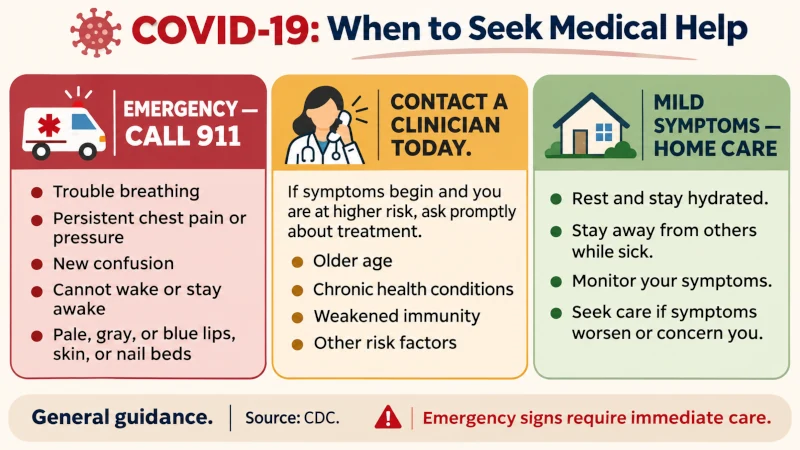
When to Seek Medical Help
Call 911 or go to the nearest ER if you or someone you’re caring for has any of these emergency warning signs [CDC, symptoms of COVID-19]:
- Trouble breathing
- Persistent pain or pressure in the chest
- New confusion
- Inability to wake or stay awake
- Pale, gray, or blue lips, nail beds, or skin, depending on skin tone
Tell the operator the person has or may have COVID-19.
Contact your primary care provider the same day symptoms start if you’re at higher risk of severe illness, even if you feel only mildly sick. If you can’t reach your provider quickly, an urgent care clinic can evaluate you. Higher-risk groups include [CDC, COVID-19 treatment]:
- Older adults, especially those 75 and older
- People who aren’t up to date on COVID-19 vaccination
- People with conditions such as chronic lung disease, heart disease, or a weakened immune system
Call a clinician about any other symptom that is severe or worries you.
Long COVID and the Cicada Variant
Long COVID is a chronic condition that follows a SARS-CoV-2 infection and lasts at least 3 months. Anyone who gets COVID-19 can develop it, including children. It is more common after severe illness, and each new infection carries some risk [CDC, long COVID basics].
There is no evidence that BA.3.2 carries a different long COVID risk than other variants. How new variants affect long COVID remains an open research question. CDC calls COVID-19 vaccination the best available tool for preventing long COVID.
How to Protect Yourself and Your Family
The strategies that work against other respiratory viruses work against BA.3.2, too [CDC, preventing respiratory illnesses]:

- Stay current on recommended vaccines, ideally before respiratory viruses peak in your area.
- Improve indoor air with ventilation or filtration where people live and work.
- Wash your hands regularly and clean commonly touched surfaces.
- Wear a well-fitted mask in crowded indoor places, especially when illness is rising or when you or the people around you are at higher risk.
- Stay home when you’re sick, and keep distance from vulnerable family members.
- Have a plan if you’re high risk: know how to reach a provider quickly so antiviral treatment can start on time.
A balanced diet supports nutrition and immune function, but no food prevents BA.3.2 infection or substitutes for these steps.
Evidence at a Glance
| Established | Preliminary or limited | Major unknowns |
| BA.3.2 is an Omicron (BA.3) descendant first sampled in November 2024 | Marked immune escape in lab antibody tests | Real-world protection from the 2026–27 XFG vaccines against BA.3.2 |
| WHO lists it as a variant under monitoring and rates its added risk as low | Lower cell entry and infectivity in lab studies | Whether future mutations could help it spread more easily |
| Symptoms, tests, treatments, and prevention are the same as for other strains | No signal of increased severity (WHO confidence: low) | Its current share of U.S. cases, given limited sequencing |
| Home and PCR tests detect it but can’t identify the variant | No evidence of reduced antiviral effectiveness (not directly studied) | Any variant-specific long COVID risk |
What to Remember
BA.3.2 draws attention because it is unusually different from other strains, not because it has been shown to be more dangerous. Watch for the usual COVID-19 symptoms and test when you’re sick. If you’re at higher risk, call a provider on day one so antivirals can start in time. Get a 2026–27 vaccine if it’s recommended for you, and seek emergency care for any warning sign.
HEALTH DISCLAIMER: This article is for general education and is not a substitute for professional medical advice, diagnosis, or treatment. Information about BA.3.2 is evolving, and guidance may change after the date above. Talk with your healthcare provider before starting, stopping, or changing any medicine or supplement, and about whether COVID-19 vaccination or antiviral treatment is right for you. If you have trouble breathing, chest pain or pressure, new confusion, or bluish lips or skin, call 911 or go to the nearest emergency room.
Frequently Asked Questions
What is the Cicada COVID variant?
It’s the nickname for BA.3.2, a heavily mutated Omicron descendant first sampled in South Africa in November 2024. WHO tracks it as a variant under monitoring and rates its added public health risk as low.
What are the first symptoms?
No early-symptom pattern specific to BA.3.2 has been identified. Like other COVID-19 strains, it can begin with any symptom on the CDC list, such as sore throat, congestion, fever, cough, or fatigue, often mild at first.
Is the Cicada variant worse than Omicron?
BA.3.2 is itself part of the Omicron family. There is no evidence it causes more severe illness than other Omicron descendants now circulating.
Does the Cicada variant cause a severe sore throat?
Sore throat is a common COVID-19 symptom, but there’s no evidence that BA.3.2 causes a worse sore throat than other strains. Call a clinician if any symptom is severe or worrying, and seek emergency care for trouble breathing.
Can you get BA.3.2 if vaccinated?
Yes. Lab studies suggest BA.3.2 can partly evade vaccine antibodies, so infection is possible. Vaccination’s main purpose is to lower the risk of severe illness, and WHO expects approved vaccines to keep doing that.
How long do COVID-19 symptoms last?
It varies from person to person, and no BA.3.2-specific timeline has been established. Many people with mild illness improve at home. Symptoms can briefly return a few days after recovery, called rebound. Symptoms lasting 3 months or more may signal long COVID and deserve a medical visit [CDC, COVID-19 treatment].
Does a home COVID test detect the Cicada variant?
Yes—home antigen tests detect COVID-19 caused by BA.3.2, and WHO has found no evidence the variant evades them. No home test can tell you which variant you have. Repeat a negative test as directed.
Is the Cicada variant spreading in the United States?
CDC confirmed BA.3.2 in patients, travelers, and wastewater across 29 states and Puerto Rico by March 2026, when it made up about 0.55% of sequenced U.S. samples. Its share since then is less certain. WHO’s fall 2026 data show XFG dominant worldwide and BA.3.2 stable or declining, and UK health officials described BA.3.2 in November 2026 as previously detected. For current figures, see CDC’s variant proportion data.
References
- World Health Organization, Technical Advisory Group on Virus Evolution. View source
- World Health Organization. Tracking SARS-CoV-2 Variants. View source
- World Health Organization. WHO COVID-19 Dashboard: View source
- Shakya M, Ma KC, Hughes LJ, et al. Early Detection and Surveillance of the SARS-CoV-2 Variant BA.3.2 — View source
- Centers for Disease Control and Prevention. Symptoms of COVID-19. View source
- Centers for Disease Control and Prevention. Testing for COVID-19. View source
- Centers for Disease Control and Prevention. Types of COVID-19 Treatment. View source
- Centers for Disease Control and Prevention. Interim Clinical Considerations for Use of COVID-19 Vaccines in the United States. View source
- U.S. Food and Drug Administration, CBER. COVID-19 Vaccines (2026-2027 Formula) for Use in the United States Beginning in Fall 2026. View source
- Centers for Disease Control and Prevention. Preventing Spread of Respiratory Viruses When You’re Sick. View source
- Centers for Disease Control and Prevention. Preventing Respiratory Illnesses. View source
- Centers for Disease Control and Prevention. Long COVID Basics. View source
- UK Health Security Agency. Should We Be Worried About the Current COVID-19 Variants? View source


