
If you’ve heard that pork is “the most parasite-ridden meat,” here’s the honest answer: pork parasites are real, but in countries where pigs are commercially farmed and inspected, infections are now rare — and nearly all of them are prevented by one thing you already control, which is cooking the meat properly.
The pork parasites worth knowing about are Trichinella, the pork tapeworm (Taenia solium), and Toxoplasma gondii. None of them should keep you from eating pork. All of them are worth understanding, because the people who get sick almost always ate meat that was raw, undercooked, or “tasted” during cooking.
Below is what each parasite actually does, how likely it is, and — the practical part — the temperatures and habits that make pork safe.
The short version: is pork actually full of parasites?
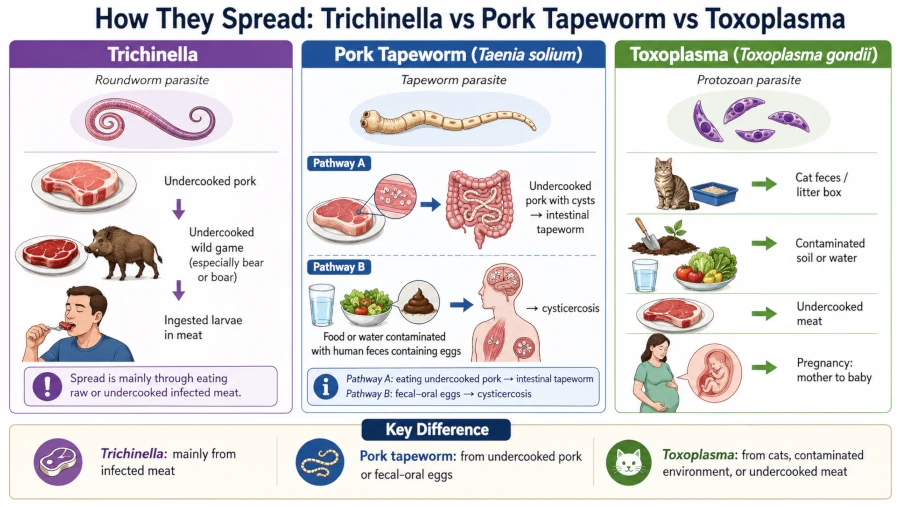
No. The reputation is a holdover from an era before modern pig farming. In the United States, trichinellosis (the infection people usually mean when they say “worms in pork”) is now down to roughly 15 confirmed cases a year, and most of those come from wild game like bear rather than commercial pork [CDC, About Trichinellosis, 2024]. Regulations on how pigs are raised and clearer cooking guidance have done most of the work.
That said, “rare” isn’t “impossible,” and the risk climbs sharply with raw, undercooked, or home-slaughtered meat. So the useful move isn’t fear — it’s knowing the three parasites and the handful of steps that shut them down.
Trichinella (trichinellosis): the classic undercooked pork parasite
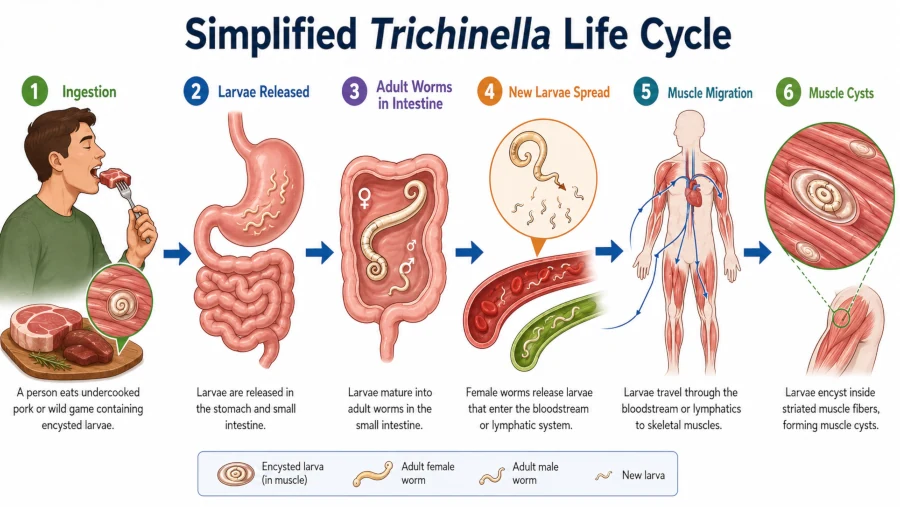
Trichinella is a roundworm whose larvae live encysted in muscle. You get infected — an illness called trichinellosis or trichinosis — by eating raw or undercooked meat that contains those larvae. In your gut the larvae mature into adult worms, and the next generation travels through the bloodstream to lodge in your muscles [CDC, About Trichinellosis, 2024].
What it does to you
Symptoms come in two waves. In the first day or two you may get nausea, diarrhea, vomiting, and stomach pain. Then, over the next week or two as larvae move into muscle, people develop fever and chills, swelling around the face and eyes, headache, muscle aches, weakness, and sometimes a rash [CDC, Symptoms of Trichinellosis, 2024].
A hallmark on bloodwork is a rise in eosinophils, a type of white blood cell — combined with fever, facial swelling, and muscle pain, it’s a classic pattern doctors look for [CDC, MMWR Trichinellosis Surveillance, 2015]. Mild cases can feel like the flu and clear on their own; heavy infections can affect the heart, lungs, or nervous system and, rarely, be fatal. Prescription antiparasitic drugs (typically albendazole) treat it, and treatment works best started early [CDC, MMWR Trichinellosis Surveillance, 2015].
How common is it, really?
Uncommon, and increasingly a wild-game problem rather than a pork problem. Worldwide there are roughly 10,000 recorded cases a year; in the US, the handful of annual cases now trace mostly to bear and wild boar [CDC, About Trichinellosis, 2024]. Some Trichinella species that infect wild game even survive freezing, which is why hunters need to be more careful than pork buyers.
The pork tapeworm (Taenia solium) — and the confusion worth clearing up
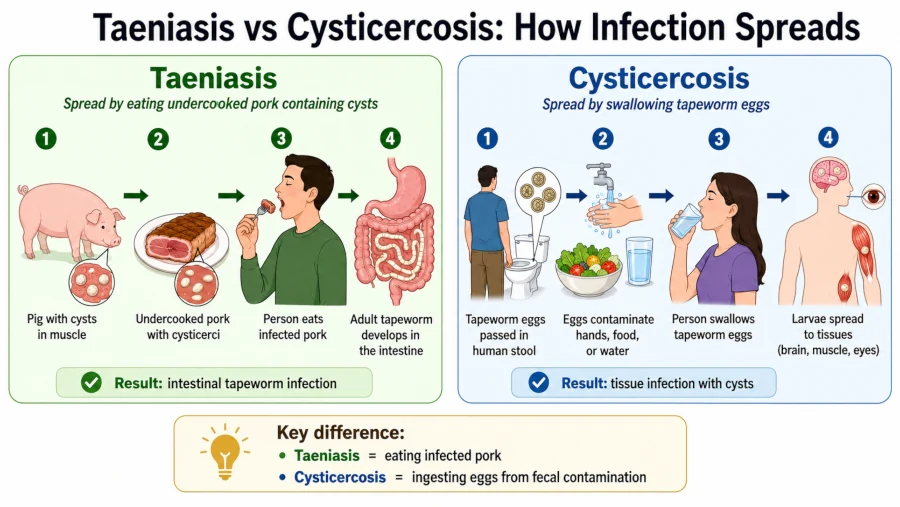
This is the parasite most articles get wrong, so it’s worth slowing down. Taenia solium, the pork tapeworm, can cause two very different diseases, and they’re spread in two different ways. Mixing them up isn’t a small error — it changes what you actually need to worry about.
Taeniasis: the intestinal tapeworm you get from eating pork
If you eat raw or undercooked pork that contains tapeworm cysts, the cyst attaches to your small intestine and grows into an adult tapeworm over about two months. This intestinal infection is called taeniasis. The adult worm is usually around 3 metres (roughly 10 feet), though it can be longer, and it often causes only mild symptoms — vague stomach upset, or noticing segments of the worm passed in stool [CDC, About Human Tapeworm, 2024]. Treatment is a prescription drug, usually praziquantel (niclosamide is an alternative) [CDC, About Human Tapeworm, 2024].
Cysticercosis: the serious one — and why it doesn’t come from eating pork
Here’s the key distinction. The dangerous form of T. solium infection is cysticercosis, where larval cysts form in body tissues — and when they form in the brain, it’s called neurocysticercosis, a leading cause of adult-onset seizures in parts of Latin America and other endemic regions [Merck Manual, 2025]; [WHO, 2022]. But you do not get cysticercosis from eating pork. You get it by swallowing T. solium eggs, which are passed in the feces of a person who already carries an adult tapeworm — spread through poor hand-washing, contaminated food or water, or self-infection [CDC, DPDx Cysticercosis]; [CDC, How Cysticercosis Spreads, 2024].
Why this matters: cooking your pork protects you from the intestinal tapeworm, and hand-washing and sanitation protect you (and the people around you) from the cysts. The old idea that a pork chop puts cysts in your brain gets the biology backwards. Cysticercosis is rare in places with low pork consumption and good sanitation, and in the US it’s uncommon in people who haven’t traveled to or lived in endemic areas [Merck Manual, 2025].
Toxoplasma gondii: the parasite that matters most in pregnancy
Toxoplasma gondii is a single-celled parasite that’s extremely widespread — more than 40 million people in the US carry it, usually without ever knowing [CDC, About Toxoplasmosis, 2025]. Most healthy people who get infected have no symptoms or a mild flu-like illness with swollen lymph nodes and muscle aches. The problem is what it can do to two groups: people with weakened immune systems, and a developing fetus.
You can pick up Toxoplasma from undercooked meat (pork, lamb, and venison in particular), from unwashed produce or contaminated water, or from accidental contact with cat feces in soil or a litter box [FDA, Toxoplasma Food Safety for Moms-to-Be]; [CDC, About Toxoplasmosis, 2025].
If a person is infected for the first time during or just before pregnancy, the parasite can cross the placenta. That can lead to miscarriage or to congenital toxoplasmosis, with effects that may include eye damage and problems with the developing brain [CDC, About Toxoplasmosis, 2025]. This is why pregnancy guidance emphasizes thoroughly cooked meat and washed produce. If you’re pregnant and want a broader food-safety rundown, see our guide to foods to eat and avoid during pregnancy.
What about cured ham and salami?
This is a genuinely mixed area, and it’s worth being straight about. Some older research points to cured pork as a risk. A study of pregnant women in Naples found that eating cured pork or raw meat at least once a month tripled the risk of recent Toxoplasma infection [Buffolano et al., Epidemiol Infect, 1996], and a larger European multi-city study likewise flagged undercooked and cured meat as a main risk factor [Cook et al., BMJ, 2000].
But newer risk modeling from Italy suggests that properly salt-cured, commercially produced products carry only a minor risk, with most infection tracing to fresh, undercooked cuts [Condoleo et al., Risk Analysis, 2018]. The practical takeaway: the evidence isn’t settled, so if you’re pregnant or immunocompromised, the cautious choice is to avoid raw, undercooked, and traditionally cured meats — while everyone else can treat commercial cured products as low risk.
How to make pork safe to eat (this is the part that matters)
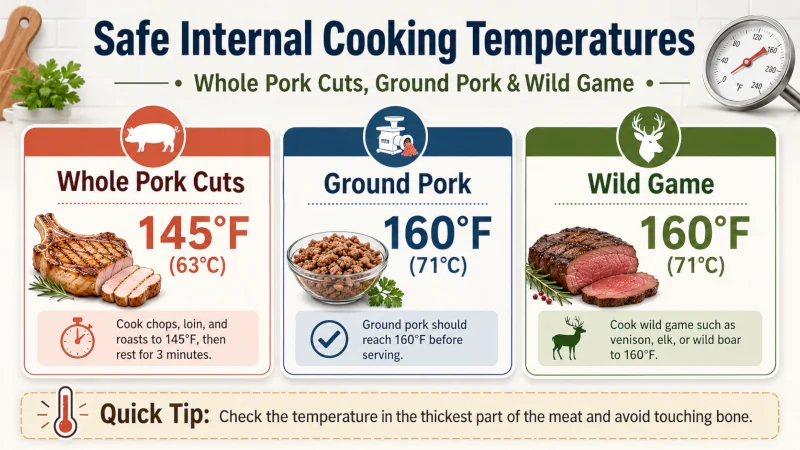
Almost everything above is prevented by heat, with freezing as a backup. You cannot judge safety by color or a “rosy” appearance — use a thermometer [CDC, Preventing Toxoplasmosis, 2024].
Cooking temperatures
| Type of pork | Cook to (internal) | Notes |
| Whole cuts (chops, roasts) | 145°F / 63°C | Then rest 3 minutes before eating. |
| Ground pork | 160°F / 71°C | No rest time needed. |
| Wild game (bear, boar) | 160°F / 71°C | Higher target; some game Trichinella survive freezing. |
Measure in the thickest part of the meat, and don’t taste meat while it’s still raw or partly cooked — tasting during preparation is a real source of infection [CDC, About Trichinellosis, 2024].
Freezing
Freezing is a useful backup for pork specifically. Freezing pork less than 6 inches thick for 20 days at 5°F (−15°C) kills Trichinella larvae [CDC, About Trichinellosis, 2024]. For Toxoplasma, freezing meat for several days at 0°F (−18°C) before cooking greatly reduces the risk [CDC, Preventing Toxoplasmosis, 2024]. Important limit: freezing does not reliably kill the freeze-resistant Trichinella species found in wild game, so cooking remains the real safeguard there [CDC, About Trichinellosis, 2024].
Curing and smoking are not enough on their own
Salting, drying, smoking, and microwaving do not consistently kill these parasites. Home-made jerky and sausage have historically caused many trichinellosis cases precisely because people assumed curing was sufficient [CDC, About Trichinellosis, 2024]. Cure and smoke for flavor, not for safety.
Don’t cross-contaminate
Keep raw pork and its juices away from foods you’ll eat uncooked. Wash your hands with soap after handling raw meat, and clean knives, boards, and especially meat grinders thoroughly after each use [CDC, About Trichinellosis, 2024]. Because tapeworm cysticercosis spreads through eggs rather than meat, hand-washing after using the bathroom and before handling food is one of the most effective protections of all [CDC, How Cysticercosis Spreads, 2024].
Who should be most careful
Anyone can be infected, but a few groups have more to lose and should be strict about avoiding raw or undercooked pork and game:
- Pregnant people, because of the risk of congenital toxoplasmosis [CDC, About Toxoplasmosis, 2025].
- People with weakened immune systems — including those with HIV, on chemotherapy, or after an organ transplant — who are more likely to develop severe toxoplasmosis [CDC, About Toxoplasmosis, 2025].
- Hunters and anyone eating wild game, where freeze-resistant Trichinella makes thorough cooking essential [CDC, MMWR, 2024].
- Young children and older adults, who generally tolerate foodborne illness less well.
If you carry an intestinal tapeworm, treating it also protects the people you live with, since household contacts of someone with a tapeworm are at higher risk of cysticercosis from eggs [CDC, Clinical Overview of Taeniasis, 2024].
Red flags: when to see a doctor
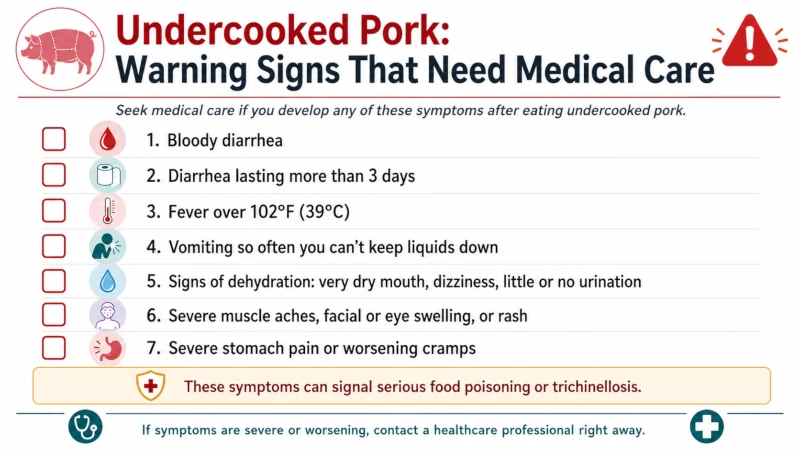
Talk to a healthcare provider — promptly — if you develop the following after eating raw or undercooked pork or game:
- Fever with muscle pain and swelling around the eyes or face, especially a week or two after a suspect meal. This is the classic trichinellosis pattern and warrants testing [CDC, Symptoms of Trichinellosis, 2024].
- A new seizure, or unexplained severe headaches and neurological symptoms, particularly if you’ve lived in or traveled to a region where the pork tapeworm is common. New-onset seizures can be the first sign of neurocysticercosis and need imaging and specialist care [Merck Manual, 2025].
- Trouble breathing, heart symptoms, or difficulty coordinating movements during an illness like the above — these can signal severe trichinellosis and are a reason to seek urgent care [CDC, About Trichinellosis, 2024].
- You’re pregnant or immunocompromised and think you may have eaten undercooked or raw meat — contact your provider rather than waiting for symptoms [CDC, About Toxoplasmosis, 2025].
Passing what looks like a flat, ribbon-like segment in your stool is worth a (non-urgent) call to your doctor as well; it can be diagnosed and treated with stool testing and prescription medication [CDC, About Human Tapeworm, 2024]. For more on infections and prevention, see our Immune & Infections section.
The reassuring bottom line is that these parasites are prevented by ordinary, boring habits: a thermometer, clean hands, and not tasting raw meat. Do those, and pork is a safe food.
| HEALTH DISCLAIMER: This article is for general education and information only. It isn’t a substitute for professional medical advice, diagnosis, or treatment. Trichinellosis, tapeworm infections, cysticercosis, and toxoplasmosis are diagnosed with lab tests and treated with prescription medication — no food, herb, or supplement is a proven cure for them. If you think you’ve been exposed, are pregnant, are immunocompromised, or have any of the red-flag symptoms above, contact a qualified healthcare professional. In an emergency, seek urgent care. |
Frequently Asked Questions
Can you get parasites from fully cooked pork?
No. Cooking whole cuts to 145°F (63°C) with a 3-minute rest, or ground pork to 160°F (71°C), kills the parasites of concern. Use a thermometer rather than judging by color [CDC, Preventing Toxoplasmosis, 2024].
How common are parasites in pork today?
Uncommon where pigs are farmed and inspected. US trichinellosis is down to about 15 confirmed cases a year, most now from wild game rather than pork [CDC, About Trichinellosis, 2024].
Does eating undercooked pork give you brain cysts?
No — that’s a common mix-up. Eating undercooked pork can give you an intestinal tapeworm (taeniasis). The brain-cyst disease (neurocysticercosis) comes from swallowing tapeworm eggs passed in human feces, usually through poor sanitation or hand-washing, not from the pork itself [CDC, DPDx Cysticercosis]; [CDC, How Cysticercosis Spreads, 2024].
Is cured ham or salami safe during pregnancy?
The evidence is mixed. Some studies link cured and raw meats to toxoplasmosis, while newer modeling suggests properly cured commercial products are low risk [Buffolano et al., 1996]; [Condoleo et al., 2018]. To be safe, pregnant and immunocompromised people are generally advised to avoid raw, undercooked, and traditionally cured meats [FDA, Toxoplasma Food Safety for Moms-to-Be].
Does freezing pork kill parasites?
For pork, yes — freezing pieces under 6 inches thick for 20 days at 5°F (−15°C) kills Trichinella [CDC, About Trichinellosis, 2024]. But freezing does not reliably kill the freeze-resistant Trichinella in wild game, so game must be cooked thoroughly.
Do “parasite cleanse” herbs treat these infections?
No. Trichinellosis, tapeworm infections, and toxoplasmosis are treated with specific prescription drugs. There’s no good evidence that herbal cleanses cure them, and relying on them can delay effective care. See a healthcare provider for diagnosis and treatment.
References
- CDC. “About Trichinellosis.” Trichinellosis (Trichinosis), reviewed Sep 10, 2024. View source
- CDC. “Symptoms of Trichinellosis,” reviewed Mar 5, 2024. View source
- CDC. “Trichinellosis Surveillance — United States, 2008–2012.” MMWR Surveill Summ, 2015. View source
- CDC. “Outbreak of Human Trichinellosis — Arizona, Minnesota, and South Dakota, 2022.” MMWR, 2024. View source
- CDC. “About Human Tapeworm (Taeniasis),” Jun 13, 2024. View source
- CDC. “Clinical Overview of Taeniasis.” View source
- CDC. “DPDx — Cysticercosis.” View source
- CDC. “How Cysticercosis Spreads,” Jun 24, 2024. View source
- World Health Organization. “Taeniasis/cysticercosis” fact sheet, 2022. View source
- Merck Manual Professional Edition. “Taenia solium (Pork Tapeworm) Infection and Cysticercosis,” 2025. View source
- CDC. “About Toxoplasmosis,” Apr 10, 2025. View source
- CDC. “Preventing Toxoplasmosis,” Jan 30, 2024. View source
- U.S. FDA. “Toxoplasma (Food Safety for Moms-to-Be).” View source
- Buffolano W, Gilbert RE, Holland FJ, Fratta D, Palumbo F, Ades AE. “Risk factors for recent toxoplasma infection in pregnant women in Naples.” Epidemiol Infect. 1996;116(3):347–351. DOI: 10.1017/s0950268800052675 (PMID 8666080). View source
- Cook AJC, Gilbert RE, Buffolano W, et al. “Sources of toxoplasma infection in pregnant women: European multicentre case-control study.” BMJ, 2000. View source
- Condoleo R, et al. “Risk Assessment of Human Toxoplasmosis Associated with the Consumption of Pork Meat in Italy.” Risk Analysis, 2018. View source
