
If you are heading on safari or to rural parts of southern Africa, African tick bite fever is worth knowing about before you go. It is a bacterial infection spread by tick bites, and it is the most commonly reported tick-borne illness in travelers returning from sub-Saharan Africa [CDC, 2026]. Most people who catch it have a mild, flu-like illness with a distinctive dark scab at the bite site, recover fully, and feel better within a day or two of starting a standard antibiotic. Serious complications are uncommon, and no deaths from this specific infection have been reported in the medical literature [Jensenius et al., 2003].
What is African tick bite fever?
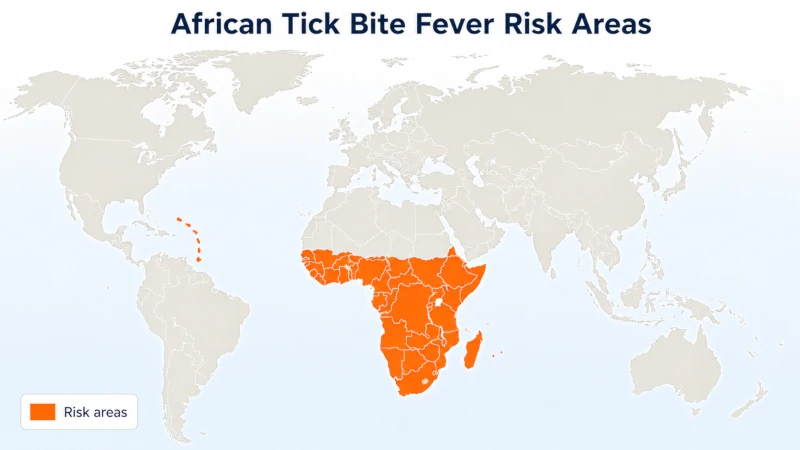
African tick bite fever (ATBF) is an illness caused by Rickettsia africae, a type of bacteria in the spotted fever group of rickettsiae. The bacteria live inside certain hard ticks and pass to people through a bite. ATBF belongs to the same broad family as Rocky Mountain spotted fever, but it is usually far milder [CDC, 2025].
The infection is found in rural sub-Saharan Africa, several islands of the eastern Caribbean (the West Indies), and parts of Oceania. R. africae has been detected across roughly 15 African countries and was carried into the Caribbean along with its tick host [Florida DOH, 2024]. Travelers most at risk are those who spend time outdoors in the bush: safari-goers, game hunters, hikers, and people working or volunteering in rural areas. Cases often appear in clusters, so if one member of a tour group is diagnosed, others with the same exposure should watch for symptoms [CDC, 2026].
How you catch it: the ticks behind the infection
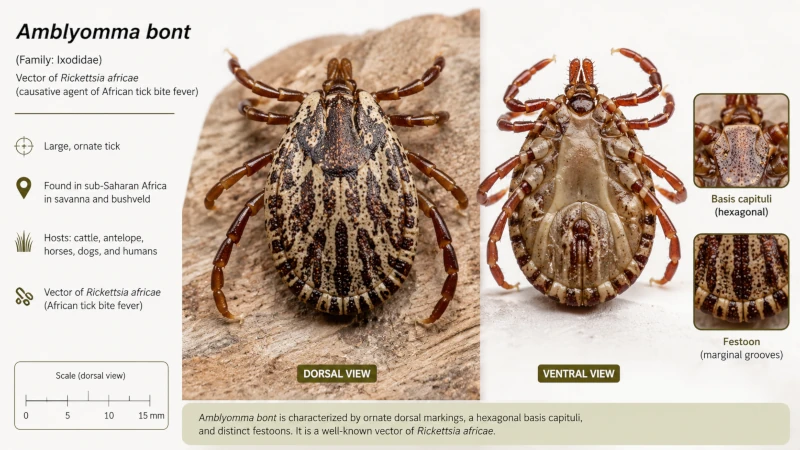
ATBF spreads through the bite of Amblyomma ticks, mainly Amblyomma hebraeum (the southern African bont tick) and Amblyomma variegatum (the tropical bont tick) [Florida DOH, 2024]. Unlike many ticks that sit and wait, these are active hunters that will move toward a person, which is one reason bites often happen in groups and people can end up with more than one bite site.
Ticks cannot fly or jump. They wait on grass and low brush, climb onto a passing host, then look for a place to attach and feed. In southern Africa, the ticks are most active in the warmer months, roughly November through April, and the risk is highest during hunting, camping, and hiking in wooded or rural areas [CDC, 2025].
Symptoms to watch for
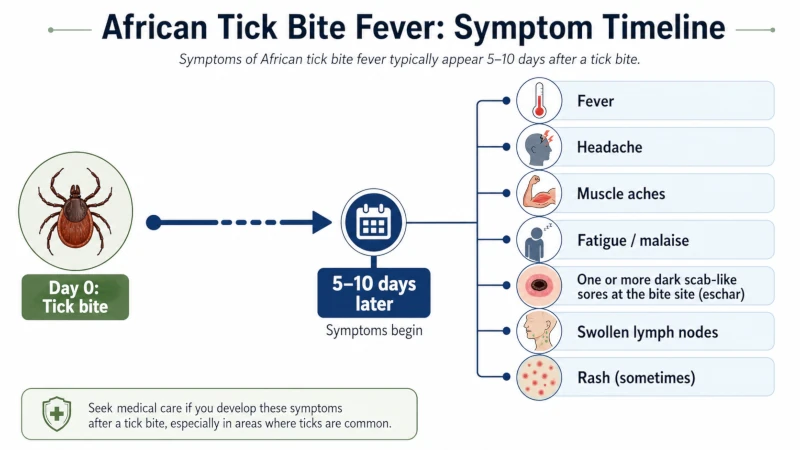
Symptoms usually start about 5 to 10 days after the bite, sometimes up to two weeks later [Jensenius et al., 2003]. Not everyone who is bitten gets sick, and some people have only mild symptoms. When symptoms do appear, the most common ones, with how often they showed up in a study of travelers, are listed below [Jensenius et al., 2003].
| Symptom | Roughly how common |
| Muscle aches (often in the neck) | About 87% |
| Headache | About 83% |
| Fever and chills | About 81% |
| Eschar — a dark scab at the bite site | About 53% (more than one in about 21%) |
| Swollen, tender lymph nodes near the bite | About 50% |
| Flat-and-bumpy (maculopapular) rash | About 26% |
| Small blister-like (vesicular) rash | About 16% |
| Mouth ulcers | About 11% |
The eschar: the telltale sign
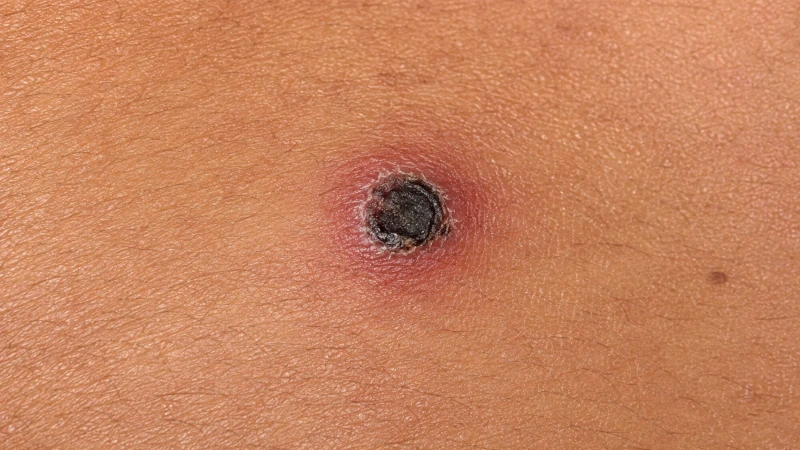
The single most useful clue is the eschar — a small sore at the bite site that develops a dark, scab-like center, sometimes with a red ring around it. Because the African ticks often bite more than once, people with ATBF may have several eschars at the same time, which is unusual among tick-borne diseases and helps doctors tell ATBF apart from other infections [Jensenius et al., 2003]. Prominent neck and shoulder muscle pain alongside an eschar is another strong hint.
How serious is it?
For most healthy travelers, ATBF is a mild-to-moderate illness that clears up with treatment [CDC, 2025]. Complications are uncommon. When they do occur, they can include joint inflammation (reactive arthritis) and, rarely, heart inflammation (myocarditis) or nerve problems that take longer to settle. Older adults and people who are already unwell appear more likely to have a rougher course [Jensenius et al., 2003]. Even so, this specific infection has a good prognosis, and deaths have not been reported for ATBF in the published literature.
When to see a doctor
See a healthcare provider if you develop fever, a rash, a headache, or an eschar within two weeks of a tick bite or travel to an area where ATBF occurs [CDC, 2025]. Tell the clinician where you traveled and that you may have been bitten by a tick — that travel history is often what points to the right diagnosis.
Seek care more urgently if you notice any of these warning signs:
- Fever that stays high or does not improve within 48 hours of starting the right antibiotic
- Chest pain, a racing heartbeat, or shortness of breath
- Confusion, severe headache, neck stiffness, or other neurological symptoms
- Severe weakness, fainting, or signs of dehydration
- Any fever in a returning traveler, which should also be checked for malaria — a more dangerous illness that can look similar early on
What to do right after a tick bite
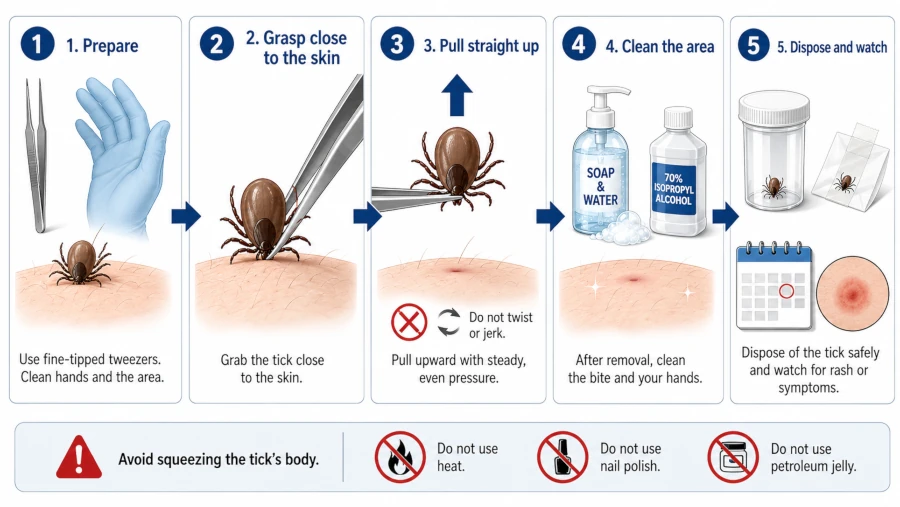
- Remove the tick promptly. Use fine-tipped tweezers to grasp it as close to the skin as possible. Pull straight up with steady, even pressure. Do not twist or jerk, which can leave mouthparts behind.
- Clean the area. Wash the bite and your hands with soap and water, or use rubbing alcohol or an iodine scrub.
- Do not take antibiotics “just in case.” Preventive antibiotics after a tick bite are not recommended for rickettsial infections [CDC, 2025]. Treatment is started only if symptoms develop.
- Watch for symptoms for two weeks. Note the date of the bite and see a doctor if fever, rash, or an eschar appears.
How doctors confirm it
ATBF is often diagnosed on clinical grounds — the combination of recent travel, an eschar, swollen lymph nodes, and fever is usually enough to start treatment [Jensenius et al., 2003]. Lab tests can confirm it: a PCR test on a swab or small sample from the eschar can detect R. africae directly, while blood antibody tests (immunofluorescence) are useful but often turn positive only later, during recovery, so a normal early result does not rule the infection out [Silva-Ramos & Faccini-Martinez, 2021].
Treatment and recovery
The treatment of choice is the antibiotic doxycycline. It works quickly: when started early, fever usually settles within 24 to 48 hours [CDC, 2025]. In fact, a lack of response to doxycycline is a sign the illness may be something else.
Current CDC guidance for spotted fever rickettsioses, which covers ATBF:
| Group | Typical doxycycline approach | Duration |
| Adults (over ~45 kg / 100 lb) | 100 mg every 12 hours | At least 5–7 days, and until 72 hours after fever resolves with clear improvement |
| Children (under ~45 kg) | 2.2 mg/kg twice daily (max 100 mg per dose) | Same as adults |
Doctors usually ask you to finish the full course even after you feel better. The CDC now lists doxycycline as the first-line choice for patients of all ages, including young children and pregnant women, because short courses are effective and the risk of tooth staining in children is very low [CDC, 2025]. For a pregnant traveler, the decision should still be made with a clinician who can weigh the benefits and any individual concerns. People who truly cannot take doxycycline may be offered an alternative such as azithromycin under medical guidance [Jensenius et al., 2003].
How to prevent tick bites in tick country
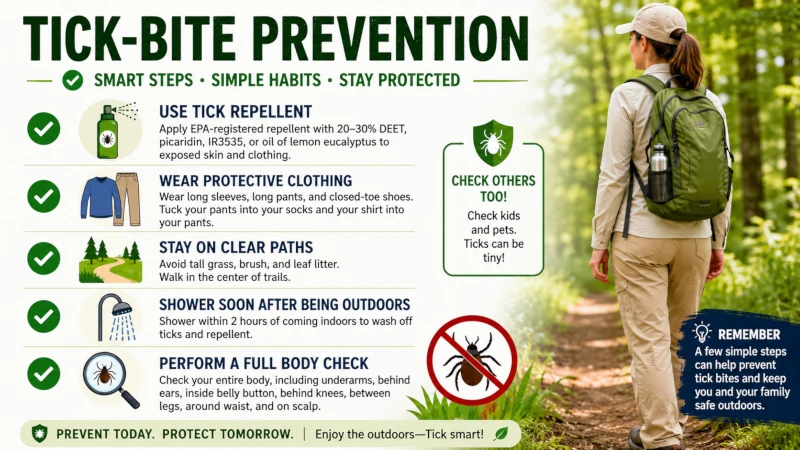
The most reliable protection is avoiding bites in the first place. There is no vaccine for ATBF. These steps, recommended for tick-borne illness generally, lower your risk:
- Use an EPA-registered insect repellent with DEET on exposed skin, and follow the label.
- Treat clothing and gear with permethrin (products around 0.5% permethrin). Apply it to fabric, not skin.
- Cover up. Wear light-colored long sleeves and long pants, and tuck pant legs into your socks so ticks are easier to spot and cannot reach skin.
- Stay on trails and avoid walking through tall grass and dense brush.
- Do a full-body tick check after being outdoors. Check hidden spots: behind the knees, the groin and waistline, underarms, in and around the ears, the navel, and the scalp.
- Tumble-dry clothes on high heat for about 10 minutes to kill any ticks that hitched a ride home [CDC, 2025].
Who should take extra care
A few groups benefit from being especially careful and from prompt medical attention if symptoms appear:
- Older adults, who have a somewhat higher chance of a more severe or drawn-out illness.
- Pregnant travelers, who should discuss both prevention and any treatment with their provider.
- People with weakened immune systems or serious underlying health conditions.
- Anyone who cannot take doxycycline, who should ask in advance what their alternative would be.
| Health Disclaimer: This article is for general education and information only. It is not a substitute for professional medical advice, diagnosis, or treatment. African tick bite fever and other tick-borne illnesses need to be assessed by a qualified healthcare provider, especially in a returning traveler with a fever. Always seek the advice of your physician or another qualified professional with any questions about a medical condition, and never delay care because of something you read here. If you are pregnant, nursing, taking other medicines, or managing a health condition, talk with your doctor before acting on this information. |
Frequently Asked Questions
Is African tick bite fever contagious from person to person?
No. It spreads only through the bite of an infected tick, not from one person to another [CDC, 2025]. Clusters of cases happen because groups are exposed to the same ticks, not because people pass it along.
Can African tick bite fever go away on its own?
Mild cases can resolve without treatment, but doxycycline shortens the illness and lowers the small risk of complications, so treatment is recommended once the infection is suspected [Jensenius et al., 2003].
How long does it take to recover?
With doxycycline started early, fever usually improves within 24 to 48 hours, and most people feel well within a week [CDC, 2025]. The eschar and swollen lymph nodes can take a little longer to fade.
I was bitten by a tick in Africa but feel fine. Should I take antibiotics now?
No. Preventive antibiotics after a tick bite are not advised for this infection [CDC, 2025]. Watch for fever, rash, or an eschar over the next two weeks and see a doctor if any appear.
How is it different from Lyme disease?
They are different infections from different bacteria and ticks, found in different regions. ATBF causes an eschar and is usually short-lived, while Lyme disease (common in parts of North America and Europe) typically causes a spreading bull’s-eye rash and can affect the joints and nervous system if untreated. Both respond to doxycycline.
Is there a vaccine?
No vaccine is available. Prevention relies on avoiding tick bites and getting prompt treatment if symptoms develop.
References
- Centers for Disease Control and Prevention (CDC). Rickettsial Diseases (CDC Yellow Book), 2026. View source
- Centers for Disease Control and Prevention (CDC). Imported Spotted Fevers, 2025. View source
- Centers for Disease Control and Prevention (CDC). Clinical Care of Other Spotted Fever Rickettsioses, 2024. View source
- Florida Department of Health. African Tick Bite Fever, 2024. View source
- Jensenius M, Fournier PE, Kelly P, Myrvang B, Raoult D. African tick bite fever. Lancet Infectious Diseases. 2003;3(9):557–564. View source
- Silva-Ramos CR, Faccini-Martinez AA. Clinical, epidemiological, and laboratory features of Rickettsia africae infection (a systematic review). Infezioni in Medicina. 2021;29(3):366–377. View source
- MedlinePlus (U.S. National Library of Medicine). Doxycycline drug information. View source
