

Gentian root has one use that holds up reasonably well: as a bitter taken before meals to nudge a flagging appetite or ease mild indigestion. Even that rests mostly on long traditional use rather than solid clinical trials. The gentian plant (Gentiana lutea, also called great yellow gentian or bitterwort) is a tall European mountain perennial, and the European Medicines Agency recognizes its root as a traditional herbal medicine for temporary loss of appetite and mild digestive complaints in adults [EMA, 2018].
Many older claims for the plant, from curing malaria to boosting immunity, have no good human evidence behind them. And if you’re tempted to dig your own, don’t. Gentian shares its meadows with a toxic look-alike that has poisoned people who made homemade gentian drinks [Czerwiec et al., 2023].
What the gentian plant is
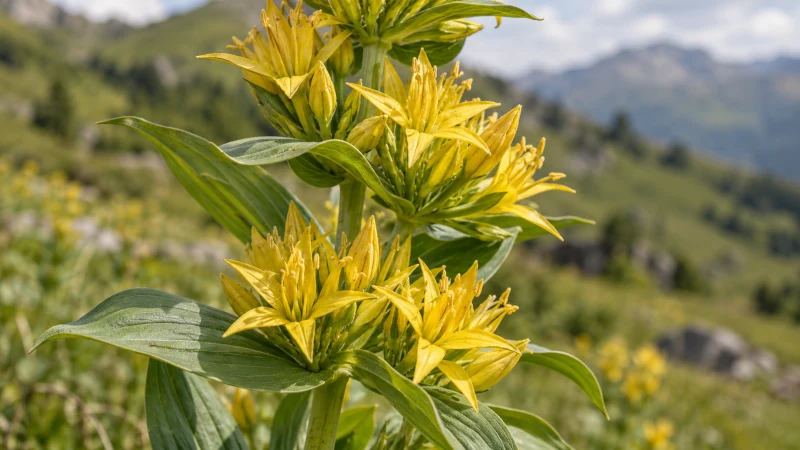
Great yellow gentian grows in the mountain meadows and pastures of central and southern Europe. It’s a tall plant, reaching up to about 1.8 meters (6 feet), with smooth oval leaves and clusters of yellow, star-shaped flowers [Drugs.com, 2025]. It matures slowly. The part used in medicine is the thick, fleshy root.
The bitterest root in the herb cabinet
Gentian’s reputation comes from its taste. The root is packed with bitter compounds called secoiridoids, chiefly gentiopicroside and amarogentin [Ponticelli et al., 2023]. Amarogentin is often called the bitterest natural substance known. A reference table published by German phytotherapy researchers gives it a bitterness value of 1 in 58 million, meaning it can still be tasted at that dilution, against 10,000 to 25,000 for the dried root as a whole [Wölfle & Schempp, 2018].
Why wild gentian needs protecting
Demand for the root has thinned wild stands in parts of Europe. North Macedonia assesses its local gentian as Vulnerable, mainly because of over-harvesting for medicinal use, and has banned collecting and trading it since 2006 [National Red List of North Macedonia, 2019]. The species is also listed in Annex V of the EU Habitats Directive [National Red List of North Macedonia, 2019], which lets member states control how much is taken from the wild.
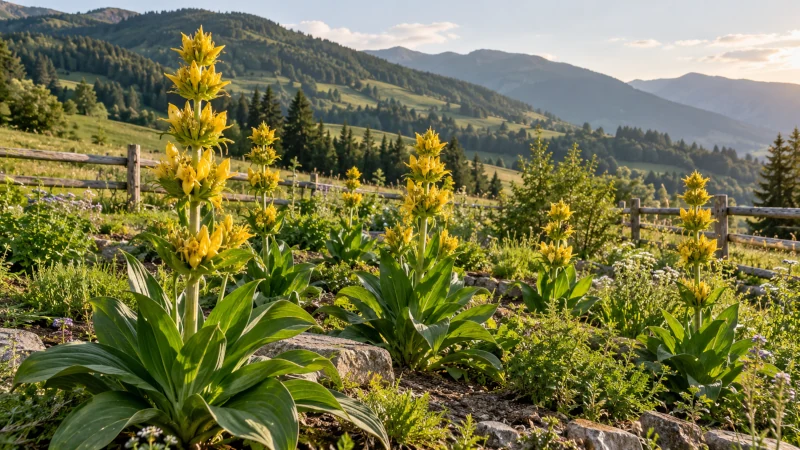
If you buy gentian, choose cultivated root from a supplier that names the species on the label. Leave wild plants where they are.
Gentian plant benefits: what the evidence supports
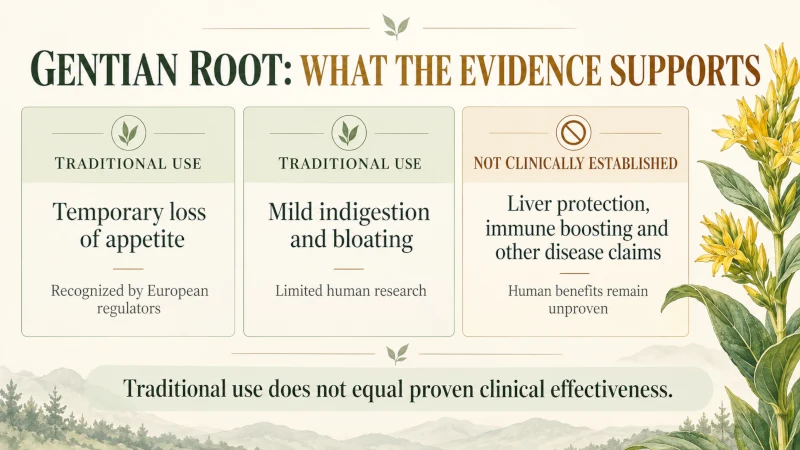
European regulators reviewed gentian root in 2009 and again in 2018. They found too little clinical-trial evidence to call it effective, but judged its use plausible and noted at least 30 years of safe use, which qualifies it as a traditional herbal medicine for loss of appetite and mild digestive complaints [EMA, 2019].
The strongest human data they had was an observational study of 205 people with mild stomach and gut complaints. Symptoms improved, but there was no comparison group, so nobody can say how much of that improvement was down to gentian [EMA, 2019].
| Claimed use | Strength of evidence | What it means for you |
| Temporary loss of appetite | Traditional use, accepted by EU regulators [EMA, 2019] | Reasonable to try for a short period, before meals. |
| Mild indigestion, fullness, bloating | Traditional use plus one uncontrolled study of 205 people [EMA, 2019] | Same. See a doctor if it lasts beyond two weeks. |
| Stomach and liver protection, anti-inflammatory and antioxidant effects | Lab and animal studies only [Ponticelli et al., 2023] | Interesting research. Not a reason to take it. |
| Immune boosting | Lab findings only | Unproven in people. |
| Malaria or fever | No human evidence for Gentiana lutea that we could find | Never use it in place of malaria treatment. |
| Gout, colds, pancreatitis, menstrual problems | No supporting studies found | Don’t rely on it. |
Where the evidence is thin or missing
Older herbal encyclopedias credit gentian with killing malaria parasites, raising white blood cell counts, and treating gout and pancreatitis. A 2023 systematic review that pulled together the research on Gentiana lutea found mostly cell and animal studies, with antioxidant, anti-inflammatory, antimicrobial and liver-protective effects turning up in the lab [Ponticelli et al., 2023].
Results like these often fail to carry over to people. None of them justify using gentian for an infection, an inflammatory disease, or a liver condition, and malaria in particular needs prompt medical treatment. If liver health is what brought you here, diet and medical care matter far more; our guide to foods that support liver health grades what the evidence actually shows.
How bitters are thought to work
The traditional explanation is simple. A bitter taste triggers a reflex that gets saliva, stomach acid and bile flowing, priming the gut for food. That fits the way regulators say to take gentian: shortly before a meal [EMA, 2018].
The mechanism hasn’t been pinned down in people, though, and the animal data cut both ways. In rodent experiments summarized in the 2023 review, gentian root extract reduced stomach acid output and protected against experimentally induced ulcers, with some fractions performing about as well as the acid-reducing drug cimetidine [Ponticelli et al., 2023]. The old idea that gentian works by simply firing up stomach acid is probably too tidy.
How to take gentian root
Use a product made for medicinal use and follow its label. The ranges below are the traditional adult doses in the EU monograph [EMA, 2018].
| Form | Single dose | How often | Daily maximum |
| Tea (infusion of cut, dried root) | 0.6–2 g in 150 ml (about ⅔ cup) of boiling water | 1–3 times a day | 6 g of root |
| Dry extract (ethanol-based) | 240 mg | 2–3 times a day | 720 mg |
| Liquid extract (1:1) | 1 g | 2–4 times a day | 4 g |
| Tincture (1:5) | 1 ml | 1–3 times a day | 3 ml |
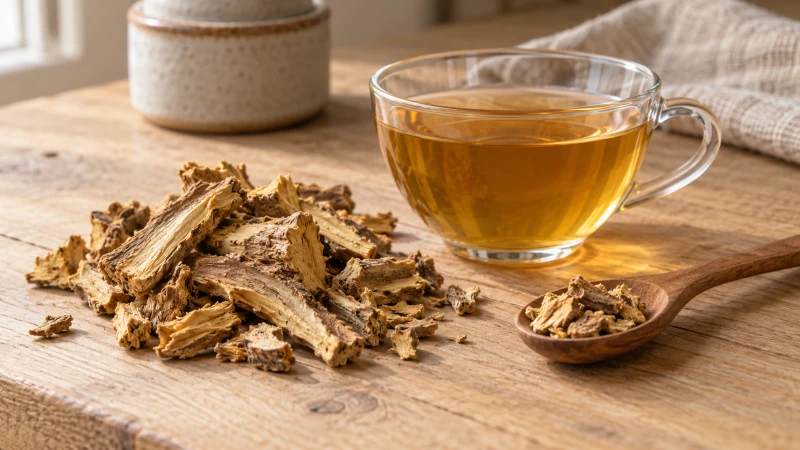
Take liquid forms (tea, liquid extract, tincture) about 30 minutes before a meal, and tablets or capsules about an hour before, since they need time to break down [EMA, 2018]. Keep it short-term. If your symptoms haven’t settled after two weeks, or they get worse, stop and see a doctor [EMA, 2018].
Some older herbal guides suggest tincture doses of up to two teaspoons (about 10 ml) at a time. That’s roughly ten times the monograph’s 1 ml. Stick with the lower, better-documented range.
Making it easier to drink
Gentian tea is fiercely bitter. A little peppermint or ginger steeped alongside it softens the taste. Older herbal books also suggest sassafras, but we don’t: the root bark contains safrole, which the FDA has barred from food since 1960 over cancer concerns (see our sassafras safety guide).
Gentian liqueurs and aperitifs are a different thing. They’re alcoholic drinks with unknown amounts of gentian, and they shouldn’t be treated as medicine.
Gentian safety: side effects, interactions, and who should avoid it
Official sources don’t fully agree about gentian, so here is where they differ. Few reported problems may reflect how little the root has been studied rather than proof that it’s harmless.
- Side effects. The EU monograph lists none known [EMA, 2018]. Drugs.com’s monograph, drawing on the World Health Organization, says gentian can irritate the stomach and cause nausea and vomiting, and rarely headache [Drugs.com, 2025].
- Stomach ulcers and gastritis. WHO-based guidance lists gastric and duodenal ulcers as a reason not to use gentian [Drugs.com, 2025], while the EU monograph’s only contraindication is allergy to it [EMA, 2018]. Given that split, skip it if you have an ulcer or active gastritis and ask your doctor what will help; our pages on foods to avoid with gastritis and herbs for stomach problems are a better starting point.
- Medication interactions. None have been reported [EMA, 2018]. Lab studies hint at effects on blood clotting and on monoamine oxidase, an enzyme some antidepressants act on, but these haven’t been confirmed in people [Drugs.com, 2025]. If you take a blood thinner or an antidepressant, check with your pharmacist first.
- Pregnancy and breastfeeding. Both the EU monograph and the WHO-based guidance advise against it, because safety hasn’t been established [EMA, 2018] [Drugs.com, 2025].
- Children and teenagers. Not recommended under 18, for lack of data [EMA, 2018].
- Alcohol. Tinctures and liquid extracts are made with 45–70% alcohol [EMA, 2018]. Choose tea or a dry extract if you avoid alcohol for any reason, including liver disease, recovery, or medications.
- Long-term use. Gentian hasn’t been tested for cancer-causing or gene-damaging effects, and some xanthones it contains tested positive in a lab mutation screen called the Ames test [EMA, 2018]. One more reason to keep use short.
The dangerous look-alike: white hellebore
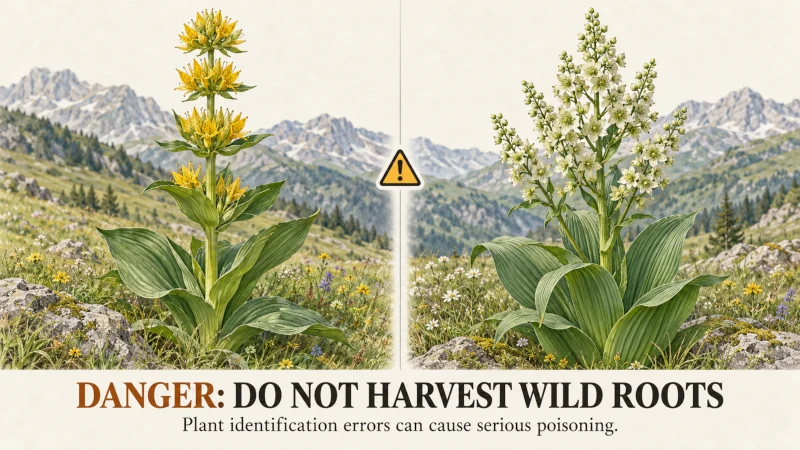
White hellebore (Veratrum album) grows in the same mountain pastures as gentian, and the two are easily confused [Czerwiec et al., 2023]. Published case reports describe the same pattern: someone gathers what they believe is gentian root, makes a homemade drink from it, and is poisoned by Veratrum alkaloids [Grobosch et al., 2008] [Czerwiec et al., 2023].
In one documented French case, a 34-year-old woman drank a homemade maceration she thought was gentian. She developed digestive upset, dizziness, headache, hallucinations and heavy sweating, then low blood pressure and a slow heart rate, and recovered after hospital treatment [Czerwiec et al., 2023].
| Safety first Don’t harvest gentian yourself. Buy root from a supplier that identifies the species. If anyone feels ill after drinking a homemade gentian preparation, call Poison Control at 1-800-222-1222 (US). Call 911 if they collapse, have a seizure, have trouble breathing, or can’t be woken [Poison Control]. |
When to see a doctor
Indigestion that keeps coming back needs a proper diagnosis. See a doctor if gentian hasn’t helped within two weeks [EMA, 2018], and get medical care right away for any of these [NIDDK, 2025]:
- Pain in the chest, jaw, neck, or arm
- Trouble swallowing, or pain when you swallow
- Frequent vomiting, or vomiting blood
- Black, tarry stools
- Severe, constant stomach pain
- Long-lasting bloating or swelling in the abdomen
- Shortness of breath
- Unintended weight loss or loss of appetite
- Yellowing of the skin or eyes
| HEALTH DISCLAIMER: This article is for general information and isn’t a substitute for advice from a doctor, pharmacist, or other qualified health professional. Gentian root is a traditional herbal remedy, and its benefits haven’t been confirmed in controlled clinical trials. Talk to a healthcare provider before using it, especially if you are pregnant or breastfeeding, have a stomach ulcer or other digestive condition, take prescription medicines, or are buying it for someone under 18. Never use gentian in place of treatment for a diagnosed illness. |
Frequently Asked Questions
Is it safe to take gentian root every day?
For a short stretch, at the doses above, it appears to be well tolerated in healthy adults, though it hasn’t been studied much. EU guidance is built around short-term use and says to see a doctor if you still need it after two weeks [EMA, 2018].
Can gentian help with acid reflux or heartburn?
How quickly does gentian work?
There’s no trial data on timing. It’s taken shortly before meals [EMA, 2018], and if you’ve noticed no difference after two weeks, it probably isn’t the answer for you.
Can I grow or harvest my own gentian?
Growing it from nursery stock as a garden plant is fine. Harvesting wild roots isn’t: wild gentian is protected in parts of Europe [National Red List of North Macedonia, 2019], and its toxic look-alike, white hellebore, has caused poisonings [Czerwiec et al., 2023].
Can children take gentian?
It isn’t recommended for anyone under 18, because there isn’t enough safety data [EMA, 2018].
References
- European Medicines Agency, Committee on Herbal Medicinal Products. European Union herbal monograph on Gentiana lutea L., radix. EMA/HMPC/607861/2017. View source
- European Medicines Agency. Gentianae radix: herbal medicinal product View source
- Ponticelli M, Lela L, Moles M, Mangieri C, Bisaccia D, Faraone I, Falabella R, Milella L. The healing bitterness of Gentiana lutea L., phytochemistry and biological activities: a systematic review. View source
- Wölfle U, Schempp CM. Bitterstoffe – von der traditionellen Verwendung bis zum Einsatz an der Haut [Bitter substances: from medical history to a rational dermal treatment option]. Zeitschrift für Phytotherapie. View source
- Grobosch T, Binscheck T, Martens F, Lampe D. Accidental intoxication with Veratrum album. Journal of Analytical Toxicology. View source
- Czerwiec A, Paret N, Guitton J, Cohen S. Intoxication par vératre : description d’un cas grave et identification des alcaloïdes contenus dans la plante [Veratrum poisoning: description of a serious case and identification of the alkaloids contained in the plant]. View source
- Drugs.com. Gentian (professional monograph). View source
- National Institute of Diabetes and Digestive and Kidney Diseases. Symptoms & causes of indigestion. View source
- Poison Control (National Capital Poison Center). poison.org. View source
- Ministry of Environment and Physical Planning, North Macedonia. View source


