
If you’ve heard white dryas called “Swiss tea,” here’s the short answer: it’s a real Alpine folk remedy for indigestion and sore throats, but it has never been tested in people. Everything we know comes from tradition and from lab work on the plant’s chemistry. That makes the white dryas plant a pleasant curiosity, not a treatment.
Its leaves are rich in polyphenols, including the building blocks of tannins. That chemistry explains why people reached for it when their stomach was off — and it points to the one downside you can predict: like other polyphenol-rich teas, it may cut how much iron you absorb from a meal.
What is the white dryas plant?
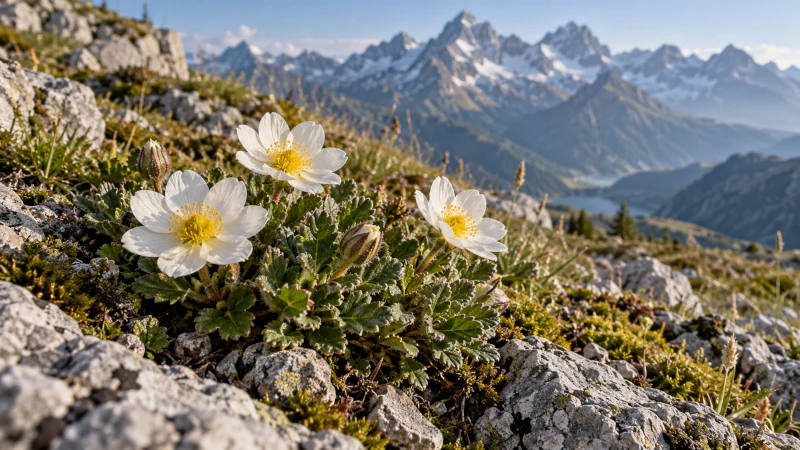
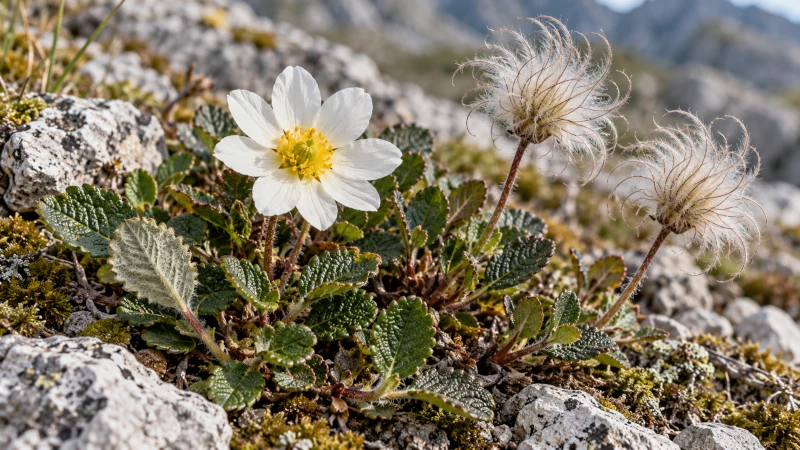
White dryas is Dryas octopetala, a low, mat-forming evergreen in the rose family (Rosaceae). You’ll also see it called mountain avens, eight-petal mountain avens, or white dryad. Each white flower sits alone on a bare stalk above a rosette of small, scalloped leaves. Once it finishes blooming, it turns into a fluffy tuft of feathery seed plumes that carry the seeds on the wind [USDA Forest Service, n.d.].
The leaves are small and leathery, with a fuzzy, whitish underside that helps the plant cope with cold, dry conditions. The flower usually has eight petals, which is where octopetala comes from; the genus name refers to the oak-like shape of the leaves [Lausanne Botanical Garden, 2023]. In French it’s dryade à huit pétales [Lausanne Botanical Garden, 2023].
This plant is so tied to cold climates that two abrupt cold spells at the end of the last Ice Age, the Older and Younger Dryas, are named after it, because its fossils are so common in sediments from those periods [USDA Forest Service, n.d.].
Does it grow in North America?
An earlier version of this page said white dryas doesn’t grow in America. That needs correcting. The U.S. Forest Service describes mountain avens as a circumpolar plant of arctic Eurasia and North America that reaches south above tree line in the Cascades and Rockies to Washington, Oregon, Utah, and Colorado [USDA Forest Service, n.d.]. The Lausanne botanical garden likewise lists Canada and the United States in its range [Lausanne Botanical Garden, 2023].
The confusion comes from taxonomy. This is a variable plant, and botanists have split it into different species and varieties over the years [USDA Forest Service, n.d.]. Kew’s Plants of the World Online, which uses a narrow definition of the species, currently gives its native range as Greenland and subarctic and subalpine Eurasia [Kew POWO, 2026]. So depending on which checklist you follow, the mountain avens on a Colorado pass may go by a different scientific name than the plant in the Alps. The traditional “Swiss tea” use comes from the European plant.
How white dryas has traditionally been used
“Swiss tea” for digestion
In the Alps, people have long brewed the leaves as an herbal tea, which is where the French nicknames thé suisse (Swiss tea) and thé des Alpes come from. The Lausanne botanical garden notes that, taken sparingly, it is said to stimulate appetite and ease digestion [Lausanne Botanical Garden, 2023].
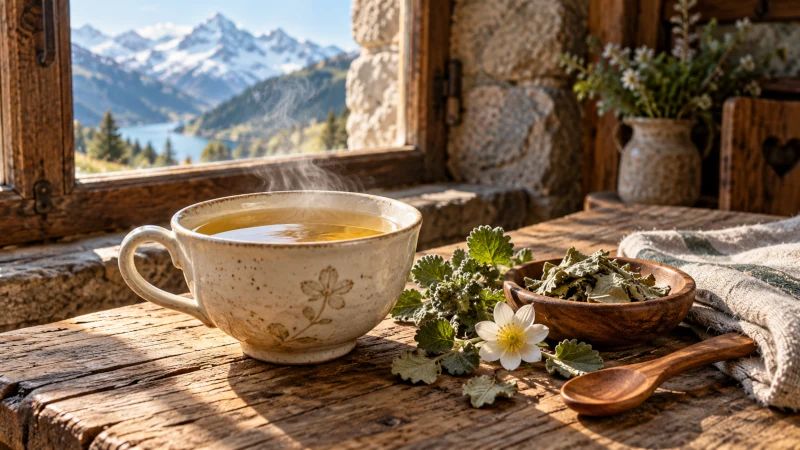
Researchers reviewing the plant’s chemistry describe traditional use of the leaves and flowers as a digestive and an antidiarrheal remedy, along with less-documented heart and nervous-system uses [Kashchenko, 2024]. It also appears in the folk-medicine literature of South Tyrol, in the Italian Alps [Petelka, 2020].
Gargles for the mouth and throat
Older herbal references, including the one this page originally cited, describe a stronger brew of the leaves used as a gargle for sore throats, tonsillitis, and mouth sores. That use rests on the leaves being astringent — tannin-type compounds tend to tighten and dry mucous membranes — not on any study of white dryas itself.
If your throat hurts, the CDC’s home-care list is a better-supported place to start: warm drinks and plenty of fluids, salt-water gargles, ice chips or lozenges (no lozenges for children under 4), a clean humidifier, and honey for cough in anyone at least 1 year old [CDC, 2024].
What the science actually shows
Here’s the honest summary: we could not find a single published clinical trial of white dryas in people — not for indigestion, not for sore throat, not for anything. What exists is chemistry.
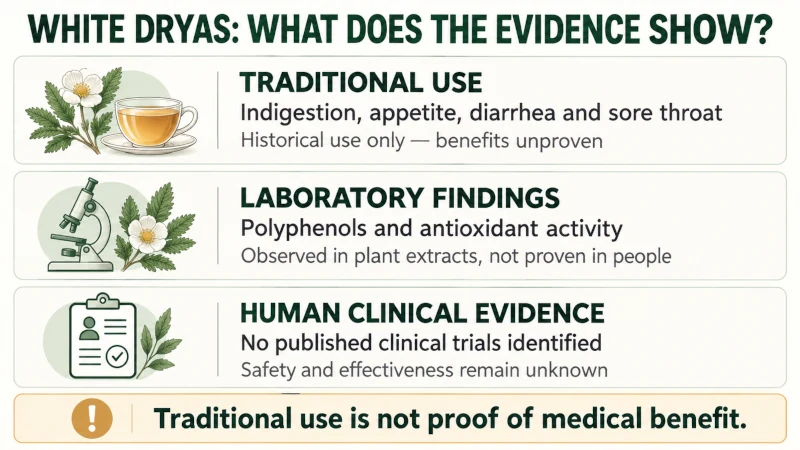
Analyses of leaves collected in the French and Norwegian mountains and in the Dolomites have identified procyanidins (the building blocks of condensed tannins), epicatechin, and flavonoids such as quercetin, kaempferol, and hyperoside, plus two unusual flavonols, sexangularetin and corniculatusin, that chemically mark the genus [Kashchenko, 2024]. In one lab comparison of four Arctic plants from Svalbard, white dryas extract showed the strongest antioxidant activity [Kashchenko, 2024].
Two cautions apply. Antioxidant activity in a test tube says very little about what a cup of tea does inside your body. And the most detailed recent chemical study in the genus actually analyzed a Siberian relative, Dryas oxyodonta, not white dryas [Kashchenko, 2024].
That kind of gap is normal for Alpine folk herbs. A review of South Tyrol’s traditional medicinal plants found that 59% of the region’s 275 native medicinal species had never been studied by pharmacological research [Petelka, 2020].
| Claim you’ll see online | What supports it | Evidence level |
| Eases indigestion or stimulates appetite | Alpine tradition; botanical-garden and ethnobotanical records | Traditional only — no human studies |
| Helps diarrhea | Recorded traditional use; tannin-type compounds are astringent | Traditional; plausible mechanism, untested |
| Soothes sore throat or mouth sores as a gargle | Older herbal references | Traditional only |
| “Antioxidant” | Lab tests of plant extracts | Lab (in vitro) only |
| Treats or prevents any disease | Nothing | No evidence |
If you want to try white dryas tea
There’s no tested dose and no formal safety testing, and “traditional” isn’t the same thing as “checked.” If you’re a healthy adult who isn’t pregnant or nursing, doesn’t take regular medication, and simply wants to taste an Alpine tradition, a few practical points keep the risk low:
- Buy dried leaf from a supplier that names the species, Dryas octopetala, on the label rather than picking it yourself. Labels on herbal products aren’t always accurate, so a reputable source matters [NCCIH, 2019].
- Keep it occasional and weak. Even the Lausanne garden frames its use as “sparingly” [Lausanne Botanical Garden, 2023].
- Drink it between meals, not with them, especially if your iron runs low.
- Stop if it doesn’t agree with you, and don’t use it to put off seeing a doctor about symptoms that keep coming back.
If calmer digestion is the real goal, our guide to herbs for stomach issues covers options with actual human evidence, such as enteric-coated peppermint oil for IBS and ginger for nausea. Another Alpine digestive plant, gentian, works differently: it’s a bitter, not an astringent.
Safety: side effects, interactions, and who should avoid it
We found no published safety studies or case reports for white dryas, in either direction. The cautions below come from what’s known about its chemistry and from general guidance on herbal products.
It may reduce iron absorption
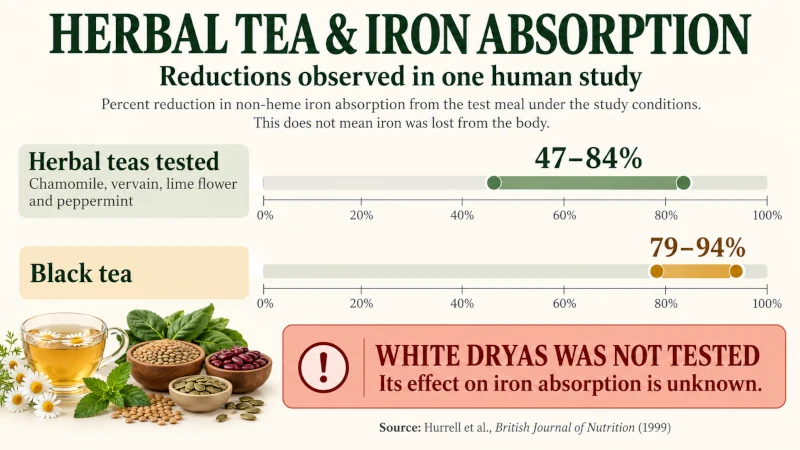
White dryas leaves are rich in polyphenols, including procyanidins [Kashchenko, 2024]. In a well-known study in adults, herb teas such as chamomile, vervain, lime flower, and peppermint reduced non-heme iron absorption from a bread meal by about 47% to 84%, and black tea by 79% to 94% [Hurrell, 1999]. White dryas wasn’t part of that study, but its chemistry puts it in the same family of drinks. If you have iron-deficiency anemia, are pregnant, or eat mostly plant foods, keep any herbal tea away from mealtimes. Our guide to foods for healthy blood explains how to pair iron with vitamin C.
Medication interactions
No drug interactions specific to white dryas have been documented — mostly because nobody has looked. Herbal products in general can interact with medicines or cause problems before surgery, which is why NCCIH advises telling your healthcare providers about any you use [NCCIH, 2019]. If you take an iron supplement, ask your pharmacist how far apart to keep it from tea.
Pregnancy, breastfeeding, and children
There is no safety information for white dryas in pregnancy, breastfeeding, or childhood, and many herbal supplements simply haven’t been tested in these groups [NCCIH, 2019]. Skip it unless your doctor or midwife says otherwise.
Who should skip it
- Anyone who is pregnant or breastfeeding
- Children
- People with iron-deficiency anemia, or at least anyone who can’t keep it away from meals
- Anyone with ongoing digestive symptoms that haven’t been diagnosed — get them checked first
- Anyone on regular prescription medication, unless a pharmacist or doctor has okayed it
Leave wild plants where they grow
In South Tyrol, researchers listed white dryas among at least ten medicinal plants restricted to the upper alpine zone that could be locally threatened as the climate warms [Petelka, 2020]. Harvesting it on a hike also raises identification problems if you’re not a confident botanist, and collecting plants in parks and protected areas is often restricted. Commercially grown leaf is the better choice.
When to see a doctor instead

White dryas has never been shown to treat any condition, so it shouldn’t stand between you and a diagnosis. With indigestion, see a doctor right away if you have any of the following [NIDDK, 2025]:
- Pain in your chest, jaw, neck, or arm
- Difficulty swallowing or painful swallowing
- Frequent vomiting, or vomit with blood in it
- Severe, constant abdominal pain, or long-lasting bloating or swelling
- Shortness of breath
- Weight loss without trying, or loss of appetite
- Yellowing of your eyes or skin
- Black, tarlike stools
You should also see a doctor if your indigestion simply doesn’t get better [NIDDK, 2025]. For sudden chest pain or trouble breathing, call 911.
Most sore throats are caused by viruses and get better on their own within about a week. See a healthcare provider for difficulty breathing or swallowing, blood in saliva or phlegm, excessive drooling in a young child, dehydration, joint swelling and pain, a rash, or symptoms that don’t improve within a few days or get worse. A baby under 3 months with a fever of 100.4°F (38°C) or higher needs care right away [CDC, 2024]. For more on everyday gut symptoms and when they need attention, see our digestive health guides.
| HEALTH BENEFITS: This article is for general education only. It is not medical advice and is not a substitute for diagnosis or treatment from a qualified healthcare professional. White dryas has not been tested for safety or effectiveness in people, and herbal products can interact with medicines. Talk to your doctor or pharmacist before using any herb if you are pregnant or breastfeeding, giving it to a child, taking prescription medication, preparing for surgery, or managing anemia or another ongoing condition. If you have chest pain, trouble breathing, vomit with blood in it, or black stools, seek emergency care or call 911. |
Frequently Asked Questions
Is white dryas the same as mountain avens?
Yes. White dryas, mountain avens, eight-petal mountain avens, and white dryad are all common names for Dryas octopetala, a low evergreen in the rose family [USDA Forest Service, n.d.].
What is “Swiss tea”?
It’s a nickname for an herbal tea made from white dryas leaves, from the French thé suisse. It’s also called thé des Alpes [Lausanne Botanical Garden, 2023]. It contains no actual tea leaves.
Does white dryas tea help with indigestion?
It has a long traditional reputation as a digestive, and its tannin-rich leaves give that some plausibility, but no study in people has tested it [Kashchenko, 2024]. For options with real evidence, see our guide to herbs for stomach issues — and see a doctor if indigestion doesn’t improve [NIDDK, 2025].
Is it safe to drink white dryas tea every day?
Nobody knows, because it hasn’t been studied for safety. Polyphenol-rich herbal teas can sharply reduce iron absorption from meals [Hurrell, 1999], so daily use with food is a poor idea if your iron runs low. Pregnant or breastfeeding women and children should avoid it [NCCIH, 2019].
Does white dryas grow in North America?
Mountain avens grows in Alaska, Canada, and the Rocky and Cascade mountains as far south as Colorado [USDA Forest Service, n.d.]. Some botanical checklists, including Kew’s, treat the North American plants as different from Dryas octopetala in the strict sense [Kew POWO, 2026].
References
- Fertig W. “Mountain Avens (Dryas octopetala).” Celebrating Wildflowers: Plant of the Week. U.S. Department of Agriculture, Forest Service. View source
- Royal Botanic Gardens, Kew. “Dryas octopetala L.” Plants of the World Online. View source
- Musée et Jardins botaniques cantonaux, Jardin botanique de Lausanne (Canton of Vaud). “Dryade à huit pétales — Plante du mois.” View source
- Kashchenko NI, Olennikov DN, Chirikova NK. “Chemodiversity of Arctic Plant Dryas oxyodonta: LC-MS Profile and Antioxidant Activity.” View source
- Petelka J, Plagg B, Säumel I, Zerbe S. “Traditional medicinal plants in South Tyrol (northern Italy, southern Alps): biodiversity and use.” View source
- Hurrell RF, Reddy M, Cook JD. “Inhibition of non-haem iron absorption in man by polyphenolic-containing beverages.” View source
- National Center for Complementary and Integrative Health. “Using Dietary Supplements Wisely.” View source
- National Institute of Diabetes and Digestive and Kidney Diseases. “Symptoms & Causes of Indigestion.” View source
- Centers for Disease Control and Prevention. “Sore Throat Basics.” View source


