
If you’re wondering whether ginger actually does something or just tastes good in tea, here’s the short answer: its strongest evidence is for nausea, especially the nausea of early pregnancy. For period cramps and knee arthritis, the research is promising but shakier. For motion sickness — the thing ginger is most famous for — most studies haven’t found it helpful.
That’s a narrower list than the ginger plant usually gets credit for. It’s also a real one, built on randomized trials and government evidence reviews rather than tradition alone. Below is what holds up, what doesn’t, how much to take, and the handful of situations where you should talk to a doctor before you start.
What the ginger plant actually is
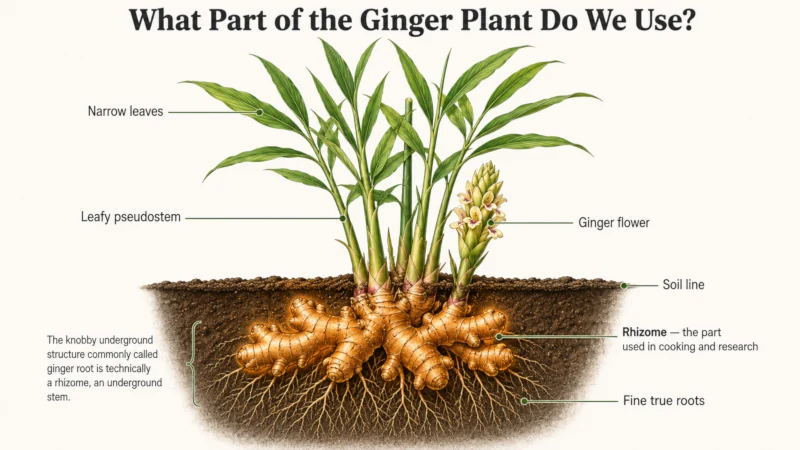
Ginger (Zingiber officinale) is a tropical perennial in the Zingiberaceae family — the same family as turmeric and cardamom. It grows to roughly three or four feet, with narrow leaves and pale flowers. The part you cook with and the part studied in trials is the same: the rhizome, the knobby underground stem people usually call the root.
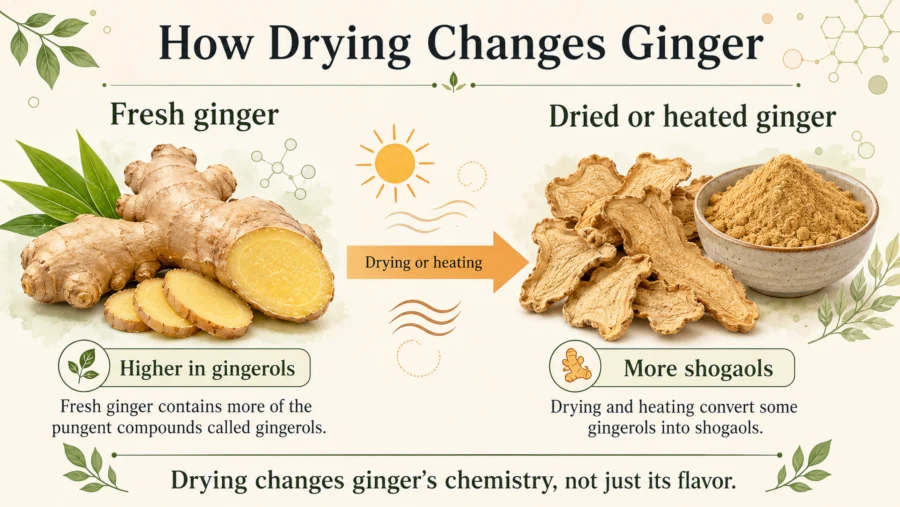
The chemistry is what matters medically. Fresh ginger is richest in gingerols; drying and heating convert those into shogaols. Both groups act on inflammation, and ginger’s pungent compounds also block serotonin 5-HT3 receptors — the same receptor family targeted by prescription anti-nausea drugs like ondansetron [StatPearls, Ginger Root, 2024]. That mechanism is the reason ginger’s nausea evidence is stronger than its evidence for anything else.
People have used ginger medicinally for a very long time. Dioscorides recommended it in the first century for weak stomachs, and Spanish traders carried it to the Americas in the early 1500s, where it took hold in Jamaica, Mexico, and Peru. Centuries of use tell you a plant is generally well tolerated. They don’t tell you what it treats. For that, you need the trials.
Nausea is where ginger earns its reputation
Morning sickness: the strongest case
A meta-analysis pooling 12 randomized trials in 1,278 pregnant women found that ginger significantly improved nausea compared with placebo (mean difference 1.20, 95% CI 0.56–1.84). The same analysis found ginger did not significantly reduce the number of vomiting episodes — there was a trend in that direction, but it didn’t reach statistical significance [Viljoen et al., Nutrition Journal, 2014]. Lower daily doses, under about 1,500 mg, appeared to work at least as well as higher ones for nausea relief.
That distinction is the practical takeaway. Ginger is more likely to take the edge off queasiness than to stop you throwing up.
The American College of Obstetricians and Gynecologists lists ginger as a nonpharmacologic option for nausea and vomiting of pregnancy [ACOG guidance on morning sickness]. The National Center for Complementary and Integrative Health reaches the same conclusion, noting that research shows ginger may be helpful for pregnancy-related nausea and vomiting [NCCIH, Ginger: Usefulness and Safety, 2025].
Cochrane is more reserved. Its review of 41 trials covering every intervention for early-pregnancy nausea concluded that ginger products may be helpful, but that the evidence was limited and inconsistent — though three recent studies did favor ginger over placebo. The review’s broader verdict was that no single intervention has high-quality evidence behind it [Cochrane review of interventions for nausea and vomiting in early pregnancy, 2015].
Chemotherapy and post-surgery nausea: genuinely uncertain
Here the picture is honestly unsettled. NCCIH states it’s uncertain whether ginger helps as an addition to standard treatment for chemotherapy-related nausea and vomiting, and equally uncertain whether it helps after surgery [NCCIH, 2025]. Individual trials point both ways: some found benefit, others found none when ginger was added to standard anti-nausea drugs.
If you’re in cancer treatment or scheduled for an operation, this is not a decision to make alone. Memorial Sloan Kettering advises stopping ginger supplements two weeks before surgery and avoiding them immediately afterward, because of ginger’s effect on platelets [Memorial Sloan Kettering, About Herbs: Ginger, 2022]. Tell your oncologist or surgical team what you’re taking.
Motion sickness: the folk claim the research doesn’t back
Ginger has a long reputation for sea, car, and air sickness. The trials mostly don’t support it: most studies of ginger for motion sickness haven’t shown it to be helpful [NCCIH, 2025].
If ginger chews settle your stomach on a winding road, there’s little harm in continuing. Just don’t count on ginger alone for a long boat trip or a flight you can’t afford to spend in the bathroom.
Pain: period cramps and knee arthritis
Menstrual cramps
A 2021 systematic review and meta-analysis found ginger significantly reduced pain severity compared with placebo in primary dysmenorrhea. Pooled data from two trials found no significant difference between ginger and NSAIDs (RR 1.15, 95% CI 0.53–2.52) [Negi et al., Cureus, 2021].
Read that second finding carefully. “No significant difference from ibuprofen” is not the same as “as good as ibuprofen” — with only two small trials and very high statistical heterogeneity (I² = 86%, meaning the studies disagreed with each other a lot), the analysis simply wasn’t precise enough to separate them. NCCIH’s summary is that ginger supplements might help reduce menstrual cramp severity [NCCIH, 2025].
Doses in this literature typically ran 750–2,000 mg of ginger powder daily across the first three or four days of the period. If cramps are your main reason for trying ginger, our guide to herbs for menstrual cramps compares it with the other options.
Knee osteoarthritis
This is the weakest of ginger’s commonly cited benefits. NCCIH notes ginger supplements might help knee osteoarthritis symptoms, but that much of the research has been of poor quality — and that ginger applied to the skin has not been shown to help [NCCIH, 2025].
A 2020 systematic review and meta-analysis in Pain Physician examined both oral and topical ginger for knee osteoarthritis and found the evidence insufficient to establish meaningful improvement in pain or function [Araya-Quintanilla et al., Pain Physician, 2020]. Bioavailability is part of the problem: ginger’s active compounds are absorbed and cleared quickly, with free 10-gingerol showing a half-life of roughly two hours [StatPearls, 2024].
Ginger in your cooking is fine and pleasant. Buying ginger capsules specifically to treat arthritic knees is a bet the current evidence doesn’t really support.
Claims that outrun the evidence
Ginger gets credited with cleansing the colon, curing colds, killing germs in wounds, treating fevers and bowel disorders, and raising body temperature to sweat out illness. Those claims go well beyond what has been demonstrated in people.
Laboratory and animal studies do show that ginger compounds have antimicrobial, antioxidant, and anticancer activity, and that gingerols affect tumor-related signaling in cell lines [StatPearls, 2024]. That’s a legitimate reason to run human trials. It is not a reason to treat an illness with ginger.
Memorial Sloan Kettering’s monograph is direct about the gaps: for appetite stimulation, indigestion, diarrhea, and respiratory ailments, ginger’s traditional uses are documented but human clinical data are lacking [Memorial Sloan Kettering, 2022].
One area with early but real human data is migraine, where small controlled trials suggest ginger may ease an attack in progress — though the one trial testing daily ginger for preventing migraines found no benefit over placebo. We cover that evidence in detail in our guide to ginger root for migraines.
Ginger benefits at a glance
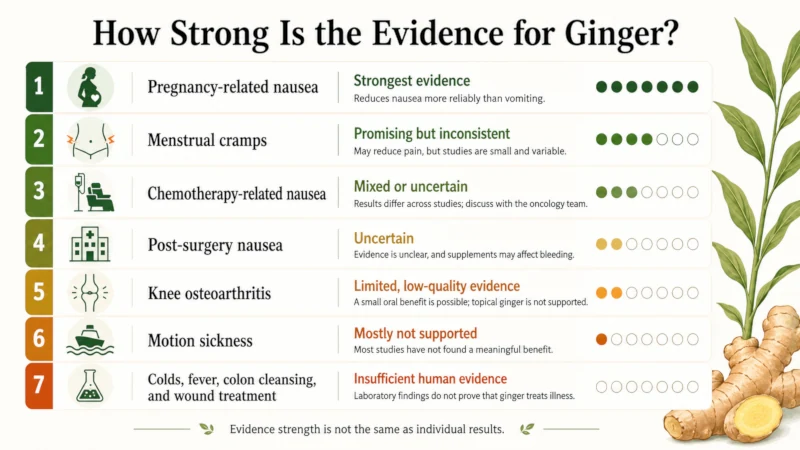
Where ginger stands, use by use:
| Use | Strength of evidence | What that means for you |
| Nausea in pregnancy | Strongest | Reduces nausea versus placebo across 12 trials; effect on vomiting not significant. Recognized by ACOG as a nonpharmacologic option. |
| Menstrual cramps | Promising but inconsistent | Beats placebo for pain; comparison with NSAIDs is underpowered and trials disagree with each other. |
| Chemotherapy nausea | Mixed / uncertain | Some trials positive, others null. Discuss with your oncology team rather than self-starting. |
| Post-surgery nausea | Uncertain | Evidence unclear, and supplements should be stopped before surgery anyway. |
| Knee osteoarthritis | Limited and low quality | Possible small benefit orally; topical ginger not shown to work. |
| Motion sickness | Mostly not supported | Most studies found no benefit, despite the traditional reputation. |
| Colds, colon cleansing, wound antisepsis, fever | Insufficient in humans | Lab and animal signals only. Not established as treatment. |
How to use ginger
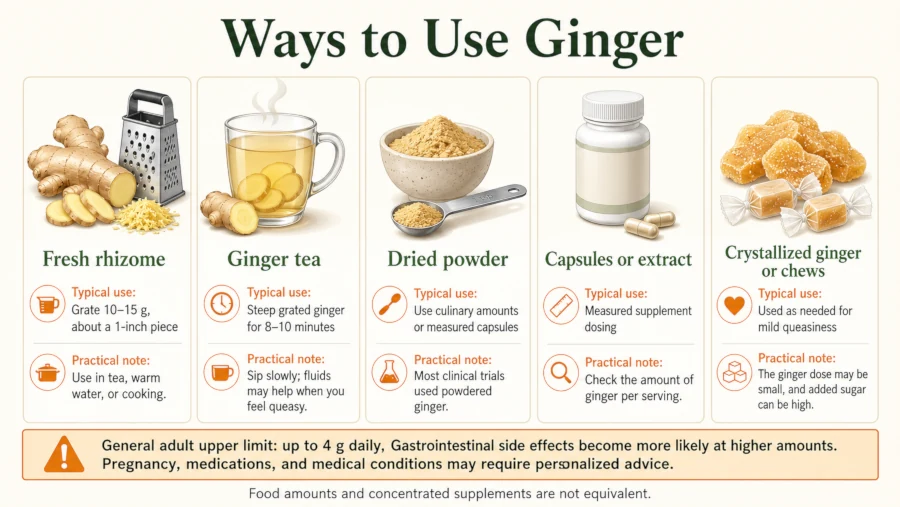
Most people get ginger from food and tea, and for general use that’s perfectly reasonable. If you’re taking it for a specific symptom, the form matters less than the dose and the timing.
| Form | Typical use | Notes |
| Fresh rhizome | Grate 10–15 g (about a 1-inch piece) into tea, stir-fries, or warm water with lemon | Highest gingerol content. Easiest to tolerate when you’re already queasy. |
| Tea / infusion | Steep grated fresh ginger in hot water 8–10 minutes; sip slowly | Adds hydration, which matters if you’ve been vomiting. |
| Dried / ground powder | Standard culinary amounts, or capsules for measured dosing | More shogaols, fewer gingerols. Most trials used powdered ginger. |
| Capsules / standardized extract | Trials for cramps used 750–2,000 mg/day; pregnancy trials favored under 1,500 mg/day | Most precise dosing. Look for gingerol content per serving on the label. |
| Crystallized ginger / chews | As needed for mild queasiness | Convenient, but the sugar load is real and the ginger dose is usually small and unlabeled. |
How much is too much
The FDA regards ginger as safe at intakes up to 4 g per day for most adults, and the usual supplement dose is up to about 1,000 mg of dried powdered extract daily. Above roughly 6 g per day, gastrointestinal problems — reflux, heartburn, diarrhea — become considerably more likely [StatPearls, 2024].
Give any new supplement a couple of weeks before deciding whether it’s doing anything, and start at the low end. There is no benefit to loading up.
Side effects, interactions, and who should avoid ginger
Common side effects
Ginger has been used safely in many studies when taken by mouth, and topical products appear safe as well. Reported side effects include abdominal discomfort, heartburn, diarrhea, and mouth or throat irritation [NCCIH, 2025]. Skin irritation, swelling, and redness can occur with topical use [Memorial Sloan Kettering, 2022]. A case report describes adult-onset anaphylaxis to ginger, which is rare but real [StatPearls, 2024].
If you have reflux or a peptic ulcer, ginger in large amounts may make things worse rather than better. Concentrated alcoholic tinctures in particular tend to irritate the stomach lining.
Medication interactions
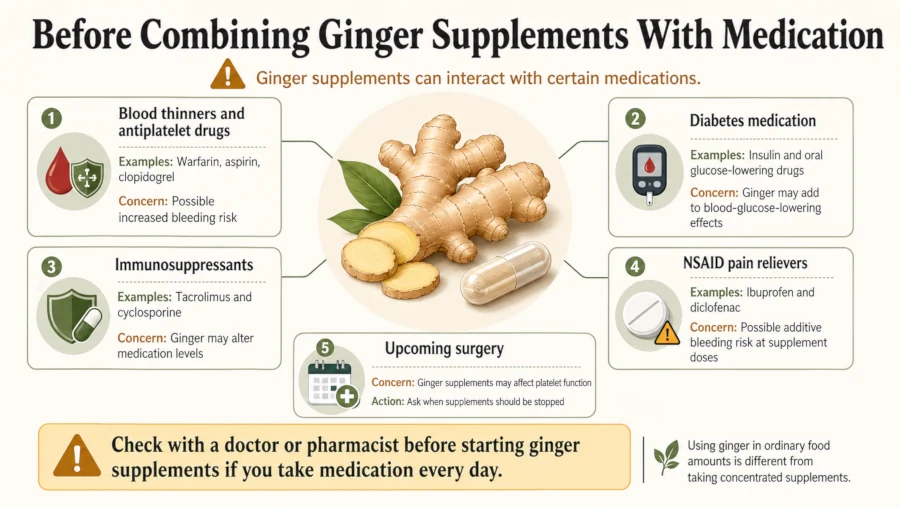
This is the section to read if you take anything daily. NCCIH’s blanket advice is worth following: if you take any medicine, talk with a healthcare professional before using ginger or any other herbal product [NCCIH, 2025].
| Medication | Concern | How settled is it? |
| Warfarin and other anticoagulants; antiplatelets including aspirin and clopidogrel | Ginger inhibits thromboxane formation and platelet aggregation, so it may raise bleeding risk. Case reports document elevated INR and bleeding. | Genuinely mixed. MSK flags the interaction but also notes a systematic review found the evidence inconclusive and called for further study. Treat as a real enough risk to raise with your doctor or pharmacist, not as settled fact. |
| Insulin and oral diabetes medications | Ginger may lower blood glucose, producing an additive effect. | Plausible; clinical relevance not established. Monitor if you start ginger supplements. |
| Tacrolimus | Ginger increased plasma levels in study conditions, which could increase side effects. | Clinical relevance not known. |
| Cyclosporine | Concomitant ginger use decreased blood concentrations in vivo. | Clinical relevance not known. |
| NSAIDs (ibuprofen, diclofenac) | Possible additive bleeding risk at supplement doses. | Dietary amounts are generally fine; ask a pharmacist about regular combined supplement use. |
Sources for this table: Memorial Sloan Kettering, About Herbs: Ginger, 2022; StatPearls, Ginger Root, 2024.
Pregnancy and breastfeeding: where good sources disagree
You will find confident advice in both directions on this, so here is the actual state of things.
- ACOG lists ginger as a nonpharmacologic option for nausea and vomiting of pregnancy [ACOG].
- NCCIH says use of ginger dietary supplements during pregnancy may be safe, while advising anyone considering it to consult their healthcare professional. It also notes that little is known about ginger’s safety while breastfeeding [NCCIH, 2025].
- Memorial Sloan Kettering takes the opposite position on supplements, advising they be avoided during pregnancy and lactation, citing a lack of human fetal-outcome data and concerns about embryo development raised in animal studies [Memorial Sloan Kettering, 2022].
The 12-trial meta-analysis found no significant increase in spontaneous abortion with ginger compared with placebo or vitamin B6, and no significant risk of heartburn or drowsiness [Viljoen et al., 2014] — reassuring, though the review’s authors flagged the limited number of studies and low quality of evidence.
A practical way through: culinary ginger, ginger tea, and modest amounts in food are widely considered fine in pregnancy, and are what most of the reassuring data reflect. Concentrated supplements at higher doses are the genuinely unsettled part, and that’s the conversation to have with your obstetrician or midwife before starting. For breastfeeding, the honest answer is that nobody has good data, so ask first.
Who should avoid ginger supplements
Talk to a doctor or pharmacist before taking ginger supplements — as opposed to using ginger in cooking — if any of these apply to you:
- You take warfarin, another anticoagulant, or regular antiplatelet medication.
- You have a bleeding disorder.
- You have surgery scheduled. Ginger supplements should be stopped two weeks beforehand and not used immediately after.
- You have gallstones or gallbladder disease. Ginger increases bile secretion, which can aggravate gallstone problems.
- You take insulin or oral medication for diabetes.
- You take tacrolimus or cyclosporine, or any immunosuppressant.
- You have significant reflux or a peptic ulcer.
- You’re pregnant, trying to conceive, or breastfeeding, and are considering supplements rather than food amounts.
Sources: Memorial Sloan Kettering, 2022; StatPearls, 2024; NCCIH, 2025.
When nausea or pain needs a doctor, not ginger
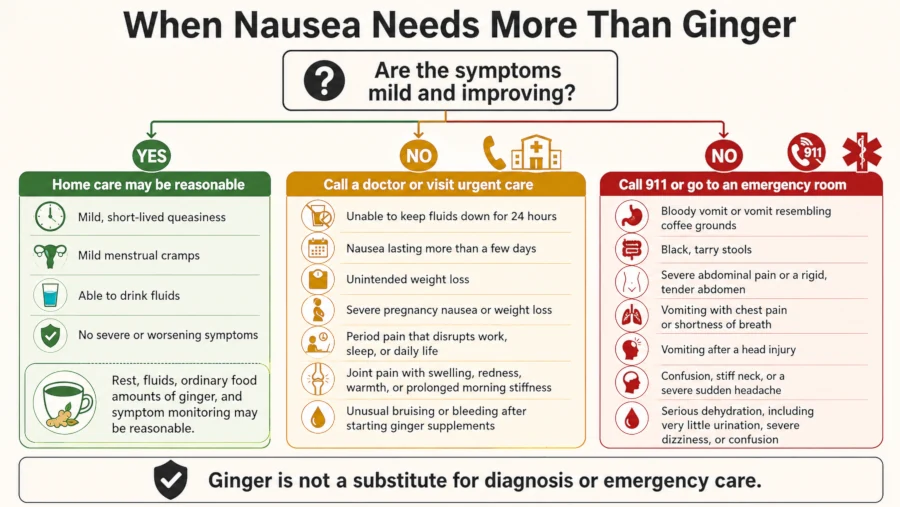
Ginger is a reasonable thing to try for ordinary queasiness or mild cramps. It is the wrong tool for anything on this list.
Call 911 or go to an emergency room if you have:
- Vomit that is bloody or looks like coffee grounds, or black, tarry stools.
- Severe abdominal pain, or a rigid, tender abdomen.
- Vomiting with chest pain, or with shortness of breath.
- Vomiting after a head injury, or with confusion, a stiff neck, or a severe sudden headache.
- Signs of serious dehydration: no urination for many hours, dizziness on standing, confusion.
Call your doctor or go to urgent care if you have:
- Vomiting that keeps you from holding down any fluids for 24 hours.
- Nausea or vomiting in pregnancy severe enough that you’re losing weight or can’t keep fluids down — this may be hyperemesis gravidarum, which needs treatment beyond home remedies.
- Nausea lasting more than a few days without an obvious cause, or with unintended weight loss.
- Period pain that stops you working, sleeping, or getting through the day, or that has gotten noticeably worse — that pattern can point to endometriosis or fibroids rather than ordinary cramps.
- Joint pain with swelling, redness, warmth, or morning stiffness lasting more than an hour.
- Unusual bruising or bleeding after starting ginger supplements, especially on a blood thinner.
Ginger is a supplement, not a substitute for a diagnosis. If something is getting worse rather than better, that’s the signal to stop guessing and get seen.
| Health Disclaimer: This article is for general education and is not medical advice, diagnosis, or treatment. Ginger is a food and a dietary supplement, not a treatment for any disease, and dietary supplements are not reviewed by the FDA for safety or effectiveness before they are sold. Talk with a doctor, pharmacist, or registered dietitian before starting ginger supplements — particularly if you are pregnant or breastfeeding, take prescription medication, have a bleeding or gallbladder condition, or have surgery scheduled. Don’t stop or change a prescribed medication because of anything you read here, and don’t delay medical care for a symptom that is worsening. |
Frequently Asked Questions
Does ginger actually stop morning sickness?
It reduces nausea more reliably than it reduces vomiting. Across 12 randomized trials in 1,278 pregnant women, ginger significantly improved nausea versus placebo, but the reduction in vomiting episodes wasn’t statistically significant [Viljoen et al., 2014]. Expect it to take the edge off rather than switch the symptom off, and talk to your obstetrician if you’re considering supplements rather than tea or food.
How much ginger a day is safe?
The FDA regards up to 4 g per day as safe for most adults, and typical supplement doses run up to about 1,000 mg of dried extract daily. Past roughly 6 g per day, heartburn, reflux, and diarrhea become much more likely [StatPearls, 2024]. Cooking with ginger normally keeps you far below these thresholds.
Is it safe to take ginger with a blood thinner?
Check with your doctor or pharmacist first. Ginger inhibits platelet aggregation, and case reports describe raised INR and bleeding in people combining ginger products with anticoagulants. That said, a systematic review found the overall evidence inconclusive, so this sits in the “real enough to ask about” category rather than the settled one [Memorial Sloan Kettering, 2022]. Food amounts are a smaller concern than concentrated supplements.
Does ginger help arthritis?
Less than its reputation suggests. Oral ginger may offer a small benefit for knee osteoarthritis, but much of that research is low quality, and a 2020 meta-analysis found the evidence insufficient to establish meaningful improvement in pain or function. Ginger applied to the skin has not been shown to help [NCCIH, 2025]; [Araya-Quintanilla et al., 2020].
Does ginger work for motion sickness?
Probably not, despite the folklore. Most studies of ginger for motion sickness haven’t shown it to be helpful [NCCIH, 2025]. There’s little harm in trying it, but bring a proven option too if you’re facing a long trip.
Is fresh ginger better than dried or capsules?
They’re different, not ranked. Fresh ginger has more gingerols; dried has more shogaols, and both are active. Fresh ginger and tea are easier to tolerate when you’re already nauseated. Capsules are the only form that gives you a reliably measured dose, which matters if you’re following the amounts used in trials.
References
- National Center for Complementary and Integrative Health. “Ginger: Usefulness and Safety.” NCCIH, National Institutes of Health, updated February 2025. View source
- Memorial Sloan Kettering Cancer Center. “Ginger: Purported Benefits, Side Effects & More.” About Herbs, Botanicals & Other Products, updated June 2, 2022. View source
- Modi M, Modi K. “Ginger Root.” StatPearls [Internet]. Treasure Island (FL): StatPearls Publishing; updated August 11, 2024. Bookshelf ID NBK565886; PMID 33351444. View source
- Matthews A, Haas DM, O’Mathúna DP, Dowswell T. “Interventions for nausea and vomiting in early pregnancy.” Cochrane Database of Systematic Reviews 2015, Issue 9. Art. No.: CD007575. DOI: 10.1002/14651858.CD007575.pub4. View source
- Viljoen E, Visser J, Koen N, Musekiwa A. “A systematic review and meta-analysis of the effect and safety of ginger in the treatment of pregnancy-associated nausea and vomiting.” Nutrition Journal 2014;13:20. DOI: 10.1186/1475-2891-13-20; PMID 24642205; PMC3995184. View source
- Negi R, Sharma SK, Gaur R, Bahadur A, Jelly P. “Efficacy of Ginger in the Treatment of Primary Dysmenorrhea: A Systematic Review and Meta-analysis.” Cureus 2021;13(3):e13743. DOI: 10.7759/cureus.13743; PMID 33842121; PMC8021506. View source
- Araya-Quintanilla F, Gutiérrez-Espinoza H, Muñoz-Yanez MJ, Sánchez-Montoya Ú, López-Jeldes J. “Effectiveness of Ginger on Pain and Function in Knee Osteoarthritis: A PRISMA Systematic Review and Meta-Analysis.” Pain Physician 2020;23(2):E151–E161. DOI: 10.36076/ppj.2020/23/E151; PMID 32214292. View source
- American College of Obstetricians and Gynecologists. “Morning Sickness: Nausea and Vomiting of Pregnancy.” ACOG Patient FAQs. View source
